A newsletter from The Wire | Founded by MK Venu, Pratik Kanjilal, Sidharth Bhatia, Siddharth Varadarajan, Sushant Singh, Seema Chishti, and Tanweer Alam | Contributing writers: Kalrav Joshi, Anirudh SK
If you like our work and want to support us, then do subscribe. Sign up with your email address by clicking on this link and choose the FREE subscription plan. Do not choose the paid options on that page because Stripe – the payment gateway for Substack, which hosts The India Cable – does not process payments for Indian nonprofits.
Our newsletter is paywalled but once a week we lift the paywall so newcomers can sample our content. To take out a fresh paid subscription or to renew your existing monthly or annual subscription, please click on the special payment page we have created – https://rzp.io/rzp/the-india-cable.
Snapshot of the day
August 11, 2026
Sidharth Bhatia
Missing in Action.
More than three weeks since the Delhi Police and the Rapid Action Force unleashed tear gas, pellet guns and nail-studded batons on the July 20 ‘Sansad Chalo’ Gen Z-led student protesters, Union home minister Amit Shah remains missing from Parliament even though “he had business listed against his name”. Prime Minister Narendra Modi has scarcely been seen either. Yet, in a curious first after 12 years in government, NDA MPs marched to Parliament’s Makar Dwar, protesting against the Opposition – yes, you read that right – for allegedly “running away” from a discussion the Opposition itself has been demanding. The government says Shah is ready for a discussion on the student protests. Parliament awaits some evidence of life.
The Lok Sabha, meanwhile, has discovered extraordinary legislative efficiency. Amid Opposition slogans demanding Shah’s presence and a discussion on the alleged Ram Mandir donation theft, it passed two bills concerning his ministries virtually without debate: the Kerala (Alteration of Name) Bill, 2026 – changing Kerala to Keralam – in three minutes, and the National Co-operative Development Corporation (Amendment) Bill, 2026 in ten minutes, even as Shah himself remained absent.
The government’s proposed Foreign Contribution (Regulation) Amendment Bill, 2026, is also running into pressure from several directions – from Nagaland to Tamil Nadu and Mizoram to Kerala – as Opposition parties, Church groups and NGOs raise concerns over its provisions. The unease has travelled to Washington too: a US congressman has warned that the Bill could affect India-US ties, prompting the ministry of external affairs to insist that FCRA is an “internal matter”. The Centre is now considering sending the legislation to a Joint Parliamentary Committee.
Elsewhere, Reuters reports the rupee fell to a near two-week low of Rs 95.435 to the dollar as oil prices jumped on fading hopes of a US-Iran deal, with likely RBI dollar sales cushioning the fall. Oil rises, the rupee sinks, the RBI reaches for the wallet. Meanwhile, Russia supplied a record 48% of India’s crude imports in June 2026, the highest share on record, even as Washington threatens tariffs of up to 100% on countries continuing to buy Russian oil.
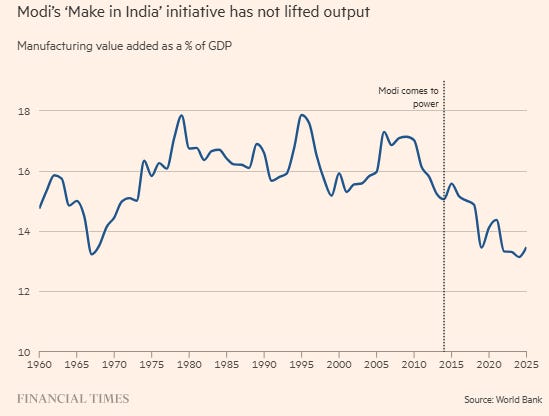
And the Financial Times’ Big Read examines AI’s threat to India’s $300-billion IT industry and its six million workers, warning that “if the sector cannot pivot to higher-value work, that could spell more trouble for a government already struggling to create enough jobs for India’s huge workforce.” The real danger is not that $300 billion becomes zero, but that six million jobs become three, two or one million, while the ‘Make in India’ initiative has failed to produce a comparable mass-employment engine in manufacturing, whose share of GDP is back around 1967 levels. Those six million jobs, meanwhile, bankroll much of aspirational middle-class India – from apartments and private schools to food deliveries, second cars and holidays.