
A newsletter from The Wire | Founded by Sidharth Bhatia, Siddharth Varadarajan, Sushant Singh, Seema Chishti, MK Venu, Pratik Kanjilal and Tanweer Alam | Contributing writer: Kalrav Joshi, with additional inputs by Anirudh SK
If you like our work and want to support us, then do subscribe. Sign up with your email address by clicking on this link and choose the FREE subscription plan. Do not choose the paid options on that page because Stripe – the payment gateway for Substack, which hosts The India Cable – does not process payments for Indian nonprofits.Our newsletter is paywalled but once a week we lift the paywall so newcomers can sample our content. Today is that day. To take out a fresh paid subscription or to renew your existing monthly or annual subscription, please click on the special payment page we have created – https://rzp.io/rzp/the-india-cable.Snapshot of the day
December 19, 2025
Sidharth Bhatia
Protests erupted in Bangladesh late Thursday after youth leader Sharif Osman Hadi, who was shot in the head in Dhaka last week, succumbed to his injuries at a hospital in Singapore. Protesters torched and vandalised the offices of the Prothom Alo and Daily Star major newspapers, which did not publish print editions on Friday. They damaged the premises of the Chhayanaut cultural organisation in Dhaka that is popular with liberals, while a group of protesters also attacked the Indian consulate in Chattogram. The protests continued on Friday, where demonstrators at Dhaka’s Shahbagh chanted slogans including “agents of India, beware” and “stop Indian aggression”, per the Dhaka Business Standard. The interim government has condemned the violence and called on citizens to “resist all forms of mob violence committed by a few fringe elements”.
Meanwhile, Hadi’s body arrived in Bangladesh from Singapore on Friday evening. His funeral will be held on Saturday afternoon at the parliament premises in Dhaka. A key leader of the July-August 2024 uprising against Sheikh Hasina’s regime, Hadi was a spokesperson of the Inquilab Mancha right-wing cultural organisation that has been at the forefront of a campaign to disband Hasina’s Awami League party; he and the Mancha were also vehement critics of India. Hadi had planned to contest the upcoming general elections in February as an independent candidate.
Earlier on Thursday, the parliamentary Standing Committee on External Affairs tabled its report on the ‘Future of [the] India-Bangladesh Relationship’, in which it flagged the fraying ties between New Delhi and Dhaka since Hasina’s ouster last year. The external affairs ministry in turn submitted that “increased extremist rhetoric including distortion and peddling of anti-India narrative continue to be addressed through sustained diplomatic engagement”. The report also touches on the deportations of people by Indian authorities to Bangladesh as well as concerns over limiting Beijing’s influence, as Devirupa Mitra reports.
Parliament repealed the Mahatma Gandhi National Rural Employment Guarantee Act early on Friday, with the Rajya Sabha passing its replacement, the Viksit Bharat Guarantee for Rozgar and Ajeevika Mission (Gramin) Bill, at 12:32 am following a six-hour long debate. Opposition MPs in the upper house too protested in the well before walking out in protest as their counterparts had in the Lok Sabha on Thursday. Sravasti Dasgupta has the details.
The NREGA Sangharsh Morcha umbrella body was denied permission by the Delhi police to protest the MGNREGA’s repeal at Jantar Mantar Road on Friday because they had not given their ten days’ notice. Morcha member and social scientist Rajendran Narayanan’s remark made to Anant Gupta is instructive: “It takes two days to repeal an Act that has been in force for 20 years, but we civilians need to give ten days of notice to register our protest.”
Meanwhile, official data has shown that more than 16.3 lakh workers were removed from the MGNREGA scheme rolls recently. The New Indian Express reports that the deletion of workers from the rolls happened over a span of 36 days a month before the bill was tabled in the Lok Sabha on Tuesday. The data, pertaining to the period between October 10 and November 14 this year, has raised concerns among rural labourers and experts about exclusion from a law that guarantees the right to work, the report states. The latest wave of deletions coincides with the introduction of Aadhaar-based e-KYC verification processes started earlier this year, claims the opposition. [See Item 1]
The Election Commission must, keeping in view the ‘ground realities’, ‘sympathetically consider’ petitioners’ requests that the deadline for the enumeration phase of its special intensive revisions of Kerala (Thursday) and Uttar Pradesh (December 26)’s voter rolls be extended further, the Supreme Court has directed. Kerala’s government said there was risk of a ‘huge’ number of omissions unless an extension was granted, while that of Uttar Pradesh pointed to the fact that the next assembly polls in that most populous state are due only by 2027.
India and Oman on Thursday signed a free trade agreement that, according to New Delhi, will provide for zero duties on virtually all Indian exports to the West Asian country. As part of the Comprehensive Economic Partnership Agreement, India will lower duties on around 78% of its tariff lines, impacting some 95% of Omani imports but excluding some sensitive agricultural products as well as gold and silver bouillon. Muscat has also made some concessions for skilled Indian workers.
The Comptroller and Auditor General (CAG) has flagged delays in 72% of Army emergency procurement contracts, according to a report tabled in Parliament on Thursday. The report notes that these contracts were not delivered within stipulated timelines and raises objections to the Army regularising deviations beyond the waivers permitted under prescribed procurement rules to meet operational needs, Hindu Businessline reports. The CAG recommended that any such deviations should be regularised only at the level of Army Headquarters. It also noted that following Operation Sindoor, the Ministry of Defence allocated about Rs 40,000 crore under EP–6 for the current financial year to procure critical equipment and systems and to replenish ammunition and spares.
Not everyone may like live-in relationships but the bottom line is they are not illegal, the Allahabad high court said earlier this week, ordering the Uttar Pradesh police to provide protection to 12 couples who alleged they are being threatened by their families. “Once an individual, who is a major, has chosen his/her partner, it is not for any other person, be it a family member, to object and cause a hindrance to their peaceful existence,” Ishita Mishra quotes the bench as having said.
The authorities in Assam’s Nagaon district on Wednesday ordered that 15 people who have been ‘declared foreigners’ leave India within 24 hours. It invoked the 1950 Immigrants (Expulsion from Assam) Act, which allows the authorities to bypass diplomatic channels and under which the Himanta Biswa Sarma government approved a standard operation procedure recently. All 15 are Muslim.
What’s the deal with Madras high court Justice G.R. Swaminathan, against whom a number of opposition MPs submitted an impeachment notice earlier this month? Ratna Singh spoke to the judge’s detractors and supporters to help us paint a picture.
Bird flu poses a low – but non-zero – risk to humans as it has been known to cross over to humans every now and then. In the event of an outbreak like that of the COVID virus, what can we do to stop it in its tracks? That’s what scientists Philip Cherian and Gautam Menon of Ashoka University set to find out with a new simulation, and they discovered, Soutik Biswas reports, that “once cases rise beyond roughly two to ten … it is overwhelmingly likely that the infection has already spread into the wider population, making its trajectory virtually indistinguishable from a scenario with no early intervention”.
Amid Beijing’s increasing assertiveness on the world stage, the West has looked to India to maintain the Indian Ocean region’s security. But two concerns stand in the way, notes Krishn Kaushik: “whether India is building sufficient capacity fast enough and, second, if New Delhi is even willing to take a stand against a power like Beijing unless its core interests are directly threatened”. Indeed, a senior military official acknowledged that India, like any other country, is unlikely to enter a conflict unless it faces a direct threat. “We are not very good friends,” he said.
Leading international experts write to Modi govt against MGNREGA repeal
Nobel economics laureate Joseph Stiglitz and nine other academics wrote an open letter to the Indian government in support of the Mahatma Gandhi National Rural Employment Guarantee Act (MGNREGA), the world’s largest rights-based public employment programme, which is now being repealed by the government to put the Viksit Bharat—Guarantee for Rozgar and Ajeevika Mission (Gramin) (VB—G RAM G) Bill in place, calling it “historic error” while describing MGNREGA as a “landmark legislation”.
The Act being replaced “affirms economic dignity as a fundamental right” and empirical evidence “underscores its impact”, the academics said. “The new funding pattern creates a catastrophic Catch-22: states bear legal liability for providing employment, while central financing is withdrawn,” they added. “Previously contributing only 25% of material costs, states now face burdens of 40% to 100% of total costs, ensuring poorer states will curb project approvals, directly stifling work demand.”
Row over police guard of honour to Kathavachak as opposition slams Yogi govt calling it an attack on constitution
A political storm has broken out over a police guard of honour accorded to Kathavachak Pundrik Goswami, drawing sharp criticism from Samajwadi Party chief Akhilesh Yadav and Nagina MP Chandrashekhar Azad, who questioned the Yogi Adityanath government and the Uttar Pradesh Police. Yadav said the police had lost sight of their core responsibility: “When the entire police machinery is busy presenting salutes, criminals in the state will roam free. The police have failed in their actual duty; instead of doing the job they are meant to do, they are wasting their limited resources elsewhere.”
MP Chandrashekhar went further, describing the salute given to the self-proclaimed spiritual leader as an attack on the Constitution, alleging that faith has been placed above the Constitution. “India is not a monastery, but a constitutional republic. And the state is not the fiefdom of any particular religion.”
Sahitya Akademi cancels awards announcement following directive from Culture Ministry
The Sahitya Akademi on Thursday cancelled its annual literary awards press conference minutes before it was scheduled to begin, following a directive from the Union Ministry of Culture as the press conference, cited by officials, had been organised without the ministry’s knowledge or clearance of the awards process. The ministry cited an ongoing restructuring of the awards and said no declarations could be made without its approval. The directive referred to a 2025–26 Memorandum of Understanding requiring the restructuring exercise to be carried out in consultation with the ministry. Adding to the controversy, an Akademi executive board member told The Telegraph that a suggestion by a ministry representative to review the names of awardees had been rejected – underscoring concerns that the “restructuring” is less about reform and more about control.
The Long Cable
We Cannot Let Osman Hadi’s Killers Win
Zafar Sobhan
One thing is certain. The killers of Osman Hadi are celebrating today. Things could not have worked out better for them.
His killing accomplished three inter-related goals.
The first was the removal from the scene of a charismatic, uncompromising, and incorruptible voice of the July Uprising from the political firmament.
Whether one was a fan of Osman Hadi or not, one could not question his integrity or his commitment or his willingness to speak truth to power, including to his erstwhile comrades.
While so many of the July revolutionaries had become compromised or corrupted in one way or another, and are on the fast track to nowhere but political oblivion, he stood out as the kind of young leader that could have been at the forefront of building a new Bangladesh.
For those who would rather see Bangladesh burn to ashes than see it rise up under any rule but their own, he was a mortal threat. He was exactly the kind of leader that could provide a threat to the old order, and that is why he had to be eliminated.
The second goal of his killing was to show that the enemies of the July Uprising are not dead yet and that there is still plenty of fight left in them. They have shown very eloquently that their enemies are neither safe nor beyond their reach, and that, even after 18 months, they can still operate with impunity.
The message has been delivered loud and clear. If Hadi can be killed and his killers sequestered beyond the reach of justice, then building a new Bangladesh is going to be a long, hard slog, and we are going to remain under enemy fire every step of the way.
But it is the third goal that is the most salient: the setting on fire of the Daily Star and Prothom Alo offices was exactly the kind of response his killers wanted to elicit.
I understand the anger that Hadi’s killing has unleashed. I understand the sorrow and the fury and the sense of frustration and desire to do something, anything to avenge his death and to send the message that this kind of targeted assassination will not stand and will be met with consequences.
However, the burning down of the two newspaper offices sent an entirely different message, one that only served the interest of his killers.
It showed that Bangladesh is a country of mob rule and insecurity, ruled by a government that, when push comes to shove, cannot protect its people and whose writ does not extend to the streets.
It showed that the press is today less free and less safe than it was under the 15 years of Awami League repression.
Indeed, the irony is that these two newspapers were considered Public Enemy Number 1 and Number 2 by Sheikh Hasina who spent 15 years trying to destroy them. No one would be more gratified by the assault on them than her.
Finally, it showed that Bangladesh is a tinder box, with law and order hanging by a thread, where anything can happen at any time to anyone.
This is precisely what Hadi’s killers hoped to accomplish. For them, it was a bases loaded grand slam (to borrow baseball terminology, because there is no cricket term that quite fits the bill).
The deeper game was to derail the elections in February and to portray Bangladesh as a hotbed of militancy and instability, thereby giving credence to the narrative of the past eighteen months that had been hammered home by Indian media and social media since Hasina was ousted.
From the very day of Hasina’s fleeing, the AL and its allies in the Indian media and social media had tried to paint a picture of Bangladesh descending into a Hobbesian nightmare of chaos and violence that was utterly at odds with the reality on the ground.
After a rocky start due to the fact that the police force has largely disappeared and the nation’s administration lay in shambles, the interim government was able to pick up the reins and quietly bring something resembling normalcy back to the country.
It was far from perfect, with the courts packed with spurious cases against the innocent and the economy still fragile from the decade and a half of looting and cronyism that the AL had bequeathed to them, but the law and order situation, with some notable and glaring exceptions such as the destruction of Road 32, was slowly brought under control.
One week ago, there was no reason to think that we were not on course for elections on February 12 or that the interim government would be unable to deliver them.
Now, everything stands in confusion.
Make no mistake: this is exactly what Hadi’s killers wanted. Hadi wanted elections. He believed in the electoral process. He believed in democracy. He was running for election in Dhaka-8. He believed in the slow, painstaking process of building a new Bangladesh and knew there could be no short-cuts. He talked about this all the time.
If we wish to honour his memory, let us make sure that nothing on Earth comes between us and this election on February 12.
The only people who gain from elections being derailed are the AL and the rightist parties and elements in society who know they can never win an election or come to power through democratic means.
If elections are delayed or derailed, then they win. The only way out for Bangladesh, the only way forward, the only way to deliver us from the current instability is to hold the elections as scheduled.
This is what the Bangladeshi people want and this is what the country needs. And now we must all come together to make sure that it happens.
The only people who benefit from elections being delayed are the enemies of the Bangladeshi people.
Elections delayed means more instability, more space for atrocity, and more scope for violence to take hold. We have already reached the very edge of how long we can survive without an elected government in place. Elections delayed beyond February could be the end of us.
Now is the time to bury our differences and join hands, and show that Bangladesh is still the great country that won its Liberation through bitter war in 1971 and overthrew a dictator in a people’s revolution in 2024, and that we stand together, and that together we will forge a future and create a country worthy of our martyrs, of whom Hadi is now one.
Let us honour the memory of our fallen brother by ensuring that his death will not divide us and provide aid and comfort to his killers and their allies.
Let us honour his memory by giving back to the people their long suppressed voice on February 12, 2026.
(Zafar Sobhan is the editor of Counterpoint, from which this article has been republished.)
Reportedly
Assam’s chief minister insists that singer Zubeen Garg’s death in Singapore in September was a “plain and simple murder”, while his government has charged four people for the same (and three others with lesser offences). However, the Singapore police on Friday repeated its stance that its investigation into Garg’s death has not yet indicated any foul play. Singapore is aware of the Assam government’s actions and until its own coroner’s inquiry scheduled for Jan-Feb is complete, “we urge the public not to speculate and share unverified information”, it said.
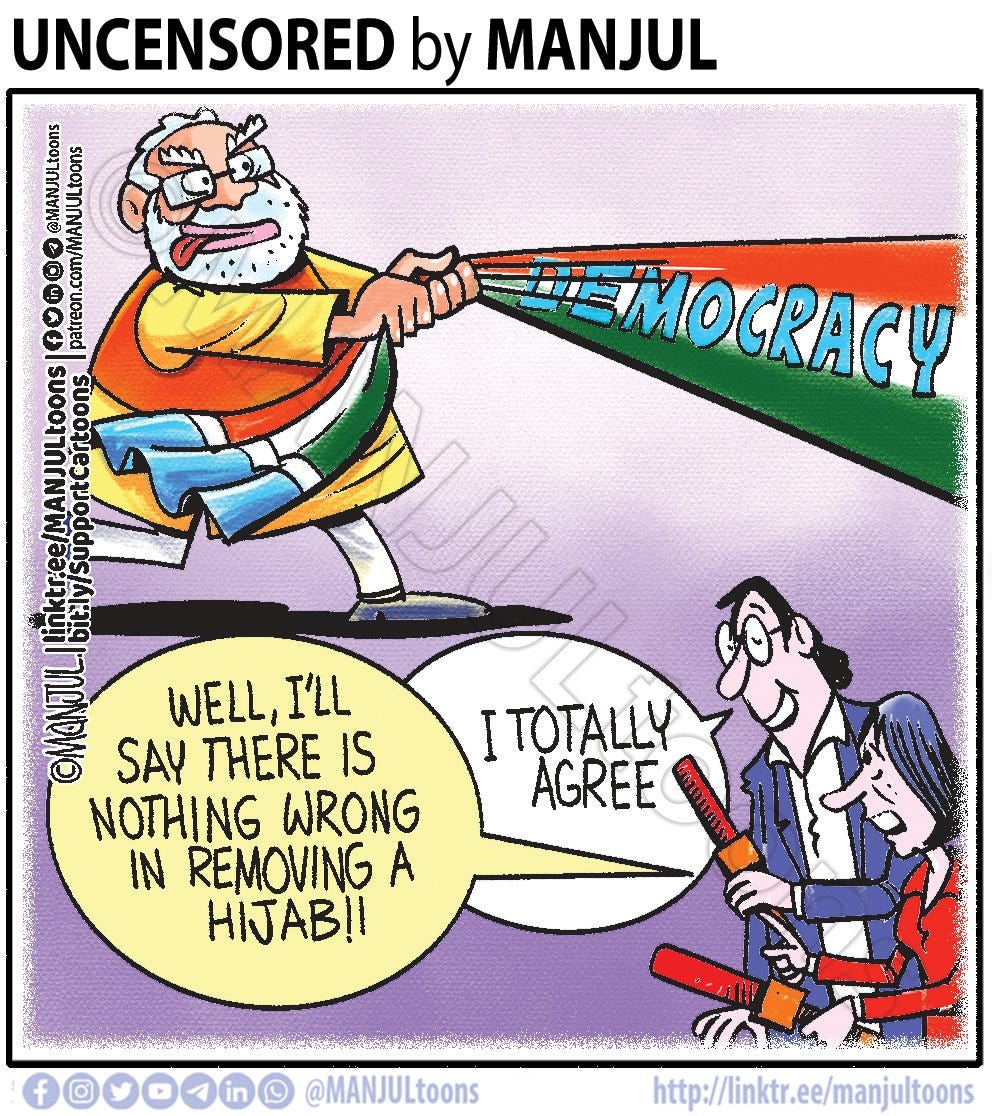
Drawn and quartered
Deep dive
On the menstrual leave debate and the broader silence surrounding women’s health in India, R. Maithreyi argues that “building a supportive ecosystem for improved menstrual health management for women is an important step towards achieving health equity. Not just the state, but employers must take on the moral responsibility of adequately supporting women’s menstrual health needs.”
Prime number: 12%
India’s tourism sector faced headwinds in 2025 as foreign tourist arrivals fell 12% year-on-year to 6.18 million in the January–September period.Opeds you don’t want to miss
“MGNREGA may well have been the bedrock safety net that underwrote political stability in a period of profound economic and social transformation. Quite literally, it provided the political and economic ground beneath our feet” – and now it’s ‘slipping away’, writes Pratap Bhanu Mehta.
Julio Ribeiro is troubled by the Goa nightclub fire in which 25 people, including many migrant workers, were killed. Arguing that the nightclub’s alleged building and zoning violations ‘could not have occurred without political blessings’, he writes that “there appears to be a sense of oblivion about the existence” of the India that such migrant workers live in “when decisions have to be taken” by those in power.
China now accounts for a sizable share of middle-income earners worldwide, while India has fallen behind, writes Andy Mukherjee. “An unambitious elite spoiled by finance — plus a working class held back by inadequate education and inequities of caste and gender — are stymying the emergence of a global middle class in India. The social change is nowhere on the horizon.”
On the Presidential Reference, in Special Reference No. 1, 2025, Sruthisagar Yamunan and K. Venkataramanan writes that “the power of granting assent is a procedural aspect of law-making and cannot be elevated to the level of a preliminary judicial review by Raj Bhavan. Any such conception of the assenting power will render it more a ‘check’ than a ‘balance’.”
Read an excerpt from ‘Speaking of History’ by Romila Thapar and Namit Arora on the Indian inferiority complex.
“The point to ponder is that this regional reality will neither recede nor ease on its own. Our larger narratives will come to a grinding halt in our neighbourhood, much like Jarasandha who still holds his own in Magadh despite being vanquished in the Mahabharata,” writes T.C.A. Raghavan.
Listen up
In the fourth episode of the Frieze Masters Podcast 2025, William Dalrymple speaks with curator Arturo Galansino about the art, poetry and politics of the last Mughal rulers.
Watch out
The unconscious is back. What follows? Watch the London Review of Books winter lecture by Amia Srinivasan on psychoanalysis and radical politics.
Over and out
In this feature for the New York Times, Indian-origin chef and cookbook author Romy Gill ‘explores Jaipur’s street food stands and palatial dining spots on her mission to understand how the city balances tradition and innovation’.
That’s it for today. We’ll be back with you on Monday, on a device near you. If The India Cable was forwarded to you by a friend (perhaps a common friend!) book your own copy by SUBSCRIBING HERE.