
A newsletter from The Wire | Founded by MK Venu, Pratik Kanjilal, Sidharth Bhatia, Siddharth Varadarajan, Sushant Singh, Seema Chishti, and Tanweer Alam | Contributing writers: Kalrav Joshi, Anirudh SK
If you like our work and want to support us, then do subscribe. Sign up with your email address by clicking on this link and choose the FREE subscription plan. Do not choose the paid options on that page because Stripe – the payment gateway for Substack, which hosts The India Cable – does not process payments for Indian nonprofits.Our newsletter is paywalled but once a week we lift the paywall so newcomers can sample our content. Today is that day. To take out a fresh paid subscription or to renew your existing monthly or annual subscription, please click on the special payment page we have created – https://rzp.io/rzp/the-india-cable.Note: Due to the amount of news, the Long Cable column is not being published today.
Snapshot of the day
May 15, 2026
Siddharth Varadarajan
Today has been a busy day on the diplomatic front. India hosted a meeting of BRICS foreign ministers in Delhi while China played host to US President Donald Trump in Beijing and Prime Minister Narendra Modi visited the United Arab Emirates. If diplomacy is about keeping one’s feet on separate stools, China is clearly ahead of everyone else. President Xi Jinping managed some plain speaking with Trump, conceded hardly anything to the US on issues of vital interest to it (like the Iran war and reopening the Strait of Hormuz) and even managed to get the US president to reverse a long-standing national policy of not discussing American arms sales to Taiwan with the Chinese side. On the commercial side, too, the pickings Trump returns with are clearly underwhelming. Meanwhile, in Delhi, the Chinese joined other members of BRICS – a “crucial platform against hegemonism and power politics” that Trump has repeatedly assailed as anti-American – and spoke bluntly and powerfully against the flagrant use of force by the US “against Venezuela and Iran, forcibly seizing control of or even assassinating leaders of sovereign states, and imposing a blockade and threats against Cuba.”
The BRICS foreign ministers failed to produce a joint statement, mainly due to the United Arab Emirates insisting that Iran be condemned. But the differences actually run deeper. Iran wanted the US and Israel to be named (and presumably shamed) for starting the war – something the Indian hosts would have themselves been unwilling to go along with. In the end, India issued a ‘chair’s statement and outcome document’ that reflected BRICS’ inability to speak in a single voice on at least three issues: the West Asia war, navigation through the Red Sea and also Palestine. Devirupa Mitra has the details.
in New Delhi, Iranian foreign minister Abbas Araghchi today alluded to this impasse and argued that Iran has only hit US bases and installations in the UAE. “I hope by the time that we come for the summit, they come to a good understanding that … we have to live with each other,” he said. He also urged India to continue to develop Chabahar port, which he called a ‘golden gateway’.
The China summit between Xi and Trump may not have produced tangible deliverables for either side but the de facto convening of what is sometimes called ‘G2’ poses significant strategic challenges for India. For the past 28 years, India has based its regional policies on the assumption that Beijing and Washington would always be at loggerheads and thus provide opportunities for New Delhi to bandwagon with the US. Atal Bihari Vajpayee as PM even wrote to President Bill Clinton shortly after the Pokhran-II tests of May 1998 laying out the threat posed by China as the reason for India acquiring nuclear weapons. The White House promptly leaked the letter to the media, leading to further Sino-Indian bitterness. Since then, India has been buffeted by the ups and downs of the US-China relationship and has failed to find a way to manage this triangular relationship. Now would be a good time to start.
In Abu Dhabi, PM Modi and President Mohamed bin Zayed al Nahyan concluded a framework for a future strategic defence partnership, besides a series of agreements on energy cooperation – against the background of the Emirates’ exit from OPEC, the Abu Dhabi National Oil Company could ramp up how much oil it stores in India’s strategic petroleum reserves and will explore expanded LPG supplies to IndianOil. But in a region still wracked by a deadly war – one that pits the US, Israel and also the UAE against Iran – Modi once again indicated his willingness to take sides. “Brother, as I have previously told you, India strongly condemns the attacks on the UAE. The way the UAE has been made a target is not acceptable in any way,” Modi said, in a clear reference to the Iranian targeting of American military and economic assets in the Emirates. At no point, however, did he condemn the attacks on Iran, despite the fact that they have led to serious energy supply disruptions for India, including an LPG crisis, in response to which Modi himself made a controversial appeal for austerity this week.
With Iran’s retaliatory closure of the Strait of Hormuz and the US blockade of Iranian ports sending oil prices beyond the $100/barrel mark – and with curtains being pulled on the assembly elections – Indian state-run oil marketing companies have hiked petrol and diesel prices by Rs 3 per litre, marking the first increase in four years. “India’s petrol demand growth will be impacted, although the price hike is modest,” a corporate ratings official noted speaking to Reuters. A few days ago Union petroleum and natural gas minister Hardeep Singh Puri had said – despite Modi’s pitch for parsimony – that although there are no supply problems, “my oil companies are losing, what, Rs 1,000 crore every day … In that context, how long can you keep it like this?”
Though the Indian oil price hike appears modest by international and regional standards, this is because Indian fuel prices remain high throughout the past decade despite falling crude oil – and petrol – prices worldwide:


Meanwhile the rupee has continued its downward spiral. Today’s new all-time low breached the 96-mark with the rupee hitting 96.05 to the dollar.
With at least one business channel reporting on the possibility of a ‘cess’ being imposed on foreign travel as part of government-driven austerity measures, Modi unusually took to X to issue a denial:

Even as the Modi government continues to attribute the current strain in the Indian economy to the war in Iran and broader “global factors,” it is well understood that the slowdown has deeper domestic roots. According to various media reports, the downturn did not begin with the present crisis but predates it by several years, pointing instead to a longer and more complex economic trajectory.
Speaking of twelve years and PM Modi has already urged citizens six times to “save the country,” comedians Varun Grover and Gaurav Gupta are at their satirical best, highlighting ground realities of the country, while the fourth pillar of democracy at large continues to act as a cheerleader for the government.
Meanwhile, Modi’s austerity messaging appears to have turned into yet another series of carefully staged PR exercises, from BJP MLA Pravesh Verma to Maharashtra chief minister Devendra Fadnavis. [See Drawn and quartered]
Gautam Adani and his nephew Sagar have agreed to pay $18 million to settle the US SEC’s allegations, Bloomberg reports. The civil case involved charges of misleading US investors, but stem from allegations of bribery in India – but as of today there has been no attempt by the Modi government or its agencies to investigate the matter. As reported yesterday, the Adani group has also given an undertaking that it would invest $10 billion in the US as part of a deal with the Department of Justice in which criminal charges against would be dropped for the same bribery allegations. While Adani has revived plans to raise $1 billion via dollar bonds, the rest of the promised investment will presumaby come out of India’s foreign exchange reserves – which Modiji wants us all to help conserve.
The religious character of the composite Bhojshala-Kamal Maula complex in Madhya Pradesh’s Dhar is a Hindu temple dedicated to Sarasvati, the Madhya Pradesh high court ruled today, also quashing a 2003 order of the Archaeological Survey of India affirming an older arrangement whereby Hindus performed puja at the site on Tuesdays and Muslims offered namaz on Fridays. The mosque side has been told it can file an application for the allotment of a land parcel somewhere in Dhar for a new structure and the government may consider it, the bench said. Although the 1991 Places of Worship Act ‘freezes’ the ‘religious character’ of places of worship as they were on August 15, 1947, the law contains an exception for “ancient and historical monument[s]” and archaeological sites – this particular complex dates back to the 11th century. Read more about the complex here.
Propelled by victim shaming, the mother of a 17-year-old survivor in the alleged sexual assault case against Bandi Bageerath, son of Union MoS for Home Affairs Bandi Sanjay Kumar, has urged the public not to reveal her daughter’s identity or circulate any private details related to the case. She also called for protection for her family from intimidation and demanded an independent investigation. Based on her complaint last week, an FIR was registered against Bageerath, initially under the POCSO Act for sexual harassment, with charges later enhanced to aggravated sexual assault. [See Watch Out]
Holding that “several other issues … still require looking into”, the Supreme Court has set aside the Delhi high court’s order from five months ago suspending former Uttar Pradesh BJP MLA Kuldeep Sengar’s life sentence for raping a child and granting him bail. The CBI had challenged the high court’s order which said that Sengar was convicted for raping the teenaged girl even though MLAs are not ‘public servants’ in the POCSO Act’s context. Today Justice Joymalya Bagchi of the apex court – which had stayed the high court order in December itself – orally remarked that the bench did not agree with the high court’s “hyper-technical approach”. It has sent the matter back to Shershah Road for fresh consideration.
Twenty-eight hostages – Kuki and Naga people held by captors from the other community – were released from multiple locations in Manipur today. State home minister Govindas Konthoujam had said yesterday that at least 38 people had been taken captive. They were abducted after suspected militants killed three Kuki church officials in Kangpokpi on Wednesday and injured four others; soon afterwards a Naga civilian was killed in an ambush in Noney district. Even as this second axis of ethnic tension simmers on, the first and larger one – between the state’s Kukis and Meiteis – remains unresolved. The Union government has meanwhile given a fifth extension to the three-member commission looking into the now over-three-year-old conflict. Recently reports said the panel had finished collecting documents and was yet to examine eyewitnesses and victims.
Eight of the 14 Muslim young men who were arrested for purportedly eating chicken biryani during an iftar party on the Ganga near Varanasi and allegedly throwing the remains below them have been granted bail by the Allahabad high court. Accused of various things including promoting enmity and defiling a place of worship on a BJP youth wing worker’s complaint, the youths were earlier denied bail by the lower courts. Meanwhile, six men remain in jail on this ridiculous charge.
Dr Sangram Patil, a UK based physician, was finally able to fly back home from Mumbai when the High Court directed that a Mumbai Police Look-Out Circular prohibiting him from leaving India be lifted. Patil is facing criminal charges for a social media post critical of Modi. "How can a 12-word post attract an FIR & LOC?" he asked before leaving. But his ordeal is not over. He is required to return to Mumbai to face ‘interrogation’ whenver the investigating officer summons him with 15 days notice.
The National Investigation Agency is formally seeking to revoke the bail of two of the Bhima Koregaon accused, Sudha Bharadwaj and Varavara Rao, on the grounds that they were allegedly at a gathering in the Mumbai Press Club in violation of their bail conditions.
For the first time in its 145-year history, St Stephen’s College announced the appointment of a woman principal, Prof. Susan Elias. However, within 48 hours, the University of Delhi intervened, directing the college to put the appointment on hold, stating that the selection committee was not formed as per UGC regulations.
Kanniyakumari “has, in many ways, served as a laboratory for experimenting with Hindu assertion, particularly in a context where demographic changes driven by religious conversion [to Christianity starting in the 16th century] have remained a significant factor,” B. Kolappan reports. Here “temples of folk deities have come to symbolise a broader process of Hindu assertion” – one marked by various kinds of Sanskritisation – and voters “appear increasingly divided along religious lines”.
CJI lashes out at lawyers, media, activists who “attack the system”
While questioning the genuineness of the law degrees of some advocates who had approached the top court over senior designations, Chief Justice of India Surya Kant lashed out at “several bogus advocates in Delhi”. He observed that he was considering ordering a CBI investigation into whether their law degrees were genuine or not. In the process, he also hit out at unemployed youth, comparing them with “cockroaches” and “parasites”, insisting on “attacking the judiciary”. The Chief Justice added that some of these go on to become “media” or “activists” attacking the system. He said:
“There are already parasites of society who attack the system and you want to join hands with them? There are youngsters like cockroaches, who don’t get any employment and don’t have any place in profession. Some of them become media, some of them become social media, some of them become RTI activists, some of them become other activists, and they start attacking everyone…and you people file contempt petitions!”
Slow count helped BJP wrest a seat it had lost to TMC
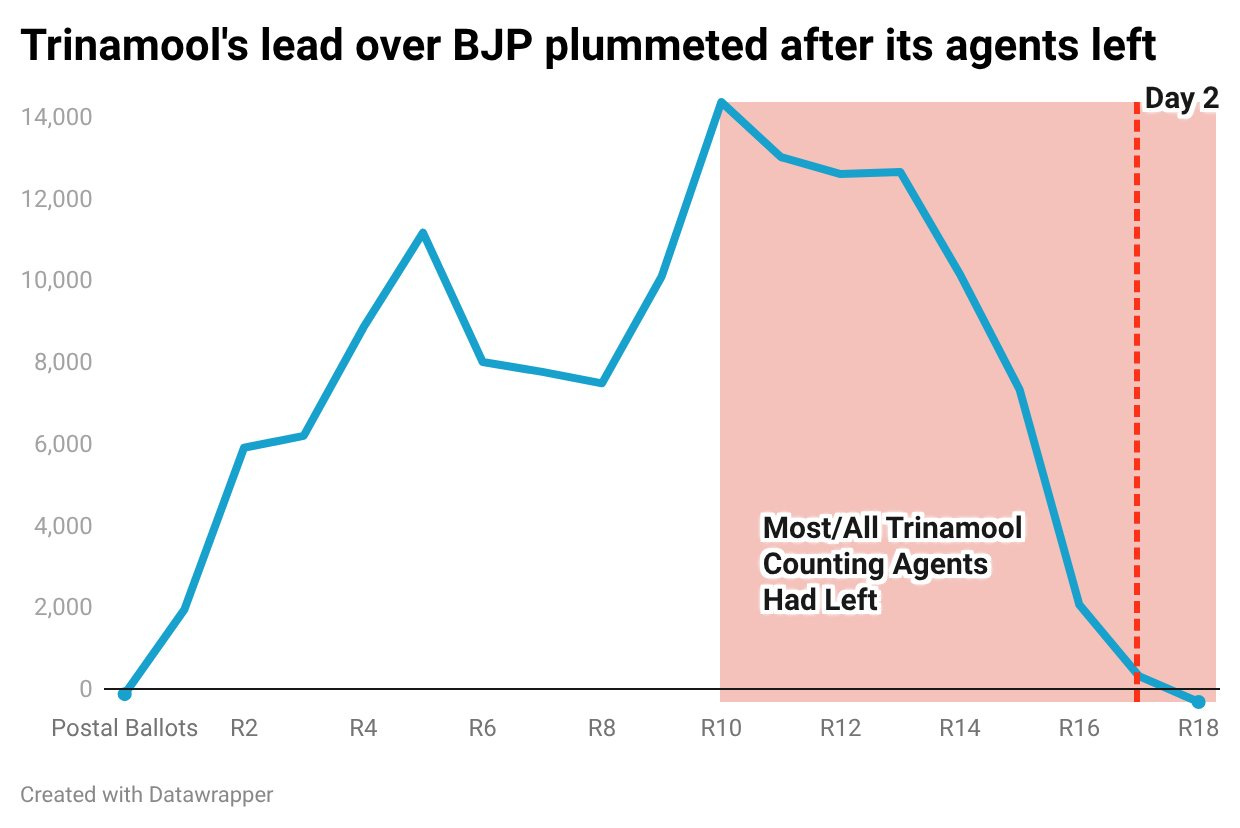
Remember the curious case of slow counting in Bengal on May 4? “Wherever the fight was tough for us, counting took place slowly,” a BJP worker told Scroll. By mid-afternoon, this had created the impression that the BJP was comfortably ahead in the state, even though only a small portion of votes had been counted.
Anant Gupta examines how this unfolded in Rajarhat New Town, a constituency considered a TMC stronghold. According to both the TMC and CPI(M), once a BJP victory in Bengal appeared likely, TMC counting agents were allegedly forced out of the counting centre.
Until that point, the TMC had reportedly maintained a sizable lead. But after the YMC agents left, the BJP rapidly closed the gap. The next day, during a special additional counting round held without TMC agents present, the BJP was declared the winner.
One year on, AI 171 crash families await answers, relief
The New Indian Express reports that nearly a year after the AI 171 plane crash in Ahmedabad, victims’ families are still awaiting compensation, clarity on the cause, and fulfilment of post-crash assurances as the first anniversary approaches next month. With less than a month left, several families gathered at Sola Bhagwat alleging that neither authorities nor the Tata Group have addressed demands including pending compensation, unfulfilled job assurances, and access to black box data. Families further said there is still no clarity on the crash investigation despite earlier expectations of a report within a month.
Reportedly
Though several countries and world leaders – including Russia, China, United Arab Emirates and Singapore – expressed condolences over the devastating storms in Uttar Pradesh, Prime Minister Narendra Modi has yet to issue a public statement on the disaster that killed at least 111 people in the state. Unseasonal hailstorms, lightning and powerful winds wreaked havoc across 26 districts in Uttar Pradesh, injuring at least 72 people and damaging more than 227 houses. In a message to President Droupadi Murmu and Modi, Russian President Vladimir Putin conveyed sympathy for the “heavy loss of life and large-scale destruction” caused by the disaster, while Singapore High Commissioner Simon Wong, in a heartfelt picture accompanying his post, appeared to offer prayers for the lives lost during the natural calamity.
A government that rarely misses a photo-op seems to have misplaced its voice when confronted with an actual disaster.
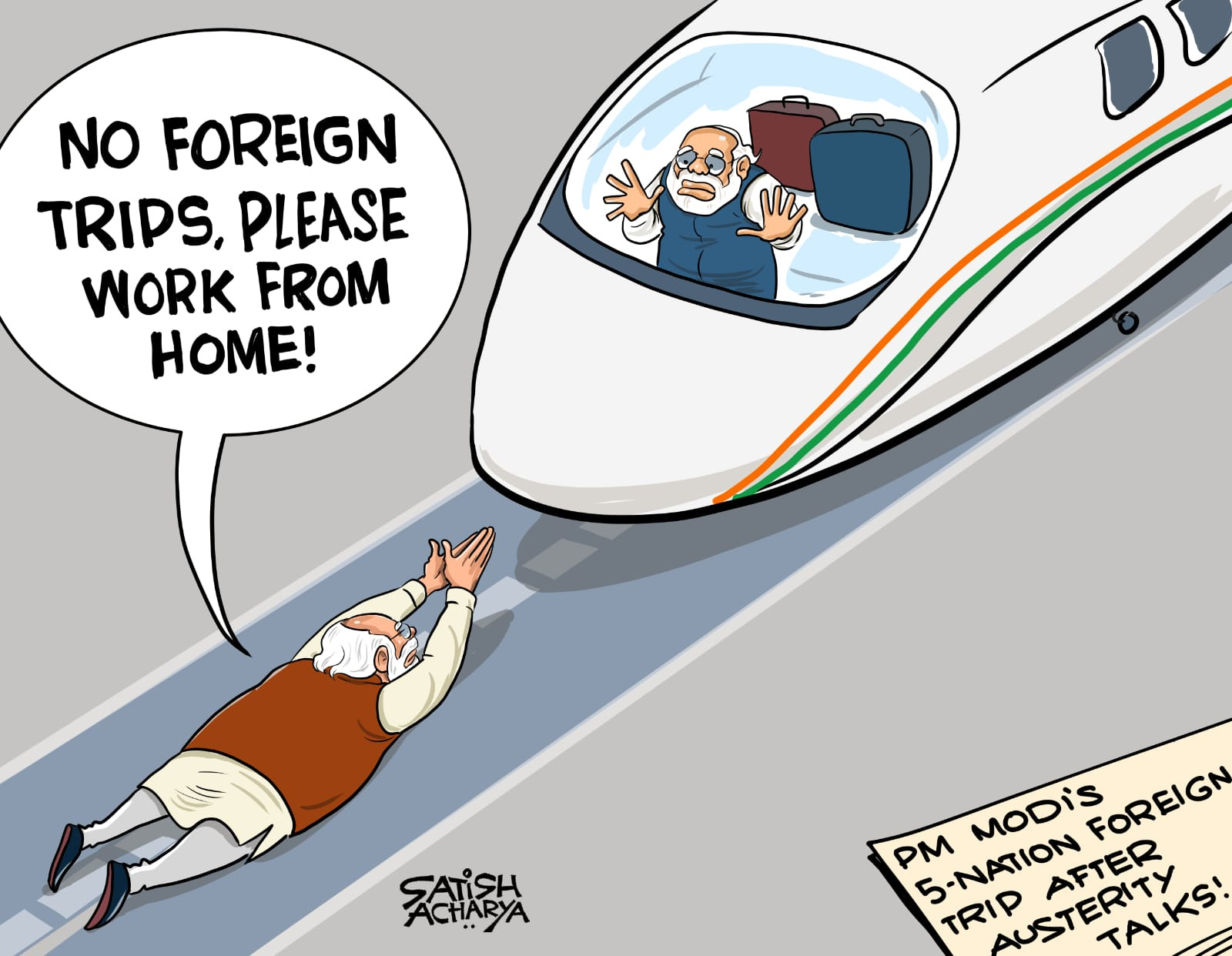
Drawn and quartered
Deep dive
Elinor Poole-Dayan, Deb Roy and Jad Kabbara have a paper on the ‘targeted underperformance’ built into LLMs — i.e. popular AI engines like Claude – based on the English proficiency, education level, and country of origin of users asking questions. Read the paper here and a helpful summary by Nav Toor on X, who concludes:
“If you are reading this from India or Pakistan or Nigeria or Iran. If English is your second language. If you did not go to Harvard. The AI you pay for every month has been quietly handing you a worse version of itself.
”It was never broken. It was aimed.”
Prime number: 7
Seven years after it was announced, the construction of the proposed Atal Bihari Vajpayee Institute of Medical Sciences (ABVIMS) has still not begun, even as “two MBBS batches affiliated to the institute having passed through makeshift facilities at the hospital,” reports Ridhima Gupta.Opeds you don’t want to miss
Sustained pressure on the Indian currency despite robust macro fundamentals points to weakness in the capital account, writes Ajit Ranade:
“India’s current account deficit may be below 2 percent of GDP, but the capital account is weak. The balance of payments will be sharply negative this year. When the BoP turns negative, either the rupee weakens or the RBI sells dollars to defend it. Both are now happening.”
Dinesh Singh reflects on the NEET exam cancellation fiasco and argues that the task of organising a ‘leak-proof’ exam is not as difficult as is being made out:
“Testing is only supposed to be a medium for learning, it cannot be a substitute for it. Educating a child has to be India’s goal, not testing whether she is capable of being educated.”
Bharat Bhusan writes on “why Modi needs RSS cover for dialogue with Pakistan”, arguing that public reactions to “the sudden ceasefire after Operation Sindoor showed Narendra Modi that the support of the Hindutva base is not unconditional.” He adds that his support is “predicated on giving no quarter to Pakistan,” and suggests that this is why Modi would require “the blessing of the RSS” in order to move forward with any engagement or dialogue with Pakistan.
MP Nathanael is not happy with the manner in which the Central Armed Paramilitary Forces are being treated compared to the Indian Police Service, whose officers are parachuted into the CAPFs in senior positions despite their lack of experience in the specific domains of these forces.
Whether Modi is ‘coup-proofing’ India’s military or simply subordinating the military to his broader political agenda, Brahma Chellaney is sharply critical of the manner in which his government has turned the key position of Chief of Defence Staff into one headed by retired Army men. Ironically, the alternative – of picking a CDS from among serving officers of the three services – would serve the purpose behind the CDS reform much better.
Suhit Bombaywala remembers Bombay’s iconic chronicler Behram Contractor, aka Busybee – and his sons Darryl and Derek; his dog Bolshoi the boxer; and his wealthy friend living on the 21st floor of a building famous for being twenty floors high.
Listen up
When people like West Bengal BJP MLA Ritesh Tiwari say they will not work for Muslims because they probably did not vote for them, it seems to suggest that “we pretend to be a democracy” and “pretend to swear by a Constitution”, former Vice President Hamid Ansari laments. “Are you going to ignore 15% of your population? … There are examples in Europe, there are examples elsewhere. I hope we are not going on that [path],” he said speaking to Karan Thapar. Listen here.
Watch out
Pooja Prasanna of The News Minute breaks down the case involving Bandi Bageerath, son of Union MoS for Home Affairs Bandi Sanjay Kumar, and the subsequent victim shaming that followed.
Over and out
Mekhala Saran has an intimate and revelatory portrait of activist Gautam Navlakha, who is out on bail in the controversial Unlawful Activities (Prevention) Act (UAPA) case, and his partner, Saba Husain. “Navlakha’s captivity provides a framework to study their [long term prisoners’] plight. His recollections diminish their obscurity. His partner’s struggles, meanwhile, offer a visual language for the countless battles that the families of other under-trials wage with an unrelenting state.”
On Xi Jinping, Trump and Modi – aka hard worker – the memesters are being particularly cruel.
That’s it for today. We’ll be back with you on Monday, on a device near you. If The India Cable was forwarded to you by a friend (perhaps a common friend!) book your own copy by SUBSCRIBING HERE.