
A newsletter from The Wire | Founded by MK Venu, Pratik Kanjilal, Sidharth Bhatia, Siddharth Varadarajan, Sushant Singh, Seema Chishti, and Tanweer Alam | Contributing writers: Kalrav Joshi, Anirudh SK
If you like our work and want to support us, then do subscribe. Sign up with your email address by clicking on this link and choose the FREE subscription plan. Do not choose the paid options on that page because Stripe – the payment gateway for Substack, which hosts The India Cable – does not process payments for Indian nonprofits.
Our newsletter is paywalled but once a week we lift the paywall so newcomers can sample our content. Today is that day. To take out a fresh paid subscription or to renew your existing monthly or annual subscription, please click on the special payment page we have created – https://rzp.io/rzp/the-india-cable.
Snapshot of the day
August 7, 2026
Siddharth Varadarajan
Responding to concerns that the government, politicians and corporations may use the Digital Personal Data Protection (DPDP) Act of 2023, to throttle investigative journalism and also gut the Right to Information Act by classifying all data as ‘personal’, the Supreme Court has agreed to examine how the two laws can be reconciled, reports Krishnadas Rajaopal in The Hindu. Justice Joymalya Bagchi said:
“The earlier law (RTI Act, 2005) gave certain access with conditions. Here (2023 Act), there is an en bloc embargo. Is this latter law repugnant to earlier law? This has to be looked into with extreme circumspection. After all, both are central laws. There is a need to actually harmonise these two.”
In Jharkhand, where students have been protesting alleged irregularities in the exams of the Jharkhand Public Service Commission and Jharkhand Staff Selection Commission for the past two weeks, the government of Hemant Soren finally held talks with them. The Congress, which is part of the Jharkhand government, has come out in support of the students, as have the Cockroach Janata Party and the All India Students Association led by Neha Bora.
Meanwhile, the Godi media machine was busy communalising the protests in Ranchi, and it was left to a Gen Z protester to call the toxic narrative exactly what it was.
Two weeks after the Modi government was forced to give in to the demands of student protesters at Jantar Mantar and get rid of education minister Dharmendra Pradhan, a Delhi High Court judge suggested the government could shut down the Jantar Mantar protest site altogether. “Justice Amit Mahajan said that the city should not be held to ransom unnecessarily by such protests,” reports Bar & Bench. Before he became a judge, Justice Mahajan was appointed special counsel by the Delhi LG to represent the Delhi Police in cases arising from the 2020 anti-Muslim riots.
Asked by Trinamool Congress MP Mahua Moitra for permission to appear before the Bengal police via videoconference in light of BJP-linked individuals’ attempts to throw eggs at her, the Supreme Court today seemed to suggest that being egged is par for the course in political life. Thus reasoned Justice Dipankar Datta orally: “Having taken the plunge into politics, you fear eggs? When our freedom fighters have taken bullets on their chest? These are applications that should not come before this court at all.” Moitra is required to go to the police in connection with a case against her lodged on a BJP worker’s complaint. In it she is accused of promoting communal disharmony while shouting at people who were trying to throw eggs at her.


Media reports over the last few days have underlined the fact that Modi is hardly the only one to have suffered a content takedown on social media – and unlike his experience, for the rest of us what is withheld (in compliance with the Modi government’s own IT rules) stays that way. Alisha Dutta reports for instance that Instagram has withheld for Indian audiences a number of posts made by Students’ Federation of India leader Sakhi, who popularised the phrase ‘vastegune huia’ during the youth protests. In four cases she received boilerplate communications from Instagram citing the 2021 IT Rules, but for one post the platform told her that it violated its guidelines on ‘adult sexual exploitation’ – this was a post where she talked about how the Delhi police tore her clothes while cracking down on the July 20 march to parliament.
Independent media too have been affected. Scroll reports today that Instagram has withheld four of its posts made since June, in all cases citing the IT Rules. The four posts had shared the newsroom’s articles on the following topics: security forces’ use of pellet guns inflicting serious injuries on Kashmiri people (a germane topic now in the wake of the weapon’s use in Delhi on the 20th); a postponement of the sentencing hearing of Nikhil Gupta, whom US authorities have accused of plotting to kill Khalistani separatist Gurpatwant Pannun on an Indian intelligence officer’s bidding; and a recent ban on the sale of meat in Amritsar’s walled city.
See these together with the social media takedown notices The Wire has received in the last few weeks and a pattern emerges. Just today Instagram informed The Wire that its post about Gupta’s sentencing hearing being delayed once again – in light of Pannun’s request to be present – has been withheld in India “through an automated system” implemented to comply with the 2021 IT Rules. Other posts made by the outlet that have been withheld deal with the related case of Hardeep Nijjar’s 2023 murder; US authorities’ indictment of gangster Lawrence Bishnoi, whom they accuse of ordering the hit on Nijjar; the use of pellet guns in Kashmir (again), an Arunachal group’s allegations of Chinese encroachment; and at least three cartoon videos lampooning Prime Minister Modi.
The 2021 IT Rules are also the lifeblood of the Union home ministry’s controversial Sahyog portal that various Indian agencies use to issue takedown orders to social media platforms. It has come to light that the Supreme Court recently stayed proceedings challenging the portal in four high courts, including by Digipub, X Corp and Kunal Kamra. It did so on the Modi government’s petitions to have them all transferred to the apex court, and issued notice on the transfer petitions.
Pakistan, Saudi Arabia and Türkiye have formalised a joint defence pact in Mecca, under which an attack on one member will be treated as an attack on all three. The agreement brings together Pakistan – the only nuclear-armed Muslim-majority country; Saudi Arabia – custodian of Islam’s holiest sites and a major global energy exporter; and Türkiye – a NATO member with the alliance’s second-largest military. The pact builds on the Strategic Mutual Defence Agreement signed by Pakistan and Saudi Arabia in Riyadh last September, which committed both sides to treating any aggression against either country as an attack on both. For New Delhi, the emerging security alignment adds another variable to an already complicated regional landscape.
India and China held the Working Mechanism for Consultation and Coordination talks in New Delhi, along the Line of Actual Control situation and discussed steps to avoid “misunderstanding and miscalculation” along the existing diplomatic and military mechanisms.
New Delhi used the talks to press Beijing to resume sharing hydrological data and called for an early meeting of the Expert Level Mechanism on trans-border rivers, amid concerns over China’s construction of a massive hydroelectric dam on the Yarlung Tsangpo in Tibet. The project, estimated to cost around $178 billion, will affect “local environment and downstream countries, including India.”
Kashmir’s chief preacher Mirwaiz Umar Farooq claimed he was placed under house arrest and prevented from offering Friday prayers at Srinagar’s Jamia Masjid. In a post on X, Farooq said while the authorities gave no reason, “as usual”, the timing of the house arrest, coming soon after the Mutahida Majlis-e-Ulema raised concerns over the alleged sale of pork products in Kashmir, was significant.
The Financial Times examines why Modi’s economic model is struggling to deliver for India’s youth, particularly on jobs and opportunities. A string of setbacks is exposing cracks in the BJP’s expansion plans, with electoral reverses and Gen Z protests forcing the party to confront the limits of long-term incumbency, notes the Hindu.
An investigation by Alok Rajput for the Reporters’ Collective has alleged a “recruitment scam at the Jawaharlal Nehru University, and at the heart of this is its own credential-verification body, the Internal Quality Assurance Cell” with “IQAC and Executive Council functioning under direct oversight of the vice chancellor.”
With Gen Z rattling the Modi government and emerging as a political force in its own right, the Sangh Parivar appears to have discovered that demonising young people has limits. This is no small constituency: those aged roughly 14–29 constitute for around 25% of India’s population. Yet their representation in the parliament remains microscopic – just six MPs and around 20 MLAs. The BJP’s first instinct was familiar: demonising protesting students as “anti-national”, “terrorist” or worse, while state machinery inflicted brutalities on them. Now, with accountability questions being asked not just by Gen Z but by the even younger Gen Alpha, the Rashtriya Swayamsevak Sangh has abruptly pivoted to outreach.
Addressing a youth conference in Mumbai, RSS chief Mohan Bhagwat felt compelled to clarify that students are not “terrorists” and declared that Gen Z and Gen Alpha are “more honest” than older generations, adding that appeals to patriotism and service resonate with them. This, apparently, was part of the outreach effort. Elsewhere, the “cultural” component seemed to involve a performance on an item song – a curious strategy for engaging a generation that has spent weeks demanding accountability from the state.
Deccan Herald, however, cuts through the performance.
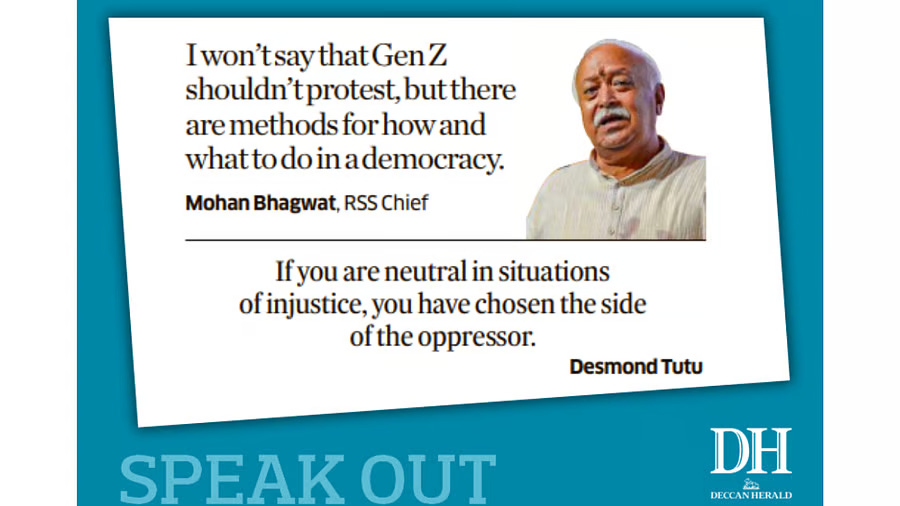
(Courtesy: Deccan Herald)
As Varghese K. George notes in the Hindu, the target audience may not actually be the Instagram generation at all. “It appears plausible that Modi, and the RSS chief, may not be trying to win over the Instagram generation, but rather to consolidate the WhatsApp generation, whose original support for the BJP is currently shaky.” The outreach, he argues, “is guided by the wisdom of the patriarch that a bird in the hand is worth two in the bush. The idea is more to stop the unravelling of what the Sangh Parivar holds, and less to win over what it does not have. Modi and Bhagwat are talking to fellow patriarchs more than to the protesters. What they are expressing is a combination of paternalistic responsibility and authority, rallying the parents of Gen-Z, the stormtroopers of Hindutva.”
The Sangh’s problem is not that Gen Z does not understand its message. It is that Gen Z understands it perfectly well. Nothing illustrates that better than the moment in Ranchi when an Adivasi youth reportedly compelled an RSS-backed Vice-Chancellor to take a seat on the ground.
A classified Canadian intelligence report – prepared by the Canada Border Services Agency’s Intelligence and Investigations Directorate – has identified the alleged overseas operatives of the Lawrence Bishnoi gang, describing the India-based criminal syndicate as an expanding transnational network that allegedly relies on local recruits, street gangs and the commercial trucking industry to carry out extortion, shootings and other organised crime activities across Canada with a “vast network” of recruits, reports Global News. This comes weeks after Canadian and US authorities announced Operation Hard Ball, a coordinated investigation into Bishnoi.
The DMK may be softening its stand on the Modi government’s controversial delimitation-cum-expansion of parliament Bill, The Hindu reports, with the Tamilnadu based party setting three conditions. The first is that there should be a 25-year freeze on the relative representation of every state in parliament regardless of population. Second, that the there be a 50% increase in the number of seats for all states. Third, that the government “present a schedule of the number of seats that each state will have in the legislative package,” report Sandeep Phukan and Sobhana K Nair, citing unidentified DMK sources.
Modi lets Trump rewrite India’s UPI success story to help Visa, Mastecard
The Taxation and Other Laws (Amendment) Bill that the Lok Sabha passed yesterday without debate would allow a merchant discount rate to be levied on certain UPI transactions, on which currently no such charge is extracted. Its passage notably comes as Washington has expressed its displeasure with India’s payment policies, saying they favour domestic providers, especially RuPay (no MDR on UPI transactions has also meant that Visa and Mastercard have lost out). But India must not give into American pressure and give up its proposed 30% market share cap for payment apps or dilute its data localisation demands, Ajay Srivastava urges – the former will protect competition, while the latter will help regulators and improve cybersecurity.
The fact that banks, payment companies and the National Payments Corporation of India have to invest a lot of money into making UPI work smoothly while there is a zero-MDR policy in place means a more sustainable approach may need to be hammered out, Srivastava adds; he has some ideas on how that can be done:
“… Financing the system does not automatically require a general merchant charge. Alternatives include targeted budgetary support, government incentives, charges on large commercial transactions, cross-subsidisation from financial services and narrowly designed fees applicable only to high-turnover merchants.”
When it comes to paid self-promotion, Yogi outdoes Modi
Yogi Adityanath’s information and public relations department spent Rs 6,811.94 crore between FYs 2017-18 and 2024-25 on advertising and publicity, surpassing even the Modi government’s expenditure over its 11 years in office and averaging to Rs 2.32 crore per day, finds Newslaundry‘s Basant Kumar. Eighty-three percent of that Rs 6800 crore was earmarked under the advertising and visual publicity category, which goes to newspapers, TV channels and digital platforms – the state government has even paid for ads on ShareChat. As for who receives this money, Kumar says he hit a brick wall: several RTI queries were filed, but “some applications went unanswered; others were rejected on the grounds that compiling information of this scale would take too long”.
Government wary of ‘creamy layer’ concept for SC/ST reservation
Responding to petitions in the Supreme Court seeking the identification and exclusion of a ‘creamy layer’ – i.e. the more well-off – of SC and ST beneficiaries of affirmative action, the Union government has resisted the idea. The petitions do not raise a constitutional issue and do not disclose a fundamental rights violation either, the social justice and empowerment ministry has told the apex court, arguing that legal precedents have clarified that the “principles of creamy layer do not apply to SCs and STs”. It also accused the petitioners of trying to mislead the court. The idea of identifying a creamy layer of SCs and STs was given a fillip in 2024 when Justice B.R. Gavai had said in his opinion on the Davinder Singh case that the government “must” find a way to make this identification.
The Long Cable
The ‘Cockroaches’ Have Upended Modi and Shah’s Authoritarian Dream
P. Raman
Narendra Modi and Amit Shah will never pardon the cockroach agitators who happened to spoil the ruling duo’s carefully crafted plans for perpetual authoritarian control. Abhijeet Dipke appeared out of the blue just when they felt they were on the cusp of success.
After a series of induced splits in the Trinamool Congress, AAP and Shiv Sena, the BJP was on the verge of a two-thirds majority in parliament. The dramatic realignment in Tamil Nadu with the Congress teaming up with Vijay’s TVK enabled Amit Shah to open talks with the DMK on delimitation bill. Everything seemed to be working to plan when the Cockroach Janata Party agitation caught the imagination of lakhs of young Indians fed up over repeated paper leaks and cancellation of all-India tests.
The CJP is not going to vanish as many in the Modi camp hope. It will stay in the battle and continue its fight for justice. The CJP also plans to respond to RSS boss Mohan Bhagwat’s call for a dialogue on GenZ’s problems. Dipke has also made it clear that the CJP has no plans to convert the outfit into a political movement. But it would build a broader public movement to restore people’s faith in the democratic process. Its leaders are in the process of consulting different segments of the polity. It has decided to launch a ‘Kya bolti hai public’ campaign and make unemployment a core issue.
A panicked regime had, in true authoritarian style, directed its ministers and senior party sides to be active on Instagram — in order to effectively counter this challenge. The aim was to restore the regime’s domination on social media.Unfortunately, only 11 of the 30 cabinet ministers increased their Instagram activity, contributing to a 13% rise in overall posting over a two-w eek period. Another study finds the BJP’s outreach through Instagram has ‘flopped’. According to media persons covering the BJP, Modi also met with the party’s social media groups about their apparent failure to wrest domination of the narrative.
We are in the midst of a political turmoil the outcome of which, at the moment, seems unpredictable. For the the first time, the invincibility of the Modi-Shah establishment has been effectively challenged. We have to wait and watch how the events will unfold in the coming weeks. There are several ifs and buts. However, a few things have already become apparent.
First, Amit Shah, who could come up with shock bills and freely impose those on parliament, has now been forced to use his parliamentary affairs minister for getting these bills through on a daily basis. This has now been happening for over a week. Thus, ironically, the ruling party has suddenly lost its heft when it is numerically stronger after its recent annexations.
Second, for the youth protesters and opposition parties, Amit Shah is fast emerging as the villain of the piece. He has followed Modi’s practice of absenting himself from parliament, even ignoring the Rajya Sabha chairman’s request. The repressive measures he used to crush the youth protesters have been widely condemned despite the loyal media doing its best to downplay the worst aspects.
The Supreme Court has now taken note of the use of such crude devices like pellet guns, lathis embedded with nails and electric batons on the youth protesters. These fascist style weapons are normally reserved for hardened criminals and violent crowds. What crime did the young protesters commit to warrant such cruelty? Some of these methods cause life-long injuries. That is why the protesters want the home minister – who ordered such cruel instruments – to be held accountable.
Then police also deployed specialised mobile command and control vehicles equipped with 360-degree high-definition cameras, live facial recognition systems and Automated Number Plate Recognition (ANPR) technology. The European Union’s AI Act restricts the use of real-time remote biometric identification in public spaces, allowing only narrowly defined exceptions. Several US cities — including San Francisco, Portland and Boston — have banned or significantly restricted the police use of facial recognition. But under Amit Shah all of these systems were deployed against young Indians.
The youngsters at the CJP protest were different from those we saw in the 1960s, 70s and 80s. With their backpacks, mobiles and water bottles, these post-reform youths in jeans are seeking scam-free tests and jobs commensurate with qualifications. They feel deceived by Modi’s slogans like Modi hai to mumkeen hai. Why use Israeli-style crude tools on them?
Third, it does seem as if political mood of the nation is turning against the ruling party. This is the conclusion most observers are drawing from the recent by-election results. Of the four results, all from the BJP-ruled states, the BJP could only retain a lone seat from Gujarat and even there its victory margin eroded sharply. The rise of Prashant Kishor’s party in Bihar and Congress’s victory in Datia in Madhya Pradesh are seen as a big jolt to the BJP.
Does the backlash of the CJP agitation and the election reverses indicate simmering discontent against the regime? We have to wait a while to know more about the growing volatility among the BJP’s core social base of Hindu voters before jumping into conclusions. Let us watch the straws in the wind.
This is visible within BJP. You may dismiss Murli Manohar Joshi’s occasional, sane advice to the Modi-Shah regime as an old man’s grumbling. But now we have more such jarring voices from those like the four-time MLA Yashodhara Scindia who belongs to Datia where the BJP suffered a setback in the recent by-election. The fear of Amit Shah’s wrath is probably keeping many such voices muffled but that does not mean all is well within.
Modi'’s preoccupation with political firefighting and the panic among the establishment indicates just that. Since the humiliation suffered over Pradhan’s ouster, the PM finds no time for any other work. Spending long hours with aides and meeting the wavering allies takes much of his time. His brief public appearances in between shows how worried the regime is.
Evidence of the growing panic comes from the strange way in which the IT parliamentary committee headed by a BJP MP sought an apology from Meta chief Mark Zuckerberg. In the first place, a parliamentary committee itself has no powers to withdraw ‘safe harbour’ protection from social media intermediaries. Such a move would require the government amending the relevant section of the IT Act. Without going into the weeds, a simple question needs to be asked: Why is a parliamentary committee so concerned over the social media image of Modi alone? What about other politicians, artists, intellectuals and eminent persons? AAP’s Arvind Kejriwal now says Meta has ‘restricted’ his Instagram accounts. “At this rate, Modi will allow only his own accounts in India,” he quipped.
The loudest defence in favour of the Modi regime came from his solicitor general, that too in the Supreme Court. Arguing the government’s case for why it wanted control over the selection of election commissioners, Tushar Mehta made several contentious, in fact tendentious, political questions on July 30. Let us discuss his misplaced political contentions.
“People must trust PM. The office of the PM has a ‘sanctity’ attached…if his decision is not to be trusted, then why we did not have a provision that he should appoint his ministers on recommendation of a, say, retired judge,” he asked.
The PM and his ministerial team are political. They are collectively responsible to parliament. Apart from parliament, they are subject to strict watch by various institutional bodies like parliamentary committees, the PAC, and watchdog bodies like CIC and CVC, though Modi has made therm dormant.
In other words, there is no special ‘sanctity’ attached to the office of the PM or his ministerial team. Under the Westminster system which we broadly follow, the office of PM is transient. It survives so long as it enjoys majority in parliament. Of course, under a dictatorial architecture, the PM is presumed to attain sanctity and permanence. Perhaps that is what Tushar Mehta was signalling.
Tailpiece: “I am ready to show all my papers regarding my educational qualifications. Can Modi?”, challenged CJP leader Dipke. This was in response to a Surat man casting aspersions on the degree and finances of Dipke. For years, Modi’s degree certificate was embroiled in controversy with Amit Shah himself coming out with dubious evidence. Modi had got the courts to put a lid on this controversy. But thanks to the ‘cockroaches’, this issue might well resurface.
(P. Raman is a veteran journalist.)
Reportedly
"Whatever our shortcomings are, I have to point them out,” UP governor Anandiben Patel said at Gorakhpur University yesterday. “This is Gorakhpur, where our Chief Minister himself resides— if such flaws persist there, what will happen?" She then proceeded to make a list of everything that’s wrong with the city.
Clearly all is not well in Fortress BJP. And elections in UP are less than six months away.
Drawn and quartered


Deep dive
Behind the DMK’s ejection from power this year is the fact that Vijay “became a point of intersection of various pathways of discontent and angst”, says V. Geetha. And a big part of how he did that, she argues, is his cultivated image of a ‘boy-man’. Not only did it confer a powerful charisma upon him but it also “spoke to a range of citizen anxieties, fears and concerns”.
Prime number: Rs 557.5 cr
The bill for PM Modi’s foreign tours since 2021 has now crossed Rs 557.5 crore, according to figures tabled in Parliament. And that’s with the France leg of his June 2026 trip still waiting for its invoice to land – so the final tab is set to climb even higher.
The highest annual expenditure was recorded in 2025 at Rs 187.83 crore, followed by Rs 109.51 crore in 2024, Rs 93.63 crore in 2023, Rs 74.59 crore in 2026 (provisional), Rs 55.83 crore in 2022, and Rs 36.12 crore in 2021.
Opeds you don’t want to miss
Harish Khare looks at what’s happening to Amit Shah, India’s home minister, and a man normally used to batting aggressively. Faced with the Jantar Mantar fiasco and calls for his resignation, he has given parliament a miss for the past week. Is Shah’s meltdown a work in progress, Khare asks.
India is rife with democratic dissents, but our systems of attention prevent us from seeing the arguments as a cohesive whole, writes Prem Panicker.
The problem with people looking to validate claims from ancient texts – such as on the medicinal properties of cow urine – is that they often start with a preconceived idea and work from there, Dinesh C. Sharma notes. But unlike before, “what’s new is official support for such research as part of a systematic state-driven effort”. Indian academics and scientists ought to spend their time fighting pseudoscience rather than promoting it, Sharma writes – he points to China as an encouraging example.
Isn’t there a glaring hypocrisy underlying the ubiquitous disparagement of welfare and slum rehabilitation schemes, asks Hussain Indorewala: “Public land occupied by the poor for use is encroachment, but public land transferred to builders for profit is ease of doing business. That the poor do not pay for housing is morally outrageous, but all the largesse granted to builders is good for development”. Likewise it is with transportation, he points out.
Cyrus Naji reviews Munis Faruqui’s new book Aurangzeb ‘Alamgir and the Mughal Empire. Faruqui “disprove[s] the popular perception that Aurangzeb systematically destroyed temples and subjugated Hindus for their religion”, says Naji, praising the book especially for its recreating of the emperor’s last days but also lamenting its academic writing style.
Listen up
Gen Z and TikTok have changed the way we speak. Here’s a BBC podcast from last year that explains Gen Z language. Watch it to understand, but please don’t mimic. Especially you, Modiji.
Watch out
Bloomberg has an excellent wrap on why India’s youth are taking on the government.
Over and out
Generations of Indian college students revered Old Monk rum and nostalgic Indian migrants fondly remember its signature taste with caramel and chocolate undertones, even claiming it holds its own against the best dark rums from Cuba, Haiti and the West Indies. Well, it turns out that Old Monk’s taste may have come less from the aging of underlying spirits but from added flavours, and the FSSAI – India’s food regulator – has banned the sale of the iconic rum until the company fixes its labels to state its product is flavoured.
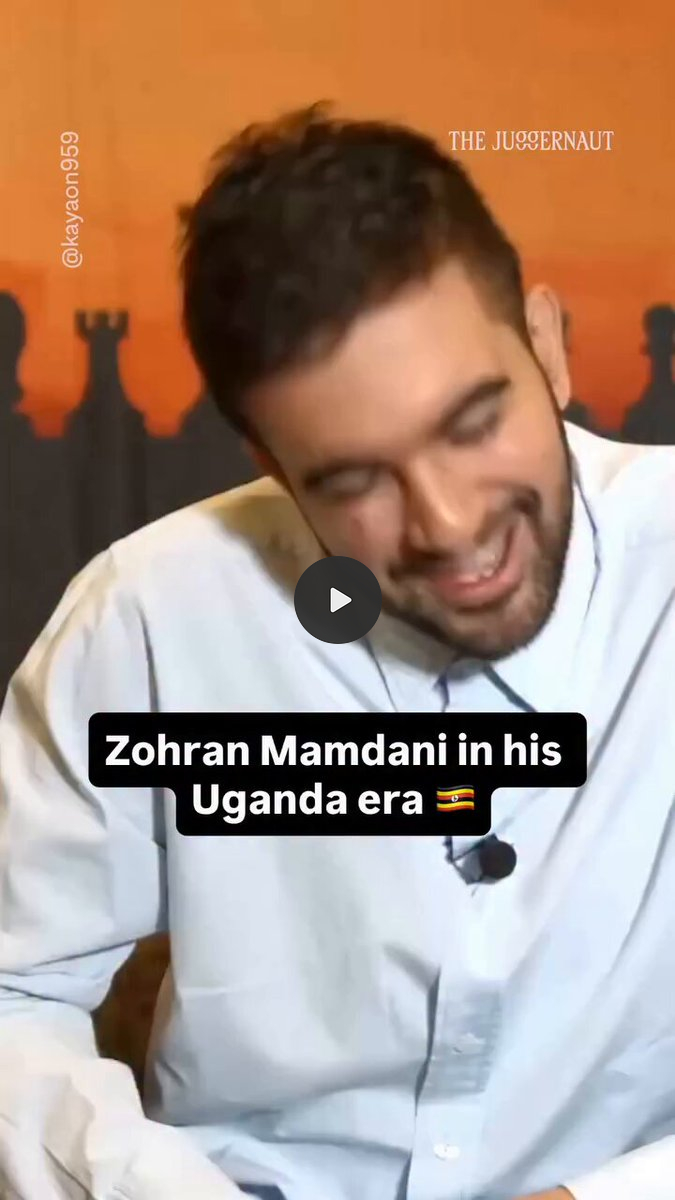
Before he plunged into politics, Zohran Mamdani dabbled in rap.

That’s it for today. We’ll be back with you on Monday, on a device near you. If The India Cable was forwarded to you by a friend (perhaps a common friend!) book your own copy by SUBSCRIBING HERE.