
A newsletter from The Wire | Founded by MK Venu, Pratik Kanjilal, Sidharth Bhatia, Siddharth Varadarajan, Sushant Singh, Seema Chishti, and Tanweer Alam | Contributing writers: Kalrav Joshi, Anirudh SK
How to subscribe to The India Cable
To subscribe for free: Click this link, enter your email address and select the FREE subscription plan.
Important: Do not select any of the paid options on Substack. Stripe, its payment gateway, does not process payments for Indian nonprofits.
To take out a paid subscription: Visit our dedicated Razorpay payment page to make your payment.
To renew an existing subscription: Use the same Razorpay payment page to renew your monthly or annual subscription.
If you have recently subscribed but are still receiving the truncated version, please write to product@thewire.in with your payment confirmation so we can resolve the issue.
Want to sample our newsletter? The India Cable is normally paywalled, but we lift the paywall once a week so that new readers can sample our content. Today is that day.
Editor’s note: This post may be cut off in your inbox due to length. Click on the title above to read it in full on Substack.
Snapshot of the day
November 13, 2026
Sidharth Bhatia, Kalrav Joshi, Anirudh S.K.
Manipur has been beleaguered by ethnic strife for three and a half years now but peace is still out of view. The second axis of conflict that erupted earlier this year, between the state’s Kuki and Naga communities, continues to claim lives even now. Yesterday a Kuki woman was shot dead and two Kuki men were wounded in the tense Taphou Kuki village straddling the state’s Kangpokpi and Senapati districts. The incident occurred at a time when the Committee on Tribunal Unity was protesting the abduction and killing of two Kuki men from the same village just three weeks ago. Normal life was affected as a result of yesterday’s incident in Kangpokpi, with businesses staying closed and roads wearing a deserted look. And in Ukhrul district today, four Naga individuals were slain in an ambush by suspected militants.
Meanwhile, the commission of inquiry that was constituted soon after the strife broke out in May 2023 – between Manipur’s Meitei and Kuki communities – has been granted another six-month extension by the Union government; now its term will run through May next year. The remit of this panel is to look into the circumstances leading up to the violence before it erupted 42 months ago.
Delhi overtook Pakistan’s Lahore today to become the world’s most polluted major city, as hazardous air quality and a thick blanket of smog reduced visibility across the capital. Swiss air-quality monitor IQAir recorded Delhi’s AQI at 334, placing it at the top of its global city rankings. The Central Pollution Control Board (CPCB), however, reported an even higher reading of 403, categorised as ‘severe’.
A new report by Dalberg estimates that reducing air pollution even by 20% could save India $85 billion in annual economic losses by 2030. And while the scale of the crisis demands urgent action, Godi Media has found a silver lining: the supposed benefits of pollution. All at the dear leader’s whim.


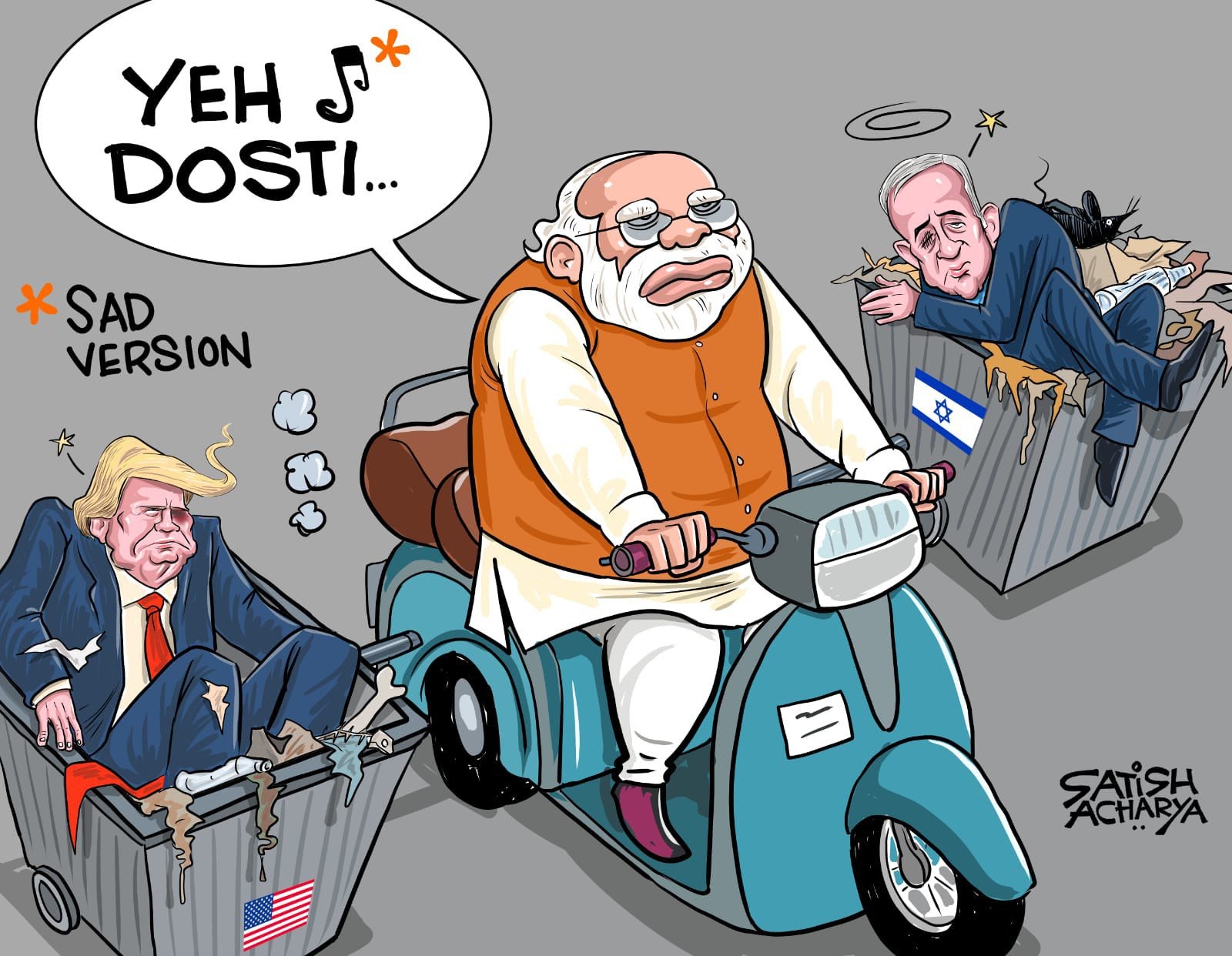
Washington has ‘assured’ India of a tariff advantage over its competitors once it finalises its tariff regime, T.C.A. Sharad Raghavan cites a senior official in the commerce and industry ministry as saying. Indian officials had previously stressed they would only move forward with talks towards the stalled interim trade deal if the United States offered India a comparative advantage. This official also told The Hindu‘s Raghavan that the two sides have agreed to an ‘unusual’ clause that would allow one party to modify its commitments under the deal in the event that the other country changes its tariffs.
Amid persisting standoffs between Indian and Chinese troops along the Line of Actual Control in Arunachal Pradesh, the Indo-Tibetan Border Police has sanctioned the building of new bridges along the border, reports Vijaita Singh. Earlier this year, in February, the cabinet committee on security had okayed the third phase of the Indo-China Border Roads project, marking only the second time such a move was cleared after the deadly Galwan clash of 2020.
The home ministry has extended its ban on proscribed preacher Zakir Naik’s Islamic Research Foundation for another five years under the Unlawful Activities (Prevention) Act. If its unlawful activities are “not curbed and controlled immediately, it will take the opportunity to continue its subversive activities and re-organise its activists who are still absconding and disrupt the secular fabric of the country by polluting the minds of the people by creating communal disharmony”, the ministry said in a statement.
This year’s Global Tuberculosis Report published by the WHO points to a decline in TB deaths in India and a 94% treatment success rate for drug-resistant varieties of the disease. But India’s incidence rate is missing from the report, even as the country accounts for a quarter of all of the world’s cases, in light of data being under review. India has also not published its own TB report, which used to be released annually on World TB Day in March. Anonna Dutt and Anuradha Mascarenhas report.
Indian households used to spend on average over 40% of their food budgets on cereals and pulses but today it is processed foods that make up the largest category of food expenditure. Rukmini S. walks us through what changed in the intervening years and how.
Justice C.S. Karnan, who became the first sitting high court judge to be sentenced to jail for contempt of court back in 2017, passed away in Chennai yesterday. Mohamed Imranullah S. recalls the instances that landed him in the spotlight, from accusations against other judges of caste-based discrimination to an order sentencing the chief justice of India and seven other Supreme Court judges to five years’ rigorous imprisonment.
Adani Green reduces cost of its hydel project by on hundredth of original cost
Though the environment ministry while recommending clearance for Adani Green Energy’s 1,500-MW Tarali hydel project in Satara, Maharashtra had pegged its cost at Rs 5,675 crore, the firm later went on to revise its expenditure to just Rs 56.75 crore – a hundredth of the original value. This move, reports Chandan Haygunde in an investigation for the Indian Express, also concomitantly reduced the wildlife conservation deposit Adani has to pay over time from Rs 227 crore to Rs 2.275 crore. The forest department greenlit Adani’s massive downgrade but following a complaint the Union government has launched a probe into the matter. “Even a layman would understand that such a huge power project cannot happen on such a low budget,” said the complainant, honorary wildlife warden Rohan Bhate.
Hasina extradition continues to stall India-Bangladesh ties
The postponement of the fifth India-Bangladesh consular dialogue, scheduled for November 17–18 in Dhaka, is another indication of how far relations between the two neighbours remain from normalising. The decision comes days after a request concerning former ousted prime minister Sheikh Hasina’s new passport and national identity card was submitted. The dialogue was expected to address a range of practical concerns, including cross-border issues, border management, streamlining visa procedures, the repatriation of citizens detained in either country, the release and return of fishermen, and mutual legal cooperation.
But Hasina’s future remains a major sticking point. Bangladesh’s acting Foreign Minister, Humayun Kabir, told journalists that Dhaka would not issue her a passport and would instead seek her extradition through what he described as an “acceptable prisoner exchange process”. He added that any such handover would have to be handled carefully. With the question of Hasina’s extradition continuing to cast a shadow over bilateral ties, even routine diplomatic engagement appears to be caught in the chill between the two countries.
Seventeen months after tragic AI 171 crash, no clarity still on final report
Although media reports suggested that a final report on the Air India flight 171 crash – which overshot its original ideal deadline of June this year – would be out by October, we are in the second week of November now and there is no word on when it will be released. In fact, the world over national agencies have not published enough air accident reports that would be necessary to generate recommendations for safer flying, advocates said on the sidelines of the International Aviation Safety Summit in Montreal yesterday. Final reports are released for just around 50% of air accidents that are probed under international rules, the International Air Transport Association’s global safety director Mark Searle told Reuters’ Allison Lampert.
The Long Cable
Tamil Nadu’s library scam – when AI starts writing books
P.A. Krishnan
The grand Periyar Arivulagam library in Coimbatore, built in the style and dimensions of a mausoleum, was inaugurated by Tamil Nadu Chief Minister Vijay on October 16, 2026. It was built at a cost of about Rs. 250 crore, with books – both digital and print – worth approximately Rs 50 crore, either already procured or in the process of procurement.
The Dravida Munnetra Kazhagam (DMK) was, understandably, livid. After all, it was their idea to erect grand libraries in the names of famous Tamil icons and adorn them with books. Thus, M.K. Stalin, who promptly visited the library on November 5, claimed that 99.75% of the work had been completed during his tenure and that, but for his government’s efforts, Vijay would have abandoned the project.
All hell broke loose on November 6. Perumal Murugan, the renowned Tamil writer, wrote an article in the digital magazine Sindhai, pointing out that about 1,800 books on the shelves had come from the same publisher, “Akal Vilakku“ (meaning an oil or clay lamp), a name unheard of in literary circles. All books were hardbound and priced exorbitantly, with a 300-page book costing about Rs. 1,445.
Moreover, they contained pure gibberish, obviously written by AI given free rein. For instance, one book solemnly stated that Tamil Nadu had, in 1947, a “prime” chief minister by the name of “Mutuvelu Subbiah Iyer” – a name so shockingly un-Brahminical that it might invite immediate excommunication from the community! Obviously, the name was fictitious, suggesting that AI does indeed have a keen sense of humour.
This was reinforced by the name of another author: “Trisha Vijay!” For the uninitiated, the supposed close relationship between actor Trisha and CM Vijay is a staple of Tamil gossip magazines. Quoting several such books, with outlandish titles, authors’ names and impossible contents, Murugan argued that this was a clear case of massive corruption in the procurement of books and demanded severe action against those responsible.
It occurred to every sensible person that, since Vijay’s government was barely six months old, corruption and ingenuity of this proportion could hardly have been its handiwork, given the rank amateurishness of its ministers – which, after all, had been the constant refrain of DMK critics. However, DMK supporters, especially some intellectuals and writers loyal to the party, launched a spirited campaign in its defence.
One group argued that since the books had been received by the library, as indicated by the stamps on them, only on June 22 – more than a month after Vijay took over – the DMK could not be held responsible. Another writer plaintively pointed out that the ‘contaminated’ books occupied only a few shelves, while the others were full of genuine stuff. In other words, he wanted the DMK to be given credit for not stuffing the entire library with rubbish!
The minister in charge of libraries, A. Rajmohan, at a series of press conferences and through official announcements, said the purchase order to Akal Vilakku Publishers had been issued on February 14 and that the payments had been released in March. The June seal, he clarified, merely indicated the date on which the books were officially received by the library and could not be construed as the date of the purchase order. He added that there had been several such bogus purchases from phantom publishers, involving books written by ghostly authors, and that the Tamil Nadu Directorate of Vigilance and Anti-Corruption (DVAC) had begun an investigation.
The DMK, too, demanded a thorough investigation.
What is the truth?
Procurement of books for public libraries has been a perennial source of corruption for all political parties that have ruled the state over the years. Visit any library in Tamil Nadu, and chances are that more than 80% of the books on its shelves are rubbish, and sometimes very toxic rubbish. Fortunately, almost all of them remain unread. Had my dear friend Murugan not taken the trouble to visit the library and chanced upon these books, this scandal might not even have come to light.
In fact, the Madras high court observed, in a case it heard in June 2024 relating to procurement of books, that “this is nothing short of a scam” and directed the government to put in place transparent procedures for the procurement of books. To be fair, the state government did announce a Transparent Book Procurement Policy in 2024 itself.
I spoke to my publisher, Kannan, who runs one of the major Tamil publishing houses, Kalachuvadu, and he affirmed that the procedure was indeed transparent and that he had faced no hassles. I also spoke to Murugan, who too said that the procedure was fair and transparent. The News Minute quoted Vijay Shankar, former editor of Frontline and member of one of the committees recommending books, as saying that the procurement process involved several committees before approval was granted.
How, then, did publishers like Akal Vilakku obtain such huge orders, the magnitude of which is still unclear, while bypassing standard procedures? Many people who served on these committees have come forward to state that they did not recommend any of these books. Who, then, recommended them? Incidentally, Rajmohan waved a paper at a press conference and said the procurement had been approved by J. Jeyaranjan, former vice-chairman of the state planning commission. I have not seen any denial from him.
Therefore, based on what is available in the public domain, it appears that the entire scam was planned and executed during the DMK regime. It is possible that some of these entities were active even earlier. The present government almost certainly had no role in this. It may be that some payments were released after it took over, but that was what the government was legally required to do.
It is certain that several publishing houses, officials and politicians were involved in this sordid affair. The whole thing looks confusing, but that is only natural, since the scandal came to light barely four days ago. A swift and thorough investigation will hopefully provide all the answers.
What is to be done?
In the United States and United Kingdom, public libraries rarely purchase books directly from publishers. They rely on library wholesalers and distributors, often called “book jobbers.” Of course, there are provisions for self-published and local authors to sell their books to local libraries, but bulk purchases are generally made through established distribution channels.
These book jobbers are thorough professionals who engage professional librarians, subject-matter experts and experienced bibliographers to sift through books. India, too, has such wholesalers and distributors, and the state government must consider using their services.
As regards AI-generated books, there are tools to identify and filter them at the pre-procurement stage itself. If some do escape scrutiny, libraries also have weeding frameworks to identify and remove unsuitable material.
Every modern tool brings its own problems, but solutions are usually found almost immediately. Our problem is that we go in search of these solutions rather leisurely, or only when a crisis arrives. In Tamil Nadu, it has arrived.
P.A. Krishnan is an author in English and Tamil. With a postgraduate degree in physics from Presidency College, Madras and experience in academia, the civil service and scientific institutions, he writes frequently on science and public life.
Reportedly
How many voters are there in Rajasthan? It turns out there is no single answer, not even officially. While the final rolls produced after the contentious special intensive revision in February record some 5.15 crore names, the list drawn up by the state election commission early last month contains 5.45 crore voters. And now, the draft rolls produced following the special summary revision have yielded 5.26 crore names, the Times of India points out.
Drawn and quartered
Deep dive
Brian Wong and Aravind Yelery write on the factors behind the pragmatic re-engagement between China and India and how the two sides can steer their relationship towards “a more mutually conducive modus vivendi”.
Prime number: 60 ÷ 11
The Navy has participated in 11 drills with allied countries over just the last 60 days. What does this mean vis-a-vis its power projections, its global ambitions and its capacity, especially considering the fact that it is not acquiring enough ships to replace – leave alone grow – its fleet? Junaid Kathju writes.
Opeds you don’t want to miss
Narendra Modi’s use of the term ‘Dimagi Naxals’ (intellectual Naxals) “echoes that of United States Senator Joseph McCarthy who rose to political prominence in the early 1950s by exploiting the fear of Communist sympathisers having infiltrated US society”, writes Bharat Bhushan. “As in McCarthy’s case, the argument runs that victory over one set of Communists has not ended the battle but requires a sustained rooting out of those who are ostensibly hiding in the interstices of politics, culture, and civil society.” That he spoke to CRPF wearing camouflage uniform, “deliberately blurred the distinction between civilian executive authority and India’s neutral security apparatus.”
Sheikh Hasina’s announced intention to return to Bangladesh puts New Delhi in a bind: it cannot restrain her from going back but it cannot disown the consequences – potentially very disruptive ones – of her homegoing either. The Modi government, notes The Hindu, “must redouble its diplomatic efforts on improving bilateral ties while also ensuring Hasina’s welfare”.
Adani’s stewardship of the new Navi Mumbai airport will be a visible test of the conglomerate’s strength, going by how it handles resistance from airlines – who are unhappy with what they perceive as the group’s superciliousness – as well as Maharashtra chief minister Devendra Fadnavis, writes Andy Mukherjee. Through the new airport’s development he also identifies one lesson: “India’s aviation industry has evolved in an inherently anti-consumer fashion … As long as well-heeled travellers aren’t disturbed too much, shifting costs to the less affluent is ridiculously easy in India.”
Bunker Roy could have easily become a well-heeled bureaucrat or corporate executive but instead he worked to alleviate the suffering of India’s poorest people, all the while recruiting others to his cause as well, recalls Harsh Mander in this heartfelt obituary. Roy was also charming and smiling and had a generosity of character rare among men, Mander writes.
That Amit Shah has responded to Rahul Gandhi’s challenge to PM Modi for a debate signifies two things, says Parsa Venkateshwar Rao Jr. One, Gandhi is no longer Pappu but the clear leader of the opposition. And two, the BJP is in a state of flux: Modi is no longer the vigorous personality he was a decade ago and even as his succession is an unresolved issue, Shah is the temporary face and voice of the party.
Listen up
After enjoying a considerable period of dominance, are the fortunes of the populist far-right finally on the wane worldwide? Christophe Jaffrelot and Irfan Nooruddin discuss with Sonikka Loganathan on InFocus.
Watch out
Sonia Gandhi’s memoir Belonging tells not only her life story but also of her quest to belong to the family she married into and to the country that she made her new home. The book is detailed and occasionally revealing – but also notable for its omissions – in addition to being moving at times. N. Ram, Aanchal Malhotra and Sidharth Bhatia discuss the book and the impression it left on them in this conversation with Karan Thapar.
Over and out
Nitesh Tiwari’s Ramayana Part 1 is making a splash at the box office and its most powerful performance is of Yash’s as Ravana. Nandini Ramnath uses the occasion to remember a rather different film, Mani Ratnam’s Raavanan (2010), which “muddies received wisdom about heroism and villainy, divinity and humanity, justice and punishment”. It also harkens back to a far more liberal time compared to today’s, where such an interpretation of the Ramayana could clear the censors and enjoy box office success, she recalls.
That’s it for today. We’ll be back with you on Monday, on a device near you. If The India Cable was forwarded to you by a friend (perhaps a common friend!) book your own copy by SUBSCRIBING HERE.