
A newsletter from The Wire | Founded by MK Venu, Pratik Kanjilal, Sidharth Bhatia, Siddharth Varadarajan, Sushant Singh, Seema Chishti, and Tanweer Alam | Contributing writers: Kalrav Joshi, Anirudh SK
If you like our work and want to support us, then do subscribe. Sign up with your email address by clicking on this link and choose the FREE subscription plan. Do not choose the paid options on that page because Stripe – the payment gateway for Substack, which hosts The India Cable – does not process payments for Indian nonprofits.
Our newsletter is paywalled but once a week we lift the paywall so newcomers can sample our content. Today is that day. To take out a fresh paid subscription or to renew your existing monthly or annual subscription, please click on the special payment page we have created – https://rzp.io/rzp/the-india-cable.
Editor’s note: This post may be cut off in your inbox due to length. Click on the title above to read it in full on Substack.
Snapshot of the day
October 2, 2026
Kalrav Joshi, Anirudh S.K., Siddharth Varadarajan
If the past 78 years (especially since 2014) have allowed Hindu hardliners to forget MK Gandhi’s core teachings, then the last 24 hours have produced an astounding irony in the invocation of his legacy. Gandhi’s wheel of non-violent resistance continues to spin, despite all the spokes being hurled its way in ‘New India’.
Even as the establishment, including Prime Minister Narendra Modi, paid homage to Gandhi and tried to invoke his ideals of truth and non-violence, access to Jantar Mantar, the capital’s officially designated site for peaceful protest, was heavily restricted for unarmed, peaceful protesters – projecting quite an emblematic image of a capital under siege from its own citizens. At least 4,000 police personnel were reportedly deployed, more than 11 Metro stations were shut and internet access was restricted in parts of the capital, while hundreds of protesters were detained as the authorities appeared to be under mounting fear (and pressure) to prevent a repeat of the recent student-led mobilisation.
Hundreds of protesters nevertheless defied the yellow barricades to demand the resignation of Chief Election Commissioner Gyanesh Kumar over irregularities in the Special Intensive Revision of electoral rolls and ‘vote chori’, as similar protests have kicked off nation-wide, from Lucknow to Indore. The Delhi Police, which reports to Union home minister Amit Shah, detained more than a thousand activists, students, reporters, bystanders, MPs and other citizens, including AISA’s Neha Bora, activist Yogendra Yadav, AAP MP Saurabh Bharadwaj and RJD MP Manoj Kumar Jha. There was also a conspicuous shortage of women police personnel in areas such as Jantar Mantar and Connaught Place, even as women protesters were handled roughly by the state, elderly people were pushed and marchers were taken away in buses. Undaunted, however, protesters kept returning to the edge of Jantar Mantar.
“Who doesn’t allow protest? Those who know they have done something wrong,” Banishree Das, a 70-year-old retired educator, told the New York Times. “They have done something wrong — depriving so many people of their votes. A vote is not just a piece of paper for us.”
But one image perhaps captured the moment best. As Sanjay K. Jha notes, “The paper carrying directive principles of the Constitution fell from the hands of a boy who was pushed away by the police. Constitution has been shown the right place.” The symbolism is difficult to miss.
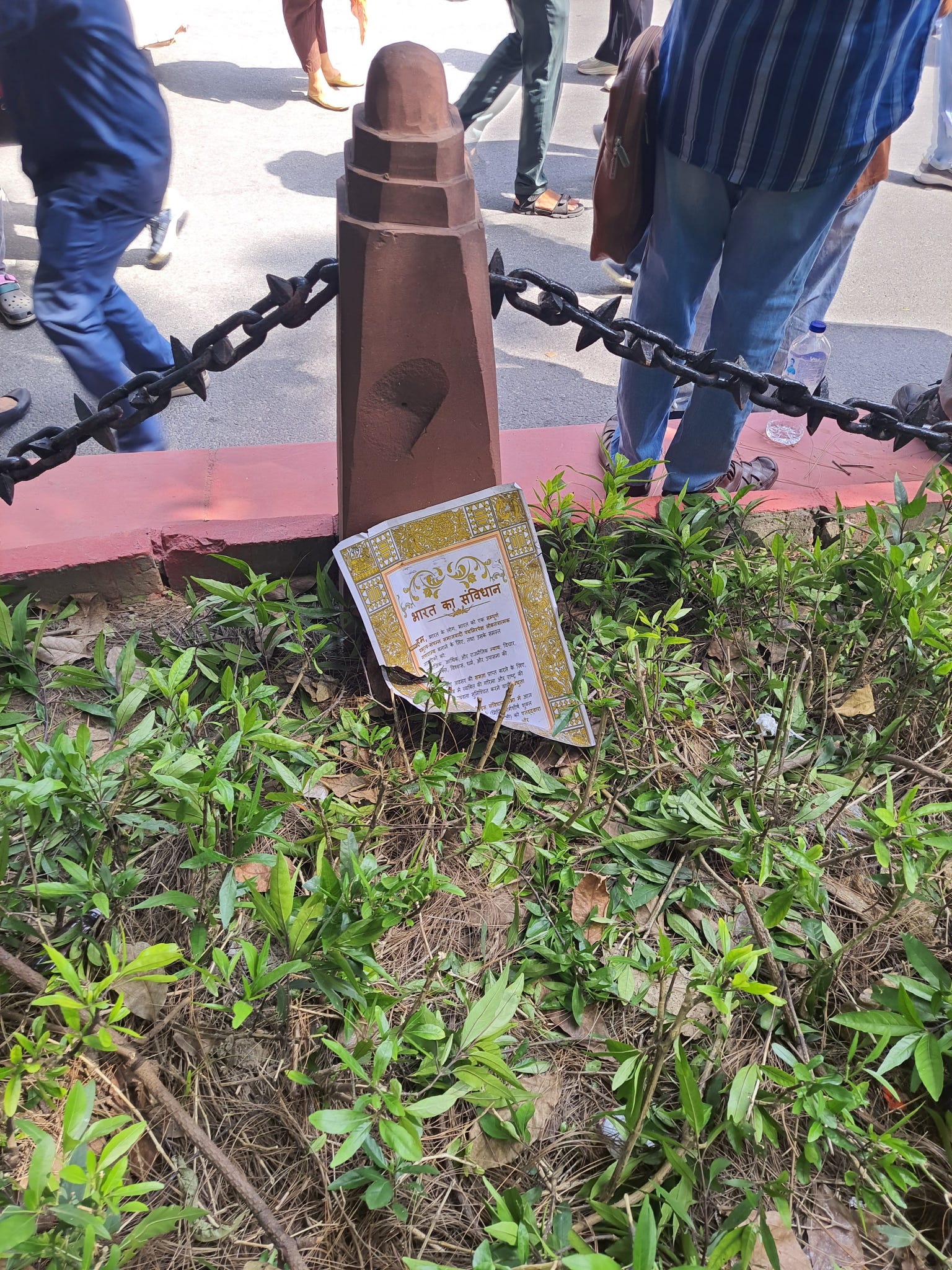
The student-led protests over the EC’s SIR are proving difficult to contain, not least because their weapon of choice appears to be the placard. In Delhi, police imposed Section 163 of the BNSS, which makes for particularly striking reading: “banners” and “placards” find themselves prohibited in the same sentence as firearms, lathis and swords.
The overwhelmingly youthful protests have supplied their own political vocabulary. Alongside ‘Inquilab Zindabad’, ‘Jai Bhim’ and ‘Vande Mataram’ came placards reading ‘Ek kachori, do samosa, Gyanesh tera nahin bharosa’, ‘Thandi rajai garam karo, Election Commission sharam karo’ and the more economical ‘Gyanu Kaka resign’. The criticism has extended beyond the EC to the Modi government, with calls also for accountability.
The financial capital then provided a considerably larger stage. Thousands gathered for the Cockroach Janta Party’s protest against the EC and demanding the resignation of CEC Kumar at Shivaji Park amidst heavy policing, with Naseeruddin Shah, Shabana Azmi, Vishal Dadlani, Vishal Bhardwaj, Rekha Bhardwaj, Anand Patwardhan and among those joining the peaceful demonstration. (See Watch Out below)
CJP convenor Abhijit Dipke has now said that the party’s supporters intend to to return to Jantar Mantar on October 10, 2026 if CEC Gyanesh Kumar does not resign by then
Five former judges, including retired Supreme Court judges A.K. Patnaik and Madan B. Lokur, have been brought together by the Lawyers’ Association for Constitution (LAFC) to independently examine the ECI’s Special Intensive Revision (SIR) of electoral rolls.
We’ve heard ad nauseam over the last year or so that the SIR will ensure no eligible voters are left out of the electoral rolls, but now the EC – under pressure as it is – has indirectly admitted that’s not quite true. The commission says booth-level officers are to compare the pre-SIR rolls with the ones produced after the exercise, draw up a list of names that didn’t make it to the latter, visit their homes, and offer Form 6 – i.e. the Application Form for New Voters – to whoever is found to have been ‘left out’ (by the SIR, that is, contrary to its own claim). BLOs are also to offer Form 6 to young and first-time electors, who by the way are its intended recipients, as opposed to wrongly deleted people. They must achieve these goals in a months’ time, a matter of worry given that the SIR’s compressed timeline has been a major factor behind its chaotic nature.
Hours before the EC’s latest communique, the Indian Express had reported that the poll body’s order for this ‘special drive’, which it seems to have first communicated to its state-level chiefs on Tuesday, will involve distributing Form 6 without an appended declaration that asks applicants for details of their relatives’ entry in the past benchmark roll. That order, report Vallabh Ozarkar and Ritika Chopra, “now confines the declaration to ‘SIR phase only’.” (the SIR is still ongoing in a number of states and UTs, where a final roll is pending.)
The most glaring sign of eligible voters being left out is in West Bengal, where many people who were struck off the rolls during the SIR and unprecedentedly barred from voting in the assembly elections are now being restored by the state’s appellate tribunals. However these bodies are only able to dispose of slivers of their workload on a daily basis, which combined with the Supreme Court’s apathy means many valid electors will miss out on exercising their voting rights a second consecutive time. Anant Gupta spoke to a number of such people in Bengal’s bypoll-bound Rejinagar and found that they do indeed care about being prevented from voting. They are also worried about getting swept up in the new BJP government’s drive to – apparently arbitrarily – detain Bengali Muslim individuals, whisk them away to detention centres and prepare to expel them to Bangladesh.
More cases of dubious Form 7 submissions, many of them targeting Muslims, keep coming to light in Karnataka. Now, Rishita Khanna of The Hindu writes, two individuals who filed ten Forms 7 seeking the deletion of Muslim names from the voter rolls in Kodagu (Coorg) district told her they did not know the details of these individuals and were acting on party orders (they declined to say which party but no prizes for guessing!).
Meanwhile in Jharkhand, 36% of all Form 7 submissions in the state were made from just one constituency, namely Chatra, reports the Hindustan Times’s Vishal Kant. In neighbouring Odisha – which has not been free of Form 7-related controversies – chief electoral officer RS Gopalan has applied for voluntary retirement from the IAS two years ahead of his superannuation; the SIR has just concluded in his state. He denied that his move has anything to do with the SIR.
Justice (retired) Sushil Gupta, whom the Madhya Pradesh government tasked with probing the contamination of water in Indore’s Bhagirathpura in December and January that killed 35 people, has finished his investigation. He has cleared two former municipal commissioners and assigned ‘primary responsibility’ to a water supply engineer and an additional commissioner for what happened. The judge had also asked for records pertaining to the water pipelines laid starting in the 1990s but the authorities failed to produce them. This, he has said, “warrants a separate and detailed investigation” into “whether any negligence or deliberate suppression of official records has occurred”. Anand Mohan J. reports.
Two months after India issued ‘standardised names’ for over two dozen places and features in Arunachal Pradesh, it has now done the same for 28 locations in Ladakh, including Gogra and Hot Spring (which were among the friction points during the recent border standoff) – areas in Aksai Chin which have been under Chinese occupation since the 1962 war – a glacier in the Shaksgam Valley (which India claims as part of Jammu and Kashmir but which Pakistan ceded to China in 1963) and areas in Pakistan-occupied Kashmir. New Delhi’s move notably also comes after Pakistan and China operationalised their joint boundary commission in Islamabad last month. It also follows multiple instances of Beijing issuing its own ‘standardised’ place names for locations in Arunachal since 2017.
The joint parliamentary committee examining the Modi government’s contentious amendments to the Foreign Contribution (Regulation) Act is not holding ‘meaningful consultation’ with stakeholders and intends to simply facilitate a third shot at having the Bill passed, Congress MP KC Venugopal – who is not part of the panel – has alleged in a letter to Lok Sabha speaker Om Birla.
The Economist takes a stab at capturing the curious (but perhaps unsurprising) collaboration between India’s financial professionals and astrologers.
Share prices continue to decline as markets in India reflect persistent economic weakness
Benchmark equity indices Sensex and Nifty marked their eighth consecutive weekly decline today, their longest losing streak in 25 years, since 2001, reports the Financial Express. The Sensex fell 570.59 points, or 0.79%, to close at 71,909.70, its lowest level in 28 months, since February 14, 2024. It also slipped below the 72,000 mark for the first time in six months. Meanwhile, the Nifty declined 198.50 points, or 0.88%, to close at 22,421.95, its lowest closing level in six months. For the week, the Sensex fell 2.69%, marking its worst weekly performance since May 15, while the Nifty declined 3.11%, recording its steepest weekly fall since March 13.
A Finance Ministry report released yesterday flagged concerns over inflation and subdued investment, while expressing confidence that these pressures could ease in the near term. It also highlighted persistent trade tensions with the US following the passage of the Lindsey O. Graham Sanctioning Russia and Iran Act of 2026, which empowers the US President to impose tariffs of up to 100% on countries importing Russian crude oil. “India’s economic outlook faces some upside inflation risks driven by compounding climate, geopolitical and monetary headwinds,” the Department of Economic Affairs said in its latest monthly economic review.
Battles deepen within Tata leadership
In the latest wrinkle in Noel Tata’s bid to keep Tata Sons privately listed, Venu Srinivasan and Vijay Singh, vice chairman at Tata Trusts, have said they were not consulted before Noel proposed to merge Tata Electronics Systems and Tata Consulting Engineers with Tata Sons to avoid a public listing, and are not aware of other trustees being consulted either. Plus, reports Jayshree Upadhyay, Singh has complained to Maharashtra’s charity commissioner about what he calls increasing interference by Tata Trusts in Tata Sons’ commercial affairs; Srinivasan had lodged a similar complaint last week. She cites sources as saying that Noel has filed a caveat, seeking an opportunity to be heard before an order is passed.
Civilians killed in Pakistani airstrikes on Afghanistan
Pakistani airstrikes on Afghanistan’s Kunar and Helmand provinces killed at least ten civilians, mostly children, and wounded nine others, the UN’s assistance mission in Kabul has said. Rawalpindi has claimed that its strike killed 22 ‘terrorists’. The attack marks an escalation between the two sides following some three months of relative peace and occurs on the heels of a militant attack on a police facility Khyber Pakhtunkhwa that claimed at least 16 lives and inflamed tensions between the two sides, which had fought their deadliest conflict in years early this year.
The Long Cable
Why is Gen Z So ‘Unserious’? Practicing Joy in Resistance
Raman Chahal
Student protests across India have gained momentum. The youth is demanding accountability, a word not very popular in political parties. The recent movement began with the Jantar Mantar protest demanding the resignation of the education minister following the death by suicide of 17 students due to the NEET paper leak. The youth now is agitating against the Election Commissioner of India over the mass deletion of names from the voter list during the revision of the country’s electoral rolls known as the Special Intensive Revision, or SIR. Meanwhile, women are leading more demonstrations across the country, triggered by a horrific gang-rape near Lady Shri Ram college, a women’s college in Delhi. While the various protests hint at political awakening, it is the ways in which dissent is expressed that has caught the public’s attention. The prominence of the Cockroach Janta Party (CJP), a satirical online account which grew into a national movement, shows us the political discernment of young people today. Distinct ways of registering dissent emerged during the protests – taunting and rhyming slogans, mocking placards, singing and dancing at protest sites, banter with the police, dressing up as super heros, etc.
“Sharam nahi hai mardon mein, aurat kyun hai pardon mein” (it’s the men who have no shame, why do women have to hide behind a veil), chanted women protesting against gender based violence and discrimination. The slogans went viral on social media as ‘vibe’, attracted support and prompted netizens to make their own versions. In Bihar, students asking the police to use water cannons for fun caught the attention of the internet. Protestors even asked the police to lathi-charge them, reportedly joking that they had ‘FOMO’ (fear of missing out). A video of the crowd singing the national anthem to stop the police in Delhi went viral. Protest goers started making GRWM (get ready with me) for the protest reels. Memes became the highlight of the feed and the internet started asking for season two after the resignation of the education minister. The support and sarcasm transcended borders, with many from Pakistan, Nepal and Bangladesh supporting the youth protests online. A viral reel template mentions “padosi mulk ka protest ek taraf aur hum bhi ussi taraf” (the neighbouring country’s protest is on one side and we too are on the same side).
Many reels carried titles such as, “they are not afraid of anything”, framing the young protesters as fearless and emotionally open, wearing their hearts on their sleeves. While many understood the radicality of joy in dissent, some dismissed Gen Z as unserious, the generation which grew online and has a shrinking sense of future. Coined by Toi Derricotte, “Joy is an act of resistance” is a relevant concept to understand here. Audre Lorde, a feminist writer and rights activist explains it further through her work that joy gives us the energy to change, “to resist the oppressive structures and status quo that make us tired and apathetic”. The perceived unseriousness in protests today is challenging the longstanding expectations that change must be burdened by heaviness, at the expense of mental wellbeing. The dissenters refused to give into the condition and turned fighting for justice into a celebration, a tradition long kept in the line of protest songs and chants. They declared that they’re not scared of water cannon or lathi-charges, turning the intimidation tools of the state into a source of laughter.
The humour in demanding social justice offsets the state’s relentless strategy to drain the emotional and physical energy of protesters. It allows for the unapologetic expression of ones’ political identity. Joy is a crucial weapon for the oppressed. However, it never ignores suffering. To the contrary, it means acknowledging pain, anger and grief, while continuing the quest for justice. Protests against sexual violence in Delhi rest on anger and demands for safety, slogans turn this individual anger into a collective voice. The subtle language of taunting and mocking allows protesters to use sharp words, the artistic freedom to criticize. Rhymes are difficult to forget, and not only keep the protests energized but also invite others to join in.
The issue is not how people ought to protest. Whether one dissents through satire or anger, the relevant question is what is being demanded, not how it appears. Justice and accountability cannot be won by memes alone, but if the world is scrolling, a trending reel is as great a place as any to begin. If suffering didn’t make us stop and watch, rhymes, costumes and songs might, and joy surely can. The young protestors know what they’re doing, and it’s high time we listened. After all, to borrow Cornel West’s phrase, “justice is what love looks like in public”, and joy helps sustain that love.
(Raman Chahal holds a degree in media, communication and development from LSE. Her master’s research explored how the media participates in the Hinduisation of Dalit identity and its implications for caste consciousness. She currently works with children with special needs.)
Reportedly
Narendra Modi made the bizarre claim that Subhas Chandra Bose took the Indian Civil Service examination in Sanskrit. Not true, says his family. “Netaji Subhas Chandra Bose knew Sanskrit, Bengali, Hindi, German, English, Urdu and Hindustani,” tweeted Chandra Kumar Bose. “He was a linguist- but he took his ‘INDIAN CIVIL SERVICE’ examination in English as that was the language used for this examination. I wonder who has given such wrong information to Prime Minister Modi. Such distortions in history should be avoided. Jai Hind!”
Drawn and quartered


Deep dive
The patchy nature of Delhi’s development has restricted access to its public transport: for instance, the posh Greater Kailash I has 37 bus stops but the working-class Sangam Vihar, which houses three times as many people and is also in south Delhi, has only 19. Rahul Goel explains in the India Forum that in order to fix this, Delhi’s “planners must consider solutions suited to the city’s roadscape, rather than only expanding marquee projects like the Metro”.
Prime number: 3,253
Thats how many days after he was first arrested in Jalandhar – eight years, ten months and 27 days ago – that British national Jagtar Singh Johal was bonded out of Tihar jail yesterday. The Delhi high court had granted bail, noting that the trial against him – on charges of involvement in a murder and being part of a banned Khalistani outfit – is unlikely to conclude anytime soon. Johal has alleged that he was tortured in Indian custody and a working group of the UN human rights council has concluded that he was arbitrarily detained.
Opeds you don’t want to miss
“If Gandhi were alive today, he would have endorsed the Jantar Mantar protest’s ethical alignment and effectiveness in no uncertain terms,” writes MH Ilias.
At a time when India’s Election Commission has become a vehicle for voter suppression, C Uday Bhaskar reminds us that Gandhi’s first fight was for the right to vote.
The INDIA bloc parties seem to agree that India’s poll process has become tainted but you never hear them speak of an electoral boycott. That of course is because pulling it off would be monumentally difficult. Yet, writes Asim Ali, “having that nuclear option in your arsenal and credibly wielding the threat of deployment are vital to exert deterrence capacity against a domineering adversary to make it respect your red lines”. He has a few ideas on how INDIA could build this credible deterrence.
Even as the Modi government continues its crackdown on cartoonists, EP Unny looks back at the cartoon as a vehicle for political dissent, recalling how even Gandhi, whom Sarojini Naidu affectionately called ‘Mickey Mouse’, embraced caricature as part of political argument.
In ‘Military academies must raise the bar’, former Chief of Naval Staff Admiral Arun Prakash (retd) argues that “there is a pressing need to review the selection procedure and training methodology at military academies.”
By trying to change the way Vande Mataram is sung, the Modi government is undoing a longstanding compromise exemplified by the 1937 Congress resolution, the 1950 decision to keep it out of the statutory framework and AR Rahman’s reimagination of the song in 1997, Sanjay Hegde writes in this colourful piece. But today is Gandhi Jayanti and his main argument is different this time:
“We have a National Anthem, protected by law, and a National Song, honoured by usage. Let the Republic recognise Vaishnava Janato as our National Prayer, through the gentle method used in 1950, and not the muscular method of 2026.”
Listen up
The en masse and apparently malicious submission of Form 7 during the SIR – not to mention election officials themselves seeking tens of thousands of deletions in West Bengal – is a matter of concern. How exactly should the EC go about tackling this? Former election commissioner Ashok Lavasa and Congress leader Prasenjit Bose discuss on the Hindu’s Parley podcast.
Watch out
A large number of people gathered at Mumbai’s Shivaji Park on October 2. There was also a heavy police deployment in Mumbai, but the large turnout effectively overwhelmed the police presence. People arrived carrying various posters demanding the resignation of Gyanesh Kumar. Abhijeet Dipke said that although a protest was not allowed to take place in Delhi today, we will soon hold a much larger protest in Delhi.
Over and out
Malini Nair writes on how Hindustani vocalist Krishna Bisht ‘became a leading practitioner and scholar of the Dilli gharana long shaped by male hereditary musicians’. The arc of her work, she explains, was part of a ‘larger moment in Delhi when some of Hindustani music’s most important women musicians were pushing the boundaries of musical scholarship’.
That’s it for today. We’ll be back with you on Monday, on a device near you. If The India Cable was forwarded to you by a friend (perhaps a common friend!) book your own copy by SUBSCRIBING HERE.