
A newsletter from The Wire | Founded by MK Venu, Pratik Kanjilal, Sidharth Bhatia, Siddharth Varadarajan, Sushant Singh, Seema Chishti, and Tanweer Alam | Contributing writers: Kalrav Joshi, Anirudh SK
If you like our work and want to support us, then do subscribe. Sign up with your email address by clicking on this link and choose the FREE subscription plan. Do not choose the paid options on that page because Stripe – the payment gateway for Substack, which hosts The India Cable – does not process payments for Indian nonprofits.
Our newsletter is paywalled but once a week we lift the paywall so newcomers can sample our content. Today is that day. To take out a fresh paid subscription or to renew your existing monthly or annual subscription, please click on the special payment page we have created – https://rzp.io/rzp/the-india-cable.
Snapshot of the day
August 14, 2026
Anirudh S.K.
Political scientist Zoya Hasan could not deliver her talk on pluralism at the Sardar Patel Vidyalaya in Delhi today because the police refused to ensure her safety from a group of people – purportedly from the Vishva Hindu Parishad – protesting against her invitation. Tarushi Aswani reports that the police turned up at the school even though its staff did not call them, and then asked that Hasan’s talk be cancelled on security grounds. When pointed out that it is their job to protect her, they said that if Hasan turned up and something happened, ‘then the school would be responsible’. This is the same police force that had mustered up barricades, lathis and an elaborate surveillance system less than a month ago. Is a speech on pluralism – ahead of Independence Day too – such a perilous thing that the police must insist you stay at home?
When contacted, VHP official Vinod Bansal did not confirm that the people who sloganeered against Hasan’s talk belonged to his outfit. He would find out more and get back to her, he told Aswani.
But no matter: Hasan has recorded her speech which, as a YouTube commenter notes, will now reach an audience far larger than the Vidyalaya’s students. Watch/listen to it here 👇
Accepting a petition challenging Bar Council of India chairman and BJP MP Manan Mishra’s move to penalise NALSAR graduands because some of them strongly dissented against Chief Justice Surya Kant, the Supreme Court today issued notice to the BCI. Ironically Justice Kant seemed more sporting than Mishra in addressing the students’ protest against himself:
“If the students have a cause to protest, they have the right to protest … It’s a dialogue between students and me … Who are they [the BCI] to unnecessarily raise an issue? This is totally uncalled for.”
Of course, Mishra’s missive seeking to pause all NALSAR graduands’ enrolment with the bar probably had less to do with some students’ opposition to the CJI than the setback his favourite politician has faced in part due to the top judge’s own invidious ‘cockroaches’ remark. But even though the council undid Mishra’s move, the petitioners argue there is still cause for action; the whole episode raises questions about Mishra’s functioning as BCI chair, they say, noting that he is not known to have convened a meeting of the council before shooting off his offending letter. For now the top court has ordered that neither the BCI nor state bar councils take punitive action against NALSAR students or faculty as Mishra had desired.
As for Mishra, here is what he told ANI this morning – whatever it means – in the wake of calls for him to step down: “… There is no hitch in students’ interests. I am there to protect students’ interests, as are the BCI’s members. If anyone is confused or there has been any hitch in communication, I would like to clarify … that the interest of students is paramount for the BCI…”
Police continue to harass Bengali-speaking working-class people on suspicion of being undocumented immigrants, and this latest incident is not from a BJP-ruled state but from Bengaluru in Congress-ruled Karnataka. Here the authorities have picked people up without telling them why, allegedly beat some of them and took many of them to privately owned convention centres and wedding halls, where they asked for documents, including entries in West Bengal’s voter rolls. Sukanya Shantha reports that in one case the police allegedly destroyed CCTV cameras in a neighbourhood before picking people up; in another they allegedly asked people to sing the national anthem to ‘prove’ their nationality; and in yet another allegedly snatched mobile phones and went through their contents.
Ultimately the police appear to have identified some 105 ‘Bangladeshi’ individuals out of the 3,000-something they ‘scrutinised’. The kicker though is that one of the people the cops picked up is a man who, just four days prior, was verified in court as an Indian citizen after being detained last year. Speaking to Shantha, he said he carries his documents with him at all times for fear of police harassment. “We have to prove our legal existence every moment,” he lamented. Most of those picked up during ‘Operation Mukta’ were Muslims and Dalits, Shantha writes.
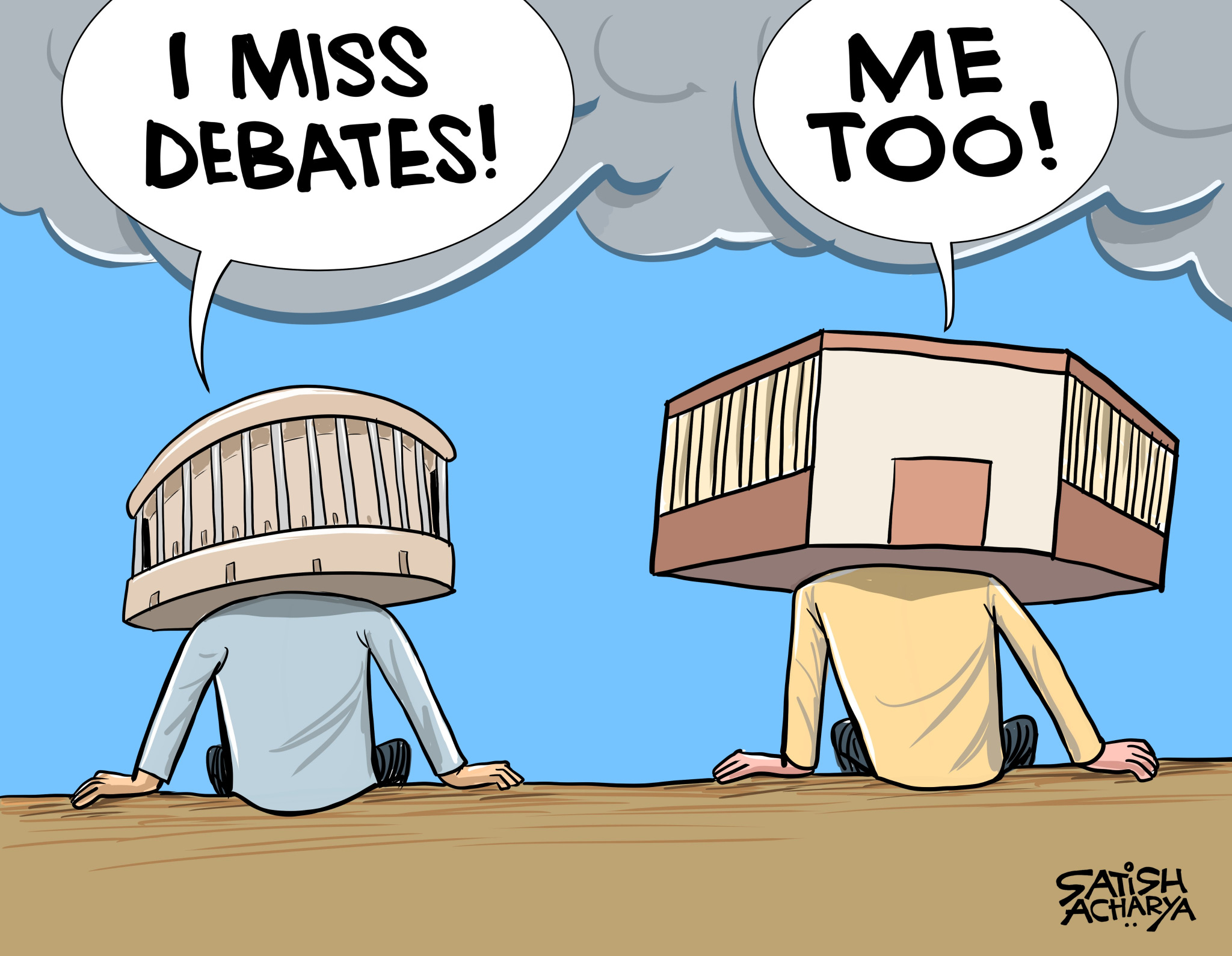
PRS has released its vital statistics for the monsoon session of parliament concluded yesterday. A few highlights: nine of the 11 Bills the Lok Sabha passed involved no discussion at all; question ‘hour’ lasted for a total of nine minutes in the lower house and two hours in the upper house; and this session marked the 86th month since the last time the Lok Sabha had a deputy speaker – the ruling dispensation has neglected to initiate an election to this vacant office even as the Constitution says that must be done ‘as soon as may be’.
Armed men opened fire on a group of farmers in the Langka Naga village in Manipur’s predominantly Kuki Kangpokpi district, killing two people and injuring two others. The Manipur unit of the Liangmai Naga Council, which blames Kuki militants for the attack, has announced a ‘total shutdown’ until further notice. In the Meitei-majority Bishnupur district, student protesters scuttled a census training programme, insisting that they will protest against the counting exercise unless a National Register of Citizens is prepared in Manipur to ‘identify illegal immigrants’ (a label often used for Kukis). And the issue of highway blockades in Manipur today reached the Supreme Court, which called on opposing communities to work towards a proposal for reopening the highways
Debris and water gushed into an under-construction tunnel at a hydroelectric project site in Uttarakhand’s Chamoli district yesterday evening, trapping 22 workers inside. As of Friday night, seven workers have been confirmed dead, 12 have been rescued and are injured, while three others remain missing. It is not clear what happened, but Narendra Sethi of the New Indian Express cites administrative sources as saying that ‘a large unstable section inside the tunnel collapsed, releasing accumulated water from above and sending a deadly mix of water and muck into the work area’.
The All Arunachal Pradesh Students’ Union has announced it will despatch a delegation to the Taksing area near the Line of Actual Control who will hoist the national flag and “assess the prevailing situation in the border areas”. Former Union home secretary and BJP minister R.K. Singh (who is no longer with the party) and the Congress have expressed their concern over local groups’ allegations of Chinese encroachment in the Taksing area, including that the PLA has denied Indian troops the ability to access one of their own patrolling points named Shera-5. After the Nah Welfare Society made claims of Chinese encroachment and camp-building in June, the Indian Army and later the Arunachal CM denied the claims.
Sachin Parashar reports for the Times of India that senior Indian officials will likely join the ‘Victory Day’ reception at the Taliban-run Afghan embassy next Monday. Asked about it at a press briefing, the external affairs ministry did not directly confirm this, saying only that New Delhi and Kabul have deepened their relationship over the last several months, something that has included four Taliban ministerial visits to India. That has taken place even as the Taliban – which stormed back to power on August 15, 2021 – imposes unconscionable restrictions on women’s and girls’ rights.
Now that the Kanwad Yatra is over, it is up to the municipal workers of Haridwar to clean up the 7,000 metric tonnes of waste that the pilgrimage has generated in the town. One discomfiting aspect of this is the plastic bottles filled with urine that have been discovered in women’s changing rooms set up for the yatra. Municipal commissioner Nandan Kumar blamed this on ‘anti-social elements’, but the finding begs the question of whether there were safe and usable toilets for women in the town. Read also this feature by The Hindu‘s Ishita Mishra, who spoke to numerous kanwadiyas, mostly men but a woman too. It offers a glimpse into their motivations for making the pilgrimage, their social attitudes and their political beliefs.
There is a subset of delivery and taxi drivers in Mumbai who have joined the gig economy not for want of skills or work, but because their workplaces have become too toxic and extractive. They are light technicians – skilled workers – working in Bollywood. Their hours, which have stretched over time up to 18 hours daily, combined with delayed pay means they are simply unable to take it anymore. Justin Rao writes for Hollywood Reporter India. Some technicians he reached out to refused to speak to him because they feared they would be placed on an industry blacklist.
The eminent Marxist historian Sumit Sarkar died yesterday after a long illness. He was 87.
In census form, new questions on caste (conditions apply), citizenship and Covid
The questions for the upcoming population enumeration phase of the much-delayed census are out. For the first time since 1931 the exercise will enumerate Indians’ caste – question 10 is to ask respondents whether they are SC or ST, and if neither, to provide their caste. Media reports indicate that the census will simply record what people say their caste is – enumerators will not carry a device with a drop-down menu and select one of the Union/states’ listed castes on it. This, it has been noted, will probably reproduce the outcome of the 2011 Socio-Economic and Caste Census, which returned nearly 46.7 lakh distinct caste names.
While the 2011 census contained 29 questions, the upcoming exercise will have 13 new questions or data fields: among these are ones on parents’ particulars, spouse’s names, nationality, ‘digital literacy status’ and ‘place of Covid-19 vaccination’.
How does the rest of the world feel about India today?
Pew Research polled people from 36 countries earlier this year and found that a median of 45% hold favourable views while 41% feel the opposite way. Countries with the highest percentage of people holding favourable views are Sri Lanka (79%), Kenya (71%) and, a few places further down, Israel (60%). Across the Green Line though, people in the West Bank and East Jerusalem feel rather cool about India (56%; 18% felt otherwise while 25% said nothing). Opinion has been stable in most countries surveyed but changed significantly in ten, with seven of these becoming more unfavourable overall since last year, among them Turkey, America and Bangladesh.
Indeed Indians and Bangladeshis feel overall more unfavourably about each other, Pew finds. Among India, Bangladesh, Pakistan and Sri Lanka, only the latter received more favourable than unfavourable ratings in all of the other three countries.
Human rights panel takes suo motu cognisance of uptick in CRPF suicides
Fifty-nine Central Reserve Police Force personnel killed themselves last year, the most since 2021, according to media reports citing official data provided by sources. Nineteen personnel had died by suicide this year as of May 22. Of the 280 or so suicides between 2021 and May 22, 2026, 77% occurred when the officer was on duty. Suicides while on leave numbered at 19 in 2025, again the most since 2021. Mukesh Ranjan of the New Indian Express cites a source as noting that “the record number of deaths in 2025 is likely to prompt renewed scrutiny of whether existing interventions are adequate and whether further measures are needed”.
Today the National Human Rights Commission took suo motu cognisance of these reports. They “raise serious issues of violation of the right to life of the personnel”, it said, announcing that it has issued notice to the home secretary and CRPF director-general.
The Long Cable
The MTA’s hidden burden
Rahul Bedi
The Indian Air Force (IAF)’s Request for Proposal (RfP) for 60 Medium Transport Aircraft (MTA), estimated at around Rs 1 lakh crore and issued on Wednesday, highlights the growing logistics burden of operating an unusually large number of different aircraft types across the service.
The MTA programme seeks to replace the IAF’s legacy Antonov An-32 fleet with a platform capable of carrying between 18 and 30 tonnes. Its eventual induction, however, will add another type to a transport fleet already spread across a wide range of platforms, a pattern mirrored in the IAF’s fighter arm, where an equally complicated mix of combat aircraft and support ecosystems prevails.
The MTA RfP has been issued exclusively to domestic companies, including Hindustan Aeronautics Limited (HAL), Adani Defence, Tata Advanced Systems and Mahindra Defence, which are expected to partner with foreign original equipment manufacturers to compete for the programme.
The tender envisages 12 aircraft being supplied in fly-away condition and the remaining 48 manufactured in India, with the programme mandated to achieve 60% indigenous content in a phased manner, in keeping with the government’s broader Atmanirbhar Bharat initiative and push for greater self-reliance in defence production.
But irrespective of which platform is ultimately selected, its induction will create another long-term support commitment for the IAF, as no aircraft is ever acquired in isolation. Each new type requires its own pool of trained air and ground crews, specialised equipment and tooling, maintenance procedures, technical manuals, simulators, software support and a whole lot else.
Engine dependency too is an especially critical and enduring commitment. The aircraft’s powerplant has to be supported, overhauled and supplied with critical components throughout its service life, potentially tying the IAF to a foreign manufacturer and its technology base for decades. The same applies to avionics and other major systems, which require their own upkeep, upgrades and technical support for as long as the platform remains operational.
All of this creates a continuing financial commitment that can endure for three or four decades, with each additional platform type increasing the cost of sustaining the wider fleet. The burden becomes particularly acute when several relatively small fleets have to be supported simultaneously, each requiring its own personnel, equipment, inventories and industrial arrangements.
The scale of that financial burden is reflected in the IAF’s remarkably diverse transport fleet, which spans six principal aircraft types sourced from the Soviet Union, Russia, the US and Europe, as well as overseas licence-produced models. These include Boeing C-17 Globemaster IIIs and Lockheed Martin C-130J-30 Super Hercules aircraft, Ilyushin Il-76 heavy lifters and An-32s, European Airbus C-295 tactical transports and German-origin, HAL-built Dornier-228 utility aircraft.
But this diversity does not end with transport aircraft alone. Added to them are Brazilian Embraer-based ‘Netra’ airborne early warning and control platforms, under-development Airbus A321-based electronic warfare aircraft and a burgeoning helicopter fleet drawn from multiple domestic and foreign sources.
Together, these diverse fixed and rotary wing fleets underscore the extraordinary breadth of aircraft types the IAF operates and needs to sustain.
The acquisition cost of an aircraft is only one part of the financial equation. Far higher and less visible are the recurring costs of sustaining the fleet throughout its service life. The scale of that burden is already reflected in the IAF’s revenue expenditure, which has risen from around Rs 47,523 crore in 2024-25 to Rs 55,000 crore in 2025-26. Much of this spending goes towards keeping an increasingly varied aviation inventory operational, even before another transport aircraft such as the MTA is added.
“The platform price figures in defence budgets, parliament and the media,” said a two-star IAF veteran, “but its logistics tail does not attract much attention because it is spread over decades.” That bill, he added, requesting anonymity, only grows over time as fleets multiply and age, requiring ever greater spending on sustenance.
The IAF’s An-32s, inducted in July 1984, and its Il-76s, inducted 11 months later in mid-1985, illustrate just how long that logistics tail can become.
The An-32 is an especially telling case. Although acquired from the Soviet Union, it was developed by the Antonov design bureau in Kyiv, then part of Soviet Ukraine, specifically for the IAF’s requirement for a rugged transporter capable of operating from high-altitude and hot-weather airfields. After the Soviet Union collapsed in the early 1990s, its design authority and much of its industrial expertise consequently ended up in independent Ukraine.
That dependence became particularly evident in 2009, when India signed a $400-odd million contract with Ukraine to overhaul and upgrade 105 of its An-32s. Forty aircraft were to be modernised in Ukraine and the remaining 65 in India using Ukrainian kits, technology and technical assistance. The programme was intended to extend their service lives by another 20-25 years.
But the arrangement subsequently became entangled in geopolitics. The Russia-Ukraine conflict after 2014, starting with the war in Crimea, disrupted the flow of Ukrainian modification kits and technical assistance, delaying the Indian portion of the programme. Till recently, only 55-60 of the original 105 An-32s had been upgraded – 40 in Kyiv and 15-20 at the IAF’s Kanpur depot – highlighting how even an aircraft operated by India for decades can remain vulnerable to events thousands of kilometres away when its design authority, specialised technology and support chain lie overseas.
Moreover, the advent of the MTA is unlikely to make the An-32 disappear quickly either. A substantial number of the upgraded aircraft are likely to remain in service well into the 2040s and possibly beyond, leaving the IAF to operate the aging fleet alongside the new MTA for several more years.
The new MTA will, therefore, not immediately eliminate an existing logistics commitment; it will, for a considerable period, add yet another one.
The IAF’s transport fleet is only one manifestation of the Force’s wider fleet-diversity problem.
This challenge becomes even more formidable in the IAF’s combat squadrons, where successive generations of Russian, French, British and Indian fighters have created a labyrinth of engines, avionics, weapons systems, maintenance regimes and global supply networks that must all be sustained simultaneously. Every new fighter inducted to enhance combat capability also expands this logistical maze, adding another long-term dependency that must be funded, managed and sustained for decades regardless of changing budgets, governments or strategic priorities.
Currently the IAF operates Russian Su-30MKIs and MiG-29s, French Rafales and Mirage-2000Hs, Anglo-French Jaguars and indigenous Tejas fighters. More fighter types are likely to follow, including the Tejas Mk2 and fifth-generation Advanced Medium Combat Aircraft, while another 114 Rafales remain under consideration, a substantial proportion of which are likely to be built domestically under a technology-transfer arrangement.
India has also initiated efforts to co-join France’s Future Combat Air System, a sixth-generation fighter programme. Indian military planners argue that such participation could bring important technological benefits, but it would also potentially add another aircraft family and industrial ecosystem to an already crowded combat inventory.
And that is the larger problem.
Every new platform solves one capability gap for the IAF while creating another long-term logistical obligation. After all, platform diversity may make the service more formidable on paper, but unless accompanied by greater fleet standardisation, it will also make the force progressively more expensive to sustain.
The danger is that the IAF could eventually field an impressive transport and fighter fleet, but one whose growing diversity makes it increasingly difficult – and increasingly costly – to keep operational.
Drawn and quartered
Deep dive
What would India’s governance and development trajectory have looked like if Narendra Modi did not ascend to power in 2014? Kevin Grier and Robin Grier, who’ve applied something known as the synthetic control method to generate counterfactual data, argue that things would have been better on both counts.
Prime number: $31.98 billion
That’s how big India’s merchandise trade deficit was in July, going up from June’s $30.43 billion to a six-month high. The figures, write Shivangi Acharya and Manoj Kumar, underline “the growing pressure on India’s external balance, as a wider trade gap weighs on the rupee and capital inflows”.
Opeds you don’t want to miss
Manoj K. Jha imagines the prime minister delivering an Independence Day address that isn’t a laundry list of his government’s achievements but acknowledges the idea that “we have achieved much, but we have also fallen short”. Modi wouldn’t need to beat himself up or invite the opposition to score wins – he would instead have to muster up some statesmanship. Here is Jha’s idea of what such an address would sound like.
Ahead of Independence Day, former cabinet secretary K.M. Chandrasekhar writes a potted history of Indian democracy and politics but senses the emergence of something new at this particular moment: “the emergence of … non-political forces concerned more with tangible socioeconomic issues than rigid party loyalties”. “Political parties have yet to fully gauge the depth of this shifting mindset, where issues like unemployment, inflation and civic governance increasingly eclipse traditional manifestos.”
“A low type of pragmatism has replaced ideology as the MEA’s core policy” to India’s own loss, and yet the ministry has been extraordinarily successful in pushing its propaganda, notes K.P. Nayar, identifying two causes for this phenomenon. And the end result is not a happy one:
“This shameful and dangerous practice of keeping its own citizens in ignorance about real issues of national security … disturbingly makes Indians in government and outside behave as if India is a global power. Damage done by such arrogance is immense and impedes the country’s progress towards any truly global role.”
One thing that the recent unrest in Pakistan-occupied Kashmir makes clear, writes Nirupama Subramanian, is that “the region cannot be taken for granted anymore by an entitled elite ruling class that runs on politics and hunts with the military, and is more at home among family and friends in the affluence of ‘militablishment’ enclaves in Islamabad-Rawalpindi than in the rough environs of Muzaffarabad”. There is a lesson here for New Delhi too:
“India … has little to gloat over Pakistan’s troubles in PoK. In fact, by dragging its feet on the restoration of statehood to J&K, the Indian leadership risks being as much out of step with the people as the Pakistani leadership is on its own side.”
Deepika Mogilishetty writes on Karnataka’s efforts to rejuvenate its public library system in the villages.
Listen up
Left activist N. Sai Balaji and journalist Kunal Purohit discuss whether India’s traditional political parties are at all able to understand the ‘grammar of Gen Z politics’.
Watch out
It has been another busy week: the government was expected to pursue its delimitation and anti-NGO agendas but ended up on the backfoot; the opposition has claimed victory but faced its own share of heat in Jharkhand; and we have some idea of how the establishment wishes to carry out (or not) India’s first caste enumeration in nearly a century. Lucky for us Seema Chishti and Amit Baruah were this week’s guests on The Wire Wrap to help us cut through the fog:
Over and out
The sort of honesty that Manoj K. Jha (from Opeds) yearns for on Independence Day isn’t an unprecedented thing. Kiran Kumbhar recalls that back in 1997, Doordarshan aired the documentary series A Tryst With the People of India hosted by Saeed Akhtar Mirza, which had “highlighted the Indian public’s poor standards of living, implicitly calling into question the national climate of celebration”. Remarkably, it appears not to have been censored at all. We’re looking at you, Ashwini Vaishnaw.
That’s it for today. We’ll be back with you on Monday, on a device near you. If The India Cable was forwarded to you by a friend (perhaps a common friend!) book your own copy by SUBSCRIBING HERE.