
A newsletter from The Wire | Founded by MK Venu, Pratik Kanjilal, Sidharth Bhatia, Siddharth Varadarajan, Sushant Singh, Seema Chishti, and Tanweer Alam | Contributing writers: Kalrav Joshi, Anirudh SK
If you like our work and want to support us, then do subscribe. Sign up with your email address by clicking on this link and choose the FREE subscription plan. Do not choose the paid options on that page because Stripe – the payment gateway for Substack, which hosts The India Cable – does not process payments for Indian nonprofits.
Our newsletter is paywalled but once a week we lift the paywall so newcomers can sample our content. Today is that day. To take out a fresh paid subscription or to renew your existing monthly or annual subscription, please click on the special payment page we have created – https://rzp.io/rzp/the-india-cable.
Snapshot of the day
June 5, 2026
Siddharth Varadarajan
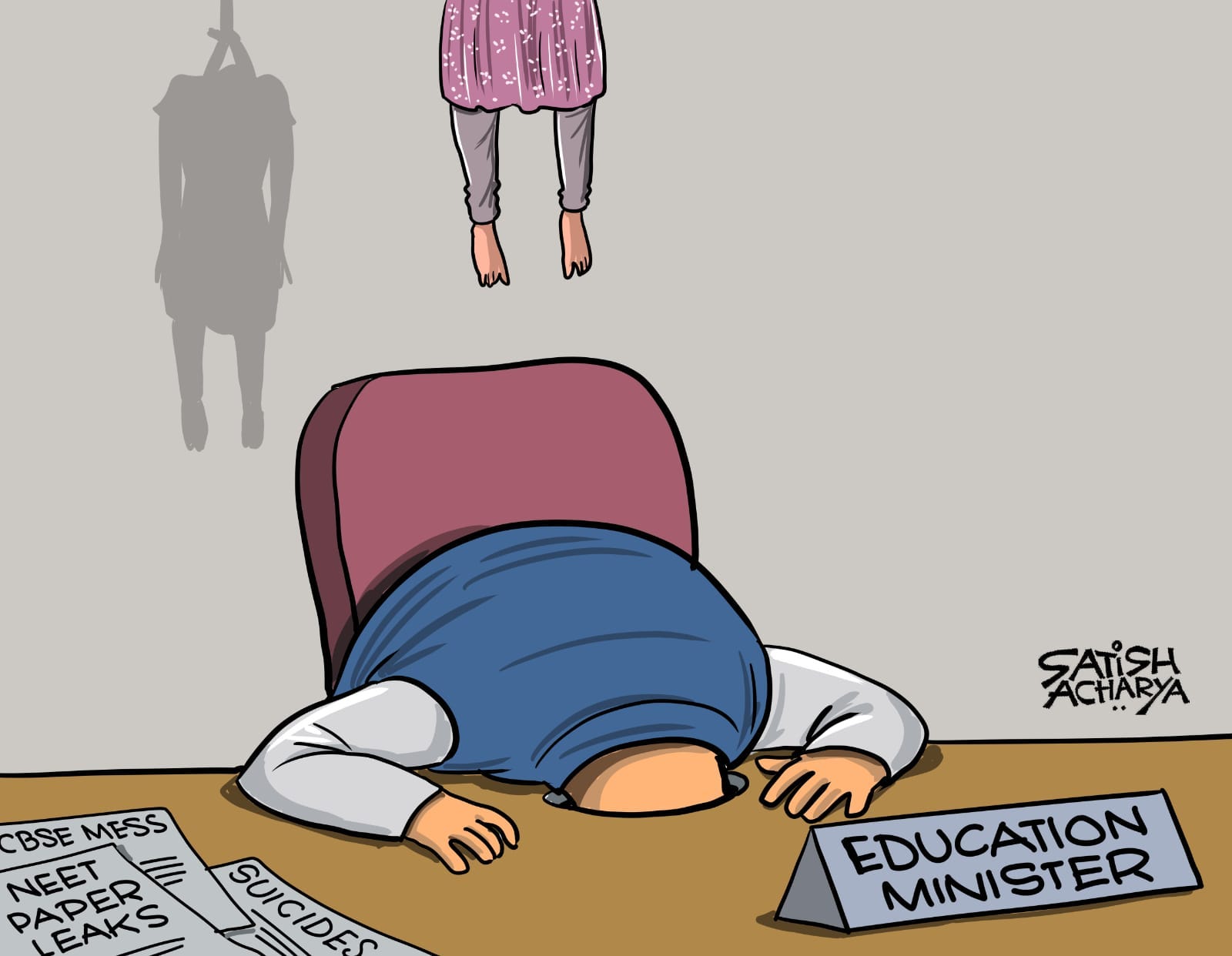
Cockroach Janata Party founder Abhijeet Dipke is due to land at Delhi airport at 8 am on Saturday and intends to proceed straight to the Parliament Street police station to seek permission for a protest at Jantar Mantar where he and other ‘cockroaches’ will demand the resignation of Union education minister Dharmendra Pradhan. Dipke is likely to be joined by the Ladakh environmental activist, Sonam Wangchuk and an unknown number of supporters.
Bangladesh says the Indian authorities have made multiple attempts to push individuals across the border in the past 48 hours. Calling this a violation of “international border management norms and bilateral understandings”, the Border Guard Bangladesh said that “no individual or group will be allowed to enter Bangladesh illegally through the border.” In a response that sidestepped Bangladesh’s allegations, the Indian Ministry of External Affairs claimed the deportation of ‘illegal Bangladeshi nationals’ is being carried out through an established bilateral mechanism.
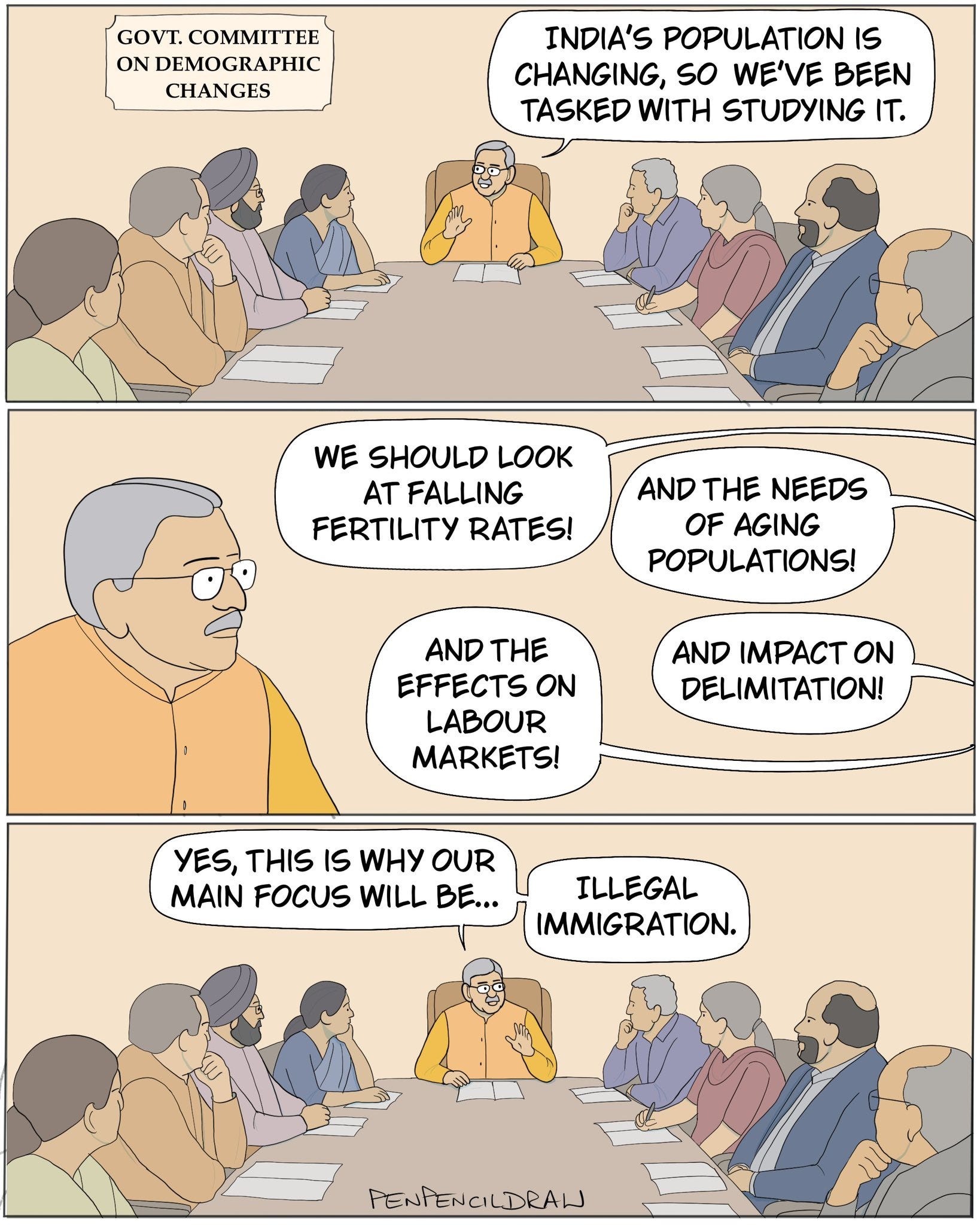
The deportations are a vital part of the demographic fears being stoked by the Modi government, as reflected both in the establishment of an official committee to study “unnatural” changes in India’s population and the move to use the electoral rolls revision process to disenfranchise citizens – especially Muslims. (See the Long Cable).
The RBI has decided to keep its repo rate – the rate at which it lends money to banks – unchanged at 5.25% and also announced a number of measures aimed at keeping the rupee from sliding further amid higher oil prices triggered by the US-Israeli war on Iran as well as persistent foreign investment outflows. Among the measures aimed at defending the rupee are an end to the 12.5% long-term capital gains tax for foreign investors on listed shares and bonds held for over a year, as well as the 20% tax on interest earned from these investments.
On a day the government said India’s economy grew 7.7% in FY26 – making it the fastest growing major economy – the RBI revised its estimates for inflation up and GDP growth down: the former is now predicted to average 5.1% this fiscal as opposed to 4.6% earlier, and the latter to stand at 6.6%, below the previous figure of 6.9%. One economist told Reuters that the revised forecasts alongside an unchanged repo rate “suggest it is preparing markets for a possible policy pivot as early as August” – a polite way of saying the central bank may already be running out of comfortable choices.
Bloomberg today retracted what it said was an ‘incorrect story’ filed on June 2 on the RBI offloading some of its gold reserves :
“The analysis erroneously used same-day domestic gold prices to value RBI’s gold reserves. Using previous day’s London Bullion Market Association price shows that gold holdings were unchanged in May.”
Market analyst Dhananjay Sinha, however, believes there has been some offloading:
“Parsing the weekly disclosures, price movements, and reported valuations points to a modest but material reduction in tonnage – a drawdown that speaks both to tactical currency defence and to deeper pressures on India’s external position.”
Members of parliament’s standing committee on finance asked the Modi government yesterday why oil marketing companies have raised fuel prices – they’ve done so four times, all of them after the recent round of assembly elections ended – even though their profits had increased by almost 130% in the last fiscal, reports Sobhana Nair. Jatin Takkar writes that panel chairperson BJP MP Bhartruhari Mahtab flagged flaccid private investment, while the government said that “consumption demand may face headwinds” due to a likely deficit monsoon and moderation in economic activity – an acknowledgment that the broader growth story is losing some of its earlier gloss.
Separately, reporting by Reuters highlights a more uncomfortable trend beneath India’s booming IPO market. “India’s red-hot initial public offering market may look irresistible as foreign firms line up for listings, but the rush is not about raising funds to expand in a fast-growing market; it’s about sending billions of dollars back to headquarters. Just one of six foreign-based companies that listed their Indian units in Mumbai since 2024 raised new funds, with all others structured purely as secondary offerings - or offer for sale (OFS), where existing shareholders sell their holdings to the public without raising any new funds, according to data from Prime Database, an Indian market research firm.”
Rajesh Exports, now in the news after the Securities and Exchange Board of India issued an interim order alleging the company had misrepresented roughly Rs 15.15 lakh crore in revenue over five years, had been a beneficiary under the Union government’s Rs 18,100-crore Production Linked Incentive scheme for Advanced Chemistry Cell battery storage. The Ministry of Heavy Industries (MHI), which administers the battery storage programme, is currently examining the Sebi order. A government official, speaking to the Economic Times, said, “There is a strong view that the company should be removed as a beneficiary,” adding that a final call will be taken after the detailed examination is concluded. Furthermore, the Ministry of Corporate Affairs is coordinating with Sebi over the issue and may order a probe to ascertain potential corporate governance lapses.The MCA may even ask the concerned Registrar of Companies to inspect the company.
Although the CBSE in its first two tenders for its on-screen marking system estimated that it would pay Rs 28 crore for a vendor’s services, its work order for the third and final tender raises this figure to Rs 38.46 crore and it is not clear why, the Hindustan Times‘s Sanjay Maurya reports. The volume of answer sheets that the CBSE accounted for seems to have stayed unchanged across all tenders. At any rate, with the board having implemented – to chaotic results – its OSM system run by tender winner Coempt Edu Teck only for class 12 students, the actual amount it owes stands at Rs 25.39 crore, says Maurya. This is “roughly 66% of the value mentioned in the work order, despite the volume of work being only 42% of that mentioned in the two tenders and also the work order”.
Apart from the system’s glitches, the manner in which the CBSE went about hiring Coempt has been in the spotlight since 17-year-old Sarthak Sidhant pored over the documents and alleged that it went out of its way to favour the firm. And remeber Nisarga Adhikary, the ethical hacker whose claims about the vulnerability of its IT system the CBSE was quick to dismiss? He has now been invited to meet with an "Indian Institute of Technology expert team to flag those security gaps, reports Maitri Porecha.
Bengal’s new bulldozer-happy BJP government has been going after small hawkers operating from various railway stations. At the Dum Dum station the authorities demolished stalls in a midnight operation on May 30, allegedly without notice, drawing criticism from vendors and passengers alike. One hawker speaking to Madhu Sudan Chatterjee pointed to a glaring irony: “The prime minister’s life story has often been published with the claim that he once sold tea at a railway station.” But when the dozers rolled on to Jadavpur station on Monday night they were greeted by hawkers, residents and Left activists prepared to stand their ground. The authorities, reports Chatterjee, had to retreat.
In other news, with Adani expressing interest and the Modi government giving its approval, the Bengal government has decided to pursue a deep-sea port at Dadonpatrobad near Digha. Pranesh Sarkar and Sambit Saha of The Telegraph recall that Mamata Banerjee’s government had picked the nearby area of Tajpur for the project so that it would not be under the jurisdiction of the Union government-controlled Syama Prasad Mookerjee Port. Adani had emerged as the top bidder for that iteration of the project but Banerjee did not go ahead after the Hindenburg report came out. Announcing the decision this week, CM Suvendu Adhikari said that Tajpur would not work for the project as there was not enough government land there. Game, set and match to Adani, whose stranglehold over the port sector in India seems firmer than ever.
An ‘award’ may not be the first thing that comes to mind when you think of last year’s Mahakumbh but the Modi government has given the event – as well as a number of tech projects – its ‘National Award for e-Governance’. This is the same Kumbh that witnessed a stampede where, per one estimate, upwards of 80 people were killed. What does that say about the ‘smart governance’ in service of crowd management that the government has touted? Crowding at the New Delhi railway station amid a high demand for trains to Prayagraj had triggered another stampede days later, this one claiming 18 lives.
AI systems are to be used only for assistance and “shall not supplant or compromise the independent exercise of judicial authority by a duly appointed judicial officer”, the draft Rules of AI in Courts prepared by the Supreme Court’s AI Committee earlier this week say. They also require that AI systems used in court processes “be designed, trained and deployed in a manner that promotes fairness and avoids discrimination”. AI must not be used to predict flight risk and recidivism and evaluate eligibility for bail, they say.
Suman Kalyanpur, who died last week, had a voice to rival Lata Mangeshkar’s but never got her due. In one of her last interviews (to Filmfare in 2025), she recalls:
“We really don’t know what happened behind the scenes. There have been times when my songs were dropped from films but I do not know how and why. Sometimes the songs which I recorded were not included in the film. Sometimes they were in the film but not in the records…. Often I was not credited for a song played on radio or a wrong name was given for a song sung by me. Also someone else’s name was given in the credits on the records that I had sung. It can’t be a mistake every time. There was a beautiful, slow lorie I had sung for a movie. But I was surprised to hear it in double speed on an EP.” Yet her voice betrays absolutely no rancour. “I’m happy with the songs I got. Even from the 10 per cent I got, 70 per cent have been hits.”
‘Green over Greed,’ LoP Rahul Gandhi slams Modi govt over Great Nicobar Project
Today is World Environment Day and Leader of Opposition in Lok Sabha Rahul Gandhi has slammed the Modi government’s justification for the destructive Great Nicobar Island Project as a “lie”. At the same time, the Public Investment Board (PIB), a Finance Ministry appraisal body, had in August 2024 assessed the proposed International Container Transhipment Port (ICTP) at Galathea Bay in Great Nicobar Island and found that it did not meet key “strategic objectives”, reports Jacob Koshy. Gandhi alleged that the project’s true purpose is to benefit Gautam Adani who seeks to construct hotels and casinos on what is India’s most ecologically irreplaceable land.
In a video spanning more than 16 minutes, drawing from his personal visit to the Andaman and Nicobar Islands in late April, the Congress leader appealed to the public to sign a petition calling on the Modi government to choose environmental preservation over corporate profit, summarising the message as: “We choose green over greed.”


Manipur’s ethnic strife continues to claim blood – now in new Kuki-Naga conflict
Three Kuki villagers were killed in Manipur’s Kangpokpi district this morning by unknown assailants and local Kuki groups say the miscreants – whom they allege are Nagas – also set fire to some homes in the village concerned. The attack took place less than 24 hours after the All Naga Students’ Association of Manipur carried out a march to protest the fact that Kuki groups continue to hold six Naga men hostage; their procession passed through Kangpokpi’s Litan area, which was the epicentre of the Kuki-Naga tensions that are now roiling an already battered Manipur. Kuki groups on the other hand say the Nagas continue to hold 14 members of their community captive (read more on the hostage crisis here).
Amidst these tensions and the persisting segregation of Manipur’s Meiteis and Kukis, the Election Commission is carrying out its special intensive revision in the state. Yesterday the Kuki Inpi Manipur body said it opposes the controversial SIR taking place even as thousands of people remain displaced by the ethnic strife.
India’s dowry death trials are rigged against the dead
Using the death of Twisha Sharma as a lens to examine why dowry death cases in India so often fail in court, The Quint’s Himanshi Dahiya analysed 500 dowry death case judgements across the states of Haryana, Uttar Pradesh, Delhi, Bihar, and Karnataka, and found one pattern: a system that keeps failing the deceased women. Apart from highlighting systemic issues such as delayed FIRs, inadequate investigations, poor witness protection, and weak forensic practices, the report argues that many women face verbal, emotional, and economic abuse that is rarely documented, making it difficult to establish the legal link between harassment and dowry demands required for conviction.
The Long Cable
The Supreme Court’s Bihar SIR Verdict and a Fresh Citizenship Crisis
Abdullah Ghazali
In The Origin of Totalitarianism, Hannah Arendt refers to citizenship as “the right to have rights.” The absence of citizenship deprives one of not just the right to vote and access entitlements, but also of the very foundation to claim them. The Supreme Court’s judgment on the Special Intensive Revision (SIR) of Voter lists - Bihar 2025 (Association for Democratic Reforms v. Election Commission of India), delivered on May 27, 2026, must be read and critiqued in this light.
On the surface, the judgment, amongst other questions, was concerned with whether the Election Commission of India (ECI) had constitutional and statutory powers to conduct the SIR in Bihar. The court has upheld it. Yet embedded within the judgment is an issue with far-reaching consequences: its direction that all persons deleted from the 2003 Bihar SIR on grounds of ‘doubt’ be referred to the “Competent Authority” under the Citizenship Act, 1955, for a determination of their citizenship status. In doing so, the Supreme Court has potentially subjected lakhs of people to a citizenship trial.
The 2003 SIR: An arbitrary baseline
The ECI used the 2003 SIR as the eligibility “base year” for inclusion in the 2025 SIR,. Individuals whose names had appeared in this eligibility list did not need to furnish any document; those who could not be traced to it were required to produce any document from a prescribed list. The court accepted this classification in favour, on the ground that the 2003 SIR was the product of an intensive revision and thus enjoyed a “higher degree of reliability”. The court, while accepting the ‘2003 SIR’ as the baseline, has in practice rendered all subsequent inclusions in the state’s electoral rolls as ‘irrelevant’.
What this means is that everyone deleted from the 2003 SIR list in Bihar on the ground of ‘citizenship under doubt’ will have to face a citizenship determination process. Take, for instance, a migrant worker from a remote district in Bihar who is working in another state and was deleted from the 2003 SIR due to a lack of proper documentation. For twenty-two years, the ECI did not act on that exclusion. The state acknowledged his continuous citizenship. But now, this deletion from the 2003 rolls – a sheer bureaucratic accident – becomes the basis for referring him to the Competent Authority to determine whether he is a citizen.
Echoes of the Assam NRC
The Supreme Court has opened a Pandora’s box by referring all excluded individuals to the Competent Authority, taising an uncomfortable parallel with the National Register of Citizens (NRC) exercise in Assam. The Assam NRC, which used a different cut-off date, had placed the burden of proving citizenship on individuals. The exercise resulted in mass exclusion, leaving lakhs in limbo over their citizenship status.
The Supreme Court’s order means that the citizenship status of ‘deleted’ individuals would next be governed by the mechanism set out under the Citizenship Act, 1955, and the newly enacted Immigration and Foreigners Act, 2025. The burden of proof will shift squarely onto the individual. This phenomenon, from the presumption of citizenship to the presumption of doubt, is the defining feature of the Assam experience and is now likely to be institutionalised in Bihar.
Statelessness crisis
The judgment crafts a referral mechanism of enormous consequence while remaining silent on its ripple effects. What happens if a genuine voter gets deleted from the SIR? The court says this will not affect their “claims of citizenship.” But if the Competent Authority formally holds a person to be a non-citizen, the legal outcome is statelessness.
Equally absent is any consideration of the cascading effect on descendants. Individuals and their descendants who were enrolled after 2003 were not required to re-establish their parental details, provided their names or their parents’ names could be traced to the 2003 list. For those who were deleted from the 2003 rolls, however, the entire family tree comes under the shadow of the referral.
Proportionality over due process
The court upheld the 2025 SIR as proportionate. It conducted a four-part proportionality analysis: a) legitimate purpose, b) rational nexus, c) least restrictive option, and d) fair balance. On each, it has ruled in favour of the ECI. While the judgment acknowledges that 47 lakh names were ultimately deleted, the court fails to examine the demographic distribution of those deletions – which districts, which communities, which constituencies bore the heaviest burden of exclusion. Without that data, the proportionality finding is a statistical average applied to a politically non-neutral exercise.
Notably, lakhs of voters were deleted from the 2025 SIR roll, yet no appeal was filed against the final list. By treating this absence of appeals as evidence that “the SIR was fairly and transparently implemented,” the court has turned its back on grassroots realities.
Instead, it should have asked: why did those individuals not challenge their exclusion? Possible answers include poverty, illiteracy, migration, paucity of legal aid, and a practical unfamiliarity with the administrative process.
A missed opportunity for strict judicial scrutiny
As the ECI announced an SIR in 19 states and UTs, this judgment has far-reaching effects. Nearly two-third of India’s electorate has to undergo a fresh SIR scrutiny. A judgment of this stature should have recognised several ground realities. First, the fact that re-enrolment in successive rolls post 2003 is in itself evidence of continuous eligibility. Second, the Citizenship Act, 1955, contains no special mechanism for determining citizenship prompted by one’s exclusion from the SIR roll. Here, the Supreme Court has initiated a legal proceeding that neither parliament intended nor the executive requested. Third, the right to vote, according to the Supreme Court itself, is acknowledged to have been “upgraded from being a mere statutory right to a constitutional right” (In Re: Section 6A of the Citizenship Act, 2024). Surely, a constitutional right demands a stricter judicial review than what the court applied here.
The Bihar SIR judgment will be remembered not for what it held about the ECI’s powers, which was perhaps necessary, but for what it created beyond: a citizenship tribunal waiting to happen. The persons whose names were deleted from a 22-year-old electoral roll now face the most terrifying question a democracy can ask to one of its own: prove that you belong here.
Hannah Arendt would have recognised this moment. When the state begins asking its citizens to prove their citizenship, it has already begun the process of making them aliens.
Abdullah Ghazali teaches law at Presidency University, Bengaluru. He writes and researches on Labour and Citizenship.
Reportedly
In Episode 420 of Smita Prakash’s podcast on ANI, notes Mohammad Zubair, a member of the Economic Advisory Council to the PM says "So what if the rupee touches 100 to a dollar? It's just a number."
Drawn and quartered
Deep dive
Indian H-1B workers moving to Dallas – driven by many companies relocating to here starting 2018 – had fuelled a housing boom in the area. But with the Trump administration cracking down on the visa scheme, report Prashant Gopal and Tanaz Meghjani for Bloomberg, “the momentum is quickly reversing … the shift has knocked down home prices, slowed population expansion and risks eroding the tax base needed to fund schools and roads planned during a five-year growth streak”.
Prime number: 7/10
Breaking into the workforce has become significantly more challenging for fresh graduates than it was five years ago, with seven in ten struggling to secure their first job due to limited internship opportunities, increasing demands for prior experience in entry-level roles, and low response rates from employers. As per the Indeed’s Fresher Hiring Report, almost half of the respondents (49%) said that their biggest challenge was to get identified while 61% said they rarely or almost never hear back after applying for jobs.Opeds you don’t want to miss
Laws in India have eroded workers’ powers for collective bargaining, writes Sophy KJ, but a recent ruling by the International Court of Justice on the right to strike must prompt reform.
Andy Mukherjee takes stock of India’s growing external imbalance and says that “to save the rupee, authorities may have no choice but to bite the bullet on domestic interest rates, and offer just enough tax sweeteners to keep global capital from slamming the door on its way out.”
UP Chief Minister Yogi Adityanath’s methods of controlling crime and criminals – i.e. police encounters – are being adopted by his counterparts in Bihar and Odisha, notes Julio Ribeiro with alarm. “The police, the prosecutor, the judge and the jailor each have a role to play independent of each other. If the cops are given the four roles by desperate politicians, the end result is a police force let loose, posing a constant danger to the public.”
Want to know why young people in India are angry and frustrated? Christophe Jaffrelot says the answer lies at the data on unemployment and inequality.
If there is one lesson we take away from the various reactions to Ramachandra Guha’s criticism of Rahul Gandhi, argues Harikrishnan S., it is this: “many people no longer know how to engage with criticism without questioning the critic’s loyalty”.
Shikha Mukherjee writes that when a rebel faces a mutiny on her own ship, the feudal succession battle in Bengal reflects Trinamool’s infighting as a second windfall for the BJP, with Mamata Banerjee facing hard choices on the road ahead as “the era of cooperative politics is being reshaped. What happened in Maharashtra seems likely to be the template for the approved opposition’s role in West Bengal.”
Rosalind O’Hanlon’s latest book, Lineages of Brahman Power, “explodes the myth that the social, material and intellectual power of Brahmans – indeed, the centrality of caste itself in Hindu social life – was largely a colonial construction,” writes Tanika Sarkar.
Listen up
Sarthak Sidhant, an 18-year-old from Bokaro, published a detailed blog questioning how Coempt Eduteck received a tender and later presented his findings to a parliamentary panel, after which the CBSE chairperson and secretary were later shunted out. Speaking to Manisha Pandey, he reflects on facing online trolling for challenging powerful institutions, while demonstrating striking political clarity and an unexpectedly sharp understanding of systems.
Watch out
Karan Thapar speaks to Kapil Sibal about the Modi government’s attempts to take over the Gymkhana Club.
Over and out
Of the many Hauz Ranis and Press Enclaves, CR Parks and Govindpuris, Samachar Apartments and Acharya Niketans – and the roads that divide them. Akash Joshi writes on the invisible borders that shape Delhi. “Imagine if our neighbourhoods were more organic and connected as they once were. Where Hauz Rani and Khirki were not merely places we visit as tourists to try out an exotic cuisine, but as people with stakes in a place.”
In between decades, her-story and everything that remains unchanged.


Jalsaghar recalls a time when Greece was crazy about Bollywood.
That’s it for today. We’ll be back with you on Monday, on a device near you. If The India Cable was forwarded to you by a friend (perhaps a common friend!) book your own copy by SUBSCRIBING HERE.
The Great Nicobar project captures India's classic 'strategic vs. local' paradox - absorbing immense ecological friction to build a vital maritime shutter against Beijing near the Malacca Strait. This masterclass in realpolitik perfectly mirrors the energy side, where New Delhi is maximizing its energy security within the highly controlled mechanics Washington allows, routing Venezuelan trade proceeds straight into a US Treasury custodial account to insulate itself from blowback. Whether it's chokepoint dominance or tightly managed oil flows under global pressure, raw resource and territorial security always dictate the play