
A newsletter from The Wire | Founded by MK Venu, Pratik Kanjilal, Sidharth Bhatia, Siddharth Varadarajan, Sushant Singh, Seema Chishti, and Tanweer Alam | Contributing writers: Kalrav Joshi, Anirudh SK
If you like our work and want to support us, then do subscribe. Sign up with your email address by clicking on this link and choose the FREE subscription plan. Do not choose the paid options on that page because Stripe – the payment gateway for Substack, which hosts The India Cable – does not process payments for Indian nonprofits.
Our newsletter is paywalled but once a week we lift the paywall so newcomers can sample our content. Today is that day. To take out a fresh paid subscription or to renew your existing monthly or annual subscription, please click on the special payment page we have created – https://rzp.io/rzp/the-india-cable.
Snapshot of the day
July 3, 2026
Sidharth Bhatia
Almost four weeks after the Ram Mandir embezzlement allegations became public, the Rashtriya Swayamsevak Sangh – whose constellation of organisations was central to the movement that broke the Babri Masjid and built the temple in its place, and with whom nine of the Mandir’s 14 trustees have close links – today formally commented on the matter. Its general secretary Dattatreya Hosabale said that the case has “deeply hurt the sentiments and faith of the entire society and Ram devotees”, and that the temple trust ought to correct all gaps in temple management. He brought in a ‘conspiracy’ angle too – Hindus, Hosabale said, must “display necessary patience and restraint during this difficult moment and to thwart the conspiracies of anti-Hindu and anti-national forces seeking to malign the Hindu dharma and society by exploiting this unfortunate incident”.
Champat Rai’s troubles are no longer confined to the Ram temple donations embezzlement. Even as allegations against the former general secretary of the Shri Ram Janmabhoomi Teerth Kshetra Trust are being probed by an SIT constituted by the UP government, a fresh charge has emerged from another Ayodhya temple. Hari Shankar Safriwala, a managing committee member of Ram Niwas Mandir, located near the main Ram Janmabhoomi temple, accused Rai and his associates on Thursday of illegally removing idols, jewellery and other valuables from the shrine. Speaking at the Samajwadi Party headquarters in Lucknow, in the presence of Akhilesh Yadav and former Ayodhya MLA Tej Narayan “Pawan” Pandey, Safriwala also alleged that land belonging to the temple, worth hundreds of crores, had been usurped.
From a quiet VHP backroom hand to one of Ayodhya’s most contentious power centres, Rai’s rise is now being looked at more closely. Basant Kumar traces how Rai became VHP vice-president in 2018 after the organisation’s first contested presidential election, which followed the split between Praveen Togadia and rival factions. “Vishnu Sadashiv Kokje won the presidency; Rai became his deputy. It’s widely believed Rai was firmly in the anti-Togadia camp, and Togadia all but vanished from public life soon after. Asked whether Rai had a hand in his ouster, Togadia said that “is correct”.”
Chinese power is returning, quite literally. India has allowed four Chinese power-equipment manufacturers with factories in the country – TBEA Energy, Nanjing Electric India, New Northeast Electric India and Taikai Electric (India) – to bid for government tenders in critical power projects, Reuters reports, citing a June 24 Ministry of Finance order.
Meanwhile, “China is investing millions in Buddhism to expand its influence in Asia, challenging India’s claim to the faith and alarming US officials as the Dalai Lama succession nears, reports Bloomberg.
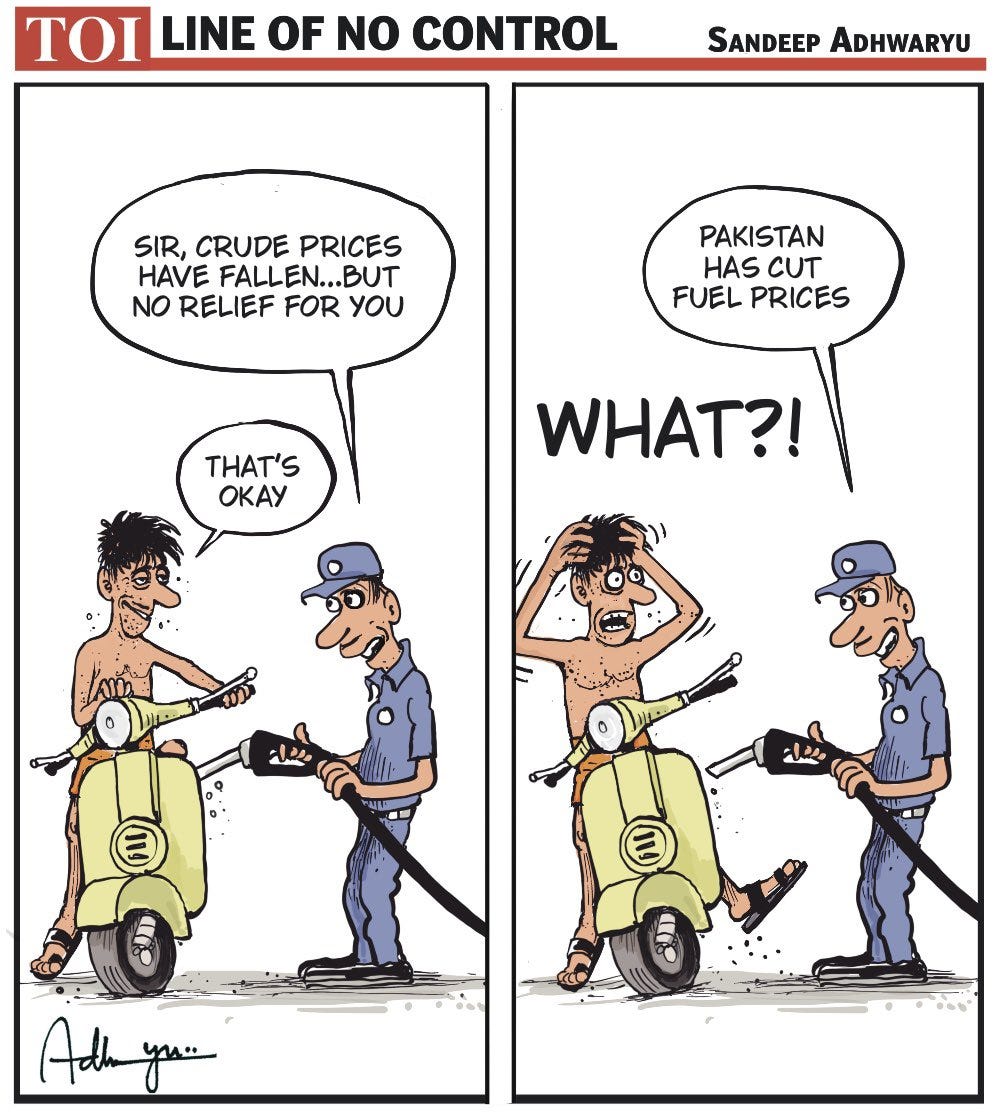
International crude prices may have fallen sharply – down 41% since April – but Indian consumers have been told not to expect relief at the pump just yet. Union petroleum minister Hardeep Puri said on Friday that a cut in retail fuel prices would become a “legitimate issue” only if global oil prices remain low for a sustained period. The savings, for now, may be routed elsewhere: towards helping government-owned oil marketing companies recover their losses.
However, in Hisar, consumers had a more basic question: “Does petrol have a colour like that?”
The Modi government’s examination machinery, already singed by one controversy after another, ran into Parliament’s Public Accounts Committee on Thursday. Opposition members reacted sharply after Union education secretary Vineet Joshi told the PAC, chaired by Congress MP K.C. Venugopal, that CBSE chairperson Lokhande Prashant Sitaram was not obliged to answer questions on the board’s recent examination-related mess, The Indian Express reports. The CBSE has been under scrutiny over serious discrepancies in on-screen marking for Class 12 exams and the award of a digital evaluation contract to a questionable firm. But before members could question the CBSE chief, Joshi, backed by BJP members, reportedly argued that the board was not funded by the Union government and therefore its chairperson need not respond to the committee. Sitaram, incidentally, is also an ex-officio member of the Ram temple trust. Accountability, it appears, is now also an elective paper. [See Prime Number]
Amit Shah’s high-powered committee on demographic changes (of the ostensible ‘unnatural’ and ‘orchestrated’ kinds) plans on asking the chief secretaries of all states for information on population changes and increases in settlements. It will also ask the Election Commission for the names of people deleted from the voter rolls under the SIR and why, Vijaita Singh reports, citing a source as claiming this will help the panel estimate the number of undocumented immigrants in India. Over a year after the SIR began in Bihar, the EC is yet to reveal how many such persons it detected during the exercise, even though doing that was one of its early stated goals.
In Assam, the paperwork still did not suffice. The Gauhati High Court has upheld a Foreigners’ Tribunal order declaring a resident a foreigner despite his producing 15 documents, including entries from the 1951 National Register of Citizens, several electoral rolls, a school certificate, PAN card and EPIC. A bench of Justices Kalyan Rai Surana and Shamima Jahan held on Tuesday that the petitioner had not discharged the burden placed on him under Section 9 of the Foreigners Act, 1946, which requires the individual to prove that he is not a foreigner. The court also said oral testimony was not enough to establish that he was the same person whose name appeared in electoral rolls from the 1990s onwards. Fifteen documents later, the burden remained his.
Maharashtra chief minister Devendra Fadnavis has directed that the restrictive new RTI rules his government notified last month be put on hold. Many information activists have objected to the new rules but the government’s decision comes two days ahead of Anna Hazare’s scheduled hunger strike meant to protest them. The rules tripled the application fee to Rs 30, required that an RTI application generally be confined to one subject and not exceed 150 words. See Deep dive below for more.
The Delhi High Court directed the government’s Grievance Appellate Committee (GAC) to decide within 15 days on an appeal seeking the removal of a YouTube video uploaded by Dhruv Rathee, where he claimed Hindu deities Lord Ram, Sita and Lord Krishna consumed meat and alcohol. The GAC under the Ministry of Electronics and Information Technology (MeitY) decides on appeals against decisions made by digital platforms on complaints related to online content or accounts.
Several days after Narmadapuram district judge Tabassum Khan was vilified and threatened because she sentenced seven cattle vigilantes to life in prison for lynching a transporter, the Madhya Pradesh high court took suo motu cognisance two days back, noting that “such activities directly [hamper] the judicial independence and fearless working of our judicial officers”. It also asked the state government to list what steps it has taken to protect Khan and act against those threatening her.
The Centre’s new EPF Scheme, 2026, keeps the 12% contribution formula intact on paper, but draws a firmer line around what is compulsory. Under the scheme, notified as part of the Code on Social Security, 2020, both employee and employer contributions are mandatory only up to the Rs 15,000 wage ceiling – effectively capping the required monthly EPF payment at Rs 1,800 each. Anything above that is now to be treated as voluntary. Employers, in other words, can get away with depositing just Rs 1,800; retirement security can take the voluntary route.
Children cannot be compelled to recite Hindu prayers at a government school, the Chhattisgarh high court has noted. It was adjudicating on a petition challenging a state government circular directing government schools to conduct Saraswati vandana and recitation of the Gayatri mantra. This circular did not contain any protection for students who wished not to participate, the petitioners had also said.
Meghalaya’s government has challenged a trial court granting bail to Sonam Raghuvanshi, who is accused of having her husband killed during their honeymoon in the state, due to a typographical error by the police (it invoked the non-existent section 403 of the BNS instead of 103, i.e. murder); the high court had upheld this decision. But the Supreme Court today declined to quash the bail order as Raghuvanshi is already at large, even though it said it has reservations over the high court’s decision.
Rohit De and Ornit Shani have been awarded the International Society of Public Law (ICON•S) annual book prize 2026 for their new book, ‘Assembling India’s Constitution: A New Democratic History’.
PM Modi’s fondness for foreign honours is no longer merely an opposition jibe; the global press is watching too. “Give him any award, and he’ll come running,” The Guardian writes, noting his habit of collecting honours on overseas trips, sometimes as their “first and only recipient”. The medal rack grows. So does the choreography.
ED moves to have scores of FEMA cases compounded, terminated; touts ‘ease of doing business’
Over the last 15 months, the Enforcement Directorate has submitted no-objection certificates to have more than 150 Foreign Exchange Management Act cases compounded by the RBI and terminated, Pradeep Thakur reports. In one such case against Apollo Hospitals where the ED alleged FEMA violations worth Rs 850 crore, the hospital paid over Rs 17 crore and its directors Rs 18 lakh each, after which the cenbank terminated the proceedings. “By shifting from a purely punitive policing model to a facilitative one,” ED director Rahul Navin said, “the ED significantly enhances the ease of doing business in India”.
Himalayan community that opposed 30-tonne shivling near mountain rejects ‘anti-Hindu’ charge
Unlike swathes of Hindus living elsewhere, the Rung community in eastern Uttarakhand’s mountains does not worship Shiva in the form of the lingam, but of mountains, glaciers and rivers. So when a group of devotees from places like Patna, Nashik and Surat tried to install a three-tonne shivling near the Om Parvat that the Rungs too hold sacred, the latter thwarted the attempt (which the ‘mainlanders’ unsurprisingly called ‘anti-Hindu’). But their concerns go beyond just symbolism. Sample what Prakash Gunjiyal, a Rung, told Ishita Mishra:
“The fear is that once a religious structure enters a sacred landscape, the transformation rarely stops there. First a statue will come, then there will be fencing. Then a donation box will be placed, which will be followed by construction of a temple. Gradually, the land will be encroached upon and the entire landscape will change, leaving behind a distorted history and eroded culture.”
They also expressed the fear that any accommodation of mainstream Hindu practices could eventually cause their unique traditions to become assimilated. Mishra also spoke to members of the ‘mainland’ group of devotees to understand where they’re coming from.
Meta fails to catch Indian ads promoting child sexual abuse material
Ads account for over 90% of Instagram’s revenue, and in India the platform has run ads promoting child sexual abuse material, BBC Eye has discovered. Overall, it was served around 30 unique ads promoting child sexual abuse material, including some linking to Telegram channels were such material is sold. When the BBC reported one such instance – showing a very young girl crying alongside text indicating she was sexually assaulted – to Instagram, the platform responded, erroneously, that the post did not violate its guidelines.
Brian Boland, a former vice president at Facebook, told the BBC’s Divya Arya: “… Because they’re not responsibly guiding and controlling it [Meta’s algorithm] – and it’s just pursuing the goals of revenue and clicks – it will create these outcomes if people [at Meta] aren’t being truly, aggressively protective over these systems.” Former Supreme Court Justice Madan Lokur said the matter is serious enough for the apex court to take suo motu cognisance. Today Union government officials indicated they intend to summon Meta over what the BBC has uncovered.
The Long Cable
This creeping Israelification of the Hindu mind…
Harish Khare
In his 2009, The Caged Phoenix—Can India Fly? Dipankar Gupta, the highly respected sociologist, had observed, with brutal professionalism: “For the ordinary Indian who comes from the majority community of Hindus, what happens to Muslims periodically is of no great interest. During the killings the Hindus may become very Hindu, but that does not sustain them over a long period. Even as their Hindu sensibilities are sharpened an overwhelming majority would not step out to kill Muslims but would look kindly upon those who do so under state support.”
Now, pray, do read a Page 6 story in the Indian Express this morning (Delhi edition, dated July 2, 2026), and, ponder how since 2009 our “Hindu sensibilities” have not only been sharpened but have been weaponized, and, how we have come to feel good about this sense of communal violence.
The Express story is simple, a tale of everyday occurrences in hundreds of streets and towns across India—a car grazed by a biker or an auto-rickshaw, and a few heated words between two drivers, maybe even a scuffle, and then two antagonists go their respective ways. But it acquires a different hue when the dispute may be between a Hindu and a Muslim. That too in Ghaziabad, in Uttar Pradesh, the land lorded over by Yogi Adityanath, a self-styled ‘baba’ who intermittently keeps talking rough to the Muslims.
In this incident, the ‘grazer’ was a 20-year-old Muslim boy on a motorcycle and the car grazed was being driven by “a real estate businessman named Rahul Mavi.” The car- owner and his friends felt sufficiently enraged to beat up the offending motorbike fellow to such an extent that the 20-year -old succumbed to his injuries.
The Express reporter quotes the bewildered father: “Was a scratch so big that someone should be killed? Even if a car is destroyed, nobody kills the other person.” A question that would gnaw the conscience of any human being.
Who can or should answer a father’s question in our supposedly spiritually-renewed Naya Bharat? This was not a death caused in a fit of road rage. The Express story has enough details to suggest a display of a new sense of empowerment in the majority community, an aggressive assertiveness, a kind of license to put “them” in their place, a feeling of immunity from consequences of visiting fatal violence on a young man from the minority community.
Plausibly the Muslim motor-biker was guilty of – what Mohan Bhagwat once disapprovingly dubbed – as ‘boisterous’ behavior on the part of the Minority community. Perhaps he dared to look the real-estate businessman in the eye. Maybe his ‘body language’ was not submissive enough even in the presence of violent intimidation, challenging his assailants to work out the Hindu virility. Or, could the dispute turn out differently – and, less quarrelsomely – if a Hindu, rather than a Muslim, was riding the motor-bike?
It is easy – and easier on our conscience—to brush aside these doubts and questions as ‘secular’ nit-picking. Unconsciously the majority community will be inclined to dismiss the Muslim youth death as an aberration. That would certainly salve the guilty conscience, and, then, move on to the daily business of negotiating a way out of everyday corruption and e
There is no getting away from the brutal fact that our new found addiction to collective aggression and macho-ism is very much in step with the legitimacy and respect that state-led and state-sponsored violence have acquired from the Trump Administration in the Middle East. No less consequential is Israel’s genocidal violence in Gaza.
Under that most cynical man on earth, Benjamin Netanyahu, Israel has reduced use of violence ---disproportionate, deadly and destructive—against hapless Palestinians to a routine and commonplace operation; and, we in India, especially the Hindu middle classes, have applauded, by our silence, this deployment. An unredeeming and unredeemable demagogue that he is, Netanyahu is clawing his way out to political survival; but, we in India have mentally acquiesced in this Israeli narrative of justifiable violence in Gaza. Whatever geostrategic calculations may have been factored in by the Modi government, our diplomatic stance reveals our own infatuation with the idea of violence against the dissenter, the rebel, and the protestor at home.
Many, many decades ago a Mahatma initiated us into the soul-lifting joys and satisfaction of civil disobedience and non-violence; and, the world marveled at how millions of ‘dumb’ Indians could summon their inner resilience to stand up against a mighty colonial power; now, we now disdainfully look down upon any talk of moral values or ethical ethos not as ‘soft power’ but as soft-headedness. We now take pride in being unapologetic practitioners of hard-power.
The only trouble is that we cannot replicate what Israel does to its neighbors. China has taught us a big lesson about the folly of over-reaching ourselves. Pakistan will no longer oblige us and has made it abundantly –and, painfully – clear that there will be a bloody nose for a bloody nose. Other neighbors have finessed the art of pin-pricking our inflated sense of self-importance.
Because violence or threat of violence against the outsiders/neighbors is no longer a rewarding choice, we turn our aroused “sensibilities” against the hapless minorities at home. Both the Israeli prime minister and the American president have given a sense of legitimacy and endorsement to our new ruling classes as they struggle to retain their very, very tenuous toe-hold on the Hindus’ collective imagination. The ruling clique may take much satisfaction from the deadly violence that was inflicted on a Muslim boy in Loni, Ghaziabad, Uttar Pradesh, Bharat a gratifying portent of Israelification of the Hindu mind. Loni today, India tomorrow.
(Harish Khare was editor-in-chief of The Tribune.)
Reportedly
Even while the RSS General Secretary Datta Hosabale expressed his anguish at the embezzlement of funds in the Ram Temple in Ayodhya, the RSS Supremo Mohan Bhagwat walked away when asked by reporters for his comment on the issue. After a speech in Nagpur, where he claimed that visitors from all over the world come to the Sangh’s headquarters and invite it to train their youth, he left and was cornered by a scrum of television reporters. His only comment, as he got into his vehicle - “Ram Ram.” Now was that a good-bye or a comment, is not known.
Drawn and quartered
Deep dive
The new Maharashtra RTI rules may be at bay now but the questions they had raised remain live, says Venkatesh Nayak: would the government have listened to arguments against the rules if there wasn’t any public pressure, and are there any checks and balances to hold back such executive overreach? In turn, two unresolved constitutional issues lie at the heart of the matter: “the extent and manner of oversight which our elected representatives can exercise on the rule-making powers of governments … [and] the imperative of making all laws and rules in a consultative manner by opening up spaces for citizen participation”.
Prime number: 1
The National Testing Agency, already in the eye of the NEET storm after a paper leak forced a re-examination – one which the Union government told the Supreme Court was personally supervised by PM Modi – has now dropped a question because it had no correct answer. This, even by the generous standards of competitive-exam chaos, is a problem: multiple-choice questions are generally expected to contain at least one right option. All candidates will now get four bonus marks.
Meanwhile, the Physics question paper had two mistakes in it.
Opeds you don’t want to miss
As Umar Khalid and Sharjeel Imam complete six years in jail without trial, another round of bail hearings is approaching under the long shadow of uneven Supreme Court rulings. Gautam Bhatia notes that the question is no longer merely about individual bail pleas, but about where the right to a fair trial now stands:
“While legal interpretation is subjective, one thing is — and should be — crystal clear: the state cannot keep people behind bars for years without trial. It makes a mockery of a system based on the rule of law, and one that entrenches the process as the punishment.”
The Supreme Court has come down heavily on the fact that a National Company Law Tribunal order contained six non-existent top court precedents. It is correct that when it comes to AI-hallucinated material the involvement of a human in the process is essential, says V. Venkatesan, but this “becomes an empty assurance unless it identifies which human must verify what, at which stage and with what consequence for failure”. He writes:
“A careless research error, a supervisory failure, reckless adoption of machine output and deliberate fabrication carry different degrees of culpability. A fair inquiry should distinguish among them. Its outcome, subject to legitimate confidentiality, should be disclosed.”
After learning of the courage that Justice Radhabinod Pal displayed during the ‘Tokyo trials’ via the Netflix series of the same name, Arjun Sheoran was drawn to think through the process by which judges are appointed in India today. Unlike rewarding the Justice Pals in the system, he says, it actually promotes the “subtler quality of going along. Of being the person who does not raise his hand when the room is nodding”. And this process begins at law schools themselves and not just at the Bar, he argues.
India’s P.K. Saxena and Pakistan’s Syed Mehar Ali Shah have publicly debated their views on the Indus Waters Treaty and this newsletter has previously referred to them here. Now, climate expert Ali Tauqeer Sheikh argues that though “their exchange is the most technically precise public debate on the Indus since the IWT was signed”, “the rivers they are arguing over are not the rivers that existed in 1960”.
Mere outrage is not an adequate response to the Justice S. Muralidhar-led commission’s findings of what Israeli soldiers have done in Gaza, says Arvind Narrain. For its part India must do more: “There must be a discussion in the Indian parliament on this report, and the Modi government must make clear its position on whether it is willing to condemn Israel for committing genocide in Gaza. India is bound by international law to both prevent and punish genocide.”
Listen up
In this episode, Jacob Koshy and Sobhana K. Nair turn to a fossil with a story to tell, and to the old whodunit of India’s dinosaurs: was it a meteor, or did volcanoes do the killing? The mystery, unlike the dinosaurs, refuses to go extinct.
Watch out
Watch out for this episode of BookShook, where Kanupriya Dhingra, assistant professor at BML Munjal University, speaks to Jahnavi Sen about Delhi’s Sunday second-hand book bazaar. Shifted in 2019 from the pavements of Daryaganj to the more orderly Mahila Haat, the market is the subject of Dhingra’s book, The Sunday Book Bazaar: Daryaganj and the Making of a Reading Public in Delhi.
Over and out
Kiran Kumbhar in this piece on the origins of modern Indian personal laws writes why the “completely ahistorical rhetoric around the so-called Uniform Civil Code – a rhetoric which, like the discourse of early [East India] Company officials, is based on the hubris derived from ignorance”. It is “but just one manifestation of the persistence of colonial ways of thinking to this day”, he says.
That’s it for today. We’ll be back with you on Monday, on a device near you. If The India Cable was forwarded to you by a friend (perhaps a common friend!) book your own copy by SUBSCRIBING HERE.