
A newsletter from The Wire | Founded by Sidharth Bhatia, Siddharth Varadarajan, Sushant Singh, Seema Chishti, MK Venu, Pratik Kanjilal and Tanweer Alam | Contributing writers: Kalrav Joshi, Anirudh SK
If you like our work and want to support us, then do subscribe. Sign up with your email address by clicking on this link and choose the FREE subscription plan. Do not choose the paid options on that page because Stripe – the payment gateway for Substack, which hosts The India Cable – does not process payments for Indian nonprofits.Our newsletter is paywalled but once a week we lift the paywall so newcomers can sample our content. Today is that day. To take out a fresh paid subscription or to renew your existing monthly or annual subscription, please click on the special payment page we have created – https://rzp.io/rzp/the-india-cable.Snapshot of the day
April 3, 2026
Siddharth Varadarajan
With no end in sight to the US-Israeli war on Iran, the costs for the world – and also India – are mounting. “The number of people facing acute hunger could reach record levels in 2026” globally, if the conflict does not end soon, says the Economist. In India, the HSBC manufacturing index showed activity in the manufacturing sector “slowed to its lowest level in nearly four years in March 2026, dragged down by the impact of the war in West Asia on costs, demand, and new order levels,” says The Hindu. The Japanese media outlet NHK reports the South Gujarat Textile Processors Association saying that half of Surat’s 200 factories have halted operations due to a shortage of gas. “The rest have cut their weekly days of operation from seven to five. It said half a million day laborers have lost their jobs due to the shortage and have left the city” and that the outlook will remain grim for sometime:
“Even if this conflict stops tomorrow, it will take around six to 12 months to get back to normal,” said Jitendra Vakharia, president of the association. “In the future, there will still be a shortage of raw materials and textiles. Owners will have to accept it.”
Reuters reporters visited Firozabad in Uttar Pradesh, a leading glass manufacturing centre, and found the industry there crippled by the shortage of gas:
“Jobless labourers loitered near the kilns they would ordinarily be toiling over, scrolling on mobile phones.
“Furnace operator Somesh Yadav said a unit that had employed more than 500 workers until last month now had jobs for fewer than 200.
“Many smaller glass artisans had shuttered shop as they waited for gas to become available, and affordable.”
Iran’s air defences had one confirmed kill of a US F-15 over its territory and there are reports of US A-10 also falling into the sea. What these visible US losses will do to the prospects of a ceasefire agreement are hard to predict but the two sides – who are not even talking directly – remain far, far apart. Javad Zarif, a former Iranian foreign minister, has a piece in Foreign Affairs on what Iran would consider an acceptable deal. Here is a useful summary of the steps. Most of the world would consider as reasonable the deliverables he proposes Iran and the US commit to but not Donald Trump and Benjamin Netanyahu.
Police in West Bengal on Friday arrested one Moffakkerul Islam and alleged that he masterminded the hours-long gheraoing of seven judicial officers adjudicating electoral claims in Malda the previous day. Islam is seen in videos of the incident – for which the Supreme Court castigated the state government on Thursday – making speeches and urging the crowd not to leave, Shiv Sahay Singh reports. He had contested the 2021 assembly elections on an All India Majlis-e-Ittehadul Muslimeen ticket and was reportedly linked to the Waqf agitation in Murshidabad that spiralled into deadly riots. The NIA is now investigating the incident.
When the Rajasthan high court earlier this week said that the Modi government’s Trans Amendment Bill (now in force) risked reducing the “inviolable” right to determine one’s own gender identity to a “state-mediated entitlement”, it did so “by mistake” as this was “neither necessary nor intended”, the same bench comprising Justices Yogendra Purohit and Arun Monga said on Friday. They excised a good deal of the ‘epilogue’ to their judgment (itself unrelated to the Amendment Bill) including the above comments, but preserved one part of this epilogue holding that the “bottom line” is that “selfhood is not a matter of concession” but “of right”.
The Jammu and Kashmir police identified the man whom the Army killed in an ‘encounter’ on Wednesday and claimed was a militant solely on the basis of documents he was carrying on his person, Jehangir Ali reports citing a senior officer. The man was later identified as 28-year-old Rashid Ahmad Mughal, whose family has filed a complaint saying he had no ties with militancy and went missing the day before the encounter. It is not clear, Ali notes, why the Army itself did not identify the deceased before handing him over to the authorities; it has also not publicly announced the name of the militant it claims to have killed despite this being common practice in Kashmir. Ali had reported yesterday that photos of Mughal’s body shows it dressed unusually and lying next to an unscathed rifle. A magisterial inquiry is underway into the matter.
Careers360 asked a ‘where are they now’ question about the students who topped the JEE – India’s most competitive joint engineering entrance exam – in the past 31 years. And found that 23 of the 31 are settled abroad.

Many eatery owners in Itanagar are not amused by the municipal corporation’s order earlier this week to drop the names of specific meats like chicken or beef from their licenses and signboards on the curious grounds of ‘public decency, animal welfare norms and prevailing sensitivities’ even as the majority of people in Arunachal Pradesh eat meat. Speaking to Joken Ete, one person retorted: “In that case, authorities should also shut down KFC, and we will seek closure of ‘pure veg’ restaurants.”
Societal expectations over what one ought to look like during their wedding prompted six brides and one groom that Reuters’s Rishika Sadam spoke to use weight loss drugs to ease this pressure before the big day. Sadam also spoke to eight doctors who reported curiosity from prospective brides and grooms about weight loss drugs, the market for which is expected to be worth some $852 million by the turn of the next decade.
A day after the Aam Aadmi Party removed him as its deputy leader in the Rajya Sabha and directed that he not be given time to speak on the party’s behalf in the House, Raghav Chadha has responded by criticising his party. “The people who have today snatched my right to speak in parliament, I want to tell them also something: ‘Don’t consider my silence as my defeat’,” he said in a video message. His colleagues in the AAP have hit back, implying that he is afraid of Prime Minister Modi. Their rift comes against the backdrop of Chadha’s silence or delayed response to important developments for the AAP, including a Delhi court’s discharge of national convenor Arvind Kejriwal in the liquor policy case. He had joined the party at its inception and was a close confidante of the former Delhi CM.
Indian workers who took part in the construction of the BAPS Akshardham temple in New Jersey have alleged “abuse, visa fraud and medical neglect during the New Jersey temple’s construction – and say two died from lung disease caused by inhaling silica dust,” reports Kristine Villaneuva in the Guardian.
Proof from Bengal’s SIR that Muslim voters are being disproportionately excluded
West Bengal’s final voter rolls prepared after the controversial SIR are out in the public domain and boy are they hard to analyse. There is first of all the sheer number of PDFs involved and the limit on how many you can download in one go. Once you navigate innumerable ‘captchas’ and manage to download all rolls for a constituency, however, their unsearchable format makes it difficult (and expensive) to comb through (this is the case even though the Election Commission has the ability to publish the data in a user-friendly format). And good luck reading voter details that have a big ‘under adjudication’ stamp placed diagonally across them.
But Alt News‘s Ankit Jain bravely downloaded and analysed the rolls for Bhabanipur and Ballygunge at a cost of Rs 11,800 and found that even though Muslim voters make up 39.5% of the combined electorate, they account for a much higher 66.5% of people placed in the ‘under adjudication’ category. He has made available a partially redacted dataset derived from the public data as well as containing Alt News‘s analysis available here.
Assam’s Muslims weigh their options and find slender pickings
When Scroll‘s Rokibuz Zaman travelled through four Muslim-majority districts in lower Assam he found that although Bengali-origin Muslim residents were apprehensive about a third term for the BJP, “they had no great expectations that the opposition parties would come to their aid”. Even as chief minister Himanta Biswa Sarma has openly inveighed against their community, many felt the Congress was not speaking up about the eviction and expulsion drives affecting them. But some said they don’t have a choice as they perceived the alternative, the All India United Democratic Front led by Badruddin Ajmal, as being hand-in-glove with Sarma. The Muslim community as a whole also finds itself in the majority in roughly 20 assembly seats after the most recent delimitation exercise – which political scientist and activist Yogendra Yadav has called “communal gerrymandering” – as against 35 seats before it.
The fate that awaits an Aravalli river
Although the Girjan river in Rajasthan’s Sikar is visited by birds and its water is clear enough for one to see the plants growing in it, the Kasawati river nearby has been less lucky. Reduced to a trickle, this river flows in a dusty landscape punctuated by mining and stone-crushing units “in shocking frequency”, reports Aathira Perinchery. Activists warn that unless illegal mining is halted, the Girjan too will end up like the Kasawati. And these illegalities are out in the open for everyone to see. Of course, people too are directly impacted by illegal mining, with activists who undertook the Aravalli Sanrakshan Yatra from Gujarat to Delhi finding that
“Many villagers also spoke out about how NOCs (no-objection certificates) are being given without their consent. The cumulative effect of mining has been the systematic dismantling of rural livelihood systems, agriculture, livestock rearing, forest-based livelihoods and water-dependent occupations…”
The Long Cable
Amit Shah’s Assault on Constitutional Morality and Judicial Independence
Madabhushi Sridhar
Is it acceptable in the world’s largest democracy for the Home Minister to virtually brand a former Supreme Court judge an ‘Urban Naxal’? Can a constitutional adjudicator be subjected to public vilification for discharging his judicial duties? And when the Supreme Court strikes down a state policy, is it legitimate for the political executive to condemn not just the verdict, but the judge himself?
These questions have acquired urgency following the parliamentary debate of March 31, 2026, where Amit Shah launched an extraordinary attack on former Supreme Court judge B. Sudershan Reddy. The remarks have reopened a fundamental debate about judicial independence, constitutional morality, and the limits of political criticism.
At the centre of this controversy lies Justice Reddy’s role in the landmark Nandini Sundar v. State of Chhattisgarh (2011), better known as the Salwa Judum case.
This is not a case of a judge entering politics and inviting scrutiny. Justice Reddy is not a career politician but a jurist of long standing. His recent vice-presidential candidacy – backed by the opposition INDIA coalition – cannot retrospectively delegitimise his judicial record. The question, therefore, is stark: is his “offence” the acceptance of a political nomination, or the delivery of a constitutionally grounded judgment?
Delivered on July 5, 2011, the judgment in Nandini Sundar v. State of Chhattisgarh addressed a foundational question: can the state outsource its monopoly on violence to civilians?
Under the Salwa Judum programme, the Chhattisgarh government had armed adivasi youth as Special Police Officers (SPOs) to combat the Maoist insurgency. The Supreme Court bench of Justices Reddy and SS Nijjar found this policy unconstitutional.
Their ruling rested on several key principles:
State monopoly on violence: The Constitution does not permit the state to delegate coercive power to untrained civilians.
Violation of fundamental rights: The policy infringed Articles 14 and 21 – i.e. equality before law and the right to life with dignity – by placing vulnerable citizens in harm’s way.
Failure of state duty: By arming adivasi youth, the state abdicated its obligation to protect them, effectively exposing them to retaliatory violence.
Immediate corrective action: The court ordered the disbanding of Salwa Judum and the withdrawal of firearms distributed to civilians.
Far from being an act of judicial overreach, the judgment reaffirmed a core constitutional principle: the state cannot convert its citizens into instruments of war. The welfare of the people – salus populi suprema lex – remains the highest law.
To characterise such a ruling as subversive is not merely inaccurate; it is a distortion of constitutional reasoning.
Shah’s attack on Justice Reddy rests on a troubling premise: that the Supreme Court’s judgment contributed to subsequent violence in Chhattisgarh.
Besides being factually incorrect, this argument is constitutionally untenable. Judicial review exists precisely to test whether executive action conforms to the Constitution. When a court finds that state policy violates fundamental rights, intervention is not optional. It is obligatory.
To hold the judiciary responsible for the supposed adverse consequences of an unconstitutional policy is to invert constitutional logic. Insurgency arises from complex socio-political factors; it cannot be simplistically attributed to a judicial verdict.
More importantly, such reasoning undermines the very purpose of constitutional courts. If judges are to fear political backlash for enforcing constitutional limits, judicial independence becomes illusory.
Balance of powers
The Indian constitutional framework rests on a delicate balance between the legislature, executive, and judiciary. Parliamentary debate is vital, but it must not degenerate into attacks that erode institutional legitimacy.
Criticism of judgments is both valid and necessary in a democracy. But criticism must engage with legal reasoning and not descend into ideological denunciation. When a former Supreme Court judge is branded in pejorative terms for a judgment delivered in the exercise of constitutional authority, it signals a dangerous erosion of norms.
The Salwa Judum verdict did not weaken the state; it clarified the constitutional boundaries within which the state must operate. The fight against insurgency, the court held, must be conducted through lawful means, by trained forces accountable to constitutional standards.
The jurisprudential legacy of Justice Reddy
Born in 1948, Justice Reddy began his legal career in 1971 and quickly established himself as a formidable constitutional lawyer. Elevated to the Andhra Pradesh High Court in 1995 and to the Supreme Court in 2007, his tenure was marked by a consistent emphasis on fundamental rights, transparency, and access to justice.
As executive chairman of the National Legal Services Authority, he strengthened mechanisms to make legal aid accessible to the most marginalised.
His jurisprudence reflects a clear commitment: the Constitution is not an abstract document but a living guarantee of dignity and equality. To retrospectively impugn such a record on political grounds is neither fair nor institutionally prudent.
India’s democratic history is replete with instances of judges, academics, and public figures being nominated to high constitutional offices. Such transitions do not invalidate their prior contributions.
What is at stake here is not political disagreement, but the vocabulary of public discourse. To casually lump a former Supreme Court judge in the amorphous category of ‘Urban Naxal’ for a constitutional ruling is to cross a line that safeguards institutional respect.
Justice Reddy has also engaged deeply with the philosophical underpinnings of the Indian Constitution. Rejecting the simplistic claim that it is merely a ‘borrowed’ document, he has echoed Dr BR Ambedkar in emphasising that constitutional borrowing is a sign of intellectual openness, not weakness.
The Objectives Resolution introduced by Jawaharlal Nehru in 1946 laid the foundation for the Preamble and articulated a vision of a federal, democratic republic. These ideas were not imported wholesale but adapted to Indian realities.
Invoking Mahatma Gandhi’s famous metaphor of a house open to winds from all cultures, Justice Reddy has argued that the Constitution is a synthesis of indigenous traditions and global democratic principles.
Attempts to pit Ambedkar against Gandhi, or to delegitimise constitutional pluralism, diminish rather than enrich democratic discourse.
A judgment for posterity
The Salwa Judum judgment remains one of the most significant pronouncements on internal security and human rights in India because it established that security policies must operate within constitutional limits, tribal communities cannot be weaponised as instruments of state policy, and that the State’s duty to protect citizens is non-delegable.
For these reasons, the judgment is widely regarded as an exemplar of what may be called “constitutional humanism.”
Justice Reddy’s career embodies the principles essential to a functioning constitutional democracy: independence of thought, fidelity to fundamental rights and the courage to decide difficult cases.
Political disagreement with judicial decisions is legitimate. But questioning the integrity of judges for performing their constitutional role sets a dangerous precedent.
In a republic governed by law, institutions must hold each other accountable while maintaining mutual respect. The strength of Indian democracy lies not only in electoral outcomes but in the enduring authority of its Constitution, and in the independence of the courts that uphold it.
Madhabhushi Sridhar is a former commissioner, Central Information Commissiomn.
Reportedly
Everybody knows the choreographed exit of Nitish Kumar from the chief ministership of Bihar to the Rajya Sabha presages the BJP’s capture of the state government but JD(U) leaders prefer to be coy and are said to be upset over the optics: in this instance the provenance of an official letter ordering the Z-Plus Security perk for Nitish babu once he shifts to Delhi.
Drawn and quartered
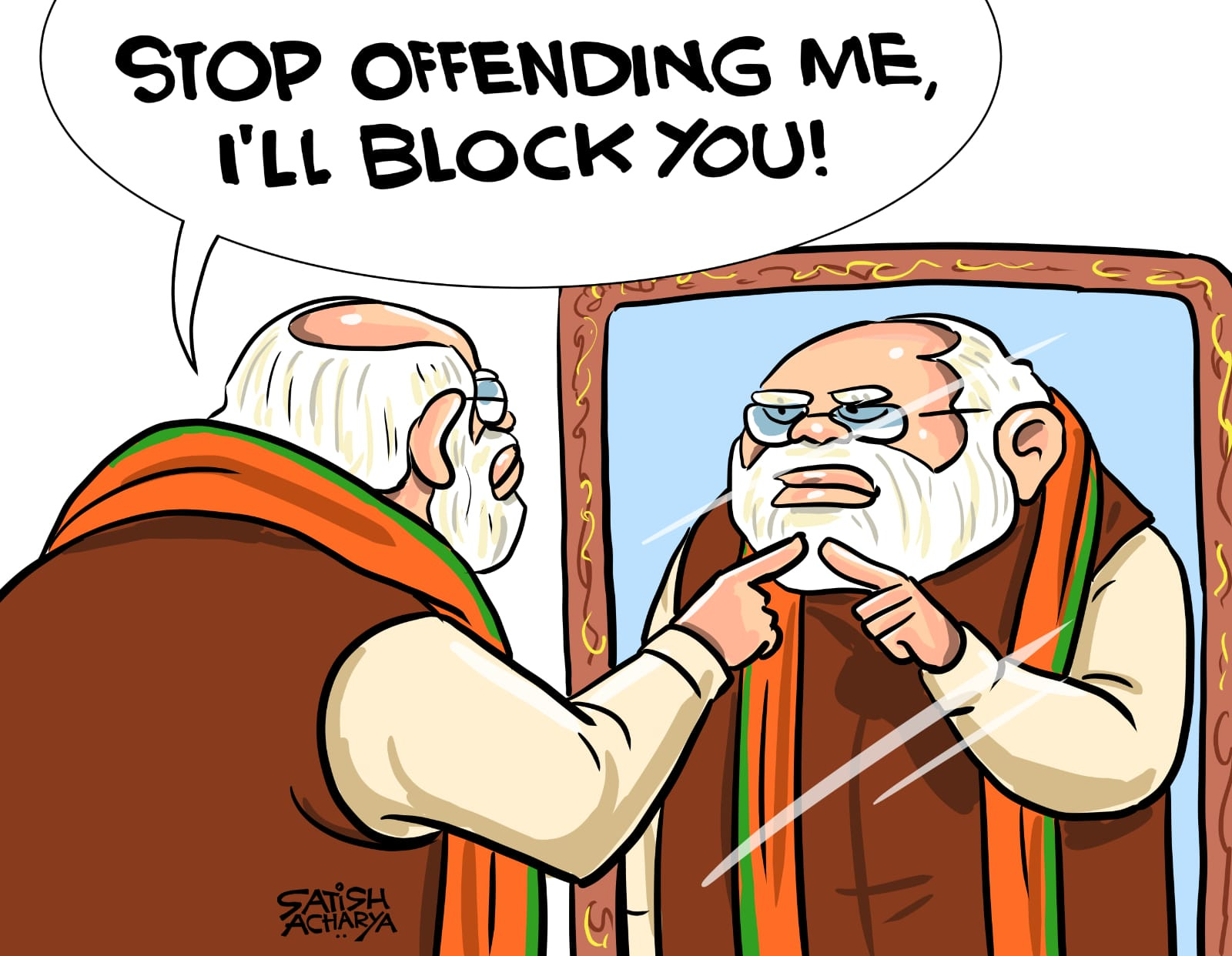
Deep dive
Narendra Modi has promoted Buddhism as part of his diplomatic messaging in Asia but as far as his ideological mentors in the Hindutva fold are concerned, they have “portrayed Buddhism in complete opposite to the ethics and value driven Buddha Modi wishes to market”, with their approach to the faith “ranging from ambivalence to appropriation and downright hostility”. In this study Pradyumna Jairam explains how “processes of omission and decontextualisation play a crucial role in cementing Modi’s message and avoiding conflict with Hindutva ideologues”.
Prime number: 400% 📈
India’s five richest families got 400% richer between 2019 and 2025, a report by the Centre for Financial Accountability and the Tax The Top campaign has determined. This report has many other fun figures, such as that the cumulative wealth of the ultra rich – whose net worth is over Rs 1,000 crore – equals almost 50% of GDP, and that the share in wealth of the bottom 50% of the population had plateaued at 6.4% by 2024.Opeds you don’t want to miss
The market is no longer confident that the RBI will be able to stop the rupee from slipping past 100 to the dollar, writes Andy Mukherjee.
Does the Election Commission really have the power to transfer senior officials as it has done in West Bengal? According to constitutional expert P.D.T. Achary the answer is, probably, no: while the poll body has plenary powers under Article 324, the Supreme Court has ruled that these do not apply when a legislation is in force in the concerned area. In this case, argues Achary, that law is the All India Services Act. Plus it is “not clear under what procedure the EC has reached the conclusion that these [transferred senior] officers are biased and unsuitable for conducting free and fair elections.”
Supreme Court Justice K.V. Viswanathan’s recent recusal from a hearing after arguments were concluded and judgment was reserved – because it turned out he had represented one of the parties when he was a senior advocate – points to the limits of the Indian judiciary’s reliance on individual discretion in such cases, V. Venkatesan writes. “The transition from bar to bench demands a more robust infrastructure of disclosure and conflict-screening than the Supreme Court currently possesses,” he says.
Drawing from her coverage on the Sri Lankan civil war – soon it will be 17 years since it ended – Meera Srinivasan writes against the backdrop of the conflicts in West Asia, Ukraine and Sudan: “The ongoing wars must stop. The urgency is even greater when we recognise that the end of a war on the battlefield is only the beginning of a long, painful, challenging and often messy process of recovery.”
The Iran War debate in Washington is overly focused on what the conflict means for US-China rivalry but ignores the bigger picture in Asia and how this will damage US interests, writes Ewan Feigenbaum. As a consequence of Trump’s actions,
“Asia faces a double whammy of pain from the United States: First, there has been a year of erratic American trade policies and fresh tariffs, which have undermined not only many of the region’s prevailing developmental assumptions but also the competitiveness of its key economies, including America’s closest regional partners. Second is American policy in the Middle East, which now threatens to wreck Asian energy security while forcing politically fraught, socially unpalatable, and deeply unpopular fiscal and programmatic choices.”
Jesuits once championed Indian languages, classical texts, and philosophical traditions, writes Rohan Basu, citing examples of European missionaries “who rejected European cultural arrogance and spent their lives translating and elevating the sacred texts of Hinduism, declaring to the world that the spiritual genius of India was not a relic of the past, but a living treasure for all of humanity.” Yet today, “the prevailing myth relies on a neat, unbridgeable divide: ‘European’ equals the Christian coloniser; ‘Indian’ equals the colonised Hindu”.
Listen up
Are the Modi government’s proposed amendments to the FCRA in line with the principles of natural justice? Is the Christian community’s fears over them justified? What impact will the contentious amendments have if they are passed? G Sampath and compliance consultant Noshir Dadrawala discuss on InFocus.
Watch out
Dr Ganesh Baraiya would not have been where he is today if his father had sold him to a circus offering a lot of money or if the Supreme Court had not ruled in his favour after he – as a person with dwarfism – was rejected an MBBS seat. The 25-year-old Bhavnagar resident was interviewed by the BBC’s Gujarati service about his struggles. [With English subtitles].
Over and out
When P.A. Krishnan found out that IIT Madras was organising an event meant to celebrate Muthuswamy Dikshithar recently he was excited, but this evaporated quickly when he heard RSS ideologue S. Gurumurthy deliver his psuedo-scientific speech on the occasion. “The sheer volume [of arguments] creates an illusion of authority, leading to ‘expertise transfer’, where students mistake the speaker’s confidence for competence,” he recalls.
It’s one thing to read or hear about India’s growing ‘stray cattle menace’ but to watch a video of scooterist rendered comatose in a three-minute long attack is something else altogether.


That’s it for today. We’ll be back with you on Monday, on a device near you. If The India Cable was forwarded to you by a friend (perhaps a common friend!) book your own copy by SUBSCRIBING HERE.
When information is technically public but practically difficult to use, it changes who can question it. That gap matters more than we admit, and it deserves more attention. How do you think policymakers in India should respond in the short term to protect workers in sectors like textiles and glass when disruptions are driven by external conflicts, especially when those same sectors depend heavily on imported energy and materials?