
A newsletter from The Wire | Founded by Sidharth Bhatia, Siddharth Varadarajan, Sushant Singh, Seema Chishti, MK Venu, Pratik Kanjilal and Tanweer Alam | Contributing writers: Kalrav Joshi, Anirudh SK
If you like our work and want to support us, then do subscribe. Sign up with your email address by clicking on this link and choose the FREE subscription plan. Do not choose the paid options on that page because Stripe – the payment gateway for Substack, which hosts The India Cable – does not process payments for Indian nonprofits.Our newsletter is paywalled but once a week we lift the paywall so newcomers can sample our content. Today is that day. To take out a fresh paid subscription or to renew your existing monthly or annual subscription, please click on the special payment page we have created – https://rzp.io/rzp/the-india-cable.Snapshot of the day
March 6, 2026
Siddharth Varadarajan
Riding the GenZ wave, the Rastriya Swatantra Party has scored a major victory over Nepal’s established political parties in this week’s parliamentary elections. At the time of publication, the RSP was leading in 109 seats – that is over two-thirds of the 165 ‘first-past-the-post’ seats up for grabs in the House of Representatives. Another 110 seats will be filled by proportional representation and there too the RSP will take a plurality. Though led by Ravi Lamichchane, the RSP leader most likely to become Prime Minister is Balen Shah, the mayor of Kathmandu and a former rapper. Setopati.com has the latest results.
Less than a month after US President Donald Trump got Prime Minister Narendra Modi to agree to stop buying Russian oil, Washington has said it will “allow” India to resume those imports for 30 days to tide over the crisis caused by the tightening of global oil supplies following the US war on Iran.
While the BJP termed this temporary US reprieve a success of the “strategic oil diplomacy” under Modi, the Opposition said the fact that the government needed American ‘permission’ to buy Russian oil was a major embarrassment for India.
The US announcement is confirmation of the fact that India under Modi has surrendered its independence when it comes to trade policy. Brahma Chellaney notes:
“Ever since the Trump administration claimed victory after designing a framework trade deal to steer India away from Russian oil, the Modi government has remained conspicuously silent. Now the cat is out of the bag.
A waiver is an exemption from a restriction. If India were still free to buy from whoever offers the best price, it would not need a 30-day license from the US Treasury to receive Russian oil. By seeking the waiver, the Modi government tacitly acknowledges the new constraints created by the US-India framework trade deal. As US Treasury Secretary Scott Bessent put it, Washington expects New Delhi to “ramp up purchases of US oil.”
The Modi government has aligned India more closely with the US-Israel axis against Iran. Yet the irony is stark: India now requires US permission to buy Russian energy even during an emergency triggered by American military action.”
Iran’s Foreign Minister Abbas Araghchi has given an account of his telephone conversation with Indian External Affairs minister S Jaishankar – something India has not done so far – and Sri Lankan FM Vijitha Herath. He “stressed the responsibility of all governments and the United Nations to firmly condemn the criminal actions of the United States and the Israeli regime” and also described the US torpedo strike on the Iranian naval ship Dena as a “criminal attack”. Araghchi also thanked Herath for the help Sri Lanka provided to the Dena’s survivors.
Araghchi’s deputy, Saeed Khatibzadeh, in Delhi for the Raisina Dialogue, said India should ask the US why it is targeting Iranian ships in the Indian Ocean.
Indian ‘official sources’ today acknowledged that another Iranian ship, the Lavan, which had also participated in the International Fleet Review in Vizag, has been docked in Kochi due to “technical” reasons since March 1. The belated disclosure has likely been prompted by the praise Sri Lanka has drawn from all quarters in India for its rescue of the Dena crew and its decision to shelter another Iranian vessel at Trincomalee.
Israeli foreign minister Gideon Saar is in Delhi for the Raisina Dialogue too and said Modi was not informed about the impending attack on Iran during his recent visit to Israel. The reason he gave – that the decision was taken after he left – has been contradicted by leaks in Israel that the attack date was finalised sometime mid-February.
Qatar’s energy minister Saad al-Kaabi has warned that an escalating war in West Asia could send shockwaves through the global economy, with oil prices potentially soaring to $150 a barrel if Gulf energy producers are forced to halt production. In an interview with The Financial Times, he said that even if hostilities stopped immediately, it could take Qatar weeks or even months to restore normal gas deliveries after an Iranian drone strike hit the country’s largest liquefied natural gas facility – raising fresh concerns for energy-importing countries such as India.
Meanwhile, the Modi government has invoked emergency powers derived from the Essential Commodities Act to direct Indian refiners to maximise liquefied petroleum gas (LPG) production and ensure that all the gas is supplied solely to domestic LPG consumers and not used to produce petrochemicals. The bulk of India’s LPG demand is met through imports, and over 80% of these volumes come via the critical chokepoint of the Strait of Hormuz, where vessel movements have effectively come to a halt due to the West Asia conflict.
For India, the fallout could extend beyond energy prices [See Prime Number]. The country’s pharmaceutical exports face growing risks as higher freight costs and shipping firms avoiding Gulf routes threaten shipments worth $300–500 million, reports The Economic Times. Global investors have also begun pulling money out of emerging Asian markets amid the uncertainty, with foreign investors withdrawing about $1.3 billion from Indian markets since the war began, raising fresh concerns about capital flows and trade disruptions, notes Bloomberg.
The United Nations’ refugee agency has declared the ongoing conflict in West Asia – triggered by the unprovoked United States and Israeli strikes on Iran, now in their seventh day – a “major humanitarian emergency” that “requires an immediate response,” Ayaki Ito, the director of emergency and programme support at the agency, said.
Nearly 100,000 people have been displaced within Lebanon by Israeli military actions, while tens of thousands of Syrian refugees have reportedly returned across the border. Senior Israeli officials described the US-Israeli offensive in Iran as proceeding “better than expected,” with their forces claiming to have largely taken control of Tehran’s airspace and destroyed significant portions of Iran’s air defences and missile infrastructure. US Defence Secretary Pete Hegseth said the strikes were “about to surge dramatically,” while the Iranian military has vowed to continue retaliatory strikes targeting Gulf countries, including US bases across the region.
India’s largest airline, IndiGo, has been forced to scale back its operations to Europe and much of the Middle East, as the ongoing conflict in West Asia widespread airspace restrictions. IndiGo’s entire fleet of widebody aircraft, consisting of six Boeing 787s that previously served destinations such as London, Manchester and Amsterdam, has been grounded, reports The Hindu. This situation, combined with Pakistan’s continued ban on Indian carriers, has created a cascade of disruptions for travelers across India, the Gulf and Europe.
Elsewhere, authorities stepped up restrictions on Friday in parts of Kashmir, with the valley’s chief cleric Mirwaiz Umar Farooq and at least one Shia leader reportedly placed under house arrest amid simmering tensions over the situation in Iran, as officials remain wary of potential unrest. High-speed mobile internet services continue to remain barred for the fifth consecutive day due to concerns over threats to “public order and security” following the assassination of Iran’s supreme leader, Ayatollah Ali Khamenei.
In a statement, Amnesty International called on the authorities on Friday to respect the right to peaceful protest in Jammu and Kashmir which is “constitutionally protected” by the Indian as well as international laws. “When the government restricts protest for public order, the test is simple: are the measures protecting public order or is dissent being silenced,” the statement said. However, spools of concertina wires and barricades were placed at the key intersections leading into the summer capital Srinagar with hundreds of J&K police and Central Reserve Paramilitary Forces personnel patrolling the roads purportedly to prevent any protests.
Under fire or not officially condemning the killing of Ayatollah Ali Khamenei or the torpedoing of an Iranian warship India had just hosted in Visakhapatnam, Modi government officials have gone around saying the official silence springs from the need to protect “Indian interests” in the Gulf. However, as Sushant Singh notes, this is less strategic prudence than a hollow justification – “flawed even from Delhi’s own strategic perspective and does not hold water when examined closely.” He writes:
“Instead, it seems driven by increasing perceptions, both at home and abroad, that the Modi government has quietly pushed India into the US-Israel camp. The premise that Gulf states would somehow endanger the ten million Indians living there, as punishment for an Indian condemnation of Khamenei’s assassination, strains credibility. These states want to keep everyone in their countries safe, and Indians are as safe or unsafe as any other residents. Indian deaths in these countries during the conflict have occurred despite India’s muted response.
Moreover, the Gulf’s treatment of its migrant workforce is foundational to its economic model and international brand. These are countries that have built entire cities, industries and service economies on the backs of South Asian labour. Gulf states like the UAE, Qatar, Bahrain, Oman, Saudi Arabia and Kuwait individually assured India of the safety of Indian nationals. That relationship is mutually dependent, not a leverage point to be switched off during a geopolitical disagreement. India thus risks overestimating the backlash and underestimating its leverage over the Gulf states.”
Two Indian Air Force (IAF) pilots, squadron leader Anuj and flight lieutenant Purvesh Duragkar, lost their lives when their Su-30MKI fighter jet crashed in Assam’s Karbi Anglong district during a training mission on Thursday evening. Earlier, the IAF mentioned in a post on X that a search and rescue mission was initiated after the Sukhoi-30MKI aircraft lost touch with the ground staff. It took off from the Jorhat airbase on Thursday evening and was last in contact at 7.42 pm.
India batter Richa Ghosh, former chief secretary Nandini Chakravorty, senior Trinamool Congress ministers Shashi Panja and Mohammad Ghulam Rabbani, former two-time MLA and panchayat pradhan Mohammad Selim, Kargil war veteran Mohammad Dual Ali: between their accomplishments and public office what they all have in common is that they’re among those placed in the ‘under adjudication’ category in West Bengal, which means they haven’t made to the state’s final rolls under the special intensive revision and hope for inclusion through supplementary lists. Also in this category is Mostari Banu, who had challenged the SIR in the Supreme Court.
But Mehebub Sheikh does figure in the final rolls, despite being one of those Bengali persons (many of them Muslim) whom the Indian authorities picked up and forced into Bangladesh, in this case allegedly at gunpoint. Murshidabad native Sheikh, who was brought back to India in light of the defective manner in which he was ‘pushed out’, “feels more vindicated than ever before” due to his inclusion, Anant Gupta reports. However a number of his relatives are ‘under adjudication’.
The Maharashtra Cabinet on Thursday approved a draft ‘anti-love jihad’ bill proposing imprisonment of up to seven years and a fine of Rs 5 lakh for unlawful or forced religious conversions. The bill, Dharma Swatantrya Adhiniyam 2026, also makes it mandatory for persons converting to another religion to seek permission from the authorities.
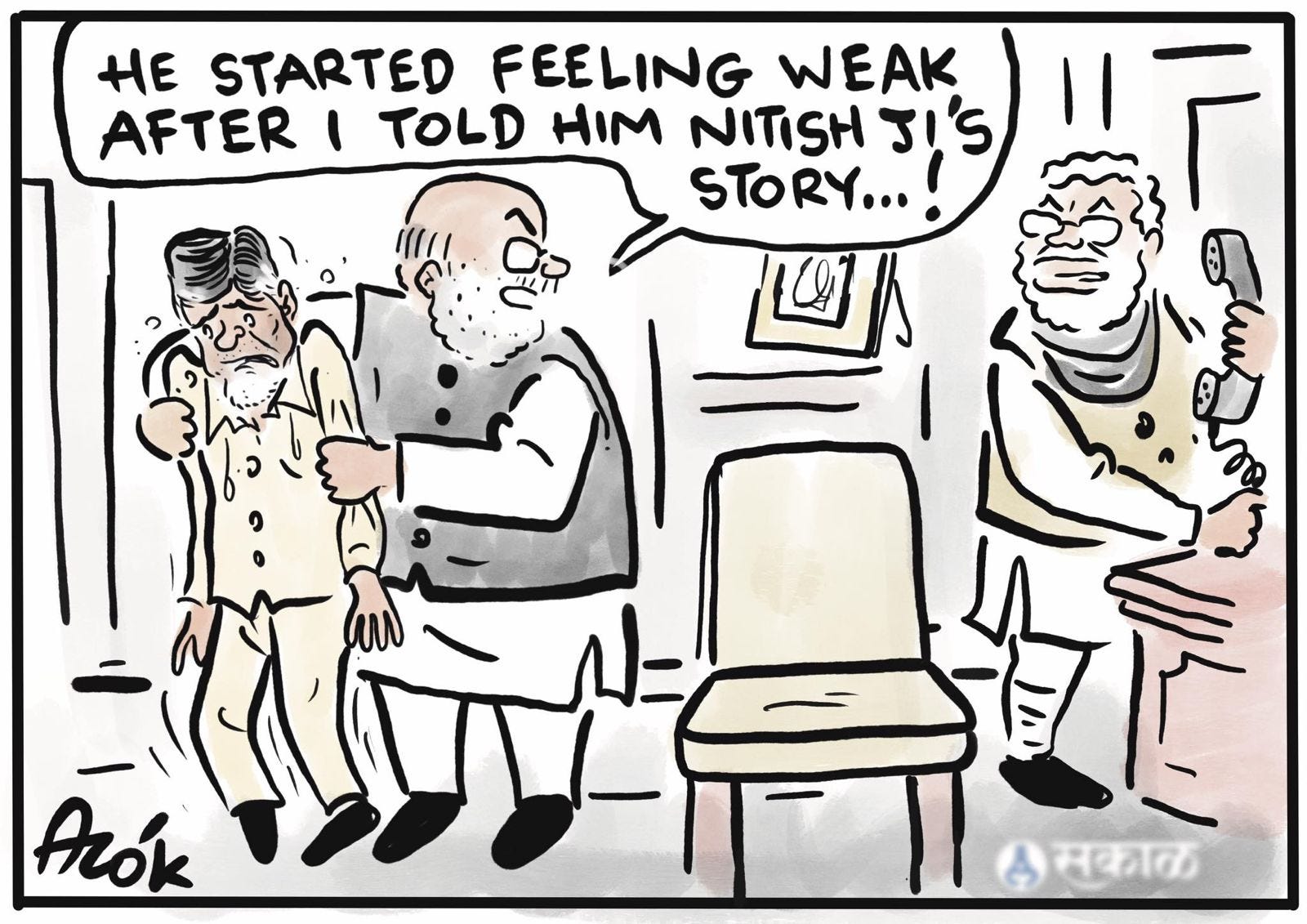
Longtime Bihar chief minister Nitish Kumar’s imminent election to the Rajya Sabha raises questions over the future of his Janata Dal (United) in the state but, “what it demonstrates more starkly is the end of an era in Bihar politics, where the heirs of Ram Manohar Lohia and Jayprakash Narayan – Kumar and RJD supremo Lalu Prasad – held sway. The generation that participated in the anti-Emergency movement and ushered in the heydays of socialist politics is making its final bows from the stage”, notes Nistula Hebbar. Even so, some JD(U) cadres hit the streets on Friday to protest Kumar’s shunting, alleging a ‘conspiracy’ by some within the party to end the liquor prohibition that the CM had enforced starting 2016.
No space for libraries in the new building constructed by the Modi government to house Union ministries, with Kartavya Bhavan leaving little room for collections once considered vital to policymaking; the ministry of external affairs, ministry of home affairs, ministry of finance and ministry of rural development have moved into Kartavya Bhavan 3, but their libraries have been left without a place – those of the MHA and the MoF continue to function from North Block, while the MEA and MoRD libraries have shifted completely online, reports Basant Kumar Mohanty.
Noted documentary filmmaker Anand Patwardhan was denied entry to the Kalina campus of University of Mumbai when he arrived to express solidarity with a research student Bhante Vimansa, who has been staging a peaceful protest – which the university has termed “illegal” – on campus for over six months and demanding, among other things, government funding for the Pali language department and the renovation of the boys’ hostel. Speaking to The Hindustan Times, Patwardhan said no proper reason was given for stopping him from entering the campus.
Karnataka plans to stop kids using social media
Karnataka will ban social media use by children below 16 years of age, chief minister Siddaramaiah announced on Friday while presenting his state’s budget, although he did not say when this will kick in. The move – which Australia recently enforced and numerous other jurisdictions around the world are considering – is meant to “prevent the adverse effects of increasing mobile phone usage”, the CM said. Elsewhere in the budget the state’s Congress-run government said that all gram panchayats will henceforth be called ‘Mahatma Gandhi gram panchayats’: this, after the Modi government in New Delhi repealed MGNREGA and introduced a replacement shorn of Gandhi’s name. It also announced its intent to enact a Rohith Vemula Act to prevent caste-based abuse in universities; no details were offered.
Former Attorney General blasts Kalyan Singh on Babri Masjid demolition
In a candid conversation with Krishnadas Rajagopal, former attorney general K.K. Venugopal reflects on the “command from political masters” that he says triggered the anti-Sikh riots of the 1980s, and recounts his sense of betrayal when he realised that then Uttar Pradesh Chief Minister Kalyan Singh had told him an “utter lie” in the 1990s that the Babri Masjid would not be demolished.
The Long Cable
India’s Geopolitical Tightrope: A “Vishwaguru” Without a Compass?
CP Rajendran
The war between the US-Israel axis and Iran has laid bare a fundamental question: What is India’s stand? As the conflict escalates and the Strait of Hormuz closes, the absence of a clear, principled position has become a critical vulnerability. The government’s response has been characterised by wordplay and ambiguity, leaving citizens and allies alike in the dark.
This crisis follows a series of high-profile diplomatic engagements that now seem contradictory. Prime Minister Modi’s February 2026 state visit to Israel was marked by the elevation of the relationship to a “Special Strategic Partnership”. However, just weeks earlier, India had signed the “Delhi Declaration” with Arab nations, explicitly supporting a “sovereign, independent, and viable State of Palestine” and positioning itself as a “bridge” between conflicting interests.
This duality raises a troubling question: How does one reconcile a “Special Strategic Partnership” with a nation at war, while simultaneously pledging support to its adversaries’ cause? The result is a foreign policy that appears transactional.
The Economic Sovereignty Question
The most immediate consequence of this strategic drift is the energy crisis triggered by the closure of the Strait of Hormuz. For years, India profited from discounted Russian oil, saving an estimated ₹12 billion. This was a pragmatic move that shored up the economy against global price volatility, although the decline in international fuel prices did not benefit the Indian customers.
However, a February 2026 tariff deal with the US included a key condition: India would scale back its purchases from Russia and begin buying unrefined, shale-sourced oil from the United States. This meant abandoning a discounted, proximate source for a more expensive, distant one, adding significant freight charges and refinery costs—effectively trading a measure of economic sovereignty for a tariff waiver.
India imports 88-90% of its crude oil and roughly 50% of its gas needs. Nearly 2.5 to 2.7 million barrels per day—about half of India’s total consumption—passes through this chokepoint. If Hormuz remains closed for just 15 days, the country faces a monumental supply crisis.
With 88% import dependency, our primary supply route (Hormuz) closed and our backup (discounted Russian oil) abandoned, India’s energy security appears alarming if the war continues. With international oil prices spiking and the Indian rupee depreciating simultaneously, the outlook is dispiriting—a brutal arithmetic that will translate directly into higher costs for fuel, food, and everything that moves on wheels.
The contingency plans being discussed—dipping into strategic reserves, and rationing LPG—are reactive scrambles, not the actions of a nation with a coherent strategy. By pivoting away from Russia under US pressure, India has lost its leverage and is now exposed to the full force of a conflict it failed to anticipate or influence.
On March 5, 2026, India received a brief reprieve. U.S. Treasury Secretary Scott Bessent announced a 30-day waiver “allowing” India to purchase Russian crude oil. The move was explicitly described as a short-term measure to keep global oil supplies flowing amid disruptions linked to the Middle East conflict. The subtext was unmistakable: this is a one-time exception, not a policy shift. Bessent immediately coupled the waiver with an expectation: “India is an essential partner of the United States, and we fully anticipate that New Delhi will ramp up purchases of U.S. oil”. Who decides India’s energy policy – Washington or Delhi?
The “Vishwaguru” Dilemma
The title “Vishwaguru” implies moral leadership and strategic clarity. Yet, in this crisis, India’s response has been defined by a search for opportunity and a marked absence of moral clarity. The attempt to please all sides has resulted in policy paralysis, leaving the nation isolated.
As the conflict engulfs the region, the world sees no leader in India. It sees a nation scrambling for oil, hoping its contradictory partnerships will somehow shield it from the fallout. India has traded its long-term strategic autonomy for short-term gains, and the bill has come due in March 2026.
The government’s policy vacuum also explains why India did not raise objections when the US chose to torpedo an Iranian ship in the Indian Ocean, not very far from the coast. The lack of clarity exposes a deeper crisis—a nation that has lost its strategic compass.
The Chabahar Folly: A Half-Billion Dollar Investment Abandoned
Nowhere is India’s strategic confusion more evident than in the case of the Chabahar port in Iran. For years, this project was hailed as India’s gateway to Central Asia—a way to bypass Pakistan and access the markets of Afghanistan and beyond. It was a long-term strategic investment, not a commercial venture.
India has already spent an estimated $500 million on port development. Yet, citing American tariff threats, New Delhi has now stopped engaging with the project. We have effectively abandoned a half-billion-dollar asset, gaining nothing in return. The US has offered no compensation, no guarantee of alternative access. We folded, trading a tangible strategic asset for the possibility of favourable US trade terms.
India is now in a fix: we are not getting any returns for the investment we made in the region. The port remains underutilised, our credibility as a reliable partner is damaged, and we have demonstrated that a phone call from Washington can reverse Indian commitments.
The self-styled “mother of democracy” has responded to the crisis in West Asia not with moral clarity but with opportunism, seeking commercial advantage while the region burns. Having abandoned discounted Russian oil under US pressure, we now find ourselves at the mercy of an “America First” administration, our economic sovereignty exchanged for a tariff waiver. At the same time, we are trying to improve relations with China, but we face unresolved border issues with that country. The normalisation with Beijing appears to conflict with ground realities. Although Chinese investment has been invited to develop manufacturing hubs, China has made no concessions on the border issue and continues to construct the largest dams globally on our border, threatening our water security.
Domestic Contradictions: The Myth of “Brand India”
While the government courts foreign investors at AI summits and hi-tech conclaves, the reality on the ground offers a different perspective. With 7,400 homes demolished as extra-legal punishment and a 93% increase in hate speech fuelling social division, the 2026 UN Human Rights Watch report presents a harsh picture: a government that has normalised violence. How does this systematic lowering of India’s human rights record on global platforms align with the image of a “Vishwaguru” (World Teacher) or the “Mother of Democracy”? Foreign investors are not blind; they monitor social stability, and the current path is worrying. Are we genuinely building a nation, or are we branding a facade that no longer reflects reality?
Beyond the immediate economic emergency and a spiking environmental crisis, a deeper rot threatens India’s future. Social divisions are being deliberately stoked, and the steady erosion of democratic norms is not merely a moral failing—they are systematically dismantling the very foundation upon which long-term, sustainable growth must be built.
We are not a guru guiding the world; we are struggling to keep pace. This is India’s weakest strategic position since 1947, and the crisis is only beginning.
Reportedly
Columnist Kapil Komireddi has said his column with The Print will not be renewed after he criticised Modi. In a social media post, Komireddi said The Print’s founder and editor-in-chief Shekhar Gupta informed him that his contract as a columnist would not be extended after he described Modi as a “coward” and a “curse on India”. He added that it was unclear – though he suspects – whether the decision was Gupta’s own or taken under external pressure (the Modi government). This contrasts, Komireddi noted, with his past criticism of the Gandhi family, whom he had called “a plague on India,” which had not drawn similar objections.
Drawn and quartered
Deep dive
Kolkata’s pice hotels, “with their clattering metal thalis and temperamental fish curries”, have given way to restaurants and stalls hawking biryani (which, here, characteristically contain portions of potato alongside meat). This change, historian Niladri Chatterjee says in this must-read piece, “is a mirror, reflecting inflation, the compression of time, the rise of delivery platforms and the way identity politics seeps into ordinary appetite”.
Prime number: 60,000 tonnes
Almost 3,000 vessels carrying some 60,000 tonnes of basmati rice are idling at Indian ports, unable to sail west because of the ongoing conflict, prompting traders to demand that the government deem the situation a force majeure so that they are freed from contractual pressures, The Hindu reports. India is the world’s largest basmati exporter and shipments to West Asia, including Saudi Arabia, the UAE and Iran, accounting for over half of all dispatches.Opeds you don’t want to miss
On Iran’s desperate gambit for survival and Israel’s moment of regional dominance, Tehran is on a stronger footing this time for Operation Epic Fury, writes ex-ambassador to Iran Gaddam Dharmendra.
Although Pakistani Field Marshal Asim Munir some months ago ‘with Trump by his side’ seemed to ‘believe he could make no mistake’, the US-Israeli attacks on Iran have unsettled matters for him: they foreground Islamabad’s mutual defence pact with Riyadh, have spurred some anger at home, complicate things in Balochistan and threaten to sap Pakistani finances vis-a-vis its Afghanistan plan in view of rising energy prices, Nirupama Subramanian explains. “Lest India believe it can take comfort in Pakistan’s problems,” she cautions, the IRIS Dena‘s torpedoing off Sri Lanka
“is oddly reminiscent of the time when Pakistan’s generals were left sputtering when helicopters crossed into Pakistani territory from Afghanistan in 2011, hit their number one target, and departed.”
Women’s reservation in parliament will become a thing in just three years but “fielding women is not the same as changing what parliament talks about”, Barkha Deva reminds us. To achieve the latter, “the issues that matter to them [must be] named, fought for and demanded loudly enough to become political priorities”, and the work must begin now. “And there is no issue more urgent, more invisible or more ready to be addressed than this: India lacks a policy framework for elder care that clearly accounts for women – and there is no political tradition of demanding one.”
“Take an anonymous survey of police officers on how many times they have faced pressure from political leaders, especially those in power, and citizens will realise what terrible damage has been done to the police and other investigating agencies,” writes Meera Chadha Borwankar on the lesson from Kejriwal case.
Fiscal federalism has entered an uncharted phase, says Avani Kapoor:
“If the Union government intends to focus on national investments while states and cities take charge of local services, the transition must be explicit and supported by predictable fiscal space. Otherwise, India risks ending up with centralised control without fiscal commitment, and decentralised responsibility without fiscal capacity. And in public finance, such mismatches rarely end well.”
“The recurring charge that marginalised communities advance by ‘playing the victim card’ reflects a deep misunderstanding of both history and constitutional morality, writes Nethrapal.
Given that the authors, booksellers and publishers alike quoted in The Guardian‘s article on Indian literature festivals all attested to how the “book trade moves slowly” round here, the “rather harmless allegation [in the piece] burst like an inflamed boil”, Pratik Kanjilal writes. Still, he points out, the article drew its figures from English publishing, even though that excludes the regional-language, used-books and piracy worlds. “A market with such varied cultures of reading, and so many languages, styles and niches, can’t be treated as a single, orderly entity bound by universal rules.”
Listen up
Given the Supreme Court’s decision not to entertain petitions seeking against Assam chief minister Himanta Biswa Sarma’s rabble-rousing but also disposing of hate speech matters pending with it since 2021, one may wonder whether the apex court is doing enough to deal with hate speech. Is it? Lawyers Shahrukh Alam and Haris Beeran discuss the question with Aaratrika Bhaumik on InFocus.
Watch out
Sari clad women snowboarding? Watch the video that’s breaking the Internet:
Over and out
On Modi, diplomacy and everything in between:
https://x.com/MANJULtoons/status/2029595812435742946
You probably know who designed New Delhi, but do you know who built it? Among those were thousands of migrant labourers who, Ragini Jha reveals, worked in deplorable conditions for dismal pay and were constantly in debt to usurious moneylenders. When the job was done, their labour camps were seen as an eyesore and the workers forced out by way of machinations including the stoppage of water supply. Some of this is unthinkable today but “echoes of this story remain familiar”, Jha points out.
That’s it for today. We’ll be back with you on Monday, on a device near you. If The India Cable was forwarded to you by a friend (perhaps a common friend!) book your own copy by SUBSCRIBING HERE.