
A newsletter from The Wire | Founded by Sidharth Bhatia, Siddharth Varadarajan, Sushant Singh, Seema Chishti, MK Venu, Pratik Kanjilal and Tanweer Alam | Contributing writer: Kalrav Joshi, with additional inputs by Anirudh SK
If you like our work and want to support us, then do subscribe. Sign up with your email address by clicking on this link and choose the FREE subscription plan. Do not choose the paid options on that page because Stripe – the payment gateway for Substack, which hosts The India Cable – does not process payments for Indian nonprofits.Our newsletter is paywalled but once a week we lift the paywall so newcomers can sample our content. Today is that day. To take out a fresh paid subscription or to renew your existing monthly or annual subscription, please click on the special payment page we have created – https://rzp.io/rzp/the-india-cable.Snapshot of the day
November 28, 2025
Anirudh S.K. & Kalrav Joshi
Amidst increasingly complex and challenging relations between India and the United States, Russian President Vladimir Putin will make a state visit to India on December 4 and 5, Moscow announced today. He will meet Prime Minister Narendra Modi as well as President Droupadi Murmu and the visit provides an “opportunity to review the entire spectrum” of the Indo-Russian “special and privileged strategic partnership”, the Russian foreign ministry said in a statement. It added that the two sides “are expected to adopt a joint statement and sign a wide range of interdepartmental and business agreements”, though it did not provide details.
Putin’s visit will take place against the backdrop of India scaling down its purchases of Russian oil – of which it became the second-largest buyer after China following Russia’s invasion of Ukraine – in the face of US and EU tariffs aimed at depriving the president’s unceasing war machine of a primary source of funding. Reuters had reported that Indian imports of Russian oil were set to hit a three-year-low next month. The visit will also occur even as the International Criminal Court’s arrest warrant for Putin – for his alleged role in the abduction of Ukrainian children – remains active, although there was never any possibility of New Delhi enforcing it.
Defence minister Rajnath Singh will meet his Russian counterpart Andrey Belousov during this visit, Saurabh Trivedi reports citing an official source. India will discuss the timely delivery of the remaining S-400 surface-to-air missile systems it has purchased as well as look into the prospect of buying additional units – the platform had notably proven its mettle during Operation Sindoor. The Indian side will also examine the possibility of purchasing the more advanced S-500 systems, Trivedi writes.
Nearly 250 primary school teachers assigned as booth-level officers (BLOs) halted work and held a sit-in protest on Thursday at the data uploading centre in Khokhra, Ahmedabad, alleging “threat and pressure” during the ongoing special intensive revision (SIR) of electoral rolls. The teachers alleged that they were not given any proper guidance as well as that officials were issuing threats and placing unreasonable demands on them to meet SIR deadlines. BLOs – particularly female BLOs – said the public circulation of their phone numbers had led to late-night abuse. Moreover, the teachers also underlined that they are under extreme strain due to long working hours since they are required to reach their centre at 7 am, conduct field work until early afternoon and return to duty after lunch, with no fixed end time. Teachers also pointed to server outages that forced them to do work even late at night, reports The Indian Express. “We would get calls from our seniors even at midnight or 1 am asking us to do the data entry and upload names for mapping when the server starts functioning. There is no time for us to spend … with family for the last three weeks,” a protestor told the newspaper.
This comes even as several alleged BLO suicides have been reported across the country in recent weeks, including in West Bengal, with officials linking the incidents to stress and pressure associated with the SIR. While investigations are still underway in many of these cases, the reports have intensified concerns over workload, official expectations and the broader conditions under which BLOs are carrying out the ongoing revision exercise.
Prime Minister Narendra Modi’s announcement that the government will open India’s nuclear sector to private companies has raised sharp concerns that yet another strategic domain is being handed over to corporate interests. Modi said that this shift would “give new strength to India’s energy security and technological leadership”. The government now plans to allow private participation even in research and development – areas long shielded from corporate influence – by pushing amendments to the Atomic Energy Act, 1962 and the Civil Liability for Nuclear Damage Act, 2010 in the upcoming winter session of parliament. Critics warn the move could weaken safeguards and place profit over public safety in one of India’s most sensitive sectors.
Meanwhile, new turban, old lies – quite a brand consistency exhibit from the dear leader. See for yourself:
https://x.com/zoo_bear/status/1994367886815826100
The Maharashtra revenue department has announced that Aadhaar will no longer be accepted as a supporting document for issuing delayed birth certificates, and all certificates issued solely on the basis of Aadhaar after the 2023 Births and Deaths Registration Amendment will now be cancelled. The Uttar Pradesh government has also ruled that Aadhaar cannot be used as a birth certificate or proof of date of birth. Instead, birth certificates, high school mark sheets and other prescribed documents must be used, officials told The Indian Express.
The bench of the National Green Tribunal hearing environmental activist Ashish Kothari’s petition challenging aspects of the Great Nicobar mega project has decided it will only refer to pleadings that both parties in the matter have placed on record – this means it will not refer to those parts of the report by a high-powered committee on revisiting the environmental clearance to the project that were not made public or made available to Kothari, reports Jayashree Nandi. The report was submitted in a sealed cover and not made available to Kothari, who has challenged this. The government’s “contention that the HPC report cannot be disclosed because it is of ‘strategic and national importance and has confidential and privileged information’ is without merit and contrary to the facts,” he has argued.
Vice President C.P. Radhakrishnan in his capacity as chancellor of Panjab University approved a schedule for elections to the institute’s senate submitted by the vice chancellor, meeting the second core demand of students and ending weeks-long protests spurred by the Union government’s attempt – which it ended up rolling back – to ‘overhaul’ the university’s governance structure. The elections are scheduled for September and October next year.
The Delhi blast matters not only because it represents a security failure, but because it reveals the deeper failure of Modi’s strategic approach. Sushant Singh writes on why Modi did not go on a Pakistan-bashing spree after the Delhi blast:
“He has invested enormous political and military capital in blaming and escalating conflict with Pakistan, and now India finds itself in an unfavourable strategic situation, thanks to Trump, Munir and the Saudi-Pakistan defence pact. Modi cannot blame Pakistan for the Delhi blast because doing so would require him to admit that his actions have produced outcomes he cannot control through force or rhetoric. These convergent pressures—domestic, diplomatic, and strategic—have left Modi with no good options. Silence may be the only card he has left to play.”
Dozens of people have perished and many others went missing in Sri Lanka from the impact of Cyclone Ditwah. Most fatalities occurred due to landslides triggered by the heavy rainfall, which have also blocked access to some affected villages, reports Uditha Jayasinghe. Several flights were diverted away from the island, including to Thiruvananthapuram and Kochi.
One of the two US National Guard personnel shot in the heart of Washington D.C. earlier this week, Sarah Beckstrom, succumbed to her injuries. The suspect in the shooting is Afghan national Rahmanullah Lakanwal, who had moved to the US during its 2021 withdrawal from Afghanistan, where he worked with the American government, including the CIA, “as a member of a partner force in Kandahar”, the AP reports citing the agency’s director. Although he did not specifically mention this incident, it appears to be the trigger for US President Donald Trump’s vow posted on Friday morning Indian time to “permanently pause migration from all Third World Countries”. He will also “remove anyone who is not a net asset to the United States, or is incapable of loving our Country, end all Federal benefits and subsidies to noncitizens of our Country, denaturalize migrants who undermine domestic tranquility” and deport people including those found to be “non-compatible with Western Civilisation”.
Police in Thiruvananthapuram invoked provisions including rape, obtaining sexual consent through deceitful means and forcing a woman into terminating her pregnancy against Congress MLA for Palakkad Rahul Mamkootathil on Friday after the survivor in the case met Kerala chief minister Pinarayai Vijayan yesterday, The Hindu reports. The Congress had suspended Mamkootathil in August when he was accused of serial sexual misconduct but there are calls now from within and outside the party for ‘exemplary action’ and for him to resign as legislator. At the same time, Congress leader and UDF convenor Adoor Prakash accused the CPI(M) of drawing from its “election-era playbook of foisting sensational crime cases” against opposition leaders ahead of the local body elections.
It will take at least three more months for the four labour codes to kick in because their rules have not been published yet. They were already ‘pre-published’ and comments on them solicited, but this process has timed out, so the rules will be pre-published again within a week or ten days from now, Union labour secretary Vandana Gurnani told The Hindu BusinessLine. The public will have 45 days to submit comments and the government another 45 days to finalise the rules, Gurnani said. She also acknowledged that the government has seen below-par disbursement of social security monies to workers – for example to construction workers – which she attributed to inadequate registration among beneficiaries. But now that aggregator platforms have been asked to collect workers’ data, Gurnani said they hope for a better outcome with respect to gig workers vis-a-vis the labour codes.
In the meantime, if you’ve yet to catch up on what changes the four codes will bring in and why some trade unions have opposed them, read Pavan Korada’s explainer here.
British foreign minister Yvette Cooper raised the prolonged incarceration pending trial of Briton Christian Michel in India with her Indian opposite number S. Jaishankar at a G7 outreach event in Ottawa earlier this month. This is after British PM Keir Starmer raised the issue with PM Modi twice – first at Chequers and then in Mumbai. “The UK government continues to raise Mr Michel’s case with the government of India at every appropriate opportunity, pressing for progress and a resolution. We remain committed to doing so until the case is resolved,” Ashis Ray quotes the British foreign office as saying. Whitehall’s moves, Ray notes, signal a willingness to amp up pressure on New Delhi on Michel’s almost seven-year-detention by Starmer’s Labour government unlike its Conservative predecessors.
Apple has argued before the Delhi high court that a regulation enacted last year allowing the Competition Commission of India to use a company’s global – as opposed to Indian – turnover to calculate fines is “manifestly arbitrary, unconstitutional, grossly disproportionate [and] unjust”, report Aditya Kalra and Arpan Chaturvedi. It has estimated its “maximum penalty exposure” using the impugned route at $38 million. The firm is facing antitrust challenges from the Tinder-owned Match and other Indian startups. A competition law advocate said however that “it will be difficult to convince the court to interfere with clearly laid down legislative policy”.
Did the volcanic eruption in far-away Ethiopia worsen Mumbai’s air quality, as the Maharashtra government argued in the Bombay high court’s hearing on petitions – including a suo motu case – on the city’s poor air? This one’s a no-brainer: the court saw right through this argument.
Three Chinese nationals were killed and one injured earlier this week in an armed attack in Tajikistan near its border with Afghanistan – Dushanbe, which did not identify the perpetrators, has said the attack originated from Afghanistan and involved an unmanned aerial vehicle equipped with grenades. Kabul too did not identify a suspect group but has promised cooperation. The incident occurred amid an apparent, slow thaw in tense relations between Dushanbe and Kabul, as well as amid Beijing’s outreach to the Taliban.
Telangana’s government yesterday notified the long-pending elections to its gram panchayats given that its attempts to reserve 42% of seats for backward class candidates have yet to bear fruit – Bills passed on the matter are pending with the Union government while the high court has stayed an ordinance; the quota would breach the Supreme Court’s 50% cap – and as it risked losing Rs 3,000 crore in grants sanctioned by the 15th Finance Commission if the polls were delayed to the end of the financial year. The polling exercise will begin on December 11, with some bodies in the state having no reservation for BCs and others having quotas of up to 27%.
Monopolies damage economies and people alike — and media monopolies are no exception. The Jio-Disney merger is already raising alarms, with the International Cricket Council warning to expect up to a 30% drop in revenue, undermining the very activities and institutions that rely most on stable funding.
Authorities in Jammu yesterday morning demolished the family home of journalist Arfaz Ahmad Daing days after he implied the involvement of Jammu (East)’s previous sub-divisional police officer in cross-border drug smuggling. Speaking to Jehangir Ali, Daing acknowledged that their home – constructed 40 years ago – lies on Jammu Development Authority land but noted that the demolition notice was issued in his name even though the property is registered in his father’s name. Journalists who attempted to cover the demolition were kept away from the site and policemen were seen trying to snatch Daing’s camera as he filmed the event. Chief minister Omar Abdullah happens to be J&K’s housing and urban development minister, Ali recalls.
But a ray of hope appeared for Daing’s family as a follower of his news channel, Jammu-based social activist Kuldeep Sharma, donated some land to them. Vowing to build the Daings a home “even if [he has] to beg for funds”, Sharma framed his decision as a bid to uphold Hindu-Muslim unity in Jammu, which has been a hotspot for communal tensions.
India’s GDP, other national accounts statistics given ‘C’ grade by IMF
Owing to “shortcomings that somewhat hamper surveillance”, the International Monetary Fund has given India’s ‘national accounts’ statistics – which include important measures like GDP and gross value added – a grade of ‘C’, which is the second-lowest grade in its rubric. Although these statistics are “available at adequate frequency and timeliness and provide broadly adequate granularity”, the IMF said that “some methodological weaknesses somewhat hamper surveillance”. It pointed to the outdated base year of 2011-12, the “use of wholesale price indices as data sources for deflators due to the lack of producer prices indices”, occasional “sizeable discrepancies” between the ‘production’ and ‘expenditure’ approaches to measuring GDP, as well as a “lack of seasonally adjusted data and room for improvement of other statistical techniques used in the quarterly national accounts compilation”.
Meanwhile, official data released on Friday shows the Indian economy surged by 8.2% year-on-year in the July-September quarter, up from 7.8%. Even as the Modi government doubles down on its economic narrative, the credibility behind it is under a cloud — a headline-grabbing GDP surge built on data the IMF itself deems shaky.
Fun fact: India’s national accounts statistics got a ‘C’ grade last year too.Maharashtra voters can feel Ladki Bahin’s impact on exchequer, but will this matter in the local body polls?
The Mahayuti government’s Ladki Bahin scheme that pays Rs 1,500 a month to eligible women has hit its ability to disburse payouts under other schemes, such as the Anandacha Shidha scheme providing subsidised rations during festivals and the Shiv Bhojan Thali scheme that provides cheap lunches. Voters in five Maharashtra districts that Tabassum Barnagarwala spoke to had noted this, but will it have an impact on the upcoming local body polls in the state? A few people expressed anger toward Ladki Bahin – including some availing the scheme – but political scientist Harish Wankhede noted that “this anger is not being mobilised by the opposition in a substantial way” and that “during elections they [the ruling parties] mobilise and ensure that at least some people benefit from the [other] schemes”, which “brings hope to people and they continue to vote for them”.
Australian activist Ben Pennings stares down Adani Group
Australian environmental activist Ben Pennings declared a ‘massive victory’ on Thursday as Adani dropped its demand that he pay it for ‘damages’ stemming from his activism pertaining to its Carmichael coal mine in Queensland that were at one point estimated at $600 million, reports The Guardian. Adani had (in vain) applied to carry out an unannounced search of Pennings’s family home on the alleged grounds that he may have had confidential information about the mine, as well as hired a private eye to surveil his family. The activist pointed out yesterday that “corporate-run SLAPP suits are just an affront to democracy”.
The Long Cable
India will preserve its strategic autonomy but a stronger Indo-American relationship is certainly possible
Anita Inder Singh
As India confronts President Donald Trump’s high tariffs and prepares to welcome President Vladimir Putin in New Delhi on December 4 and 5, three imperatives stand out.
First, India has to do what it takes to preserve its strategic autonomy – which implies that it must maximise its diplomatic and political options, just like any country, aligned or nonaligned.
Never mind the old rhetoric about tried and tested friendship with Russia, or the more recent talk about India-America trust and mutual respect.
Realpolitik defines India’s relationships with both countries. Since the Cold War, the mutual understanding between India and America, the world’s two largest democracies, has run parallel to ups and downs in United States-India bilateral relations.
Second, India gets much more from the United States on the economic/trade front than it does from Russia. As the buyer of 18% of India’s exports, the US is its largest market. Russia purchases a mere 1.1% of India’s exports.
Third, Russia has certainly supplied India with more arms than the US. Over the past two decades, Russia provided India with more than 65% of its weapons for $60 billion. New Delhi bought $ 20 billion worth of American arms during the same period.
In 2018, New Delhi spent $ 5.43 billion on the S-400 Triumf surface-to-air missile alone, although Moscow first sold it to India’s Asian arch-rival, China, in 2014.
So, the signing of an Indo-US defence pact on October 31 and news on November 20, about a $93 million military deal for weapons New Delhi will get from Washington to enhance regional security and strengthen India-United States military ties should be kept in perspective.
Trump has pressed India to buy more American military equipment, perhaps to reduce the US trade deficit with India. Talks between Washington and New Delhi on arms sales were halted last August, after Trump penalised India with 50% tariffs, in part for buying Russian oil.
In an ongoing show of strategic autonomy, India is dealing with its Russian and American partners simultaneously. New Delhi has highlighted as “a historic first” its agreement with Washington that India will start buying liquefied petroleum gas (LPG) from America.
It is hard to say whether India will continue to import Russian crude and, if so, how much. Those imports rose by 11% in October, defying Trumps assertion that India “had agreed” to stop buying Russian oil “within a short period of time”.
That period of time may not be over. As Trump’s sanctions on Russia’s oil buyers closed in on November 21, India’s major oil refining companies announced that they would stop purchasing it. Until then, India continued to buy Russian crude. Indian oil refineries, one of them in Prime Minister Narendra Modi’s home state of Gujarat, exported refined oil to Europe and the United States and made millions. Facing Trump’s threats they shunned state-owned oil companies like Rosneft and Lukoil. Then, with Moscow increasing its discounts, Indian oil refining companies tried to buy Russian oil from unsanctioned suppliers.
However, loadings headed for India from Russia fell by 47% in November. The chances are that Russian oil for India’s exporting refineries will drop further in December-January.
Meanwhile, India is far from finished with Trump’s high tariffs on its exports to the United States. The tariffs – which took effect in August and are among the highest in the world – include a 25 penalty for transactions with Russia. They could shave 0.8% off India’s GDP growth this year.
If the trend continues, India’s hopes of becoming a developed economy by 2047, the centenary of its independence, would be dashed.
Contrary to New Delhi’s claims, India was not always buying Russian oil because it was the cheapest. It often paid higher prices for it than the $ 60 price cap set by the G-7 in US dollars, UAE dirham and even Chinese yuan.
New Delhi is decidedly indignant that Trump has negotiated a one-year trade truce with China, which has bought far more Russian oil than India. That was because he realised that heavy tariffs on China were unsustainable: Beijing crafted a strategy aimed at controlling the global industries that depended on Chinese inputs. Those included clean energy and car manufacturing. Without naming the United States, India has upbraided what it sees as Washington’s “double standards”.
On another plane, Russia’s war in Ukraine has spurred India’s attempts to diversify its weapons base. India’s military have pointed out that deliveries of Russian arms have stalled since Moscow’s invasion started in 2022. Moscow has delivered only two of the five S-400 air defence systems ordered by India since 2018. That has put pressure on India to diversify sources of arms buys, from France, Germany, Spain and Israel.
The trade front
Differences between Washington and New Delhi on trade remain, although Trump has predicted that a trade truce is on the cards
This does not mean that he has accepted India’s red lines on America’s agricultural exports to India. New Delhi has drawn those lines because a large share of India’s population commands the farming sector. But Modi’s preaching to farmers to think beyond flour and rice reveals the extent to which India has clearly come under pressure. The long-term question is what India and America can do to reduce their competing commercial priorities and strengthen their trade ties.
Outlook: Russia, America, China and India
This raises the important question: Are US-India relations on firm ground?
More American arms sales to India could help. That in turn could hinge on how Trump envisions India’s contribution to the defence of the Indo-Pacific, since it is economically the weakest member of the Quadrilateral Security Dialogue, (Quad), revived by Trump 1.0 in 2017, and the only nonaligned one. Compared to China’s, its progress has been slow - and even slower compared to that of its democratic partners in the Quad - the US, Japan and Australia - which are among the world’s richest countries and have the capacity to counter China technologically.
Eventually, the quantity of America’s defence sales to India, and defence-industrial cooperation between the two countries will determine the depth and strength of military cooperation.
On the other hand, arms, oil and trade problems with Trump have not pushed India closer to Russia and China, although Modi attended the Chinese-led summit of the Shanghai-led Cooperation Organisation at Tianjin from 31 August 31 to September 1 to show that India has good relations with other powers. For, China’s old claims to Indian territory remain an obstacle to strengthening ties. It is also India’s top source of imports, and has a huge trade surplus of $ 99.2 billion with India. China is also Russia’s most valued strategic and economic partner because its offerings are much larger than those of India.
India will continue to perform a difficult juggling act with the United States on one side and Russia on the other. Putin’s trip to India will reveal how difficult. More S-400 missiles, more military aircraft, like the fifth-generation Su-57 stealth fighters and more discounted oil are likely.
But not much more, even as India hails its relationship with Russia as a contributor to global stability.
Nevertheless, as the world’s largest economy, militarily and economically, the US can and should offer India a lot more than it does. Both countries have much to gain from stronger ties with each other.
(Anita Inder Singh is a founding professor of the Centre for Peace and Conflict Resolution in New Delhi. She has been a Fellow at the National Endowment for Democracy in Washington D.C. and has taught international relations at the graduate level at Oxford and the LSE.)
Reportedly
Months after a map of the Maratha empire in the NCERT’s new Class 8 social science textbook triggered a controversy, the expert panel set up by the Council is still spinning its wheels. The situation got trickier when a leading historian on Maratha history passed away after the panel was formed, leaving NCERT scrambling for a replacement. Apparently, even historical accuracy has to wait in line while bureaucracy perfects the art of delay.
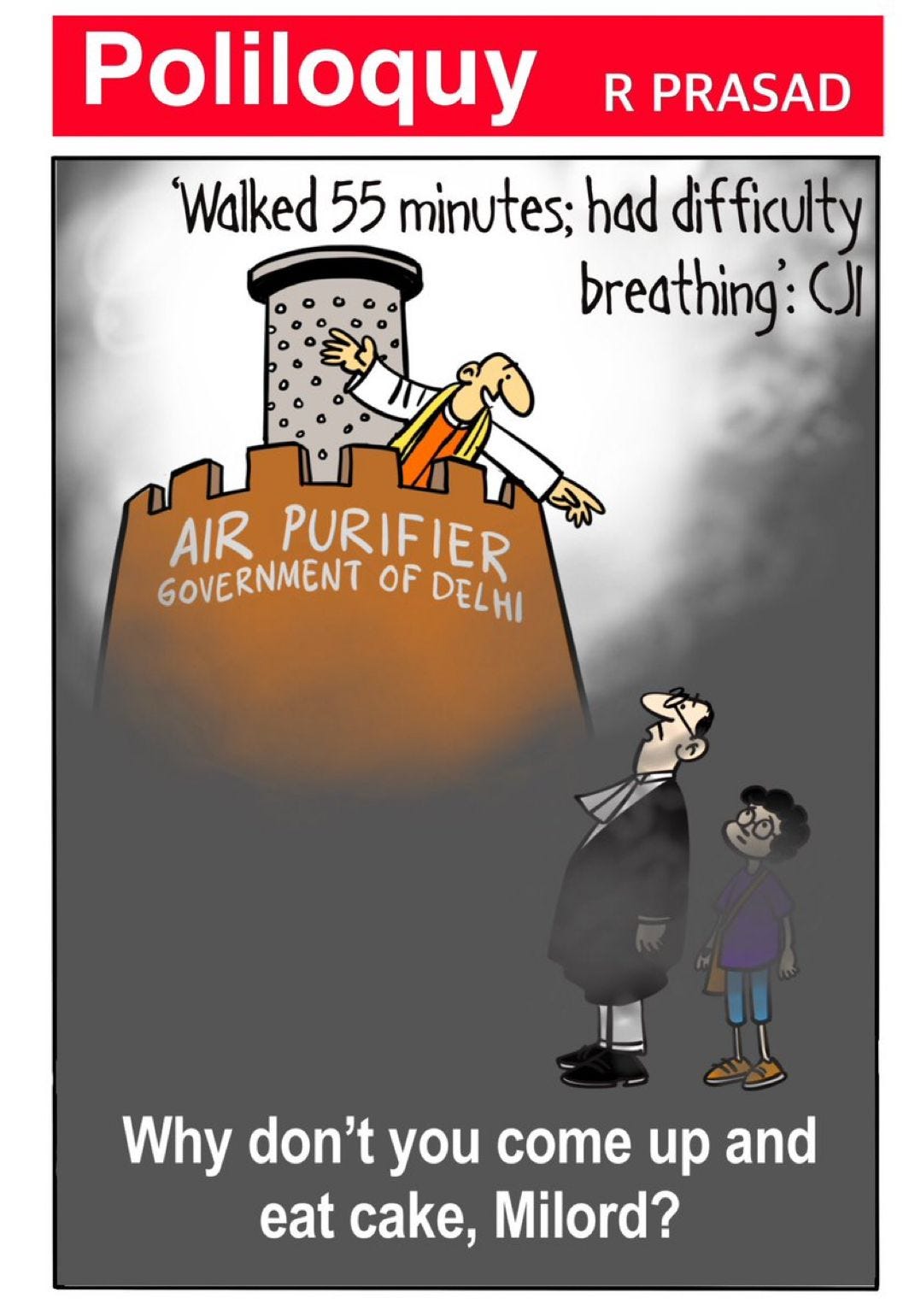
Drawn and quartered
Deep dive
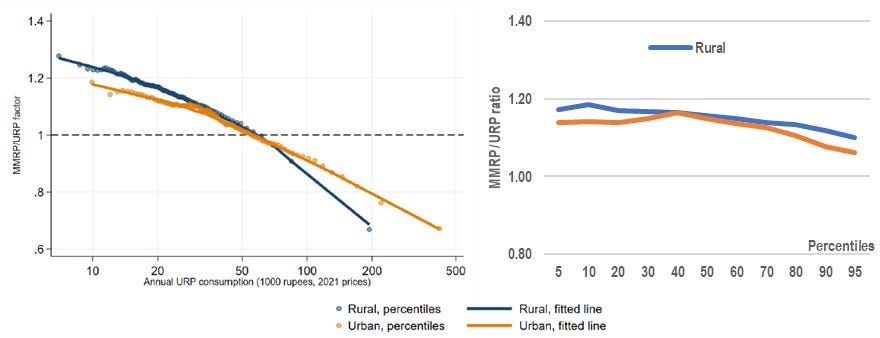
“Persistent comparability problems between the 2011–12 and 2022–23 consumption surveys, compounded by the World Bank’s contested adjustments, leave India’s poverty and inequality trends uncertain. Though poverty has likely fallen the magnitude remains disputed,” writes Gaurav Datt.
Prime number: $26.31 million
The rupee has been in a free fall this year, shedding a staggering 6.5% since May – yet another reminder of how poorly the Indian economy has been managed despite the government’s endless chest-thumping. After briefly stepping back from the currency markets following Q1 2025, the RBI has been forced to rush back in as a firefighter, ramping up forex interventions once again since September. Bloomberg’s estimates show the RBI has poured $26.31 billion into propping up the rupee between September 1 and November 15 – an extraordinary amount that exposes just how fragile the currency has become. Instead of confronting this weakness honestly, the system is once again relying on heavy-handed regulatory support and market manipulation to keep the optics intact.Opeds you don’t want to miss
Modi biographer and journalist Nilanjan Mukhopadhyay analyses the prime minister’s speech during the saffron flag-hoisting ceremony at the Ayodhya Ram temple.
The prime minister’s critique of ‘colonial mentality’ in his Ayodhya speech, Bharat Bhushan says, “signals a desire for reinterpreting [the Constitution] by foregrounding what he calls Indian civilisational values”.
The raid on the Kashmir Times should jolt us into remembering the challenges that journalists living in Kashmir face every day, particularly since August 2019, after Article 370 was read down, writes Kalpana Sharma, arguing that “the cost of irresponsible reporting is being borne primarily by ordinary Kashmiris, who are living their lives, trying to study and qualify for jobs, and basically surviving like so many in the rest of this country”.
Sheikh Hasina’s in absentia trial and subsequent death sentence have deepened Bangladesh’s political divide, may have rendered reconciliation nigh impossible ahead of general elections and strengthened India’s case against extraditing her, Ashok Swain points out.
Filmmaker Sivaranjini discusses her debut Malayalam film Victoria, releasing today, sharing insights on her dynamic visual style, instinctive casting choices and the “unexpected beauty-parlour moment that started it all”.
Listen up
Mikhail Sen reads an excerpt from Snigdha Poonam’s Scamlands: Inside the Asian Empire of Fraud that Preys on the World. Listen here.
Watch out
Why are there so few women lawyers with disabilities? Why does a blind person need to prove their merit again and again? Meet 25-year-old advocate Anchal Bhatheja:
Over and out
More than 25 years ago, author-artist-ceramicist Anuradha Roy and her husband came across a derelict cottage at the edge of a Ranikhet estate and decided that was where they wanted to live. It was a year of changes – not only did they pack their bags and leave Delhi to build a life in the mountains, the two also started their own publishing house, Permanent Black, at the same time. Writing about it now, in her first book-length non-fiction work Called by the Hills, Roy remembers how they decided to move in right after the basic reconstruction of the cottage was done, while it was still a “shell”. Read this interview of Roy with Jahnavi Sen about her intimate yet expansive view of a life in the hills.
That’s it for today. We’ll be back with you on Monday, on a device near you. If The India Cable was forwarded to you by a friend (perhaps a common friend!) book your own copy by SUBSCRIBING HERE.