
A newsletter from The Wire | Founded by MK Venu, Pratik Kanjilal, Sidharth Bhatia, Siddharth Varadarajan, Sushant Singh, Seema Chishti, and Tanweer Alam | Contributing writers: Kalrav Joshi, Anirudh SK
If you like our work and want to support us, then do subscribe. Sign up with your email address by clicking on this link and choose the FREE subscription plan. Do not choose the paid options on that page because Stripe – the payment gateway for Substack, which hosts The India Cable – does not process payments for Indian nonprofits.
Our newsletter is paywalled but once a week we lift the paywall so newcomers can sample our content. To take out a fresh paid subscription or to renew your existing monthly or annual subscription, please click on the special payment page we have created – https://rzp.io/rzp/the-india-cable.
Snapshot of the day
June 19, 2026
Siddharth Varadarajan
Iran is sending its petroleum minister to Delhi for next week’s BRICS National Security Advisers’ meeting as Tehran moves to sign up India as a customer for its oil now that the US-Iran peace deal includes an American commitment to waive sanctions on Iranian energy exports. The Modi government stopped buying oil from Iran as soon as Washington imposed unilateral sanctions.
The Trinamool Congress has submitted 20 separate petitions to Lok Sabha Speaker Om Birla seeking the disqualification of the 20 party MPs who have defected to the BJP-led NDA, reports Preetha Nair. The 20 MPs have merged with a little-known outfit, the Nationalist Citizens Party of India. “The Tenth Schedule [of the Constitution] clearly states that voluntarily giving up membership of one’s political party is a ground for disqualification,” said TMC leader Abhishek Banerjee. “Even if 28 or 29 MPs of a parliamentary party leave together, it does not amount to a merger under the Constitution,” he added.
Condemning the defection of six of his MPs to the NDA, Uddhav Thackeray offered to resign as leader of his faction of the Shiv Sena. "I would be happy if someone from the party ranks becomes the next Shiv Sena president, but I will not let it pass on in the hands of thieves," he told a meeting of party cadres today. “The country is moving towards ‘one party, no election’,” he said, mocking the BJP’s slogan, ‘One nation, one election’.
Cross-voting cost the Congress a Rajya Sabha seat from Jharkhand with the NDA-based businessman, Parimal Nathwani, who is from the Reliance group, getting elected. “With this, the BJP-led NDA is cruising towards the two-third mark of 163 in a House of 243,” reports Shemin Joy.
Reports have claimed that at least 11 NEET-UG aspirants have allegedly died by suicide in the run-up to the re-test scheduled for Sunday, intensifying anger over the handling of exam-related controversies and student distress. Against this backdrop, CJP founder Abhijeet Dipke has written to Prime Minister Modi demanding Rs 1 crore compensation for affected families and renewed his call for the removal of Education Minister Dharmendra Pradhan. The Gen-Z led-group is also set to protest at Jantar Mantar on June 20 – permission has been given by the Delhi Police – against the government for failing to respond to mounting distress linked to the paper leak crisis. Speaking from Maharashtra, Dipke cited a NEET-UG aspirant’s alleged death by suicide and claimed the family received no official outreach, contrasting their suffering with the ruling establishment’s unstated policy of “using money to procure MLAs and MPs.”
The government's decision to entirely block the messaging app Telegram in India until the day after the NEET-UG retest in order to prevent another leak of the exam was legally justified, the Delhi high court has ruled. Justice Tejas Karia held that the government's move to ban the app itself was the least restrictive measure possible – a requirement laid by the Supreme Court in Anuradha Bhasin (2020) – to achieve its objectives in this case because, according to the IT ministry, Telegram's features for preventing leaks are insufficient. The judge also said that the government can ban an entire app – as opposed to specific messages or channels – under section 69(A) of the IT Act as an emergency measure.
The Supreme Court today held that the right to walk on secured footpaths is a fundamental right and urged the government to bring a law that declares this right and recognises the duty of municipal authorities and local bodies to build, demarcate, and maintain necessary pedestrian infrastructure.
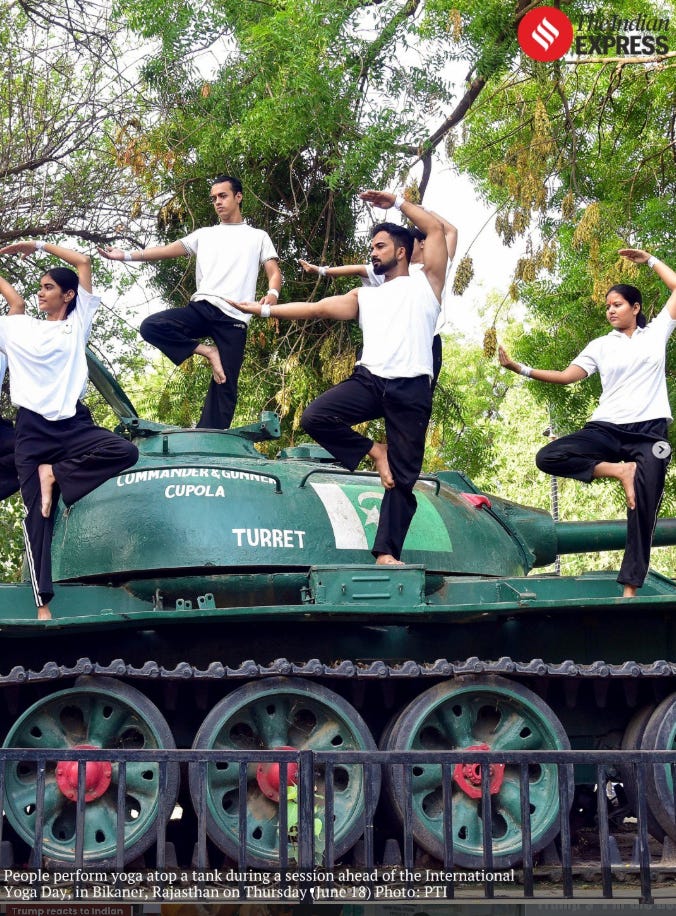
The West Bengal government was forced to clarify on Friday that participation in the International Yoga Day celebrations scheduled for June 21 in Kolkata – which the PM is expected to attend – is voluntary and not mandatory for state government employees. The clarification came after the Calcutta High Court disposed of a petition challenging an alleged directive that made attendance compulsory, with the state government informing the court that the communication was merely an appeal and not an enforceable order.
Meanwhile, the spectacle continues …
Confidence in robust defence preparedness takes on a different texture when ageing fleets are kept airborne through cannibalisation. India is set to receive nine retired British Jaguars for spares and sub-assemblies, as the world’s last remaining Jaguar fleet – already notorious for requiring around 20 hours of maintenance for each hour of flight – to sustain its six remaining squadrons of the Cold War-era fighter even beyond the 2030s.
Elsewhere in the constitutional courts of New India, the Madras high court has granted an interim injunction restraining a church official from constructing a church on public land in Coimbatore. The reason is that there is a Mariamman temple close by and some Hindus have opposed the church’s construction since 2011. Thus spoke Justices G.R. Swaminathan and V. Lakshminarayanan: “When Hindus constitute an overwhelming majority and they vigorously oppose the construction of a church in the immediate vicinity of the temple, then the authority must not casually brush the objection aside.” In the same breath the bench claimed that “we should not be understood as holding that if there is opposition, the state must submit to it”.
Coempt Edu Teck, the firm that made the on-screen marking system that the CBSE hastily rolled out for its class 12 board exams this year, has responded to the scrutiny surrounding its platform. Apart from denying allegations that the CBSE altered its tender requirements to favour it, Coempt also noted that almost 95% of students who requested soft copies of their marked answer papers had received them. What happened to the remaining 5% – or around 20,000 students – is unclear, reports Sanjay Maurya.
Speaking of the CBSE, the Supreme Court yesterday declined to give interim relief in a petition challenging the board’s new and contentious three-language policy for students of classes 9 and 10 (and above). Two of these three languages must be of Indian origin, so that necessarily means English and two other Indian languages. In much of north India the third language will likely default to Sanskrit, while in the south it could be Hindi, which was bound to stoke controversy.
Tomato, onion and potato (among other) prices have increased in large swathes of the country – with tomatoes becoming almost twice as expensive at Rs 53 per kilo in Delhi compared to last month – but farmers have been compelled to sell their produce at very low prices, the Samyukta Kisan Morcha has flagged. “Who is gaining from this increase … the corporate houses in the retail trade and big traders are gaining,” it said.
Among those in the Sangh parivar who have responded to Karnataka home minister Priyank Kharge’s call for the RSS to register itself is the BJP’s MP for Bijapur (Vijayapura) Ramesh Jigajinagi. “Why does a Dalit person need to get involved with the RSS?” he asked at a press conference. He also said that “no one who has messed with the RSS has ever survived”. Jigajinagi, who is Dalit himself, has previously criticised the BJP, saying it does not give space for Dalit leaders to grow. The cat is indeed out of the bag.
Ten airports or terminals in one state, six opened in a single day in early 2024 – PM Modi’s much-touted airport-building frenzy, as the Economist notes, is already seeing several facilities in decline within a year, looking less like planning and more like political ribbon-cutting on overdrive. “The fact that elections followed within a month was no doubt just one of those strange cosmic coincidences,” notes the British magazine. “Airports in places that most Indians could not find on a map either never saw a single flight or hosted a handful and then faded away. It was always an act of extreme optimism to think Saharanpur, an overgrown town of mostly poor people, could support an airport. Modi’s critics seized on the failures as evidence of the government’s obsession with vote-winning optics over governing substance.”
Kerala is cited in the UN Special Rapporteur’s Roadmap for Eradicating Poverty Beyond Growth as an example of achieving low infant mortality and advancing universal healthcare “despite decades of relative poverty.”
Amit Shah clears plan to equip police with portable fingerprint scanners
The police in India will soon be equipped with portable fingerprint scanners linked to a national database of 1.3 crore criminal suspects and convicts, “letting them stop individuals anywhere, even on the streets, to collect thumb impressions and instantly check for any pending criminal records,” repors Vijaita Singh in The Hindu. While portable fingerprint scanners have been introduced in the UK, the police need to have probable cause in order to check the biometrics of anyone on the street. If this system is operationalised in India, the legality of the police compelling an ordinary person – not under arrest and not reasonably suspected of a crime – to provide their fingerprint on demand is bound to be challenged in court.
Palestine seeks urgent Indian aid, says scale of health crisis ‘alarming’
The Embassy of Palestine in India has urged New Delhi and the international community to ensure the uninterrupted delivery of humanitarian and medical assistance to Palestinians, warning of a “catastrophic collapse” in the healthcare crisis in Gaza and the occupied West Bank as a result of the ongoing Israeli military offensive that has claimed 1,000 lives despite a ceasefire.
At a press conference yesterday, Palestinian Ambassador to India Abdullah M.A. Abushawesh described the situation in Gaza as dire. Addressing the Indian public and government, he asked, “If not India and the Indian people, then who? And if not now, then when?” arguing that timely aid could save thousands of Palestinian lives.
Anthropic CEO says Modi’s AI Summit was ‘disorganised’, a hollow PR exercise
Anthropic head Dario Amodei has called India’s recent AI summit “extremely disorganised.” In an interview with Bloomberg’s Emily Chang, Amodei also spoke of the moment on stage at the New Delhi event when he and his former colleague at OpenAI, Sam Altman, were forced to be in some proximity:
Emily Chang: There was a moment at India’s AI Summit where you and Sam Altman refused to hold hands on stage. What happened there?
Dario Amodei: What happened is that the summit was extremely disorganised. We all came up at the last minute and they like changed the order in which we were standing and then, like, they took a picture of us and then they ordered us all to, like, hold hands. You know, if you’ve ever been to one of these summits – I am not saying anything bad about India in particular – but like, all of these kinds of international type summits that have, like, heads of state are, like, super disorganised.
Emily Chang: Okay, but everyone else held hands. Come on.
Dario Amodei: I, I, look, I don’t know what to tell you. Okay? There was like, you know, Narendra Modi up there suddenly telling everyone to, like, telling everyone to hold hands.
Amodei’s remark has been shared by several Congress leaders among them Abhishek Singhvi who said on X that the summit was for “Artificial Image Management”.
The Long Cable
Until Everyone Is Safe? India’s Refugee Regime Says Otherwise
Kaveri and Jyoti Singh
Disorder, said Foucault, is often a manifestation of underlying structure. India’s lack of a refugee policy is a good example of this. The absence of a refugee law is not the product of legislative oversight but the means by which the state maintains arbitrariness towards various refugee groups.
The United Nation High Commissioner for Refugees (UNHCR) theme for World Refugee Day 2026, Until Everyone Is Safe asserts that safety is indivisible. It is a claim that sounds philosophical until you place it against India’s non-accession to the 1951 Refugee Convention. For a country born out of partition, an event that triggered one of the largest mass migrations in human history; this trajectory is particularly significant. Surrounded on nearly every side by conflict-affected, refugee-generating countries and territories such as Myanmar, Bangladesh, Afghanistan, Sri Lanka, Tibet etc. India’s evolving approach to refuge, citizenship and belonging deserves far greater analysis than it has so far received.
B.S. Chimni’s calls it strategic ambiguity: By declining to codify refugee protection in domestic law, the state has preserved maximum flexibility, extending protection when it is in alignment with its foreign policy and withholding when it is not. The consequences have been visible across decades. Tibetan refugees have been hosted in structured settlements; geopolitical assets carefully managed to neither fully antagonise China nor surrender the leverage they provide. Tamil Sri Lankan refugees were received across Tamil Nadu in a gesture that resonated with ethnic solidarity and regional politics. Afghan Sikh and Hindu refugees were evacuated to safety as well; neatly aligned with India’s domestic and foreign politics optics. India’s approach to humanitarian protection is openly driven by foreign policy and domestic political calculations.
Recent legislative developments in India suggest a shift from this earlier model of strategic flexibility toward a more formalised regulatory framework, codifying the prevailing arbitrariness. The Citizenship Amendment Act 2019 (CAA) and the Immigration and Foreigners Act 2025 together mark a decisive departure from strategic ambiguity toward a more structured regime of citizenship and migration governance through constitutional legitimacy. This is what scholars of democratic backsliding have begun to call populist constitutionalism: the deployment of legal and constitutional instruments by elected governments to redefine who belongs, who deserves protection, and who can be legitimately excluded, all within the formal bounds of democratic procedure.
The reasoning behind the CAA is quite simple, although the significance it carries is contentious. The law allows for the expeditious conferment of citizenship on some minority religious groups from Afghanistan, Bangladesh, and Pakistan but does not include Muslims in its scope. Through this, religion is brought out explicitly as a criterion in the citizenship framework, marking a notable departure from the previous approaches that were not formally structured around explicit religious identity. This distinction has prompted much discussion in terms of its constitutional, political, and humanitarian ramifications. Critics argue that the Act deviates from India’s usual practice in matters of refugee law, which takes into consideration only individual cases, as opposed to the inclusion of religion in this new Act as a determinative factor that affects one’s right to citizenship. The shift is widely read by scholars as reflecting the ideological framework of contemporary Hindutva politics, in which belonging is increasingly understood through religious and civilisational classifications. As Jayalakshmi Itla Ragiri argues, immigration law functions as an infrastructure of sorting that decides whose movement is travel and whose is invasion or ‘infiltration’, whose suffering counts and whose does not. The CAA institutionalises precisely such a logic, now embedded in Indian statute.
The Immigration and Foreigners Act 2025 consolidates this architecture further. By swapping fragmented legislation with an integrated approach that enhances state power of detaining, deporting and classifying individuals, it reduces the room for manoeuvre that was possible through discretionary administrative powers. Considered collectively, these laws may be seen as representing a major change in the law regulating immigration and citizenship, with substantial repercussions for refugee rights and the possibility of gaining legal status.
The consequences of this approach is perhaps clearly visible through India’s treatment of the Rohingyas. Fleeing genocide and statelessness in neighbouring Myanmar, Rohingya refugees in India continue to endure legally precarious conditions governed by surveillance, biometric registration and the constant risk of detention and deportation, caught between humanitarian claims for protection and the state’s concerns over security, migration and border governance.
During the Supreme Court hearing of a case related to Rohingya deportation in 2025, the Union government maintained that Rohingyas are governed by India’s existing legal regime for foreigners due to India’s non-accession to the 1951 Refugee Convention. Consequently, the Supreme Court viewed their case within the purview of the Foreigners Act, leaving the door open to their detention or deportation. Such developments have renewed discussions about the applicability of the principles of humanitarian protection like non-refoulement in the absence of a proper refugee protection regime. The absence of an asylum law in India means that such questions continue to be answered through the broader immigration and foreigners’ legislations. An Asylum Bill was introduced in Parliament in 2015 and again in 2021, but was never passed..
According to the International Rescue Committee, 118 million people remain forcibly displaced worldwide, a figure that has doubled over the past decade. Resettlement is at its lowest since 2011. Asylum backlogs have grown over the years. Nearly 70% of refugees are hosted not in wealthy nations but in low and middle-income countries, many of them India’s neighbours. The global architecture of protection is under strain everywhere. The evolving laws in India raise some pertinent issues concerning the provisions of protection and the need for balance between refugee management and considerations of sovereignty, security and citizenship.
The UNHCR theme says Until Everyone Is Safe. However, the trend in recent legislative measures indicates that there is an increasing emphasis on legislative categorisation of who qualifies as a refugee and who is excluded from this category, which is based on religion, nationality or political interest. The implications of this question extend far beyond refugees and asylum seekers, shaping the contours of protection, humanitarianism, citizenship, and belonging in India in the years ahead.
Kaveri is an assistant Professor at Azim Premji Universit. Jyoti Singh is an advocate based in Delhi.
Reportedly
India’s sense of nationhood is so fragile, per the Maharashtra police, that the idea of a Pakistani song being danced to at a school was enough to invoke the new sedition law (i.e. section 152 of the BNS, which deals with acts endangering the sovereignty, unity and integrity of India), against two persons along with other provisions pertaining to promoting enmity and spreading misinformation affecting national integration. The school’s principal has said that the song was actually Turkish and that they never showed the photograph of someone being deemed as ‘Pakistani extremist Mumtaz Qadri’. Do our jails have enough room for everyone who’s enjoyed ‘Pasoori’ or a Nusrat Fateh Ali Khan song?
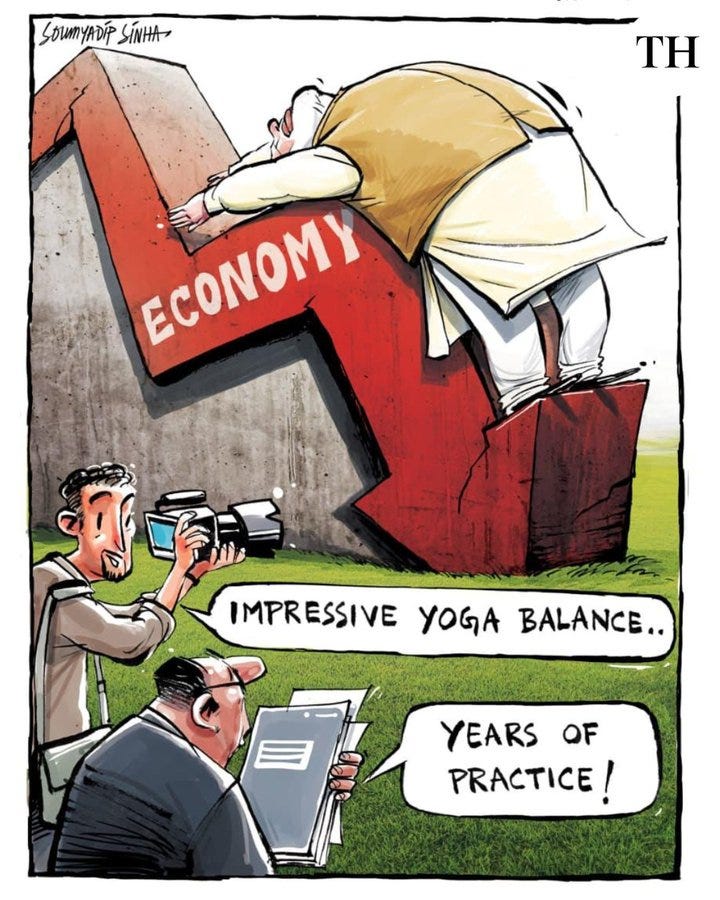
Drawn and quartered
Deep dive
Read Aakar Patel’s incisive analysis of how India’s media has lost both its independence and its financial strength under PM Modi. Backed by hard numbers, he shows how the industry has shrunk dramatically – yet much of the mainstream media continues to behave as if nothing has changed.
Prime number: 84 days, but who’s counting
A septuagenarian lawyer approached the Supreme Court to complain that his appeal for inclusion into the West Bengal voter rolls has been pending from March 27, i.e. for 84 days now, after he was left out citing ‘logical discrepancies’ in his data during the state SIR even though he has practiced in the local court for over 50 years. The bench asked the relevant appellate tribunal to hear his case out of turn. That’s anyway too little too late for the lawyer, who has missed voting in the assembly elections – as did 27 lakh others like him – for the unprecedented reason that there was not enough time for the tribunals to hear their appeals. Last month the Indian Express‘s Damini Nath had reported that the tribunal in this lawyer’s district of Murshidabad had disposed of only 100 cases as of the 14th.
Opeds you don’t want to miss
Dropping ‘Indo-Pacific’ clarifies the Pentagon’s China strategy, writes Ken Moriyasu. “By removing ‘Indo’ from the name of its largest command, US has told India, China, its allies and Pakistan exactly where they stand.”
Modi and Trump’s meeting in Evian was less about warmth than utility, says Manoj Joshi. The two sides have important business to conclude with each other but the relationship is clearly on a “more transactional and perhaps difficult plane” than before.
“High-stakes centralised exams like NEET are driven by a coaching-market economy that creates powerful economic incentives for malpractice” and in such a context more centralisation simply will not help, Arun Kumar P.K. argues. Instead, a more federal model may have the key. “Alternatives like multiple pathways, state autonomy [and] portfolio-based admissions are not untested idealism, they are the norm in most countries that produce competent doctors,” he points out.
Jawhar Sircar, who resigned from the Trinamool Congress and as Rajya Sabha MP on conscientious grounds two years ago, appeals to the party’s rebels both in Bengal and in parliament to resign and then seek re-election without the taint of defection. And as for the BJP, he writes:
“People are watching as the BJP relishes eating an infected TMC with a knife and fork and some tomato sauce on the side. They pray that they do not suffer indigestion or food poisoning. After all, not every body is Neelkantha Mahadev, the god who could swallow poison without any harm.”
The recent U.S.-mandated shutdown of access to Anthropic’s advanced AI models for non-Americans was a warning about the dangers of technological dependence, writes Rohit Kumar. Countries and companies that rely on foreign AI platforms can suddenly find themselves cut off by geopolitical decisions beyond their control. With AI becoming strategic infrastructure, India must invest in domestic capabilities, compute infrastructure, legal safeguards and sovereign technological capacity rather than assuming continued access to American AI systems.
Listen up
Rathin Roy dives deeper into his argument – which he presented in Wednesday’s Economic Times – that India’s growth is accumulating among the rich while the state pays for the welfare of the poor, “leaving the vast majority of the middle class in a state of income/consumption stagnation”. Tune in to his conversation with M.K. Venu.
Watch out
BBC follows the life of Shanti Rajput, a construction worker in Lucknow – a glimpse into the realities faced by millions of women labourers in the country.
Over and out
On history and its rather recurring buffoonery.


That’s it for today. We’ll be back with you tomorrow, on a device near you. If The India Cable was forwarded to you by a friend (perhaps a common friend!) book your own copy by SUBSCRIBING HERE.