
A newsletter from The Wire | Founded by Sidharth Bhatia, Siddharth Varadarajan, Sushant Singh, Seema Chishti, MK Venu, Pratik Kanjilal and Tanweer Alam | Contributing writers: Kalrav Joshi, Anirudh SK
If you like our work and want to support us, then do subscribe. Sign up with your email address by clicking on this link and choose the FREE subscription plan. Do not choose the paid options on that page because Stripe – the payment gateway for Substack, which hosts The India Cable – does not process payments for Indian nonprofits.

Our newsletter is paywalled but once a week we lift the paywall so newcomers can sample our content. Today is that day. To take out a fresh paid subscription or to renew your existing monthly or annual subscription, please click on the special payment page we have created – https://rzp.io/rzp/the-india-cable.
Snapshot of the day
March 27, 2026
Sidharth Bhatia
Germany’s foreign minister Johann Wadephul has said the United States and Iran are in “indirect contact”, with representatives from both sides expected to meet “very soon” in Islamabad. Speaking to Deutschlandfunk, as cited by The Financial Times, Wadephul said preliminary engagements had already taken place through indirect channels, and efforts were now focused on arranging direct talks. “Based on my information, there have been indirect contacts, and preparations have been made to meet directly. That would be very soon in Pakistan,” he said, indicating that an in-person meeting in Islamabad is a strong possibility.
The emerging mediation effort by Pakistan has gained high-level traction and, if realised, could mark a significant diplomatic development. The dynamic also highlights a contrast in regional approaches, with Pakistan appearing more open to hosting third-party talks, even as India appears sidelined in the “peacemaking” efforts under Prime Minister Narendra Modi, notes The New York Times. “Unlike India, Pakistan is enthusiastic about third-party mediations. India’s position with regard to the war in Iran was made awkward by Modi’s vaunted closeness with Benjamin Netanyahu, Israel’s prime minister, who hosted him in Tel Aviv two days before Israel and the United States attacked Iran.”
India is also moving to revive Russian Liquefied Natural Gas (LNG) imports and ramp up crude purchases despite US pressure, as tensions in the Middle East squeeze energy supplies and reshape New Delhi’s strategic calculus. Russia – which has maintained close ties with India since the Cold War – is also reportedly pressing its advantage. Any new LNG agreement is likely to come on less favourable terms for India compared with the 20-year supply deal signed in 2012 between India’s state-owned GAIL and Russia’s Gazprom. “It is now a seller’s market,” Reuters reports citing sources.
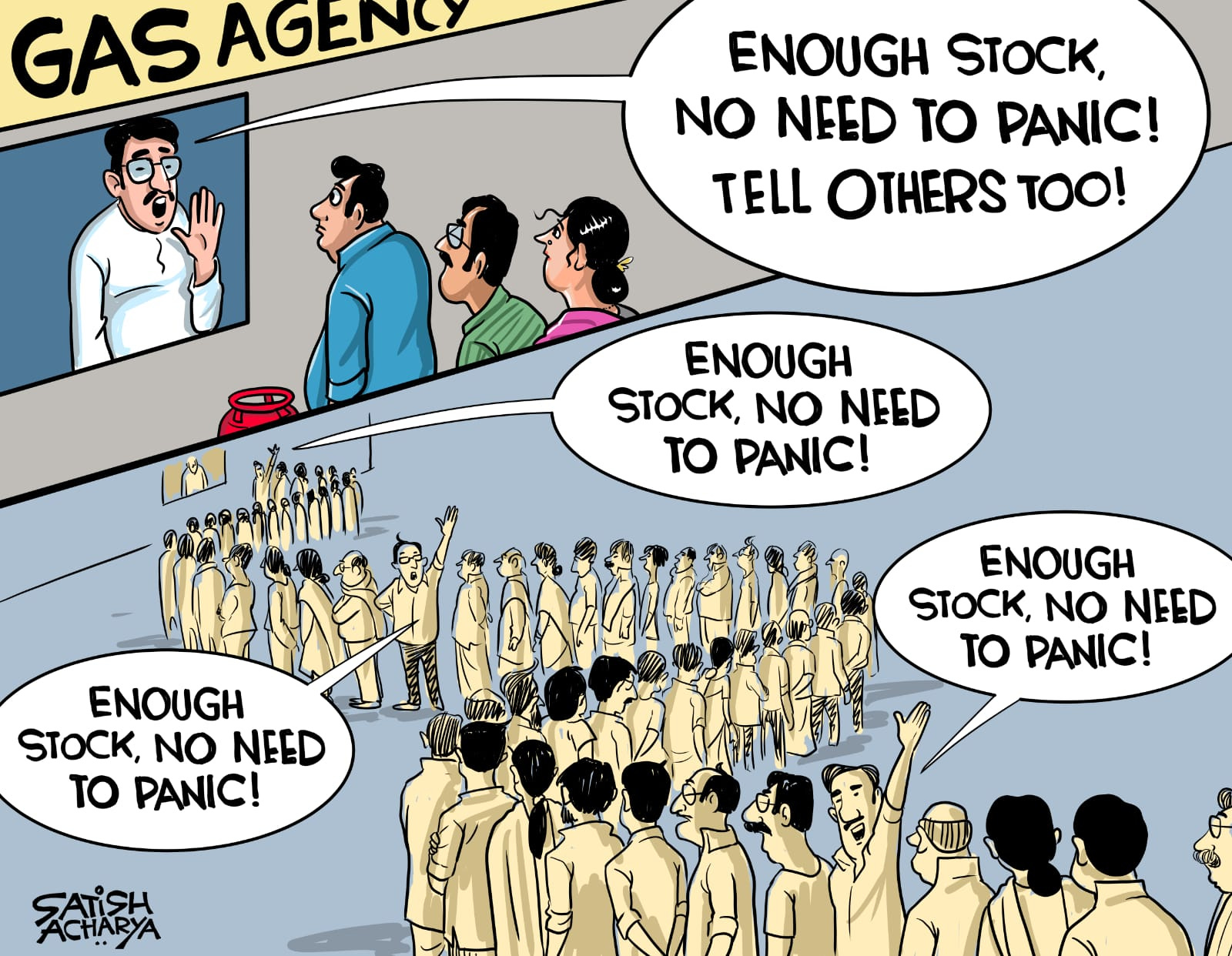
The Modi government, feeling the pinch (and punch) of the energy squeeze, was forced to reduce the special additional excise duty on petrol to Rs 3 per litre and brought it down to zero for diesel, with Petroleum Minister Hardeep Singh Puri saying the government had to choose between drastically increasing fuel prices or taking a “hit on its own finances” to protect buyers. He also debunked rumours of an impending nation-wide lockdown as a result of the energy crisis, saying they are “completely false” and that India is “resilient”, even as long queues have been reported at fuel stations across the country.
The move comes as global crude prices have risen steeply from about $70 a barrel a month ago to around $111. With retail prices unchanged, Oil Marketing Companies (OMCs) have been absorbing the additional costs rather than passing them on. The excise duty cut is expected to ease this burden on OMCs.
However, the decision has raised a broader question: if the Modi government could intervene now to support OMCs amid rising prices, why were similar steps not taken earlier when crude prices were significantly lower? During that period, OMCs benefited from cheaper imports, but retail fuel prices remained unchanged, offering little relief to common people.
The Opposition hit out at the centre over its excise duty cuts on fuel, calling the move “late” and politically motivated, timed with upcoming assembly elections in states like West Bengal and Assam rather than aimed at providing genuine relief. “When global crude oil prices fell as they did on seven different occasions in the past 12 years, consumer prices in India were not reduced. Today’s announcement was because of assembly elections. Wait till April 30th,” Congress general secretary Jairam Ramesh wrote on X.
According to Vivek Chaturvedi, chairperson of the Central Board of Indirect Taxes and Customs, the excise cuts will cost the government Rs 70bn ($739m) every fortnight. Of this, about Rs 15bn will be recovered through export taxes on certain fuel products, leaving a net impact of Rs 55bn per fortnight on government finances. Meanwhile, finance authorities reimposed export taxes on diesel and aviation fuel, raising them to 21.5 rupees ($0.23) and 29.5 ($0.31) rupees per litre respectively, after previously scrapping them in 2024.
The rupee weakened to record lows amid mounting economic pressure as the strain of rising oil prices intensified. The currency declined 0.9% to close at 94.8125 after hitting an all-time low of 94.84 against the dollar. It has fallen about 4% since the conflict began at the end of February and is down 11% in the current fiscal year.
At the same time, foreign investors have been pulling out of Indian markets, reflecting concerns over inflation and growth as oil prices surge due to the conflict. Since the start of the war, they have sold a net $12.14bn worth of Indian equities, marking the largest monthly outflow on record.
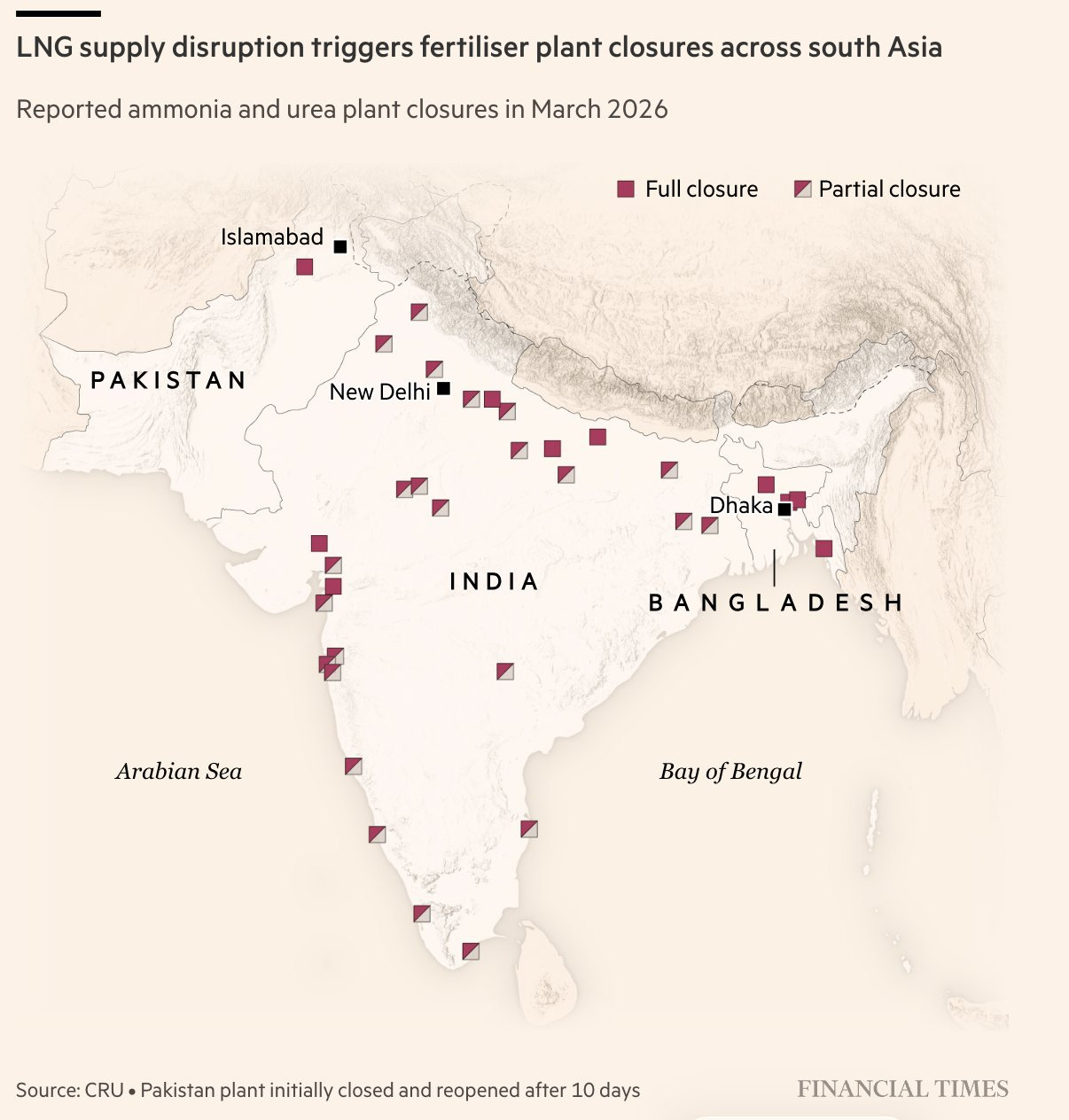
And by the way, Mauro Gilli points out, citing The Financial Times, that the war in Iran could have far-reaching consequences for global food security, particularly in South Asia, with India especially exposed as disruptions to LNG supplies force fertiliser plant shutdowns – since without natural gas, the production of ammonia and urea, the key nitrogen fertilisers, cannot be sustained.
Having moved to Iran as students and labourers, many Afghans are going back to Afghanistan – which is already reeling from the return of tens of thousands expelled earlier by Tehran and Islamabad – due to the danger from the US-Israeli airstrikes. In the case of Afghan workers their families across the border too are affected due to the halt in remittances. And the women among these returnees must now live with the Taliban’s highly misogynistic restrictions. Elian Peltier reports.
Thirty-five year-old Balendra Shah has taken oath as Nepal’s prime minister – he has the distinction of being the country’s youngest. Prime Minister Narendra Modi congratulated him on X, writing that he hoped the two of them can take bilateral relations to “even greater heights”. Separately, external affairs minister S. Jaishankar also congratulated his new opposite number Shisir Khanal. The new Nepali government is being formed on the back of an early election triggered by the violent protests of September last year that ousted the then-regime of K.P. Sharma Oli. The latter lost from his backyard seat of Jhapa-5 earlier this month.
Eight MPs have written to Union information and broadcasting minister Ashwini Vaishnaw asking that the Central Board of Film Certification re-examine its oral ban on The Voice of Hind Rajab – whose release in India has been held up ostensibly for fear of denting Indo-Israeli ties – in accordance with the constitutional values undergirding freedom of expression. The parliamentarians are John Brittas, Jairam Ramesh, Ram Gopal Yadav, Javed Ali Khan, Manoj K. Jha, Salma, Haris Beeran and Sarfaraz Ahmed, all belonging to or nominated by opposition parties.
Calcutta high court Justice (retired) Sahidullah Munshi is ‘humiliated’ and ‘pained’ that his name, which was one among 60 lakh names undergoing adjudication post the contentious special intensive revision, has been deleted from West Bengal’s voter rolls. He pointed out to Tanusree Bose that his documents were already vetted when he was elevated to a judge of the high court.
Bangladesh’s high commissioner in New Delhi, M. Riaz Hamidullah, said at an event on Thursday marking 56 years of Bangladeshi independence that while the two countries share a relationship that is rooted in history and moulded by a shared culture and geography, “should there be difficult or sensitive issues, those can and ought to be addressed forthright”. His remarks come amid a thaw of sorts in Indo-Bangladeshi ties following the election of Tarique Rahman as prime minister in Dhaka. They also come ahead of an unofficial visit to India by the new Bangladeshi foreign minister, Khalilur Rahman, on April 8.
The Modi government’s proposed amendments to the Foreign Contribution Regulation Act (FCRA) are “dangerous and alarming” in their implications, the Catholic Bishops’ Conference of India, the apex body of the Catholic Church in the country, said, expressing “grave concern”.
Bodoland People’s Front chief Hagrama Mohilary is a regional leader who has adopted rhetoric at odds with Hindutva, especially the Muslim-bashing of Himanta Biswa Sarma, and is known to have stood up to the BJP. Then why has he allied with the ruling party for the upcoming assembly elections? It’s probably because the Bodoland Territorial Council he heads is dependent on the Union government for money, analysts speaking to Rokibuz Zaman point out. “If the same party is in power at both the Centre and the state, then it puts more pressure on them,” one of them said. Still, there is a risk for the BPF here: given the BJP’s track record it may stand to become subsumed by its larger ally.
A similar risk looms over E. Palaniswami, who has taken his Anna Dravida Munnetra Kazhagam back into the NDA ahead of the Tamil Nadu assembly elections. His actions in the recent past, including travelling to Delhi twice to meet Amit Shah, and his smaller NDA partners’ attempts to directly negotiate seat-sharing with the BJP had bolstered the idea that Palaniswami could end up as “Tamil Nadu’s Nitish Kumar”, D. Suresh Kumar writes. However the former chief minister has recently taken steps to reclaim a larger role in the alliance, he points out.
Indian football was hit by another off-field controversy on Thursday, as national team head coach Khalid Jamil and three players were denied entry into Kochi’s Jawaharlal Nehru International Stadium ahead of their AFC Asian Cup qualifier against Hong Kong, reportedly due to a pending payment to the Greater Cochin Development Authority (GCDA), reports Reuters. The incident disrupted pre-match media commitments, with players Ashique Kuruniyan, Sahal Abdul Samad and Bijoy Varghese stopped at the gates along with Jamil, raising questions over administrative coordination as the team prepared for its first match in Kochi in nearly a decade.
Booker Prize winner Arundhati Roy has just picked up another major honour – the US National Book Critics Circle Award. On top of that, her powerful memoir Mother Mary Comes to Me has also been shortlisted for the prestigious Women’s Prize for Non-Fiction 2026.
Veterans disconcerted by decorated general’s official lecture on Bhagawad Gita
Many military veterans are unhappy that General Neeraj Varshney, a highly decorated commandant of the Military College of Electronics and Mechanical Engineering in Secunderabad, delivered a lecture on the Bhagavad Gita at the College of Defence Management on Wednesday and that Headquarters Integrated Defence Staff has officially endorsed this. One three-star Army veteran speaking to Rahul Bedi reasoned that the CDM is an apex institution meant to train mid-career personnel and that ‘diverting that space towards Hindu religious texts risked eroding both focus and professional credibility’. Some veterans also said that the general’s speech marked an ‘unwarranted’ fusion of personal religiosity with the military’s secular ethos.
HC does not quash FIR against UP reverend for purportedly saying Christianity is the only true faith
One reverend Vineet Pereira approached the Allahabad high court seeking that the case against him alleging outraging of religious feelings be quashed. But Justice Saurabh Srivastava declined, holding that Pereira’s frequent remarks per the FIR that Christianity is the only ‘true’ religion were “wrong” and “[imply] a disparagement of other faiths”. Hence it cannot be said that a prima facie case does not exist, the judge said in a recent order. Meanwhile, a cursory Google search reveals that Uttar Pradesh chief minister Yogi Adityanath as recently as September 2024 said that sanatan dharma “is the single true religion”, any “threat to [which] poses a danger to humanity as a whole”.
Sanitation workers protest deaths due to hazardous cleaning of sewers, septic tanks
Sanitation workers and family members of workers who were killed while undertaking hazardous cleaning of sewers protested against such deaths at Delhi’s Jantar Mantar Road on Wednesday. The Safai Karmachari Andolan and its convenor, the Magsaysay Award winner Bezwada Wilson, noted that the Union government’s figures on the number of people killed while undertaking such work always tallies lower than their own figures. They demanded a national apology from Prime Minister Modi for deaths in sewers and septic tanks – the hazardous cleaning of which is conspicuously excluded from the definition of manual scavenging – as well as an action plan to stop such deaths.
The Long Cable
US Hegemonic World Order, the West Asia Crisis and the Security of Weak States
Nazir Mir
An international order is supposed to ensure the security of states. The so-called international liberal order was sold on the premise that it had something for most, if not all, countries. Now, with signs of United States (US) decline and a crisis in the world order it had shored up, Washington appears most threatened by the prospect of changes to that order.
This is clear in US imperial policies, which the country has pursued while masking them as efforts to help people liberate themselves from what are labelled as oppressive regimes. As Robert Vitalis argues in White World Order, Black Power Politics, “The project of liberation was from its inception (and by necessity) a world-spanning political and theoretical movement in response to the theory and practice of white supremacy.” This posture of imperial policy makes the statement of President Trump – “I’m willing to live with” the fact that 165 school girls were killed – appear normal.
All efforts are being made to protect the racist international order that the US shaped at the end of World War II. Secretary of State Marco Rubio made this clear at the Munich Security Conference in February 2025, where he invoked the apparent superiority of “Western civilisation”. Rubio said, “And finally, we can no longer place the so-called global order above the vital interests of our people and our nations. We do not need to abandon the system of international cooperation we authored, and we don’t need to dismantle the global institutions of the old order that together we built. But these must be reformed.”
From this position, it can be inferred that the crisis in the world order is essentially a crisis of legitimacy, driven by voices from the Global South seeking equality and fairness. Therefore, the US will seek to influence and shape the emerging new order in line with its interests.
For this, Washington seems keen to push its allies into joining its wars, without even attempting to build consensus. The ongoing US-Israel invasion of Iran, which started on February 28, has sent a clear message: when it comes to the US interests, it not only flouts the basic principles of the existing order but can also trample upon the rights of those it associates with its opponents.
More importantly, the US can, at will, take its weak allies for granted and overlook their security concerns. President Donald Trump did not spare even Spain, a NATO ally, when it refused to support his illegal war on Iran. He responded with threats that the US could use Spain’s military base unilaterally and “nobody is going to tell us not to use it”.
An order for the hegemon
Alliances in international politics are generally forged on the basis of converging interests of the alliance partners, which are meant to maintain peace and the security of all members. This implies that each member state in the alliance gets a say in alliance decisions and that its security concerns are taken into account when such decisions are made.
In the case of the US, however, alliances seem to take on a different meaning. Membership in a US-led alliance or world order implies subservience of its members and the partners giving preference to US interests. There is a growing realisation of this dynamic not only in the non-West but in the West as well. At the Munich Security Conference, Canadian Prime Minister Mark Carney pointed out that “great powers have begun using economic integration as weapons, tariffs as leverage, financial infrastructure as coercion, supply chains as vulnerabilities to be exploited”.
In the context of the Russia-Ukraine war and the Iran war, countries like India – and Russia as well – are victims of a policy to weaponise oil. First, New Delhi was forced to stop buying oil from Russia; then, with Iran blocking the Strait of Hormuz and creating a supply shortage, the US gave it “permission” to resume buying Russian oil.
Thus, the US does not seem prepared to give up its hold over the world. By attacking Iran, it not only blatantly flouted international law, but also coerced its weaker allies into rallying behind a narrative rolled out by Washington – that Iran posed an imminent threat to global peace, was pursuing nuclear weapons, aimed to attack the US and its allies and so on.
In the end, in the context of the West versus the Global South, President Trump was trying to uphold the existing world order by resorting to older tactics of racialised and demeaning policy towards a southern country. The US can possess thousands of nuclear weapons – and remains the only country to have used them twice – yet Iran’s uranium enrichment program for civilian use is cast as dangerous. Various reports have stated that Iran was not planning to attack the US, nor seeking to build nuclear weapons.
A sense of regional security
In the US, the war on Iran is being debated, and many argue that Trump invaded Iran because of the influence of the pro-Israel lobby and Israeli Prime Minister Benjamin Netanyahu. If so, America is fighting Israel’s war. Despite their differences with Iran, it is unlikely that Gulf countries would prefer a stronger Israel at the cost of an unstable Iran – at least that is what a strategic calculation would dictate.
Moreover, despite hosting US military bases and bearing significant costs associated with that, many in Washington do not seem to think the Gulf states are doing enough. It wants the Gulf countries to join the war – one that even the US’s NATO allies have refused to join. Republican Senator Lindsey Graham has, for instance, been critical of Gulf countries publicly, demanding that they join the US-Israel war against Iran, and warned Saudi Arabia of “consequences”.
Some in the Gulf appear aware of the larger game at play. As the former prime minister of Qatar Sheikh Hamad bin Jassim noted in a tweet, the region should avoid being drawn into the war on Iran. He warned that “there are forces that want the [Gulf Cooperation] Council’s states to become directly embroiled with Iran.” He added that any such engagement would “deplete the resources of both sides and provide an opportunity for many forces to control us under the pretext of helping us escape the crisis”.
The Gulf region thus offers an instructive instance of how a security architecture formulated by a global hegemon who believes in an inherently racist world order cannot guarantee security. Instead, it risks endangering the security of others through pursuing policies and waging wars that are meant to shore up its political and economic hegemony.
To avoid getting dragged into the conflicts of a hegemon and its imperial ambitions, the ongoing US-Israel war on Iran offers an instructive lesson. Countries – particularly the Global South – can deepen regionalism and develop some regional security architectures to make themselves independent of the US-led world order. In the absence of an alternative global hegemon, regional security arrangements may help create balanced regional orders, diminishing the perceived need for a global hegemon.
Moreover, a regional security framework would help mitigate military conflicts within these regions themselves. The US-Israel invasion of Iran illustrates how even unwilling European countries – those not even informed about the invasion – could be pulled into rallying behind the US-Israel alliance. In fact, till the evening of February 27, the discussions were about NATO and the Western-led world order being under strain. After the invasion of Iran, even the Canadian Prime Minister threw his weight behind the US-Israel alliance and justified it.
If countries in the West can overcome their severe differences, those in various regions of the Global South should not find it as difficult to overcome theirs. In fact, compared to tensions within the West, where President Trump has threatened partners such as Canada and Greenland and openly criticised Germany – differences across much of the Global South remain manageable. They can start by identifying the issues that unite them and address local and regional security concerns.
Nazir Ahmad Mir holds a PhD in Conflict Analysis and Peace Building and is a Non-Resident Fellow at the Research Centre for Asian Studies, Hong Kong.
Reportedly
Uttar Pradesh’s “Rs 25,000 crore” MoU with Puch AI firm lasted only four days after it was announced, all thanks to a community note appended to the CMO’s X post casting doubt on the company’s ability to execute the deal. Invest UP has announced that the MoU stands cancelled because “due diligence showed lack of net worth and credible financial linkages for the project’s scale” (where was this due diligence before such a costly deal was announced?). The community note had recalled that Puch AI is barely a year old and claimed it earns less than Rs 50 lakh a year, although the firm’s co-founder has contested this. Puch has made audacious announcements in the past. Last year it had also made an “$50B unsolicited offer” to buy the Perplexity AI firm.
Drawn and quartered
Deep dive
Fourteen Muslim men who gathered for an Iftar on a boat in the river Ganga now find themselves lodged in a Varanasi jail, facing a case marked by contradictions and apparent gaps. The charges against them have since been escalated to extortion – an offence carrying a 10-year sentence. As Shinjinee Majumder reports, several aspects of the case remain unclear: the boat owner’s account appears at odds with the extortion allegations; what exactly transpired on the boat is disputed – whether bones were thrown or hands were merely washed; there is little clarity on the evidence cited; and the complainant’s version of events has shifted repeatedly.
Prime number: 1,11,185
That’s the number of things the Union home ministry’s Indian Cyber Crime Coordination Centre took off the internet under section 79(3)(b) of the IT Act – via the contentious Sahyog portal – between its formation in March 2024 and end-March 2025, the ministry has revealed in its annual report. That averages to some 291 pieces of content a day.
Opeds you don’t want to miss
“For all its preening proclamations of its own rise and importance on the world stage, Modi’s ‘New India’ proved too inconsequential to influence the warmakers—and too weak, craven, and self-woundingly stupid to be spared the war’s effects,” writes Kapil Komireddi, examining how Modi became Washington’s lapdog.
While India under Modi has sought to break from its Nehruvian foreign policy, Sarayu Pani notes that “Iran, by positioning itself as the only country in the world today with the courage to take on both the US and Israel militarily has made itself into a living symbol of legitimate anti-imperialist aspirations. Iranian public diplomacy has successfully conveyed this framing of the conflict to the Indian public.”
The contentious Transgender Amendment Bill reflects not only a worldwide “unease around ideas of gender unfamiliar to the government”, but also a colonial mentality that is at odds with Indian history, writes Dhrubo Jyoti. “For a country that once took the lead in recognising diverse identities and has historically been more tolerant of non-normative expressions of gender, the amendments represent a step backwards. They are the opposite of decolonial.”
Suresh Menon feels dimly about Sunil Gavaskar’s remark suggesting that the Sunrisers indirectly contributed to funding Pakistani terrorism by purchasing bowler Abrar Ahmad for The Hundred tournament. He writes: “There is something disturbing about a national figure, a hero to millions mouthing the kind of stuff that is the preserve of social media trolls. If we see parts of ourselves reflected in our heroes, then this is not a wholesome reflection.”
In The Economist‘s divergent coverage of a few recent events: its encouragement of Washington’s blockade against Cuba, but its anger at Trump’s desire to ‘acquire’ Greenland and its decision to carry the Omani foreign minister’s article condemning the US-Israeli attack on Iran – Srinivasan Ramani sees a lesson for all editorial writers from the Global South. “The editorial writer’s dependence must be qualified with the ability to read accounts in the Western press critically,” he cautions.
Listen up
Should men be able to take paternity leave in India? That’s the question economist Ashwini Deshpande and lawyer Sanjoy Ghose discuss on this InFocus episode.
Watch out
“Gruelling hours, job insecurity, stagnant wages and rising living costs are pushing workers in tech, healthcare, government and the gig economy to the brink” in India yet the likes of N.R. Narayana Murthy and L&T’s S.N. Subrahmanyan insists that their compatriots work for 70-90 hours. “Can India achieve its development ambitions without sacrificing its workforce?” asks the Singapore-based CNA channel in this documentary.
Over and out
Ajay Kamalakaran takes us through archival material to understand how New Delhi and Tehran found common ground after the Islamic Revolution of 1979 overthrew the Pahlavi Shah.
That’s it for today. We’ll be back with you on Monday, on a device near you. If The India Cable was forwarded to you by a friend (perhaps a common friend!) book your own copy by SUBSCRIBING HERE.