
A newsletter from The Wire | Founded by Sidharth Bhatia, Siddharth Varadarajan, Sushant Singh, Seema Chishti, MK Venu, Pratik Kanjilal and Tanweer Alam | Contributing writers: Kalrav Joshi, Anirudh SK
If you like our work and want to support us, then do subscribe. Sign up with your email address by clicking on this link and choose the FREE subscription plan. Do not choose the paid options on that page because Stripe – the payment gateway for Substack, which hosts The India Cable – does not process payments for Indian nonprofits.

Our newsletter is paywalled but once a week we lift the paywall so newcomers can sample our content. *Today is that day.* To take out a fresh paid subscription or to renew your existing monthly or annual subscription, please click on the special payment page we have created – https://rzp.io/rzp/the-india-cable.
Snapshot of the day
February 27, 2026
Sidharth Bhatia
The opposition has come forward to accuse the Bharatiya Janata Party (BJP), now the ruling party in the national capital, of filing a “fabricated” case and “weaponising” investigative agencies for political gains. The remarks came after a special court today refused to take cognisance of the Central Bureau of Investigation (CBI)’s “voluminous chargesheet” in the Delhi liquor policy case and discharged Aam Aadmi Party national convenor and ex-chief minister Arvind Kejriwal, his former deputy Manish Sisodia, Telangana politician K. Kavitha and 20 others citing “misleading averments” and aspects not corroborated by witness statements and evidence. In its 598-page order, the court slammed the central agency for its handling of the investigation and flagged several lapses – ruling ‘no cogent evidence’ against Kejriwal and ‘prima facie case’ against Sisodia. Following the order an emotional Kejriwal, who has denied the allegations in the matter, addressed the media accusing Prime Minister Narendra Modi and Union home minister Amit Shah of “hatching the biggest political conspiracy of independent India”.
Below are few important pointers from this analysis by Scroll decoding what the court said while acquitting Kejriwal and Sisodia in the excise policy case:
“The court said that investigations by the CBI or the Enforcement Directorate cannot be allowed to enter the “political arena” on allegations of excessive electoral spending by a political party, reported Live Law. Permitting this would lead to the “criminalisation of electoral competition” and arm the executive with “coercive instruments capable of influencing political outcomes”, it added. The judge said that this would erode the level-playing that is “at the heart of free and fair elections”.
The judge further noted that once liberty is curtailed, it cannot be meaningfully restored by a subsequent acquittal. The passage of time cannot compensate for the loss of liberty because of pre-trial detention, he added. “The balance between the power of the investigating agency and the right to life and personal liberty is not a matter of legislative grace, but a constitutional command,” the court observed. “Any failure to maintain this balance is likely to undermine both the rule of law and public confidence in the administration of criminal justice.”
The court also said that the Enforcement Directorate making arrests and filing prosecution complaints in money laundering cases before the facts of a case are examined in the court “reveals a disturbing inversion of the statutory scheme”, Bar and Bench reported. The judge noted that once a person is charged under the Prevention of Money Laundering Act, they are required to meet stringent conditions for bail. “This results in a situation where an individual is deprived of personal liberty on the strength of an allegation whose legal sustainability remains uncertain,” the legal news outlet quoted him as saying.”
The investigation agency has said it will appeal the decision in the Delhi high court.
In other news, a Mumbai special court has accepted the Economic Offences Wing (EOW) closure report in the Rs 25,000-crore Maharashtra State Cooperative Bank (MSCB) case, effectively clearing Maharashtra Deputy Chief Minister Sunetra Pawar, the late Ajit Pawar, and over 70 others, reports Bar and Bench. The decision signifies a legal reprieve, significantly complicating the Enforcement Directorate’s (ED) parallel money-laundering probe which hinges on the EOW’s findings. The EOW concluded no criminal offense was committed, highlighting substantial loan recoveries and no financial loss to the bank.
Canadian Prime Minister Mark Carney has landed in Mumbai for the first leg of his India visit amid the two countries’ diplomatic reset – here he will meet business leaders and hold talks towards a trade agreement before heading to Delhi. His visit is also part of Ottawa’s strategy to reduce dependence on the US in light of Donald Trump’s tariff policy and rhetoric, but Sushant Singh writes that the Modi government’s response to Washington’s moves give reason for Carney to act cautiously. New Delhi’s halting purchases of Russian and previously Iranian oil in view of Trump’s sanctions, Singh writes,
“should worry Carney, because it suggests that Modi will not stand up to Trump if forced to choose between Washington and Ottawa … In that scenario, painstakingly negotiated energy or mineral deals, and even the nascent security framework, could be sacrificed without warning, leaving Canada exposed and overinvested in a partner that sees its North American hierarchy as non‑negotiable.”
Meanwhile in Canada, although a Carney government official told presspersons ahead of his visit that Ottawa no longer believes the Indian government is linked to violent crimes on Canadian soil, former national security adviser in the Justin Trudeau administration Jody Thomas has expressed some scepticism of this view. “It would be lovely to know that all of the threats and the interference have ended” but such a scenario would surprise her, she told Steven Chase of the Globe and Mail. Former national security analyst Stephanie Carvin told the newspaper that the unidentified senior official’s statement “seems to be bordering on the politicisation of intelligence”.
Even as the United States probes alleged corruption linked to Adani Group entities, Norway’s US $1.2 trillion sovereign wealth fund, the world’s largest, has decided to exclude Adani Green Energy Ltd (AGEL) from its portfolio due to concern about its alleged links to financial crime. Norges Bank, which had in May 2024 excluded Adani Ports and Special Economic Zone Ltd, on its website added AGEL to the list of companies that it has decided to exclude from its portfolio. It cited “gross corruption or other serious financial crime” as the criterion for its decision, but gave no explanation. When Norges Bank first bought AGEL shares in July 2020, the share price was Rs 341. Now it is Rs 944.
Police in Delhi have arrested 14 people, including JNU student union president Aditi Mishra, in connection with yesterday’s protest march against vice chancellor Santishree Pandit’s recent remarks claiming that some Dalit people are engaged in an untenable ‘permanent victimhood’. Students had planned to march from their campus in south Delhi to the education ministry on Raisina Hill but were held back by barricades and a heavy police presence at the university’s gate; in the scuffles that followed both students and the cops have accused the other side of violence. A total of 51 protesters were detained on Thursday.
Former Tamil Nadu chief minister and Anna Dravida Munnetra Kazhagam leader O. Panneerselvam today joined his former outfit’s long-time rival, the Dravida Munnetra Kazhagam, in Chennai and resigned as MLA. After meeting the chief minister and DMK chief M.K. Stalin, Panneerselvam blamed ADMK supremo E. Palaniswami for behaving “with arrogance and authoritarian tendencies” and dooming his former party to a “situation in which … [it] may never win in future”. The move by the Jayalalithaa loyalist, who was expelled from the ADMK in 2022, marks a “seismic realignment of the Tamil Nadu political landscape just a few months ahead of the legislative assembly elections”, notes The Hindu.
The Kerala High Court allowed the release of the film The Kerala Story 2: Goes Beyond, lifting a stay ordered a day earlier by a single-judge bench who had observed that the film could disturb communal harmony. [See Op-eds]
Union commerce and industry minister Piyush Goyal met his US opposite number Howard Lutnick in Delhi yesterday and the two men discussed trade and economic relations, days after the Supreme Court in DC scrapped Donald Trump’s ‘reciprocal’ tariffs. Lutnick, Reuters reports citing an unnamed Indian trade official, was here on a personal visit.
Goyal had earlier said that India and the US would resume talks towards the first tranche of a trade deal once the waters unsettled by the Supreme Court ruling became clearer. In the meantime India’s Russian oil supplies are projected to continue declining through this month and March, Bloomberg notes. With India diversifying its crude imports portfolio to include West Asian oil, and American forces building up in the region to posture against Iran, that leaves Indian refiners vulnerable to supply shocks, the news agency’s Rakesh Sharma writes. “Millions of barrels of Russian oil stored on tankers at sea could still provide Indian refiners with a quick and cheap solution,” he says, “provided they get the nod from New Delhi”.
Lok Sabha speaker Om Birla has reconstituted the three-member committee that, following a notice for removal proceedings was accepted in the House, is looking into the discovery of piles of cash in the residential premises of former Delhi high court Justice Yashwant Varma after a fire there. The move comes ahead of member Justice (retired) M.M. Shrivastava’s imminent retirement, Ayesha Arvind reports. The panel’s new members are Supreme Court Justice Aravind Kumar, Chief Justice of the Bombay high court Shree Chandrashekhar, and senior advocate at the Karnataka high court B.V. Acharya.
What exactly were the ‘consultations with state governments’ and ‘multiple stakeholders’ prior to the VB-G RAM G Act’s passage that Union rural development minister Shivraj Singh Chouhan referred to last year? Asked this question by LibTech’s Chakradhar Buddha in an RTI query, Chouhan’s ministry declined to provide an answer saying that the new rural employment scheme “has not yet been formally notified by the States/UTs and has not become operational”. It also indicated a reluctance to share “ongoing deliberations and decision-making relating to policy implementation”.
Apple is in talks with several Indian banks and global card networks as it prepares to launch its Apple Pay service in India, Bloomberg reports, citing people familiar with the matter. The iPhone maker is in talks with ICICI Bank, HDFC Bank and Axis Bank as it aims to introduce its payment service in India around the middle of 2026, the report said.
India’s emergence as a supposed global data-centre powerhouse is being hailed as an economic triumph, but the celebration looks increasingly premature, notes The Economist. As the British magazine writes, the benefits may just prove temporary:
“Whether Indians will benefit from all this is unclear. Data centres themselves only generate a significant number of jobs while they are being built. Jensen Huang of Nvidia, the leading seller of AI chips, has argued that the data-centre boom could be as good for India’s economy as the internet. That is optimistic. India’s data centres, once erected, become ghostly presences. Still, the country can reassure itself that it will soon control much more of the plumbing through which its enormous volume of data passes.”
Pakistan declares ‘open war’ with Afghanistan as both sides exchange deadly attacks
Pakistan and Afghanistan have exchanged deadly attacks over the last day and Pakistani defence minister Khawaja Asif has declared that the two sides are in “open war” with each other. After the Taliban on Thursday launched cross-border attacks in retaliation against Pakistan’s weekend air strikes along the Durand Line, the Pakistani military over the last night bombed targets in Kabul and Kandahar – Reuters says it attacked Taliban military targets in the two cities, marking the first time Islamabad has directly hit its former ally. Now the Taliban has said it has launched counter-attacks on Pakistani military installations. Both sides have claimed heavy casualties on each other. Moscow, Istanbul, Doha, Riyadh and Tehran have all reportedly offered mediation.
UN rapporteurs urge Modi government to investigate allegations of ‘hundreds of extrajudicial killings’ by law enforcement officials
Two UN special rapporteurs have urged the Union government to investigate allegations of hundreds of extrajudicial killings and thousands of torture-related deaths and injuries caused by law enforcement officials. Saying they had received “credible information indicating a pervasive pattern of excessive and often lethal use of force by police, especially in Uttar Pradesh and Assam”, the human rights experts pointed to the so-called ‘encounters’ and ‘half-encounters’ and expressed concern that “these operations appear to substitute lawful policing and due process with summary violence”. Dalit, Adivasi and Muslim individuals are disproportionately affected and there are allegations that those who have pushed for accountability have been harassed, they noted, calling for the Indian police force to be modernised.
Some disasters like Wayanad landslides were preventable, says Disaster Management Authority
The National Disaster Management Authority has in a recent compilation of ten disasters suggested that some of them, including the 2021 Chamoli avalanche, the 2023 Silkyara tunnel collapse and the 2024 Wayanad landslides, were preventable, report Neeraj Chauhan and Jayashree Nandi. The Chamoli avalanche points to the insufficiency of regular project assessments in the Himalayas while the Wayanad landslides showed that there were gaps in long-term risk mitigation and community preparation measures, they write. And the NDMA also noted that “environmental experts and geologists had repeatedly warned that the Char Dham project’s scale and pace exceeded the carrying capacity of the Himalayan ecosystem”.
The Long Cable
Reading for pleasure in the world’s biggest democracy
Ravinder Kumar
I did not grow up in a house that had books – not one novel or shelf of stories was read for pleasure or kept by our beds. The only books I knew were school textbooks and competitive exam guides – to pass exams, to move to the next class and later to try for a government job, which I did not get.
I was born into a Dalit household in north India. None of my forefathers attended school. My father studied through the eighth grade before leaving to work as a daily-wage labourer to support his family of five. When he died last year from a preventable medical tragedy, he left us resilience, integrity, endurance, medical bills and debt – but not a shelf of books.
Today, I am a graduate student in the United States. I read for work and for pleasure. But for much of my life, “reading for pleasure” was not a thing I could afford.
This is why I have been struck by the recent debate over whether India “reads for pleasure”. The argument began after an essay questioned how a country that hosts hundreds of literature festivals each year could still struggle with pleasure reading. It sparked a debate online in which many well-intentioned critics called the question patronising, a misrepresentation of Indian realities or “ignorant and irritating”.
Soon after, an Indian magazine published a confident rebuttal. It painted lush scenes of book fairs, invoked the vibrancy of multilingualism and marshaled publishing statistics to argue that the question’s premise was flawed. India’s reading culture, the rebuttal insisted, is public, collective and not reducible to Western measures of solitary leisure.
I do not dismiss the rebuttal. It is right that the English-language trade market is only one slice of India’s print ecosystem and that reading cannot be measured solely by sales charts. But it replaces one fragile assumption with another: it mistakes spectacle for substance.
A crowd at a book fair can mean many things, like curiosity, aspiration or simply a pleasant winter outing. None of that is insignificant, but conflating attendance with access is grossly problematic. Footfall is not a habit.
The International Kolkata Book Fair reports about 3.2 million visitors. Delhi’s fair claims roughly two million. Add Jaipur, Pune, Bengaluru and other marquee festivals, and you might generously reach eight to ten million entries in a good year. In a country of 1.45 billion people, that is well under 1% of the population – and these include repeat visits and are not all confirmed readers, not even necessarily book buyers.
The deeper question is not whether Indians read at all. Of course, they do – students read for exams, aspirants read for competitive tests and professionals read for credentials or promotions. But reading for pleasure – as a habitual, socially normalised activity – requires time, disposable income, quiet space, libraries, bookstores and the legitimacy of being a “reader”. These conditions have never been evenly distributed in India.
A book priced at Rs 300 may seem inexpensive to the urban middle class. Yet recent household expenditure data show that the average monthly per capita consumption expenditure in rural India is just over Rs 4,000. A single book can absorb more than 7% of a rural person’s monthly budget. Before we even account for the time required to read it, the purchase itself is a significant luxury.
At the same time, approximately 800 million Indians are provided with subsidised food grains through public distribution programs. That is more than half the population. In such a landscape, it is difficult to argue that pleasure reading is a mass habit simply because a few million people gather at urban fairs each winter.
India is a caste society, and caste shapes not only income and occupation but also proximity to knowledge. The higher one stands in the hierarchy, the more likely one is to inherit books, literate elders, the confidence to see oneself as a “reader” and the overall cultural capital. The lower one stands, the more likely it is that reading remains purposeful – a ladder out of poverty rather than a pleasure practice.
Educational inequalities based on caste and class remain well-documented, yet discussions of India’s “reading culture” often universalise the experience of a narrow, urban elite minority. A glance at prize lists and major festival lineups suggests that the same social groups disproportionately dominate publishing houses, prize committees, festival panels and literary visibility, whether in English or regional languages.
As a result, the claim that “India reads” frequently reflects the habits of those already embedded in print networks, while vast sections of the population remain structurally distant from bookstores, libraries and the inherited legitimacy that makes reading for pleasure feel more natural than aspirational.
India is not a single republic of print. It is what economists Jean Dreze and Amartya Sen once described as “islands of California in a sea of sub-Saharan Africa”. Parts of urban India resemble global cultural capitals. Other parts still struggle for basic amenities. More than half the population lives in rural areas. For many of them, the bookstore is hours away, if it exists at all.
Despite all that, things are changing – unevenly, but undeniably. Cheap mobile data and smartphones have brought text, audio and video content to millions. Dalit and other marginalised people are gaining access to educational institutions, books and reading materials; writers from these groups have been writing and publishing on digital platforms as well as in mainstream media, despite their small numbers and as they bypass traditional gatekeepers.
Social media can expose someone to a poem or a political text who might never set foot in a bookstore. Even this exposure is crucial. If someone attends a festival for selfies but leaves with a pamphlet or a name to Google later, that is meaningful. But exposure is not the same as structural equality. Reading for pleasure remains a privilege shaped by caste, class and access. Festivals and footfalls add texture to that story, but they do not resolve it.
My father never owned a book. This was not due to a lack of curiosity, but rather because the world he inherited did not allow for leisure reading. If India wants to claim a culture of pleasure reading, it must build the conditions and break the social and economic barriers that could make it normal in homes like my father’s, where books are not heirlooms of privilege but fixtures of everyday life. Because why should a small minority of Indians read for pleasure?
Ravinder Kumar is a PhD candidate at the University of Oregon’s history department.
Reportedly
In a discreet and tony part of Mumbai is a 4.3 acre property with a few bungalows called Silver Oak complex. It is not a stretch that anyone on the main arterial roads would ever see or even know of. In one of the bungalows lives Sharad Pawar and his family. This property was owned by a Parsi charity trust at one time—it was meant to belong to the community, but somewhere along the way, it became a ‘cosmopolitan’ trust and the Parsis disappeared, which is what allowed Pawar to move in this verdant part of Mumbai. How this happened nobody knows. Now, the Times of India reports, this will be ‘redeveloped’; which translates as the construction of many luxury towers that will be worth multiple crores. How many crores and who will move there is anybody’s guess.
Drawn and quartered
Deep dive
Is the Gujarat government’s proposal to require parental notification before marriages are registered legal? While the proposed changes “raise questions about personal liberty, autonomy and the right of consenting adults to marry whomever they like”, they also leave a number of questions unanswered. “They do not clarify what happens if parents object after being notified, whether such objections can affect registration or what safeguards exist for couples facing family pressure,” she writes.
Prime number: 5
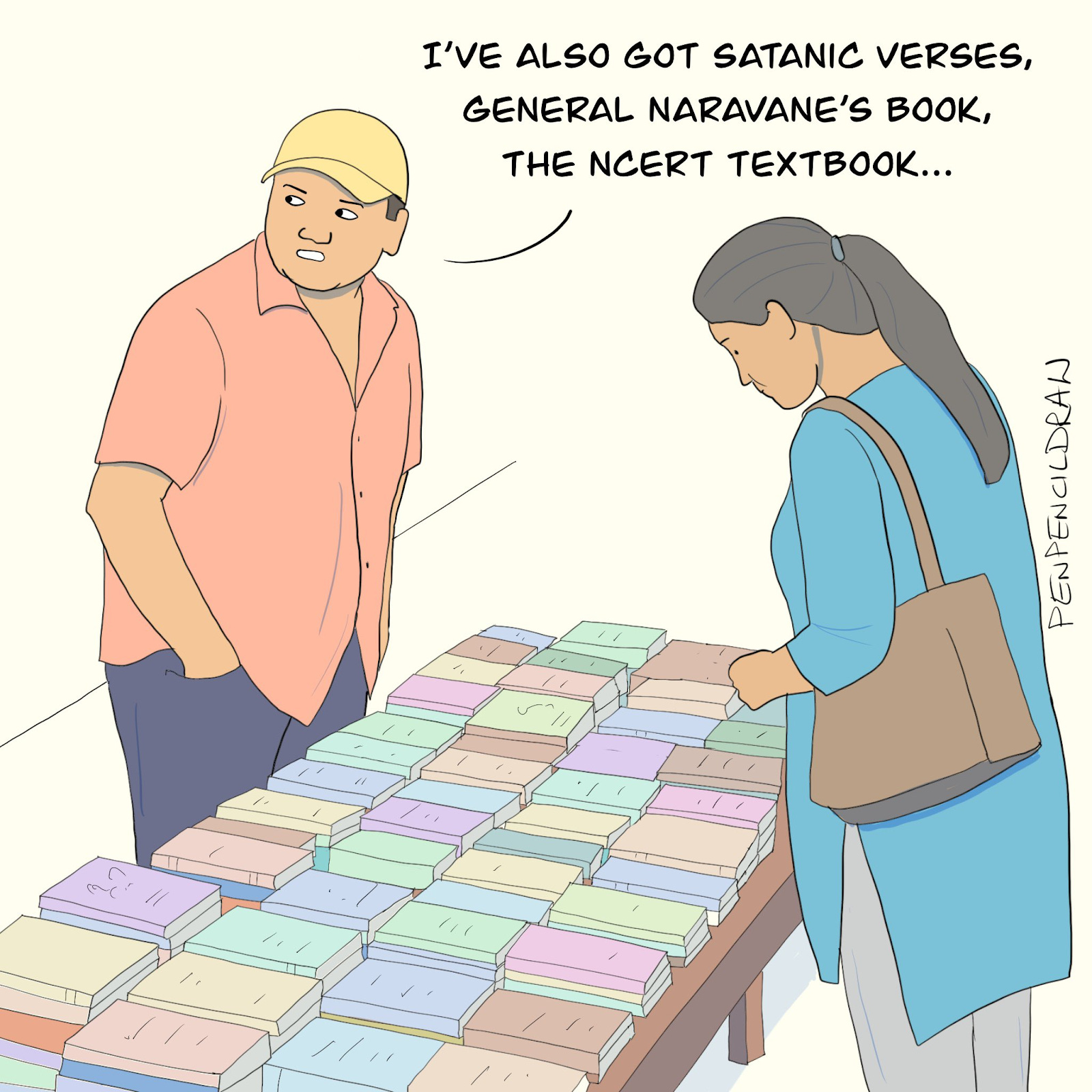
NCERT’s decision to withdraw from circulation its class 8 social science textbook that contains a section on ‘corruption in the judiciary’ is the fifth major decision that the authorities in charge of education have had to roll back in the face of contention in the last year and a half, Anubhuti Vishnoi writes. The other four are the UGC’s anti-discrimination guidelines, the Union government’s attempt to restructure Panjab University’s senate and syndicate, a draft UGC regulation on how vice chancellors would be appointed and the National Testing Authority’s ‘grace marks’ mechanism after the NEET-UG paper leak.Opeds you don’t want to miss
Manoj Kumar Jha observes that Modi’s speech to Israel’s Knesset was marked less by diplomatic balance than by a conspicuous moral omission:
“The Indian Prime Minister chose not to name the oppressed people of Palestine and actively sided with the aggressor’s narrative. To keep silent about injustice is a form of participation because when leaders avoid naming a humanitarian catastrophe, they risk contributing to the very normalisation of horrific violence that Hannah Arendt warned about. It is this that allows extraordinary violence to exist and continue as if it was just an administrative footnote.”
By standing “with full conviction” beside Israel amid war, genocide, arrest warrants, and regional escalation, Modi has redefined India’s West Asia posture, writes Muqtedar Khan arguing that “the era of calibrated equidistance appears over.”
If India becomes the AI world’s unpaid intern, it’s a governance failure, notes Catherine Thorbecke. “These free-to-use services and promotions bombarding Indian consumers come with a cost. It’s part of a strategic Silicon Valley land grab for Indian languages, voices and behaviors that will make foreign systems smarter first. The South Asian nation risks repeating a familiar historical pattern of exporting the raw materials for pennies then buying back the imported models at a premium. Meanwhile, it will be left to absorb the job shock and social impacts at home.”
Even as The Kerala Story 2: Goes Beyond has been cleared, John Brittas reminds of the persistent challenge: “prioritise responsible storytelling over sensationalism that profits from fear, hatred, and polarisation. Kerala’s discerning public has often rejected such narratives; the hope is that this critical lens prevails nationwide before more noxious and fetid content widens societal fractures further.”
If only the Supreme Court had acted with similar alacrity as in Thursday’s NCERT case in matters concerning the council’s contentious rewriting of history textbooks, “it would have constituted a significant service to the cause of education. Unfortunately, the Court failed to do so,” writes Albert P’Rayan.
It is in the Hundred franchise owners’ interests to ensure that the tournament remains open to all, writes Mike Atherton amid reports that Indian team owners are considering not hiring Pakistani cricketers. But beyond this controversy, he expresses his hope for what the sport can be:
“I’m writing this column in Colombo where, almost to the week 30 years ago, in 1996, leading players from India and Pakistan — Sachin Tendulkar and Wasim Akram among them — came together to play in the same team in a show of solidarity for Sri Lanka, which was reeling from a bomb attack on the city. What if, in time, players from Pakistan and India played together again? A naive and unrealistic hope maybe right now, but one worth clinging to.”
Listen up
As various governments consider banning social media for younger children and amid a trial in the US over allegations that Meta is intentionally attempting to get young users addicted to its platforms, Dr Lakshmi Vijayakumar and The Hindu‘s Zubeda Hamid discuss what social media can actually do to a young person’s brain, whether and how an addiction to it is similar to addictions to substances, and more on the newspaper’s InFocus show.
Watch out
Former senior advocate at the Supreme Court Dushyant Dave is disappointed that the apex institution did not hear petitions seeking action against Assam chief minister Himanta Biswa Sarma for his remarks against Bengali-speaking Muslims. By doing this, he argues, the bench made a “Himalayan blunder” and “let India down”. Watch his conversation with Karan Thapar:
Over and out
In a “seismic event,” the Green Party – a left-leaning party focused on climate policy, social justice and anti-war positions – has won the Gorton and Denton by-election in the UK, pushing the Labour Party into third place. Their campaign materials in Urdu and Bangla have reportedly unsettled both the ultra-right Reform UK and the ruling Labour Party. In one video, UK Prime Minister Keir Starmer is shown shaking hands with Modi, who is perceived responsible for the communal pogrom that took place during his tenure as Chief Minister of Gujarat in 2002.
On Holi, vibrancy and Bhang. Courtesy the Chief Justice of India.


That’s it for today. We’ll be back with you on Monday, on a device near you. If The India Cable was forwarded to you by a friend (perhaps a common friend!) book your own copy by SUBSCRIBING HERE.