
A newsletter from The Wire | Founded by MK Venu, Pratik Kanjilal, Sidharth Bhatia, Siddharth Varadarajan, Sushant Singh, Seema Chishti, and Tanweer Alam | Contributing writers: Kalrav Joshi, Anirudh SK
If you like our work and want to support us, then do subscribe. Sign up with your email address by clicking on this link and choose the FREE subscription plan. Do not choose the paid options on that page because Stripe – the payment gateway for Substack, which hosts The India Cable – does not process payments for Indian nonprofits.
Our newsletter is paywalled but once a week we lift the paywall so newcomers can sample our content. Today is that day. To take out a fresh paid subscription or to renew your existing monthly or annual subscription, please click on the special payment page we have created – https://rzp.io/rzp/the-india-cable.
Note: Due to the amount of news, the Long Cable column is not being published today.
Snapshot of the day
May 22, 2026
Anirudh S.K.
In an apparently significant breakthrough, the Leh Apex Body and Kargil Democratic Alliance civil society organisations that are agitating for constitutional safeguards and democracy in Ladakh said they have reached an “in-principle understanding” with the Union home ministry following talks. Per their understanding the montane territory would receive constitutional safeguards along the lines of those enjoyed by Nagaland, Sikkim and Mizoram, and would come under a model wherein elected representatives will have legislative, executive and financial powers. Importantly, all bureaucrats in the Union territory would report to the executive head of a UT-level legislature — “proposed to be chief minister” — which would be a better deal than what Jammu and Kashmir currently has. The “only reason” Ladakh cannot be a state yet is because it cannot generate enough revenue, the LAB and the KDA cited the MHA as saying. [Read founder-CEO of the Himalayan Institute of Alternatives, Ladakh, Gitanjali Angmo, destroying this need-revenue-for-democracy argument here.]
Notably Sonam Wangchuk was present in today’s meeting as part of the LAB; the Modi government had jailed and has sought to blame Wangchuk for the violent protests that rocked Leh during the agitation last September. Now a larger, high-level committee led by junior home minister Nityanand Rai is to take the “understanding” forward.
The RBI’s central board today approved a transfer of Rs 2.87 lakh crore to the Modi-led Union government as its surplus transfer – that’s a record amount that beats last year’s also-chart-topping dividend of Rs 2.69 lakh crore. It is however lower than the Rs 2.9 trillion to Rs 3.2 trillion payout that economists had expected, but see this chart made by Reuters to get a sense of just how big it is:
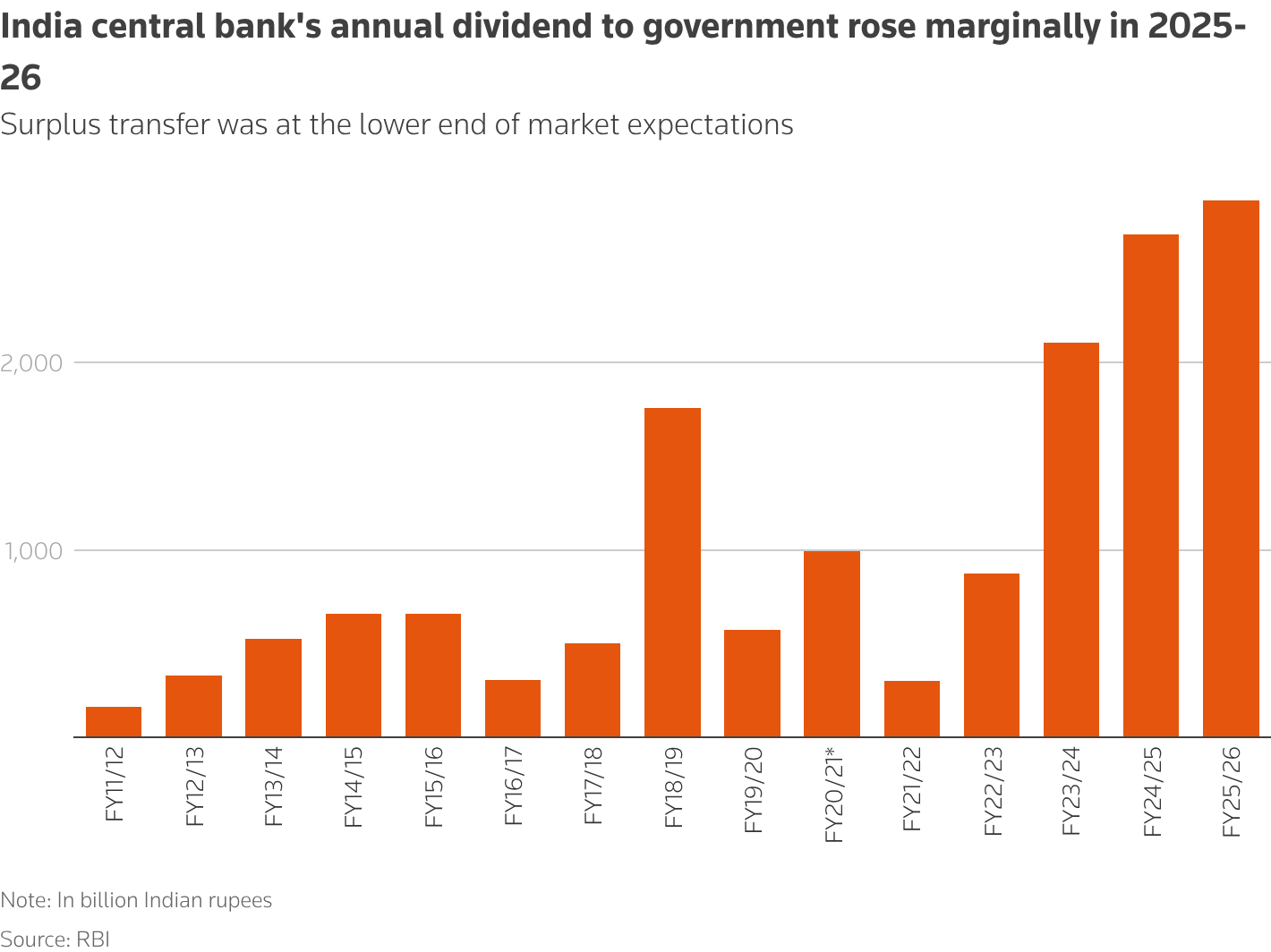
The transfer comes as India faces mounting external stress and a weakening rupee, which has fallen 7% in 2026 and could slide to 100 per dollar if the decline continues. Importantly, the steep rise in the RBI’s transfers to the government is not a good thing for monetary credibility — as the economist Ajit Ranade had written in Mint in expectation of another record transfer this time,
“Once governments start depending on central bank transfers, subtle pressures arise: to maintain lower risk contingency buffers; to maximise profits via forex gains; to support government borrowing; and to optimise central bank profitability. This weakens monetary credibility … The strength of a central bank lies not in its balance sheet or magnitude of profits, but in the credibility of its restraint.”
Nearly three months after the illegal US-Israel airstrikes on Iran, after which the Strait of Hormuz remains severely restricted if not effectively closed, global energy markets remain under severe strain. Analysts at Rapidan Energy Group warn that if the crucial shipping route remains blocked beyond August, the world could face a recession rivalling the 2008 financial crisis. Import-dependent economies like India are particularly vulnerable due to rising fuel costs and inflationary pressure. Against that background, former finance secretary Subhash Chandra Garg warns that the Modi government’s “panic response will push the economy into an even bigger crises”. “Currency management must be done carefully and decisively,” he told M.K. Venu. [See item on India decouples from ‘Emerging Markets Index’]
For India, the fallout extends beyond energy prices. Its job market is increasingly under pressure from multiple fronts: shrinking opportunities for overseas workers in Gulf economies affected by the crisis, uncertainty around domestic manufacturing growth and the growing threat posed by AI-driven automation. Economists warn that if unattended, “the strain could hurt consumption and fuel unrest” as was seen in parts of north India including Noida last month.
Meanwhile, Bank of America Securities expects the foreign investor exodus from Indian equities to persist into 2027. “India is already seeing earnings downgrades, while other AI-driven markets are witnessing upgrades,” the firm’s India research head Amish Shah told Bloomberg, adding that global investors are unlikely to return “before 2027 or perhaps even 2028. It definitely does not look like a 2026 event.”
Circling back to energy for a bit: apart from fuel, another key role that oil and gas have is as feedstock for various chemical products, including urea. India produces nearly all of its urea from oil and gas, the now-constrained supply of which may prompt it and other countries to look China-ward, Bloomberg’s Javier Blas writes, noting the scale of China’s huge coal-to-chemicals industry. India’s large reserves and nascent industry mean New Delhi has before it the same advantages that Beijing seized upon decades ago, such as reducing import dependence, bolstering food security and preserving foreign exchange, Blas says. But there will be a big cost: “any extra use will keep the dirtiest fossil fuel in demand for longer”.
While headlines highlight financial stress in state-run oil companies due to high crude prices, the underlying issue is a policy choice to freeze daily dynamic fuel pricing. Oil marketing companies are reportedly facing large under-recoveries, with losses of around Rs 1,000 crore per day as global oil prices stay elevated. The Wire in analysis argues that this reflects a policy-driven imbalance, as retail prices were not reduced when crude was cheap, while the Modi government instead raised excise duties and collected higher taxes and dividends.
Also, there is a catch in the US’s newest sanctions waiver extension for floating Russian oil, S. Dinakar points out: like the previous renewal issued last month, this one too applies to crude cargoes loaded on or before April 17, and not May 17 as one may have expected given that this extension was given on Sunday. Most Russian oil shipments loaded before April 17 have already been sold, including to India, Dinakar cites two senior officials as noting.
Of all possible reasons to offer for the government’s decision to have the increasingly noticed Cockroach Janta Party’s X account blocked, an unnamed official speaking to the Indian Express invoked “national security concerns” said to have been flagged by the Intelligence Bureau. “In particular,” this official claimed, “the concern stemmed from the fact that the account’s content was gaining traction among young people”, and the CJP’s Instagram account – which now boasts of 11.7 million followers more than the BJP’s – may well be next. The statement comes on the back of the establishment apprehending a Nepal or Bangladesh-style ‘Gen Z’-led uprising in India. That officials are willing to even suggest that spirited criticism of the government is a ‘national security’ issue speaks volumes of the Modi government’s attitude to free speech.
For decades, Indian politicians have spread misinformation and minimised the severity of the country’s air pollution crisis. Citing documents related to the revision of the National Ambient Air Quality Standards, Rishika Pardikar reports that this denial has constrained and weakened policymaking efforts.
Speaking of which, nearly one in eight babies in Delhi is now born prematurely, with the preterm birth rate rising by 21% over the past five years. Doctors and researchers are increasingly associating the surge with exposure to the city’s severe air pollution. Read this report by Astha Savyasachi and Akankhya Rout for Newslaundry.
Amid the US-Iran war and its growing impact on India’s energy security, US secretary of state Marco Rubio has begun his India visit. Starting Saturday, Rubio is expected to tour four Indian cities and attend a gala reception in Delhi marking the 250th anniversary of America’s independence. A Catholic, Rubio is also set to visit Kolkata — which was home to Mother Teresa and is today to the oldest US consulate in India — besides the Taj Mahal in Agra and the palaces of Jaipur. Meanwhile, US Congressman Chris Smith, in an op-ed, has urged Rubio to raise the Modi government’s suspension of the FCRA licence of Mother Teresa’s Missionaries of Charity.
Differences over a sudden change in March in the UK’s position on duty-free imports of iron and steel have reached the WTO Council for Trade in Goods, where India has joined Turkey, China, Brazil, South Korea, Australia and others in opposing the tariffs. This turns the UK’s move into a trade-policy issue as well as a diplomatic irritant for India, as the two countries were just about to operationalise their free trade agreement. Starting July 1, Whitehall will cut tariff-free steel import quotas by 60% from current levels. Further, it will impose a hefty 50% tariff on imports beyond the new quota. This is a setback for India, whose negotiators have been scrambling since March for a “creative” solution – a special exemption within the trade deal – to overcome the hurdle.
Some within the external affairs ministry and the PMO are now questioning whether the country has joined too many coalitions and initiatives, raising global expectations it cannot always meet, reports The Economist:
These days “there is less domestic benefit in playing global host,” thinks Dan Markey, an expert on China and South Asia at the Stimson Centre, a think-tank in Washington. Leaders of big powers are giving up the pretence of consulting large groups of the sort India likes to chair. While India was hosting the BRICS ministers, Mr Trump and Xi Jinping were meeting one-on-one in Beijing.
Others think India should become much more forthright about the big issues of the day. “We should be able to say to both America and Iran: ‘You cannot hold the world hostage like this’,” says Shivshankar Menon, a former Indian national security adviser and foreign secretary. For years the country’s prime minister, Narendra Modi, sold India as a vishwaguru, or teacher to the world. Yet India very often seems reluctant to divulge what, precisely, it wants the world to learn.
The Supreme Court has said that even in case of a trial under a special law such as the Prevention of Money Laundering Act the accused has to be heard before a court can take cognisance of any money laundering case. The bench quashed a PMLA court’s order that had taken cognisance of the offence without hearing the accused.
The apex court has also withdrawn its earlier order that had barred three academics from involvement in publicly funded curriculum work over a Class 8 NCERT textbook chapter discussing corruption in the judiciary. The bench lifted the restriction after considering the submission from the experts Michel Danino, Suparna Diwakar and Alok Prasanna Kumar – that their preparation of the impugned section was not mala fide and that it was finalised after a collective decision.
After the Delhi high court issued notice to journalist Saurav Das in a plea seeking criminal contempt proceedings over one of his reports – which raised concern over the appearance of conflict of interest and a reasonable apprehension of bias in Justice Swarana Kanta Sharma, who was hearing the CBI’s appeal in the Delhi liquor policy case – Das issued a statement standing by his reporting, arguing that “questions cannot be contempt” and that “journalism that seeks to uncover these uncomfortable facts in the larger public interest is part of the constitutional duty of the fourth pillar.”
The US and China have, almost at the same time, launched youth leadership programmes in Nepal, intensifying efforts to connect with Gen Z, members of whom helped topple the K.P. Sharma Oli-led government last year, says Nikkei Asia. Elsewhere, tighter H-1B visa rules under Trump are prompting a shift in Indian tech talent away from the US. Once central to Silicon Valley’s rise, Indian professionals are now increasingly looking to other destinations as barriers to US entry grow.
The Gujarat police’s crime branch has arrested fugitive murder convict Hemant Modi, who had been on the run for 12 years while allegedly living in Mumbai and trying to make a career as an actor in the film industry, where he starred on screen alongside Bollywood’s top names, including in Thugs of Hindostan with Amitabh Bachchan and Aamir Khan, and Jayeshbhai Jordaar featuring Ranveer Singh.
Alt News, the non-profit fact checking website founded and run by Pratik Sinha and Mohammed Zubair, has been shortlisted for the RSF Press Freedom Awards 2026.
Interim bail for three days to Umar Khalid, six months to Tasleem Ahmed and Khalid Saifi
The Delhi high court has granted three days of interim bail to scholar and activist Umar Khalid in the case in which the Delhi police alleges he was part of a conspiracy behind the 2020 riots in northeast Delhi. Khalid has been languishing in jail under provisions of the draconian Unlawful Activities (Prevention) Act since September 2020. A division bench of Justice Prathiba M. Singh and Justice Madhu Jain ordered his release from June 1 to June 3, subject to strict conditions. He had sought 15 days of interim bail to attend a memorial function for his uncle and help his mother undergo a medical procedure.
But should Khalid (and his co-accused Sharjeel Imam) still be incarcerated pending trial, five and a half years (in Imam’s case more than that) after being arrested? Confronted with a conflict over whether bail or jail should be the rule even in UAPA cases, with two benches of the Supreme Court taking differing stands on the matter, the apex court today addressed the question to a larger bench. The bench of Justices Aravind Kumar and P.B. Varale also granted interim bail to Tasleem Ahmed and Khalid Saifi, two more accused in the ‘conspiracy’ case, for six months.
Only 6,541 appeals decided by 12 of Bengal’s appellate tribunals
Twelve of West Bengal’s 19 appellate electoral tribunals decided just 6,581 appeals against exclusions and additions to the voter rolls made by judicial officers, adding 4,043 names and deleting 1,267 as of May 14, Damini Nath reports. These are still just a small share of the over 27 lakh people whom the judicial officer-led adjudication process excluded from the voter rolls and whose status as electors was unprecedently not confirmed by voting day for want of time. The tribunals in Murshidabad and Malda districts, which saw the highest deletion and appeal figures, disposed of just over 100 cases each as of the 14th, Nath reports.
Suvendu says authorities will skip courts and send ‘infiltrators’ straight to BSF
From now on West Bengal’s government will directly hand over suspected undocumented immigrants from Bangladesh who are not eligible under the Citizenship Amendment Act – its word of choice is ‘infiltrators’ – to the Border Security Force and skip sending them to a court first, chief minister Suvendu Adhikari has said. This is in line with the ‘detect, delete and deport’ framework, he said. Going by the MO of the Union and Assam governments though, it is not clear whether the authorities will actually deport these individuals or simply force them across the border.
Reportedly
Modi’s sartorial choices since becoming prime minister – particularly his preference for a notably tight churidaar, reminiscent of Sultanate or Mughal-era darbars, rather than the more relaxed Aligarh pyjama commonly favoured by politicians – have long drawn attention. Yet never before has the contrast between what the rest of the government wears and what the prime minister himself chooses been so pronounced. Do take a look here.
Though one is tempted to wonder whether the dress code is now the most carefully centralised policy in the Modi government.
Drawn and quartered
Deep dive
Kanak Mani Dixit examines Nepal’s foreign policy outlook under the new Balendra Shah-led government, outlining both potential risks and policy recommendations. He flags a range of key issues spanning the Limpiyadhura territorial dispute; water and reservoir-related matters; China-related developments; the RSS and Hindu Swayamsevak Sangh’s influence and much more.
Prime number: 217
The government has told the Supreme Court that 217 Indian nationals joined the Russian armed forces, of whom 49 were killed and six remain missing. It also noted 139 people have been released from service. Counsel for the families who have approached the court have asked for compensation and action against agents who allegedly misled their kin into ultimately joining the Russian military. The Hindu reports.Opeds you don’t want to miss
Keji Mao in his tour de force article, ‘Chess Piece’ to ‘Blood Bag’? What Trump-Xi Summit Could Spell for India, argues that the US was able to play India and other countries like pieces on a chess board, with the fear of China being primary. Now, with Washington having stabilised its relationship with Beijing somewhat, is still wanting to use India as a “blood bag”, in use and throw mode, not “chess piece” mode. India needs to assert genuine strategic independence — that is the only way to get out of the bind, says Mao.
Diplomat Sibi George’s long-winded response to Norwegian journalist Helle Lyng suggests he was trying to “show to certain sections in India that he was giving a fitting reply to an impertinent Western journalist who was asking disrespectful questions about the country”, notes Vivek Katju. But this is not his job as a diplomat: “A politician may seek popularity, but that cannot be the purpose of Indian diplomacy … Catering to sympathisers of the ruling dispensation in India can never be the primary object of Indian diplomacy.”
With India moving to slowly normalise ties with China, and the RSS recently batting for keeping the dialogue door between India and Pakistan open, a rapprochement across the Radcliffe Line is probably not far behind, says K.P. Nayar. Either way he makes a case for executing it:
“‘No talks’ cannot be a long-term policy between two neighbouring countries when the possibility of conflict perennially looms over them and both adversaries are nuclear-armed … there is unease in the strategic community that while the government in New Delhi is behaving like the proverbial ostrich by burying its head in the sand over Pakistan issues, India is being shortchanged as a consequence.”
The exit of the Trinamool Congress’s Falta strongman Jahangir Khan from the seat’s repoll clearly shows of Abhishek Banerjee’s ‘Diamond Harbour model’ – which was actually a “machinery of control that should never have had space in a democracy” – that “an empire built on the crutch of state-sponsored coercion cannot survive when forced to stand on its own”, Aparna Bhattacharya writes.
Selecting chiefs of defence staff by ‘recommissioning’ retired officers “must stop”, says Lieutenant General (retired) H.S. Panag in the context of Lt. Gen. (retd) N.S. Subramani’s appointment to the post, noting that “the government’s merit-driven selection procedure is opaque and lacks credibility”. He further points out:
“Presently there are no specific criteria, competency requirements or qualifications codified for the appointments of the service chiefs and the CDS. There is no detailed appraisal done within the armed forces for appointments of Army commanders (and their equivalents), or by the defence minister for selecting service chiefs. It goes without saying that the selection of the service chiefs and the CDS, if made on “merit” under the current circumstances, will remain subjective.”
Listen up
“Has China Trump-ed the USA?” This also has implications for India and the region. Listen to Alastair Campbell and Rory Stewart analyse the question here.
Watch out
Speaking at the launch of celebrated human rights lawyer Indira Jaising’s memoir The Constitution Is My Home, which is in the form of a conversation with co-author Ritu Menon, watch Justice B.V. Nagarathna’s much-praised keynote address here:
Over and out
Since Chief Justice Surya Kant’s comparison of a section of India’s youth to “cockroaches” – despite claims of the media misquoting him – the metaphor (and insect) has taken on a life of its own, spawning everything from outrage cycles to the formation of a satirical Cockroach Janta Party. As Aathira Perinchery notes, tongue firmly in cheek,
“... Your honour, cockroaches are important insects. They may be pests in houses but they come there because of how we keep our spaces: garbage-filled and messy. In nature, where most of these insects are found, they play a crucial role in nutrient cycling in ecosystems.”
Mira Nair finds new audiences not just as an acclaimed filmmaker, but also as the mother – “like any proud mother” – of New York Mayor Zohran Mamdani, notes NYT. Speaking to the newspaper, she said, “All the things we believe in and stand for, all our lives, he’s been able to distill into actual politics.”
That’s it for today. We’ll be back with you on Monday, on a device near you. If The India Cable was forwarded to you by a friend (perhaps a common friend!) book your own copy by SUBSCRIBING HERE.