
A newsletter from The Wire | Founded by MK Venu, Pratik Kanjilal, Sidharth Bhatia, Siddharth Varadarajan, Sushant Singh, Seema Chishti, and Tanweer Alam | Contributing writers: Kalrav Joshi, Anirudh SK
If you like our work and want to support us, then do subscribe. Sign up with your email address by clicking on this link and choose the FREE subscription plan. Do not choose the paid options on that page because Stripe – the payment gateway for Substack, which hosts The India Cable – does not process payments for Indian nonprofits.
Our newsletter is paywalled but once a week we lift the paywall so newcomers can sample our content. Today is that day. To take out a fresh paid subscription or to renew your existing monthly or annual subscription, please click on the special payment page we have created – https://rzp.io/rzp/the-india-cable.
Snapshot of the day
June 12, 2026
Sidharth Bhatia
A year after the crash of Air India 171 in Ahmedabad that killed 260 people, a crucial cog in the country’s aviation safety – a crack unit meant to certify that aircraft in our skies are safe to fly – is even more short-staffed than it was before the accident. Data obtained by Kunal Purohit under the Right to Information (RTI) Act, 2005, show that of the total 310 posts in the Directorate of Airworthiness (DAW) a total of 136, or 44%, were lying vacant. This number is across levels. Last July, a month after the crash, an RTI query by The Wire had revealed that 133 posts were vacant which has now increased to 136. The Modi government had not made a single new hire in the unit, nor created any new post in it, since the air crash.
The anniversary itself offered a telling contrast. The first person to pay homage at the crash site was not an Indian minister or senior official, but the British High Commissioner, who visited Ahmedabad to honour those who died. At the site, there were few visible signs of an official remembrance ceremony. The absence of any significant public commemoration raised questions not only about accountability in the aftermath of one of India’s deadliest aviation disasters, but also about how the state chooses to remember those whose lives were lost, says Jagriti Chandra.
Amid mounting criticism of its handling of the US Navy’s targeted repeated missile attacks on Indian-crewed vessels in the Gulf of Oman which is in Indian Ocean, part of Indo-Pacific framework of India-US cooperation – one of which killed three Indian seafarers – the Modi government today summoned the US’s charge d’affaires in New Delhi Jason Meeks for a second time and handed over a demarche expressing its strong protest over the attacks as well as its “deep concern over the use of lethal and deadly force against civilian shipping”. Unlike on Wednesday when India summoned Meeks in the evening, this time it called him up during working hours with TV cameras positioned outside and within the Ministry of External Affairs. US ambassador Sergio Gor – who is also special envoy to South and Central Asia – is understood to still be travelling outside India.
Yet even before the MEA lodged its second protest, Iran had issued a far stronger condemnation on Friday: hours after Modi government officials expressed their ‘concern’ over the attacks and ‘hoped and expected’ they would stop, the Iranian foreign ministry said the “brutal” US attacks “stand as clear evidence of America’s ongoing policy of armed robbery and State piracy”.
Defenders of Modi government’s weak response or his own continued silence – have pointed to sanctions violations by some of the vessels involved, almost sounding like defending US actions. However, available information indicates that only one of the three tankers targeted – Marivex – was under US sanctions. The other vessels were not sanctioned, raising serious questions about the legal basis for the attacks and the use of lethal force against civilian shipping.
The Modi government’s response also marks a stark departure from the more assertive posture India has often projected in matters involving Indian citizens abroad. More significantly, it suggests an implicit acceptance of the legitimacy of Washington’s enforcement of the Hormuz blockade, despite the absence of any UN Security Council mandate authorising such military action.
The US killing of Indian sailors have once again reignited concerns of India’s strategic autonomy and “compromises”, a concern also raised by Leader of Opposition and Congress leader Rahul Gandhi. As The Wire notes,
“PM Modi’s continued silence on these US military attacks violates the constitutional responsibility to defend Indian lives. Article 52 of the Constitution establishes the President as defender of the nation, but the political executive, led by Modi, holds operational responsibility for protecting citizens abroad. Silence when US forces kill innocent Indians in international waters is an abdication of his constitutional duty as the prime minister.”


The Modi government has imposed restrictions on diesel sales for 90 days after state-owned fuel retailers struggled to manage rising demand amid disruptions in West Asian crude supplies, with authorities citing concerns over “black marketing and hoarding of diesel by unscrupulous elements”. The Indian government has capped purchases at retail outlets and prohibited commercial buyers from filling up at pumps.
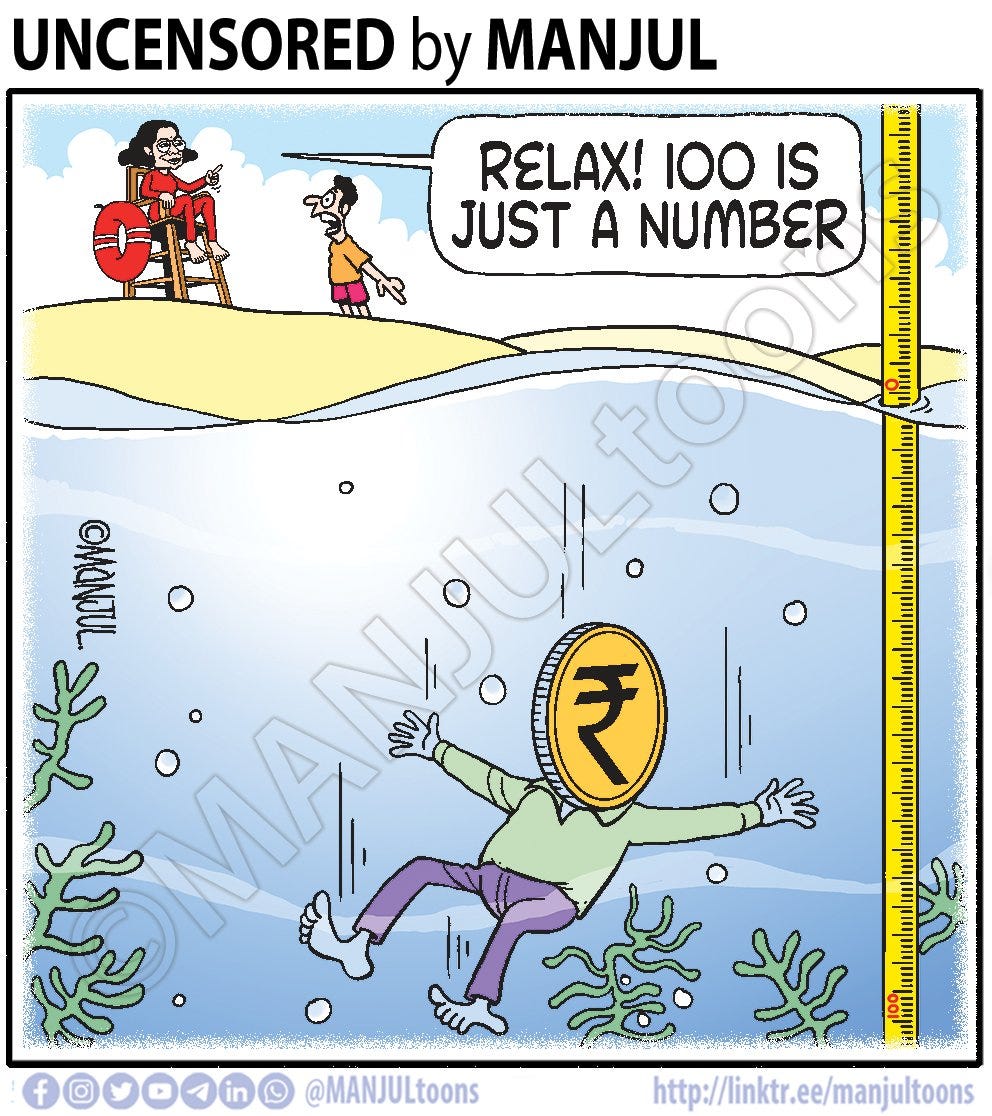
Hopes of a resolution between the US and Iran have eased oil prices, softened the dollar and helped push up the rupee, which hit a weekly high of 94.955 to the dollar during trading today but ultimately settled at 95.11. However, writes Dharamraj Dhutia for Reuters, this “was not enough to protect the currency from posting its first weekly decline, after rising for the last three weeks”.
A landmark defence agreement between India and France for 114 Rafale fighter jets, estimated roughly at $39 billion – at nearly four times the cost of the original Medium Multi-Role Combat Aircraft (MMRCA) proposal – is unlikely to be announced when PM Modi travels to Paris tomorrow on the sidelines of the G7 Summit, despite the two countries discussing some of the deal’s most contentious terms. French diplomatic sources told the Hindu Business Line on Thursday that Paris is seriously engaging with New Delhi’s demand for access to source codes – a condition that would let India independently integrate its own weapons and systems onto the aircraft. India’s insistence that the entire acquisition be routed through the ‘Make in India’ procurement policy is also under consideration, as per the report.
The timing is particularly striking. Ahead of Modi’s bilateral meeting with Macron, France has proposed expanding maritime security cooperation with India, including New Delhi’s participation in a multinational initiative to safeguard freedom of navigation through the Strait of Hormuz, according to the Hindu.
Senior Advocate Chander Uday Singh has slammed recent Supreme Court rulings that have narrowed the scope of bail under the Unlawful Activities (Prevention) Act, 1967 (UAPA), contending that prolonged detention under such stringent laws cannot substitute for credible evidence. Referring to the Delhi riots’ larger conspiracy and Bhima Koregaon prosecutions, he asserted that the allegations in both cases are fundamentally weak and unlikely to substitute for credible evidence. According to Live Law, Singh said that “every judge knows” the conspiracy charges in these cases are hollow and would eventually collapse when tested during trial.
“Hundreds taken to the border and many others put in detention centres as part of a ‘detect, delete and deport’ crackdown on undocumented migrants,” reports Al Jazeera, as Bengal pushes out Muslim Bangladeshis, deepening religious tensions between the two countries. The two countries have also agreed to coordinate patrols on the border and share intelligence.
A 47-year-old Kozhikode man has acquired a Nipah infection and is on ventilator support. The district administration has kicked off its containment protocol, with 77 of the patient’s contacts under surveillance. The Hindu reports it is suspected that he may have become infected either after coming into contact with bat excreta while cleaning a godown or after eating sapota from his garden. This is the fourth time the deadly viral infection is being reported from Kozhikode.
UNAMA, the UN’s mission in Afghanistan, has said that Pakistani airstrikes in eastern Afghanistan earlier this week killed 13 civilians, 11 of them children, one of them a woman and another a man. The strikes had unsettled about a month of calm that followed some of the worst fighting in decades between Pakistan and Afghanistan. Islamabad said its strikes targeted militants.
WhatsApp and Meta have approached a US federal court saying that NSO Group had violated the bench’s injunction against it – almost immediately after it was issued – by using the messaging platform for ‘testing’ purposes and to send malicious URLs to target users that are consistent with the deployment of its infamous Pegasus spyware. They have called on the court to impose daily escalating fines on NSO until it complies. Pegasus has been used against Indian activists, journalists and politicians and since NSO has clarified its clients comprise only governments there are no prizes for guessing who deployed the spyware here. The Modi government has consistently refused to confirm or deny whether it used Pegasus.
The Iran Embassy in India calls out unverified claims aired by Godi media Aajtak anchor Anjana Om Kashyap about the economic crisis in Iran.
In a gesture of friendship that transcends geographical borders, Lahore’s Aitchison College dedicated Classroom 108 to former Punjab Chief Minister Harcharan Singh Brar after Pakistan-based industrialist and philanthropist Syed Babar Ali – his lifelong friend and former classmate – donated PKR 4 million for the purpose, reciprocating Brar’s 1989 visit to Lahore when he inaugurated a library at the college and dedicated it to Ali.
SC dismisses Meenakshi Natarajan’s plea challenging rejection of nomination papers
An election petition is Congress leader Meenakshi Natarajan’s only option to challenge the rejection of her nomination papers for the Madhya Pradesh Rajya Sabha elections, the Supreme Court said today citing Article 39(b) of the Constitution and dismissing her plea. The court has not interfered in challenges to electoral procedures before and if it were to carve out exceptions it would read into the law a principle that does not exist, a bench comprising Justices Prashant Mishra and Atul Chandurkar ruled.
The returning officer concerned had rejected Natarajan’s nomination papers after the BJP complained that a ‘case’ was ‘pending’ against her in Hyderabad but that she did not reveal it. The Congress has pointed out that Natarajan was named as a respondent in a molestation complaint against another party leader, and that neither did the court take cognisance of the private complaint nor have charges been framed against her, in which case she would have needed to make the disclosure. When Congress leaders cried foul over a Jharkhand BJP leader’s nomination the returning officer there had given him time to resolve the objections.
Opposition and BJP demand probe into allegations of financial misappropriation in Ram Janmabhoomi Trust
The Ram Janmabhoomi Teerth Kshetra Trust’s initial terse statement on allegations of financial misappropriation have convinced neither the opposition nor the saffron camp itself, and BJP leaders and even the successor of the Trust’s president calling for or suggesting an independent probe into the matter. One of them, a former media man for the Uttar Pradesh government when the temple was being built, has demanded that Prime Minister Modi be made chairman of the Trust, as is the case for the Somnath temple. Nripendra Misra, a former principal secretary to Modi and the chairman of the temple’s construction committee, made a visit to Ayodhya after the allegations, setting off speculation over whether the PMO is getting hands-on over the matter. Omar Rashid reports.
BJP-led UP govt orders ‘anti-conversion’ cells in universities, higher education institutions
Even as there is enough evidence on how anti-conversion laws are misused by the enforcement agencies both suo motu and on political directive from the Hindu nationalist groups, Uttar Pradesh governor Anandiben Patel has directed all universities, higher educational institutions including medical and dental colleges in the state to set up “anti-conversion cells”, a move that has been backed by the ruling BJP-led Yogi government in the state.
“Any kind of illegal or forced religious conversion attempt carried out by influencing students, instilling fear, creating mental pressure or offering unethical inducements is completely unacceptable, unethical and contrary to law,” the letter reads. “At the university and institutional level, ‘Anti-Radicalisation’ units or Student Welfare Cells should be made highly active.”
The Long Cable
The Anxious governance of public Namaaz: why the state fears Muslim prayer in public
Fahad Zuberi
If you have ever lived in an Indian city, or observed Indian weddings or festivals, you can understand that all conversations about traffic disruptions due to Eid and Friday Namaaz are distractions. If you have observed an election season in India, you know about the loud rallies and roadshows that go on for weeks. Why, then, is the Indian state so obsessed about restricting and criminalizing only Muslim prayer in public space? What does this focus tell us about governmentality in India today?
Let us begin with a larger question: What is the role of festive congregation and prayer in public space? Conceptually, public space is a realm where everyone, as Hannah Arendt said, can appear as they are – with their beliefs, opinions, bodies and identities – and as equal members of the society. Public space – streets, sidewalks, parks and markets – is where members of a society interact with others and encounter differences, negotiate conflict, and learn tolerance and solidarity.
Festive congregation and religiosity form an integral part of this practice, especially across ethno-religious lines. Public space, when accessed responsibly and safely for public displays of religio-cultural expression, can be a site of inter and intra communal cohesion and learning. Celebrating festivals like Diwali in your local park, having public iftar during Ramzan, going to a Langar, or sharing cake on Christmas eve in your neighborhood Church, are some commonplace examples. By enabling festive congregation and prayer, these instances enable citizenship and solidarity beyond, across and within religious identities. Public space is, therefore, the canvas of this politics.
The role of the state in this context, then, remains that of a guarantor of safety and security – the enabler of this peaceful interaction. Simply put, the state is responsible for managing traffic, making sure there are no threats for those attendees and regulating space to prevent accidents like stampedes or fire. Countries across the world – including India, in case of Hindu festivals like Ganesh Chaturthi – observe this very regularly. Internationally, The World Charter on the Right to the City treats public congregation and prayer as part of the broader right to the city – a necessary condition for a democratic urban life.
But on the question of Muslims praying for half an hour for Fridays or Eid, the Indian state – hiding behind the logistics of traffic that they otherwise manage – assumes a punitive role. Moreover, conversations in defense of Muslim rights get muddled around issues like whether Muslims have enough mosques available to pray or not. These are all distractions. There is a deeper anxiety that the Indian state shows when it uniquely criminalizes Muslim prayer in public spaces: The anxiety about emergence of a consciously Muslim politics – a politics that is aware of being both Indian and Muslim and does not hold Muslimness and Indian-ness as opposing binaries.
India has the second largest Muslim population in the world and oppression of Indian Muslims is a fact. Additionally, Indian Muslims find themselves in a moment of disenfranchisement – both, directly through policies like the SIR, and indirectly through political untouchability and voter suppression. Indian Muslims are, therefore, an oppressed, disenfranchised community that is missing consciously Muslim politics. Barring rare examples, political success for Muslims is impossible and most movements for Muslim rights are either directly crushed or indirectly dismissed by the mainstream as being “communal.” Indian Muslims are denied a political consciousness of their own.
Suppressing congregational prayer and public expressions of religiosity is integral to this denial. Praying on the street on Eid with equal rights just like members of a Ganesh Chaturthi celebration do, will cement Muslim citizenship without shedding an explicitly Muslim religiosity. Having the state play the role of guaranteeing safety and security to Muslims as they pray will make the state recognize Muslims as equal citizens and stakeholders of the Indian Republic. Having non-Muslim fellow citizens navigate diverted traffic just as Muslims do for non-Muslim processions, will teach them acceptance for a people in an inclusive urbanity. And finally, an expression of Muslim religiosity will also give Muslims hope and confidence in being accepted as equal citizens of India. Praying in public, therefore, will build a politics of solidarity within Muslims and recognize them as a legitimate political and ethnic group within the Indian nation.
Under conditions of oppression, public acts of worship by the oppressed also build a moral core to their politics. During the Civil Rights movement, Martin Luther King Jr. and other civil rights leaders used prayer publicly during protests and mass meetings – one well-known example is King leading prayer after marchers were arrested in Selma in 1965. For King, public prayer was an important part of the movement’s life as it strengthened and unified participants. Gandhi also used public prayer as part of his political practice. His daily prayer meetings were public gatherings, and prayer services were an integral part of the Indian independence struggle. They functioned as visible acts of nonviolent resistance and witness. In both the cases, the American state and the British attempted to criminalize and violently suppress public prayer.
In the Indian context, public Namaaz gains an even more urgent meaning. A community of 200 million cannot be confined to private invisibility without attacking the very idea of plural democracy. Public space being the canvas of pluralism, thus, is a critical site of Indian Muslim erasure. When a minority community is being harassed, surveilled, stigmatized, and publicly marked as dangerous or excessive, the act of gathering peacefully for prayer acquires the force of civic affirmation.
Muslims praying publicly sends one message. It says: Muslims are here, they belong here, and they have the same claim to the city as anyone else. The Indian state seems very keen to ensure that these claims are not asserted, and they do not manifest into civic confidence for Muslims. The criminalization of an obsessive focus on preventing public Namaaz reflects the Indian state’s anxieties about the emergence of a Muslim politics. The state controls public space and prayer to suppress Muslim politics and undermine communal solidarity.
(Fahad is a PhD Student in History, Theory and Criticism of Art and Architecture, at the Massachusetts Institute of Technology. He writes about architecture and cities through the lens of politics, culture and history.)
Reportedly
Lieutenant General Rajiv Ghai’s appointment as Military Adviser to the National Security Council Secretariat will inevitably fuel commentary in New Delhi’s ever-active ecosystem over regimental loyalties, institutional networks and regional affinities. Commissioned into the Kumaon Regiment in 1989, Ghai—who served as Director General of Military Operations during Operation Sindoor last year—further reinforces the conspicuous Uttarakhand imprint on the national security establishment, where National Security Adviser Ajit Doval also traces his roots.
Whether coincidence, comfort with familiar professional networks, or simply the outcome of merit and circumstance, the optics are unmistakable: in New Delhi’s security establishment, the hills of Uttarakhand continue to punch well above their weight.
Drawn and quartered
Deep dive
From Nehru to Modi, how has the Indian leadership understood the concept of state sovereignty? Scholar Raphaelle Khan traces this arc and finds that “whereas India’s territorial view of sovereignty has remained constant and amplified under the prime ministership of Narendra Modi, Indian worldmaking ambitions have narrowed”, thereby changing India’s relationship with sovereignty internationally.
Prime number: 3.93%
Driven up by higher fuel and food costs, retail inflation in India rose to 3.93% in May from the previous month’s 3.48%. Transport inflation went up last month as state-owned refiners hiked fuel prices four times. Food inflation, notes Reuters, stands to climb higher if El Nino conditions weaken the monsoon.
Opeds you don’t want to miss
The Madhya Pradesh returning officer’s rejecting Congress leader Meenakshi Natarajan’s nomination papers in view of a private complaint against her “reeks of extreme arbitrariness and even a conspiracy”, The Hindu points out, mincing no words. The Election Commission “has the sacred constitutional duty of ensuring free and fair elections” but “is failing in that duty, damaging democracy in the process”.
Publishers who truly matter, says Pratik Kanjilal after Penguin Random House India’s decision to ditch Joe Sacco’s latest book on the Muzaffarnagar riots, “think like incubators of culture, not like risk managers who got confused on the way to a rewarding but obscure career in merchant banking”. As for what exactly Penguin seems to have demurred at, he points us to this clue:
““We are trying to reach a riot… The riot happened more than a year ago,” writes Joe Sacco in the first chapter, ‘The Great Untruth’. “But what we seek isn’t just the fading memory of an actual event: we want the fiction, the myth, the imposter that is taking its place.” In a post-truth world, that’s a dangerous manifesto.”
You read here yesterday that the INDIA bloc faces a challenging time ahead. What must the alliance do now to move ahead from its recent setback? Anand Sahay advises that the bloc “would gain an altogether new dimension if its constituents began to take part in people’s struggles initiated by one another”. And as for its primary constituent in the Congress, it needs to “build a sound election-based organisational structure from the booth-level up”.
“Should Modi’s prime ministership ultimately be judged on the day it clocked 4,399 days, surpassing Nehru’s number by one day, or by what endures?”, asks Bharat Bhushan, asking the question in the context of comparisons between Narendra Modi and Jawaharlal Nehru’s ‘elected’ tenure in office. Record-breaking longevity proves electoral success; it does not automatically confer greatness. “So, one must ask: Has India under Modi become more just, free, prosperous, and confident in its institutions?” Listing many comparisons between Nehru’s time and India today, he writes: “By modern standards, Modi’s economic record is better than Nehru’s licence-raj economy, which stifled entrepreneurship. However, growth became possible later precisely because Nehru built the industrial, scientific, and educational institutions — a network of CSIR laboratories, ISRO, Atomic Energy Establishment (later renamed BARC), steel plants, dams, IITs, AIIMS — that underwrote it.”
Why was the MEA reticent about the acting Venezuelan president’s plans to visit Puttaparthi, asks former diplomat K.P. Nayar. “It is true that according to convention, such diversions are outside the business of the state,” but New Delhi “must adapt to changes to include the country’s soft power appeal in promoting leadership chemistry in international engagement,” he argues.
Listen up
India has long focused on limiting its population growth but with the overall fertility rate going below the replacement rate of 2.1, the question arises if it should now encourage larger families instead. Aparajita Chattopadhyay of the Indian Institute of Population Sciences and Neelanjan Sircar of Ahmedabad University take a whack at that question in this episode of InFocus.
Watch out
Sushant Singh and Sobhana Nair joined Jahnavi Sen to take stock of this week’s major developments, from the US Navy killing three Indian seafarers and striking three Indian-crewed ships in West Asia to the Trinamool Congress’s unravelling and Meenakshi Natarajan’s foiled Rajya Sabha nomination and quite a bit in between. Watch their discussion here:
Over and out
Guyana-born Reginald Lal Singh was “at various times a jungle child, medical student, political activist [for Indian independence], prisoner, author, lecturer, editor, wartime rescuer, cultural ambassador and Hollywood actor”. Anu Kumar has profiled his intrepid and intriguing life.
On Modi’s 4,399-days-in-office euphoria and everything that is wrong with it, irony could not have been starker.


That’s it for today. We’ll be back with you on Monday, on a device near you. If The India Cable was forwarded to you by a friend (perhaps a common friend!) book your own copy by SUBSCRIBING HERE.