
A newsletter from The Wire | Founded by Sidharth Bhatia, Siddharth Varadarajan, Sushant Singh, Seema Chishti, MK Venu, Pratik Kanjilal and Tanweer Alam | Contributing writers: Kalrav Joshi, Anirudh SK
If you like our work and want to support us, then do subscribe. Sign up with your email address by clicking on this link and choose the FREE subscription plan. Do not choose the paid options on that page because Stripe – the payment gateway for Substack, which hosts The India Cable – does not process payments for Indian nonprofits.
Our newsletter is paywalled but once a week we lift the paywall so newcomers can sample our content. Today is that day. To take out a fresh paid subscription or to renew your existing monthly or annual subscription, please click on the special payment page we have created – https://rzp.io/rzp/the-india-cable.
Snapshot of the day
February 20, 2026
Siddharth Varadarajan
After weeks of prevarication over United States President Donald Trump’s invitation to join his ‘Board of Peace’ on Gaza, India yesterday chose the ‘neti neti’ route, sending a senior official as an ‘observer’ to the inaugural meeting of the controversial body in Washington but not committing money or troops. The event saw participation from nearly 50 countries but India’s presence was striking.
It is an open secret that the Board’s aim is to undermine the authority of the United Nations and, thereby, scuttle any prospects for the people of Palestine to exercise their right to a free and independent nation. Less than a week ago, the Ministry of External Affairs had described the US proposal as “under review”, indicating that a final decision on the invitation had not been taken. India had also skipped the January 22 ceremony in Davos where Trump formally unveiled the Board of Peace.
Despite no official statement clarifying why the shift occurred, India quietly took a seat in Washington. The MEA spokesperson was asked if observer status is a prelude to formal membership. “India has supported the Gaza peace plan initiative of President Trump and the efforts that are underway pursuant to UN Security Council Resolution 2803,” he replied, sidestepping the question. For now, what this means in practice is that the Modi government is quite happy to politically endorse Trump’s scheme – which is what matters most to him – without coughing up the $1 billion fee other countries are paying.
Is there a case for India to engage with Trump’s BoP? T S Tirumurti, a former Indian ambassador to the UN sees two positives:
India would be in a position to shape outcomes from within, especially on Gaza and potentially other conflicts, rather than leave the field open to countries like Pakistan and Turkey.
This would strengthen India–US ties and give India leverage in West Asia while aligning with its broader diplomatic outreach to the Arab world and the Global South.
However, the reality is that the BoP is a Trump and US-controlled body set up to ensure Israel accomplishes its goals – which is the gutting of the two-state solution and the eviction of the Palestinians from their homeland. As long as India goes along with this plan, India-US ties will be ‘strengthened’. That is why India continued to support Israel and even sold it arms during its genocide in Gaza.
Beyond Gaza, the optics of the BoP meeting became even more awkward when Trump said 11 “very expensive jets” were shot down during the May 2025 exchanges between India and Pakistan and claimed he warned both countries that the US would impose 200% tariffs and halt trade deals if the fighting continued. He said he personally called Indian Prime Minister Narendra Modi and Pakistan Prime minister Sharif and told them he would not proceed with trade arrangements unless hostilities stopped. “When it came to money, it’s nothing like money,” Trump said, adding that the confrontation ended soon after.
Sharif, present as a founding member of the Board, praised Trump’s intervention, calling him a “man of peace” and crediting him with averting large scale loss of life in South Asia. Describing Trump’s remarks as “most disquieting”, former foreign secretary Kanwal Sibal stated that Trump was expanding the scope of the Board of Peace. “Our relations with the US are no doubt very important but we should carefully measure the risks involved in overlooking the threats to our interests from Trump’s fixations,” he said.
Washington, which has been pushing India to stop buying Russian oil and said that Modi had agreed to do this to facilitate a trade deal, has “seen India diversify on their oil” and that “there is a commitment”, US ambassador in New Delhi Sergio Gor has said. He also said that the two governments are in “active negotiation” over the sale of Venezuelan oil, whose exports the US government now controls, to India in order to ‘help it diversify’ its crude supplies. Indian refiners were Caracas’s second-largest market for oil before the Trump administration first sanctioned the commodity in 2019.
Gor made his remarks on the sidelines of an event in Delhi where India joined the US’s ‘Pax Silica’ initiative – aimed at strengthening Washington in its high-tech rivalry with Beijing. The Pax Silica Declaration is branded as aimed at building a ‘secure, resilient and innovation-driven supply chain for critical minerals and artificial intelligence’.
India and the US also signed a joint statement on cooperation in AI an addendum to this declaration, in which the two countries agree to “pursue a global approach to AI that is unapologetically friendly to entrepreneurship and innovation … [and] champion a pro-growth regulatory environment that fosters AI innovation and empowers builders, coders, creators, startups, and the platforms that enable them, in both countries to test, deploy, and scale rapidly to build secure and trusted AI ecosystems.” By tying India to a loose regulatory environment that is “unapologetically friendly” to the demands of American tech giants, the US hopes to gain unfettered access to India’s vast data, developer base and user market, and also ensure its own cloud and compute dominance.
A majority of the bulk Form 7 applications nominating people for deletion from Indore’s voter rolls as part of the special intensive revision (SIR) there have been filed against Muslims, Tabassum Barnagarwala cites booth-level officers, locals and corporators as saying. In several cases the Form 7s were filed by BJP workers, three of whom nominated 53 Muslim voters – all Indian citizens – for deletion, including an elderly man whose name appears in the ‘reference’ voter rolls of 2002-3. Asked why he’d filed these forms, one of the BJP workers said: “There are infiltrators in our country who enrolled themselves as voters … We need to remove them.” Barnagarwala also reports that there have been cases of Forms 7 filed in the names of people who denied having done that, as has happened elsewhere in the country.
Citing a “trust deficit” between the Election Commission and the West Bengal government amid the SIR in that state, the Supreme Court on Friday asked the Calcutta high court to depute serving judicial officers – i.e. judges – and some retired ones to help adjudicate those cases pending under the ‘logical discrepancy’ category. “The circumstances being extraordinary, the entrustment to judicial officers/former judicial officers is also extraordinary,” the apex court bench said. As part of this ‘trust deficit’ the poll body said that the state government did not despatch enough Group B officers to adjudicate claims under the SIR, and the state government accused the EC of deploying ‘special roll officers’ to “trump” the work being done by electoral registration officers.
In other SIR-related news, the EC said on Thursday that the revision exercise in 22 more states and Union territories is expected to begin in April. These include Manipur, where many thousands of people displaced by their state’s ethnic strife still live in relief camps. Once this kicks off the SIR will have taken place in all states and UTs barring Assam, which is undergoing a separate ‘special revision’.
At 155 square metres, the booth that Galgotias University occupied – and was later asked to vacate – at the India AI Impact Expo on Wednesday was larger than those of four IITs and a research foundation at IIT Kanpur combined, Soumyarendra Barik notes. While an event organiser said space at the expo were allotted on a first come, first serve basis, the allocation process involved “no formal vetting” of what the institutions at the event planned to present (or, in Galgotias’ case, falsely passed off as their own), he writes.
With Gitanjali Angmo telling the Supreme Court that the authorities did not show her husband, the inventor and climate activist Sonam Wangchuk, the four videos they cited as the basis for his detention but only their thumbnails on a laptop inside jail, the bench on Thursday said it would watch the relevant videos in the matter including the one of police officers interacting with the detained Wangchuk.
A UP-based pharma company, Marion Biotech, whose cough syrups were linked to the death of 18 children in Uzbekistan in 2022, moved the Supreme Court hoping for relief from the summons they had received under India’s Drugs and Cosmetics Act. Instead they got a tongue lashing. The bench insisted they would have to respond to the case filed and added that the firm’s bosses ought to also be charged with murder – “but for want of jurisdiction”.
An expert committee constituted by the Commission for Air Quality Management in Delhi-NCR said in a report – made in July but uploaded to the CAQM’s website recently – prepared on the Supreme Court’s directions that most continuous ambient air quality monitoring stations or CAAQMSs in the region are not measuring all 12 parameters as specified as well as that “several gaps persist in the manual monitoring of ambient air quality” here. “Regular calibration and auditing of manual monitoring stations … are not regularly conducted,” Jasjeev Gandhiok cites the report as saying.
Air pollution is among the risks that a group of 102 architects, designers and planners in Mumbai – where too the sky is visibly choked up – have flagged over the state government’s plan to redevelop the Mahalaxmi racecourse ground and build parking and sports facilities under it. Such a project would be expensive, “inevitably introduce access controls”, affect the ground’s function as a water recharger, turn the ground into a “concrete slab without trees”, increase dust and air pollution and, on another note, ‘unlock additional floor space index’ for nearby properties, they have pointed out.
India’s real philanthropy engine isn’t its billionaires – it is everyday household giving. A new study by Ashoka University estimates that total household giving amounts to Rs 540 billion ($6 billion) annually, spanning cash donations, in-kind support and volunteering. Is generosity more common and widespread in India than we think? the BBC asks.
IPL-owned teams in UK to skip Pakistani players ahead of The Hundred 2026 auction
Pakistan cricketers are reportedly unlikely to be picked by Indian-owned franchises in next month’s auction for the 2026 edition of The Hundred – a cricket league run by the England and Wales Cricket Board, sources have told BBC Sport. Four of the tournament’s eight teams are now partly owned by companies that control IPL franchises. According to the report, a senior official from the ECB told an agent that “interest in his Pakistan players would be limited to sides not linked to the IPL” while another agent “described the situation as ‘an unwritten rule’ across T20 leagues with Indian investment.” Last year, Richard Gould, the ECB chief executive, had reportedly said he expected “players from all nations to be selected for all teams” in The Hundred, while also stressing that the organisers had implemented “clear anti-discrimination policies” to ensure fairness.
ESPN quotes former England captain Michael Vaughan urging a speedy resolution of this issue: “The ECB need to act fast on this,” Vaughan wrote on X. “They own the league and this should not be allowed to happen .. the most inclusive sport in the country is not one that allows this to happen.”
Modi govt wants to send complaint against Rahul Gandhi to parliamentary panels it never bothered to set up
Nearly two years after the current Lok Sabha was constituted, two of its most critical watchdog panels – the Privileges Committee and the Ethics Committee – remain conspicuously missing in action, reports Preetha Nair. The delay is glaring, especially as the Modi government now weighs referring Leader of Opposition Rahul Gandhi’s case to one of these very bodies that do not yet exist. The issue surfaced after Parliamentary Affairs Minister Kiren Rijiju responded to a “substantive motion” moved by BJP MP Nishikant Dubey against Gandhi over remarks made during the Budget session. Rijiju said that if the Speaker admits the motion, a decision will be taken – in consultation with the Chair – on whether the matter should go to the Privileges Committee, the Ethics Committee, or be debated in the House when Parliament reconvenes on March 9.
Opposition leaders argue that even invoking the possibility of referring the matter to committees that have not been constituted underscores the deepening dysfunction apparent in the House. Former Lok Sabha Secretary General and constitutional expert PDT Achary described the delay as “unusual.” He warned, “Without their constitution, any move to refer matters to them could face practical hurdles.”
Hate speech: What happens when the Supreme Court drops its guard
Although the Supreme Court earlier this week declined to hear petitions seeking action against the Assam chief minister for his statements on Bengali Muslims in his state, a few years ago its stance on hate speech was markedly more active: in 2020 it began its intervention by staying the broadcasting of a TV programme alleging ‘UPSC jihad’ by Muslims and in 2022 and 2023 it ordered the authorities to suo motu register FIRs in instances of hate speech. But, recalls Ratna Singh, by the time 2025 rolled around “the tone of hearing began to change”, with the apex court indicating it cannot “continue tracking every instance of hate speech across the country”. What’s more, enforcement on the ground level never quite picked up, and this “has allowed hate speech incidents to shoot up”, Singh writes.
The Long Cable
Jammu & Kashmir’s Sporting Success, a Happening to Cherish
Badri Raina
In the late 1950s, Tej Saraf was a budding journalist working with The Statesman in Calcutta.
His senior colleague there was Pearson Surita, the famed cricket commentator.
Tej, always a joyful lover of the game of cricket although only a stop-gap man on the field with tiny hands that could barely hold a cricket ball with secure grip, broached the subject of bringing the prestigious Ranji Trophy contest to the backwaters of Jammu & Kashmir.
The large-hearted Pearson took up the idea, and J&K came to be accorded inclusion to the national-level contest.
At the time we played our first game in 1959, all we knew of cricket was a coir or jute matting, pretty unseasoned Kashmir willow bats, a new cricket ball if and when we got one, (almost never in the nets for want of allocations) lots of talent and energy, and often only roasted chick peas in our pockets for nourishment.
Playing on mat, most of our prowess in scoring came from bottom-handed, cross-batted shots, since the ball always kept a height on coir or jute.
Our star players pulled or cut with gusto, although hook shots were rarely executed with any commendable efficiency because the art of bowling bouncers was still alien.
Never having seen or played on a turf wicket, and never having been coached at any stage of our zestful immersion in the game, our left elbows never learnt to bring the bat down straight to confront the line of the ball, making driving in the V a rare sight in any innings.
Nor had our bowlers any consistent idea of how to use a new ball to effect with a delivery stride suited to seam or swing, in or out.
If such things happened, they happened rather as pure circumstance, aided by the presence of a floating cloud above the field of play.
We had spinners who turned the cherry prodigiously, but without any great sense of strategy or direction, not always knowing how and where to place nine men on either side of the pitch.
There were hardly any players in any city level or college/ university level teams who boasted a wicket keeper professional to the job.
Improvisations were the order of the day, not always without success, let it be said.
Most of our games were one-day engagements, so that hardly ever did our tactics see beyond to a more extended challenge.
So imagine for the first time coming face to face with legends of the game that we had often only drooled about from the mountain-ringed confines of our valley, green as its foliage.
As part of J&K’s Ranji team over sixty years ago, I had the privilege of rubbing shoulders with some of the finest cricketers of my time.
There was the incomparably astute Lala Amarnath (who could look at a first day pitch and prophecy how and when the match would end) with whom I was to toss twice as captain (1961-62);
Tiger Pataudi (whom I had the shocking honour to clean bowl once off a ball that chose to cobra back (for no fault of mine) into the stumps as he shaped to cut, never mind that he had already made 52 in some 20 minutes at the crease;
Hemu Adhikari, whom I had seen make 63 graceful runs against the fearsome Wesley Hall and Roy Gilchrist in the test match at Kotla in 1959, if memory serves me right;
Surendra Nath whose inswing was literally a curve ball that started from the cover region and left the batter underneath his left armpit, in one match crushing my toe unforgettably with a yorker of a vintage that Bhumra may still need to match;
the wily Bishen Bedi, whose flight never once let you guess correctly the length of any single delivery;
even Dattu Phadkar in one match at the Railway Stadium in Delhi, of whom Polly Umrigar once said had he been allowed some leeway in his delivery stride he would have been the world’s fastest bowler;
Budhi Kunderan, who played his first Ranji match against us, having already played test match cricket;
Balu Gupte, a more than difficult customer to fathom, and others who were equally proficient although short of test match experience, like the deadly Rajendra Pal.
Those were days of course when the game had nothing mercantile about it, and when one hardly thought of taking up cricket as a livelihood prospecct.
And in that early, nubile phase of JK cricket, we got used to headlines in print that called us “minions”, often underscoring the “massacre of the innocents” etc, sometimes kindly noting some runs well made, some wickets well taken, some catches that surprised, and spirits that never once flagged, however awful the drubbing we got.
Speaking for myself, I left the state in 1962 and thus lost touch with JK cricket in subsequent years, to the point that I am unable to name the warriors who have just brought us such glory in the Ranji semi-finals, barring those of the fiery Nabi and the stolid Abdul Samad.
But the moot point is that slowly, but thankfully, came the turf wickets, the coaches, the equipment, the patronage, the official will to be counted, and the youth who , transcending local circumstances, harvested such merit for themselves and the place I call home.
Two or so generations later, here we are – contenders to win the coveted Ranji Trophy.
Those of us still alive from yesteryears feel no less members of our troop than the young players that have so decisively proved their metal , trouncing the high and mighty more than once.
We were the foot soldiers who first fell to the bullets on the frontlines; and those that sent us are to be lauded for having built behind us an edifice of prowess that has now brought pride and glory to the beleaguered ‘Union Territory’.
If one may speculate: should not the territory be now restored to full statehood as prize for the outstanding Nabi and his compatriots who may well lift the cup that the greatest in the game have lifted before now?
And may we not rightfully expect to see a Nabi for a start donning the India cap?
To Tej Saraf, who, last I know, lies on perpetual dialysis at home let us say “thanks you O selfless pioneer; feel good, your dream has come true.”
To team JK we say “excelsior” and climb the final mile as only we of the hills can.
We will applaud you to the echo which will applaud back.
(Badri Raina taught at Delhi University. Between 1959/60 and 1961/62, he played cricket for Jammu and Kashmir)
Reportedly
Railway staff were told by their minister to take off their bandhgalas as ‘twas colonial. Then why is Modi all buttoned up like a colonial stooge?


Drawn and quartered
Deep dive: Segregation
A working paper on residential segregation across 15 lakh urban and rural neighbourhoods in India – released by the National Bureau of Economic Research – provides evidence of systemic exclusion of Muslims and Scheduled Castes. This systemic exclusion leads to significantly unequal access to basic public services like water, electricity, schools and clinics within neighbourhoods. These disparities are often invisible when data is viewed at the broader district level, hindering effective policy intervention. Researchers Sam Asher, Kritarth Jha, Paul Novosad, Anjali Adukia and Brandon Tan used census-linked data to show that segregation directly affects who receives basic public services.
Prime number: 2x
Mobilising the $10 trillion needed globally over the next three to five years for the renewable energy transition will require far greater collaboration and funding, experts said at Mumbai’s inaugural Climate Week. They stressed that Indian corporates, in particular, must double their “total current spending to meet climate goals.”
Opeds you don’t want to miss
“India needs a robust and modern air force, and it needs it now. The real turbulence isn’t in the air – it is in the deal itself”, writes Sushant Singh slamming the Modi government for a decade of decisions that have left the nation’s air power teetering on the edge. “When billions are spent, they must translate into maximum numbers of modern fighter aircraft and meaningful technology transfer. Anything less is a betrayal of the brave pilots defending the nation and the citizens who fund their efforts.”
The robot dog debacle at the AI summit raises tough questions, writes Dinesh C Sharma:
“The focus should be on developing a robust and sustainable AI infrastructure and reskilling the workforce. Instead, policymakers are promoting captive GPU infrastructure in the form of private clouds owned by global giants (Microsoft, Amazon, Google, etc).
“This is another form of outsourcing, and more harmful, as large data farms are power and water guzzlers. Giving them tax holidays at the cost of environment is a dangerous idea. Data centres owned and operated by global firms in India do not contribute to the development of Indian capabilities in AI, as is being projected by the government.
“If the government is interested in promoting research and innovation, it cannot afford to neglect the basics — support to both fundamental and applied R&D and enforcement of academic and quality parameters.
“Policymakers and ministers should stop making tall claims and creating hype about research and innovation. Instead, the process of policymaking in AI should be open to wider discussion and debate, as AI has serious societal implications. The Galgotias episode is a grim reminder.”
Many youngsters at the AI Impact Summit were optimistic despite the organisational snafus there but “optimism doesn’t substitute for an ecosystem”, Catherine Thorbecke writes. Noting also the irony of hotel room prices skyrocketing and homeless people being shifted by a summit billed as ‘democratising AI’, she adds that India will be a “test case for whether AI diffusion empowers everyday people or widens inequality”.
On General M.M. Naravane’s revelations surrounding the Rechin La incident, Lieutenant General (retired) H.S. Panag writes that although the former Army chief was restrained and sagacious at the time, “strategic systems cannot rely on success achieved through individual judgement alone”. He advises that in the sort of grey-zone conflicts that India is likely to face in the future, “military strength alone will not suffice. The decisive factor will be the ability of the state to align political intent with military execution through institutionalised doctrine.”
In 2023, Alisha Dutta met the young woman who was gangraped amid Manipur’s ethnic conflict and who succumbed to her trauma recently. She writes about the guilt and hope she has felt since she first met the victim in Kangpokpi two and a half years ago.
Care-giving does not occur in isolation, writes Barkha Deva. “It unfolds within homes, supported — or constrained — by tools and products that make daily care workable”, which is why it is inexplicable that the latest budget has increased customs duty on adult diapers:
“Countries such as Japan, Germany, and Singapore treat assistive products as infrastructure — subsidised, tax-exempt, and integrated into care systems. India’s approach remains fragmented. Caregiver training sits in one silo; taxation in another; health and social care elsewhere. The solution is not complicated: Remove duties and GST on assistive products, recognise elder care as economic infrastructure, and build a coherent ageing strategy centred on dignity, not just pensions and hospitals.”
Listen up
Listen to Rakesh Sood talk about what the expiration of the New START treaty – the last treaty constraining the nuclear weapons and their delivery systems of the US and the Russian Federation – means for “global nuclear stability, and the uncertain future of nuclear risk management” on The Hindu’s Infocus podcast.
Watch out
It’s been another hectic news week, what with Nikhil Gupta pleading guilty in the Pannun murder plot, a new elected government taking over the reins in Bangladesh, organisational lapses and the Galgotias controversy stealing the headlines on the AI Impact Summit in Delhi, and more. Why don’t you watch this latest episode of The Wire Wrap anchored by Sravasti Dasgupta and featuring international relations professor and Bangladesh expert Sreeradha Datta and Siddharth Varadarajan to cut through the fog:
Over and out
A recent estimate indicates that Chandigarh’s per capita liquor consumption is over 6.5 times the all-India average. Indeed, drinking in the ‘City Beautiful’ has come to be “curated, social and worn almost as a badge of urban celebration”, writes Chandigarh resident Rahul Bedi. Read his witty and charming account of the “carefully ordered ritual, honed over time” that governs how this city, but especially its more well-off, tend to wet their beaks.
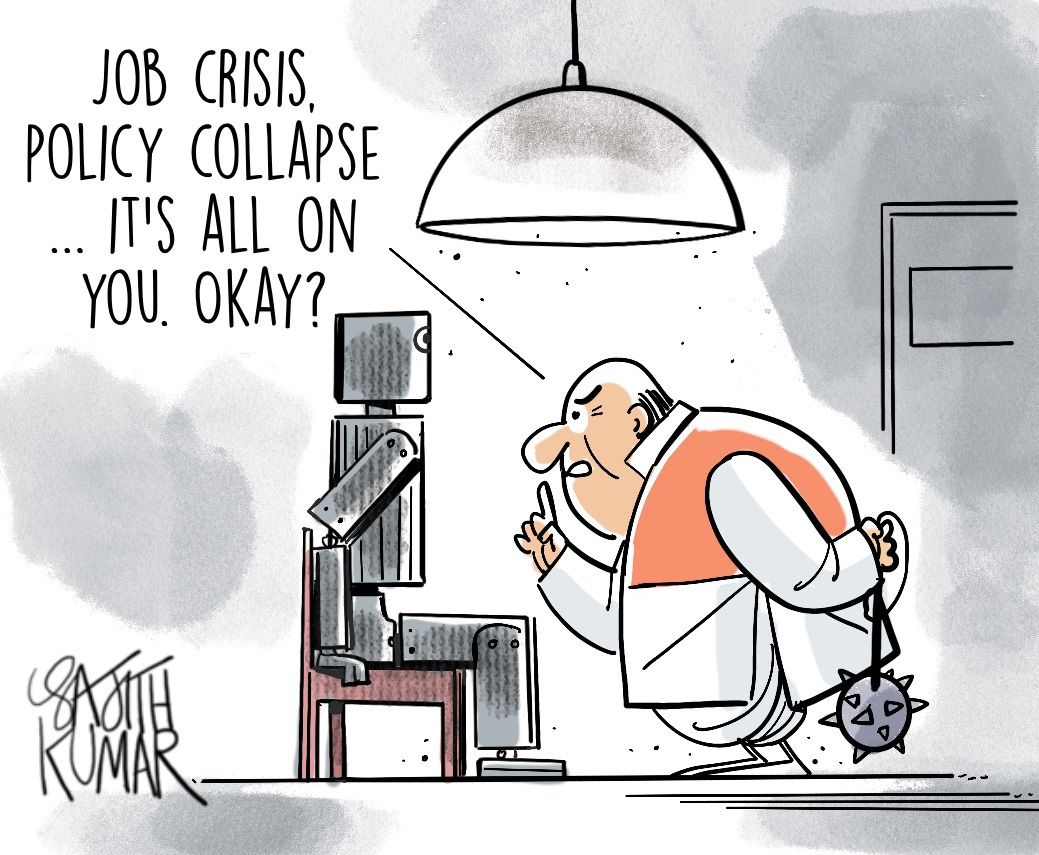
As the five-day, chest-thumping India AI Impact Summit in Delhi limps to a close, guess what stole the show? Not a homegrown breakthrough. Not a path-breaking policy. But chaos on the ground – and a Chinese robodog that trotted away with the spotlight. Cartoonists, unsurprisingly, had a field week. Sketches of robo-dogs chasing grand promises, AI panels grappling with basic logistics and slogans collapsing under their own weight captured what many attendees were already muttering: the spectacle outpaced the substance.
Anoushka Shankar and Arijit Singh jammed together briefly in Kolkata last week, the result was pure magic. The song, an adaptation from a composition by Ravi Shankar, Anoushka’s father, for Anuradha (1961).
That’s it for today. We’ll be back with you on Monday, on a device near you. If The India Cable was forwarded to you by a friend (perhaps a common friend!) book your own copy by SUBSCRIBING HERE.