
A newsletter from The Wire | Founded by Sidharth Bhatia, Siddharth Varadarajan, Sushant Singh, Seema Chishti, MK Venu, Pratik Kanjilal and Tanweer Alam | Contributing writers: Kalrav Joshi, Anirudh SK
If you like our work and want to support us, then do subscribe. Sign up with your email address by clicking on this link and choose the FREE subscription plan. Do not choose the paid options on that page because Stripe – the payment gateway for Substack, which hosts The India Cable – does not process payments for Indian nonprofits.

Our newsletter is paywalled but once a week we lift the paywall so newcomers can sample our content. To take out a fresh paid subscription or to renew your existing monthly or annual subscription, please click on the special payment page we have created – https://rzp.io/rzp/the-india-cable.
Snapshot of the day
February 25, 2026
Anirudh S.K.
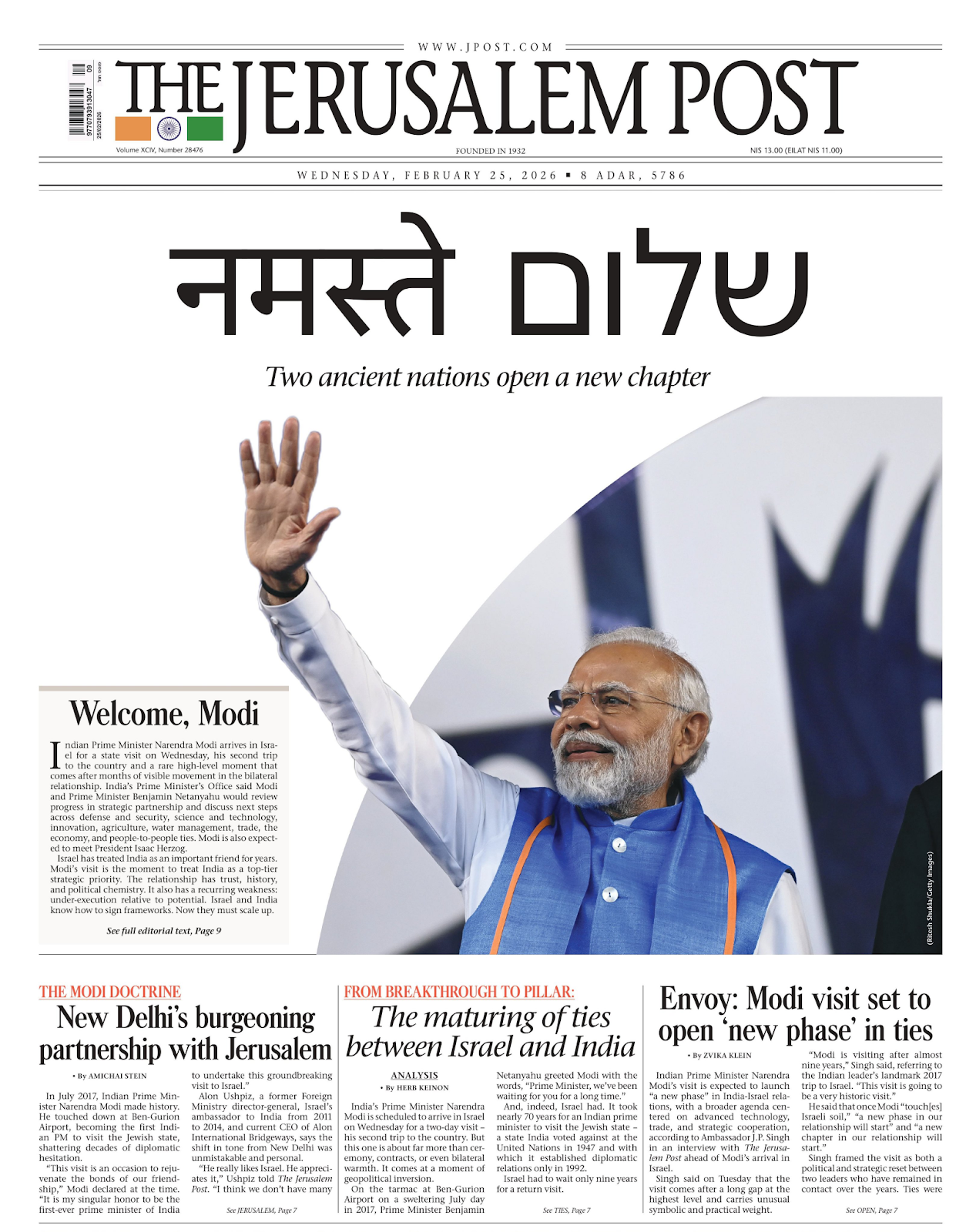
Israel is increasingly isolated on the world stage in view of its brutal military campaign in Gaza so when Prime Minister Narendra Modi landed in Tel Aviv on Wednesday, Benjamin Netanyahu was quick to embrace him right off the plane. After the duo travelled to the Knesset in Jerusalem, an effusive Netanyahu said he had “never been more moved” than by the visit of the Indian prime minister, whom he likened to a brother. The scale of the destruction wrought in Gaza didn’t make it to the foreground: Modi, who condoled the roughly 1,200 deaths caused by Hamas’s October 7, 2023 terror attack on Israel, did not mention what had followed, except to endorse Washington’s Gaza ‘peace plan’, which he said “holds the promise of a just and durable peace … including by addressing the Palestine issue [sic]”. The Indian government’s official support for a two-state solution – which envisages Palestine as a fully sovereign nation with East Jerusalem as its capital – did not figure in his address.
For his part Netanyahu hailed the “Indian-Israeli alliance” – a term for the relationship that is stronger than the ‘partnership’ term Modi used – under which the two sides had “doubled our trade, tripled our cooperation, quadrupled our understandings in ways that I cannot begin to describe”. And, he went on to add, “in some ways probably shouldn’t describe”. Knowing the Indian visitor’s appetite for collecting awards and medals, Knesset speaker Amir Ohana also handed Modi the ‘Medal of the Knesset’, which has been described as a ‘new’ award.
Among the areas of cooperation that the two sides will discuss during Modi’s visit are “science and technology, innovation, defence and security, agriculture, water management, trade and economy, and people-to-people exchanges”. For a bird’s eye view of what bilateral cooperation between the two sides has involved in recent years, check out this article by Middle East Eye correspondent Azad Essa, who frequently writes about the two countries and whose X account has been withheld in India on the Modi government’s request.
Predictably, the pro-Netanyahu Israeli media has been as fulsome in its coverage of the Modi visit as the pro-Modi outlets in India.
As perhaps the only country supporting both Israel and Russia in their respective military operations, India joined 50 other countries in abstaining from a General Assembly resolution calling for an “immediate, full and unconditional ceasefire” between Russia and Ukraine – introduced by Kyiv on the fourth anniversary of Russia’s invasion. The resolution was adopted by the 193-member Assembly, with 107 nations voting in favour and just 12 against. The document explicitly condemned Russia’s continued attacks on civilians and critical infrastructure as well as the worsening humanitarian crisis – yet India chose to sit on the fence. This abstention fits a broader pattern in Modi’s foreign policy: balancing ties with powerful allies while avoiding any stance that might complicate trade, defence or strategic alignments.
Speaking of which, Russia and Ukraine are increasingly
