
A newsletter from The Wire | Founded by MK Venu, Pratik Kanjilal, Sidharth Bhatia, Siddharth Varadarajan, Sushant Singh, Seema Chishti, and Tanweer Alam | Contributing writers: Kalrav Joshi, Anirudh SK
If you like our work and want to support us, then do subscribe. Sign up with your email address by clicking on this link and choose the FREE subscription plan. Do not choose the paid options on that page because Stripe – the payment gateway for Substack, which hosts The India Cable – does not process payments for Indian nonprofits.
Our newsletter is paywalled but once a week we lift the paywall so newcomers can sample our content. Today is that day. To take out a fresh paid subscription or to renew your existing monthly or annual subscription, please click on the special payment page we have created – https://rzp.io/rzp/the-india-cable.
Snapshot of the day
October 16, 2026
Anirudh S.K., Kalrav Joshi
Prohibitory orders, detentions and the (credible) threat of assault by security personnel proved no bar for thousands of protesters who turned up for yet another day of demonstrations, this time to wave the tricolour at Connaught Place in defiance of the Modi government’s continuing crackdown on dissent. Cockroach Janta Party founder Abhijeet Dipke, who called for the ‘Lehra do Tiranga’ (‘Wave the Tricolour’) demonstration, himself could not attend because police officers took him into custody en route to the protest site this afternoon. As this newsletter goes to press early on Saturday, Dipke’s whereabouts are unknown, and the CJP has said his lawyers do not have access to him either.
All India Students’ Association president Neha Bora too was detained – again – and her organisation noted that the police denied her advocates an opportunity to meet her at a detention centre, that officers subsequently attempted to surreptitiously move her to another location, and that it remained unaware of her location for hours. At midnight AISA said its lawyers met Bora at the R.K. Puram police station but it was unclear when and if she would be released.
But Dipke and Bora’s detentions did not deter tricolour-wielding demonstrators, who continued to arrive at Connaught Place (unable to enter the actual protest site of Central Park because the administration has closed it off) in batches through early evening. Security personnel detained some 150 people today.
Journalists at the protest site were discouraged from filming security personnel in public before the Tiranga march began, but in case you weren’t there to get the message, the Press Council of India was bound to have you covered. Silent so far on the detention – and in some cases the alleged assault – of journalists during this past week’s protests, the statutory body today felt the need to instead issue ‘guidelines’ to reporters covering protests. Among its tips are that journalists must visibly display their ID cards (it is another matter that this did them no good last weekend, when the police picked them up anyway), “avoid arguments during tense situations” (wouldn’t that be convenient for detention-happy cops) and “maintain a reasonable and safe distance from confrontations”.
Meanwhile in Chennai, the high court said that the Rashtriya Swayamsevak Sangh shall be allowed to hold route marches later this month and early next month on the occasion of its centenary. The bench disposed of a petition by the Sangh challenging the Tamil Nadu government’s move to deny it permission after the state said the marches can ‘go on subject to modifications by the police depending on the local conditions’, reports LiveLaw. It would be quite ironic if the Sangh gets to march with lathis or saffron flags days after youths waving the tricolour were detained in the heart of the national capital. The high court also came down on the state government for its justifications for denying permission to the RSS.
Amid the pressure it is under, the Election Commission has announced a special summary revision of the voter rolls in 17 states and Union territories where the special intensive revision (or special revision in Assam’s case) is over. The EC hasn’t conducted an SSR ever since the contentious SIR kicked off in Bihar in June last year; Anubhuti Vishnoi of the Economic Times has reported that this was so even though election commissioners Sukhbir Singh Sandhu and Vivek Joshi were in favour of resuming the exercise (implying that chief election commissioner Gyanesh Kumar may have been against it). SSRs generally aim to enroll newly eligible voters and electors who have shifted. The SSR announcement also comes days after the EC announced its conciliatory ‘special enrolment drive’ in the wake of the Indian Express‘s expose of its functioning as well as of the public anger against it.
There’s about a month left until Maharashtra’s final, post-SIR electoral rolls are due, but a list of individuals who’ve been served notice for being ‘unmapped’ to the previous benchmark list or for having so-called ‘logical discrepancies’ in their data is still yet to be published. Asked by Vinaya Deshpande Pandit about the delay, the office of the state’s top election officer passed the buck to the constituency-level electoral registration officers. If an elector misses attending their hearing pursuant to such a notice, perhaps because they never know about the said notice, they risk getting struck off the voter rolls.
That, as we’ve seen already, can be bad news and not just during election time. Debraj Mitra reports the case of a 37-year-old Murshidabad, West Bengal man who has cleared the tests and interview to be a police constable but is unable to take up the job because his name was excluded from the state’s final rolls. He was deleted after being flagged for a ‘logical discrepancy’ even as all five of his adult siblings made it on to the rolls. In fact, writes Mitra, an appellate tribunal heard his case out of turn and decided to put him back on the list but a formal order remains pending because of the standoff between the tribunals and Nirvachan Sadan in Delhi.
But god forbid someone supports the protests against this SIR – especially someone not from India. Our ambassador in D.C. Vinay Kwatra declared yesterday that Congresswoman (D. Wash.) Pramila Jayapal’s expressions of concern over the exercise and support for the ongoing agitation amount to “unacceptable interference in India’s internal affairs”.
It’s been 64 days and counting since the monsoon session ended but the Modi government hasn’t prorogued parliament yet. Opposition parties suspect that may be because the government plans to take another whack at its delimitation agenda, and now Congress president and Rajya Sabha leader of opposition Mallikarjun Kharge has written a fourth letter to Prime Minister Narendra Modi requesting an all-party meeting to discuss that agenda if it really is on the cards. The government’s previous attempt to pass its delimitation package through parliament failed because it could not muster support from a two-thirds majority of MPs present and voting.
Former Keralam chief minister Pinarayi Vijayan has moved the Supreme Court against the high court’s move to order an FIR naming him, his daughter Veena and her husband Mohamed Riyas in connection with the corruption allegations against them. Yesterday a division bench of the high court dismissed Vijayan’s argument that the single-judge bench ought to have heard him before ordering the FIR last week. The Enforcement Directorate, which has lodged its version of an FIR against them, has meanwhile summoned the former CM for questioning on Wednesday.
That the US embassy and ambassador in Delhi first announced secretary of state Marco Rubio’s visit to India – he will go to Mumbai and Jamnagar but not to New Delhi – is not surprising, the Congress said, recalling how it was US President Donald Trump who broke news of the cessation of hostilities between India and Pakistan last year. “But what is quite extraordinary,” party MP Jairam Ramesh said, is his [ambassador Sergio Gor’s] statement that “we expect the Minister Dr. Jaishankar to be joining us there along with other individuals”.” Today the external affairs ministry acknowledged Rubio’s visit to Mumbai and defended it saying India often receives foreign dignitaries in places outside Delhi.
The affair, Rahul Gandhi said, is as if “Mr Rubio has summoned his employee to Mumbai”. (Whose employee is Jaishankar really? Rubio’s? ‘Prime Minister Ambani’s’? Jokes aside, Reliance today responded to Elon Musk’s jibes against Mukesh Ambani – though without naming him – saying that the conglomerate ‘welcomes competition in satellite communications, including [from] Starlink’, and that the Union government is applying the same standards to Jio and to Musk’s firm.)
The BJP celebrates the success of non-resident Indians as proof of India’s inevitable rise, conveniently ignoring the more damning reality: a country that takes pride in its diaspora while failing to retain its own talent. As The Economist argues, the exodus of talent is as much an indictment of India’s failures at home as it is a story of success abroad. The British magazine notes:
“The diaspora can do little to stem the hate, let alone advance India’s interests. In America it has failed to persuade the Trump administration to adopt policies favourable to India. Indeed just last month Congress in Washington passed legislation allowing 100% tariffs on India for buying Russian oil. The diaspora may be large and even influential, but it is no diplomatic corps.
Mr Modi has hailed his overseas audience as rashtradoot, or emissaries of India. But for all their attachment to India, few in the diaspora want to return to a country where decent jobs are scarce and cities are unlivable. Those are the same factors contributing to frustrations among youngsters in India who are increasingly expressing their anger on the streets. Celebrating success abroad may feel good, but a real reason for national pride would be for Indians to flourish at home.”
India is deeply concerned by an attempted mass shooting at a Hindu temple near Chicago earlier this week, the external affairs ministry said, adding that the incident comes amid “growing concerns over racist hostility and anti-India hate in the US”. Local media reports that the police have arrested a 19-year-old man in connection with the incident; disaster was averted allegedly only because his rifle jammed up once he arrived at the temple on Sunday and a coworker tipped the police off about his plans. The accused sent his coworker a document outlining a plot to kill non-white people and using racial slurs to refer to them, prosecutors have alleged.
The RBI has deployed some $75-80 billion in dollar sales and swaps to support the weakening rupee, depleting more than half of its $140 billion foreign exchange boost, reports Reuters. And these aren’t the only ways in which the central bank is supporting the rupee: in a bid to discourage demand for dollars, it has made it costlier for importers to hedge future current-account payments, and in a reversal has also hiked the cost for banks to buy foreign currency for certain transactions in addition to disallowing firms from rebooking cancelled forex contracts. Such changes to hedging rules, a portfolio manager told the news agency, could undermine policy predictability and fracture currency market liquidity.
Negotiations between the home ministry and Ladakhi groups agitating for constitutional safeguards for the Union territory continued yesterday, with the Leh Apex Body flagging a ‘huge gap’ between their demands and what Raisina Hill had to offer; the next round of talks is scheduled for Wednesday. The two sides are wrangling over the nature of a future Union territory-level elected body for Ladakh as well as over fresh safeguards for the region under Article 371.
Salman Rushdie, Mira Nair throw weight behind India’s protesting cockroaches
As the protests seeking CEC Kumar’s resignation over alleged SIR irregularities continued in Delhi and other parts of the country and were met with brutality and suppression, Booker Prize-winning, Indian-born author Salman Rushdie has extended support to the CJP. Speaking at a pre-Diwali dinner in New York City that doubled as a fundraiser for the Asian American Writers’ Workshop, according to Amitava Kumar, Rushdie said:
“There is something going on in India right now. India is boiling. And I would feel wrong not to say – maybe not the thing to say in a restaurant – to celebrate the cockroach. Young people of India have given us the most hopeful moment for a very long time.”
The dinner was hosted by acclaimed filmmaker Mira Nair, mother of New York City mayor Zohran Mamdani, alongside Rushdie and former Vanity Fair editor-in-chief Radhika Jones. Nair, who described herself as a “mamma cockroach”, said, “I am so deeply energised by the cockroaches of our country, the cockroaches of today and the cockroaches of tomorrow, because this is what Diwali is also about – to light a lamp for change,” the New York Times reports.
Gujarat’s very own ‘hate machinery’ rumbles on at garbas
In a disturbing display of religious intolerance, Muslims and other non-Hindus were asked to leave a high-end garba event in Ahmedabad earlier this week, with the anchor announcing that the “Vishva Hindu Parishad has come here to protect Sanatan Dharma”. Attendees were also given a helpline number to report “suspicious people”. Following this, popular folk singer Aditya Gadhvi, the event’s lead performer, distanced himself from the announcement. “A few words from me, because a lot is being said in my name. I am an artist. I am a proud Hindu. Navratri is the most sacred time of my year, and standing on a stage singing for Maa Ambe in front of thousands of people dancing garba is the greatest blessing of my life,” Gadhvi said in a statement on Instagram, without naming the VHP.
Meanwhile, Gujarat VHP spokesperson Hitendrasinh Rajput defended what happened, saying it was just stuff that Bajrang Dal volunteers regularly do at garba events across the state. Another addition to the Model State file.
After ordering compensation, Gauhati HC orders Dispur, MEA to trace woman ‘pushed back’ to B’desh
Earlier this week the Gauhati high court told the external affairs ministry and the Assam government to trace the whereabouts of 44-year-old Mumtaz Begum, whom the authorities expelled to Bangladesh earlier this year under dubious circumstances. Last month the court ordered Rs 2 lakh in interim compensation to Begum after finding that the foreigners’ tribunal that declared her a non-Indian had acted maliciously in ordering her arrest after being asked to reconsider her case. The judge, Bipul Kumar Nath, “had taken a personal grudge on the matter being remanded back for a fresh opinion”, the high court had said. Begum went missing as a result of her summary expulsion across the border.
Reportedly
Did NIT Hamirpur’s administration ‘cancel’ its Navratri celebrations in order to retaliate against students for their low attendance at a recent programme held by BJP MP Anurag Thakur, after he expressed displeasure at the small size of his audience? That’s what an X user alleged had transpired at the university. We would link to it directly here but the account has vanished from the platform.
Drawn and quartered
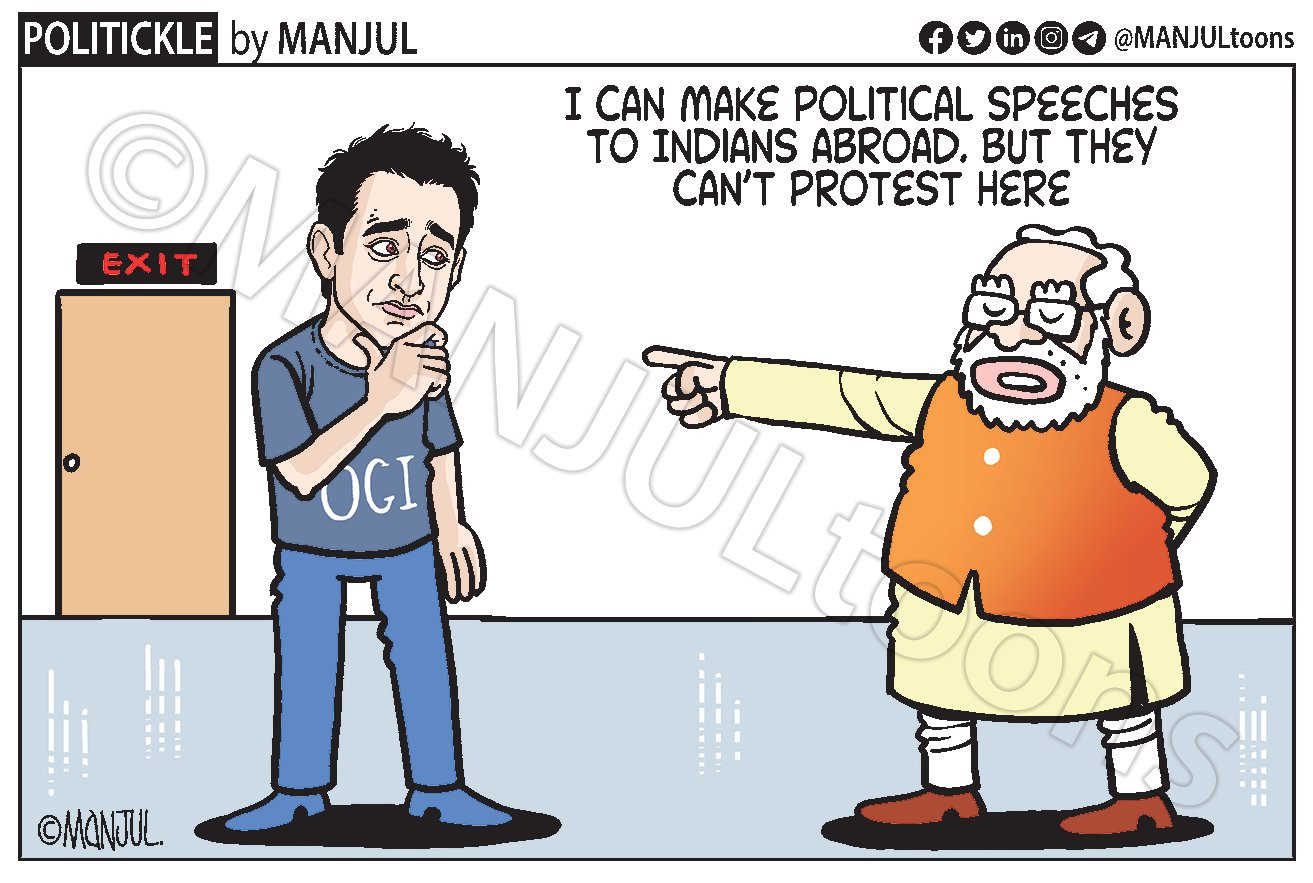
Deep dive
If China no longer views the US-India partnership as a threat, what exactly is Washington gaining from the relationship? Yun Sun has written a timely analysis.
Prime number: 3️⃣
Three countries – Russia (44.3%), the Emirates (17.4%) and America (5.1%) – accounted for more than two-thirds (66.8%) of India’s oil imports in August, notes T.C.A. Sharad Raghavan. The price India paid for US oil, averaging $810.6 per tonne, is a good deal higher than the $640 per tonne it paid on average overall in August.
Opeds you don’t want to miss
“What I really want to say about those AI companies is this: terminate with extreme prejudice,” writes Arundhati Roy in Equator magazine.
Washington has controlled India’s energy choices and, by way of its war on Iran, made its development dearer; meanwhile “all we have had to offer in resistance is stony silence”. Maybe the time has come for New Delhi to “convey to the US that, while we are open for business, we do not pay homage to this new Pax Americana” characterised by Trump’s imperialist vision, writes Pratap Bhanu Mehta. “We ought to find all possible leverage to stand up to it, rather than pass over it in cowed silence.”
“The path to securing another non-permanent seat on the UNSC next year is not easy. India’s win can only be guaranteed by defeating the ambitions of its old friend and regional partner [Tajikistan] – the choice is between a Pyrrhic victory versus a tactical defeat,” warns Suhasini Haider as New Delhi campaigns for the non-permanent Asia-Pacific seat at the Council.
One could object to Jantar Mantar being the designated protest site because it is prone to traffic disruptions, but such an assertion would be “valid only as much as similar arguments that are usually raised against democracy itself”, The Hindu points out. Indeed, such an objection would be in keeping with the “reactionary view that democracy delays decision-making, elections disrupt development and economic activity, and that there should therefore be fewer elections and less politics”.
Sociologist Avijit Pathak argues that India’s students are increasingly finding classrooms on the streets and in detention centres.
“What is refreshing about the ongoing protest in the streets of Delhi and other cities is that we are seeing a new kind of studentship. We are seeing young students seeing beyond their own careers; they are cherishing their creative agency; they are laughing at the mighty power of the coercive state; and above all, they are negotiating in their own ways with Gandhi, Ambedkar and Marx and trying to save the soul of democracy.”
Recent developments in Keralam – including a Muslim cleric’s proclamation that women ought to stay at home – point to the reality that misogyny ‘is not something imposed on the state from the outside but endemic to its social structure’, contrary to its popular image, says Pulapre Balakrishnan. Political parties can ameliorate low levels of women’s representation in Keralam’s institutions but a wider change would be beyond their remit, he writes.
Listen up
On The News Minute‘s South Central podcast, Siddharth Varadarajan, Sukanya Shaji and Abhinandan Sekhri speak with Dhanya Rajendran and Anisha Sheth on violence against protesters and journalists in detention centres, the involvement of individuals accompanying the police in confronting demonstrators, and how mainstream legacy media has covered the detentions.
Watch out
Historian Ayesha Siddiqa examines the ‘stranglehold’ that the Inter-Services Public Relations wing or ISPR of the Pakistani armed forces ‘maintains over the national conscience’. You can also read her piece in Himal Southasian here.
Over and out
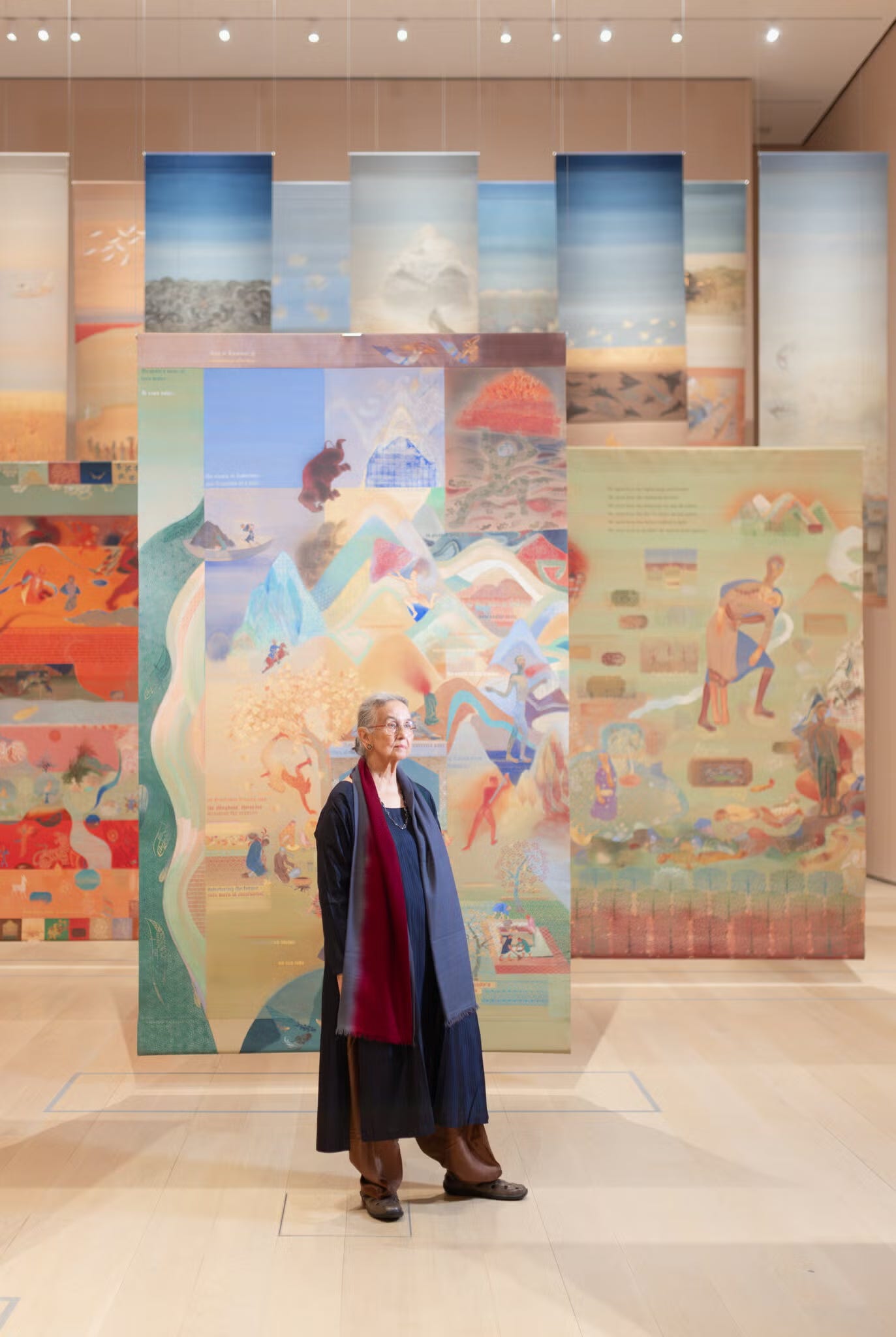
The Museum of Modern Art, New York presents Nilima Sheikh: Fractured Skies, the Indian artist’s first solo exhibition in the city. Her paintings juxtapose Kashmir’s breathtaking beauty with the violence that has shaped its history since partition in 1947. The series Home, Land responds to the 2018 rape and murder of eight-year-old Asifa Bano. The New York Times features the exhibition and profiles Sheikh, the Vadodara-based artist whose work has profoundly shaped contemporary South Asian art.
That’s it for today. We’ll be back with you on Monday, on a device near you. If The India Cable was forwarded to you by a friend (perhaps a common friend!) book your own copy by SUBSCRIBING HERE.