
A newsletter from The Wire | Founded by MK Venu, Pratik Kanjilal, Sidharth Bhatia, Siddharth Varadarajan, Sushant Singh, Seema Chishti, and Tanweer Alam | Contributing writers: Kalrav Joshi, Anirudh SK
If you like our work and want to support us, then do subscribe. Sign up with your email address by clicking on this link and choose the FREE subscription plan. Do not choose the paid options on that page because Stripe – the payment gateway for Substack, which hosts The India Cable – does not process payments for Indian nonprofits.Our newsletter is paywalled but once a week we lift the paywall so newcomers can sample our content. Today is that day. To take out a fresh paid subscription or to renew your existing monthly or annual subscription, please click on the special payment page we have created – https://rzp.io/rzp/the-india-cable.Snapshot of the day
May 8, 2026
Siddharth Varadarajan
The Bharatiya Janata Party has decided Suvendu Adhikari will head its government in West Bengal. A former minister in the Mamata Banerjee government, Adhikari faced serious corruption charges until the time he defected to the BJP in 2020 and embraced the communalism of the party. During the 2026 assembly election campaign, he openly vilified Muslims and declared after he won his seat in Nandigram that he would work only for Hindus since Muslims had not voted for him. Adhikari will be sworn in on Saturday morning.
In a symbolic seizure of power before Adhikari’s investiture, BJP supporters at a college in Calcutta shot a video of themselves applying saffron tilaks on the portraits of Bengal icons like Sister Nivedita, Mother Theresa, Netaji Subhas Chandra Bose, Ishwar Chandra Vidyasagar, Raja Ram Mohan Roy and others.
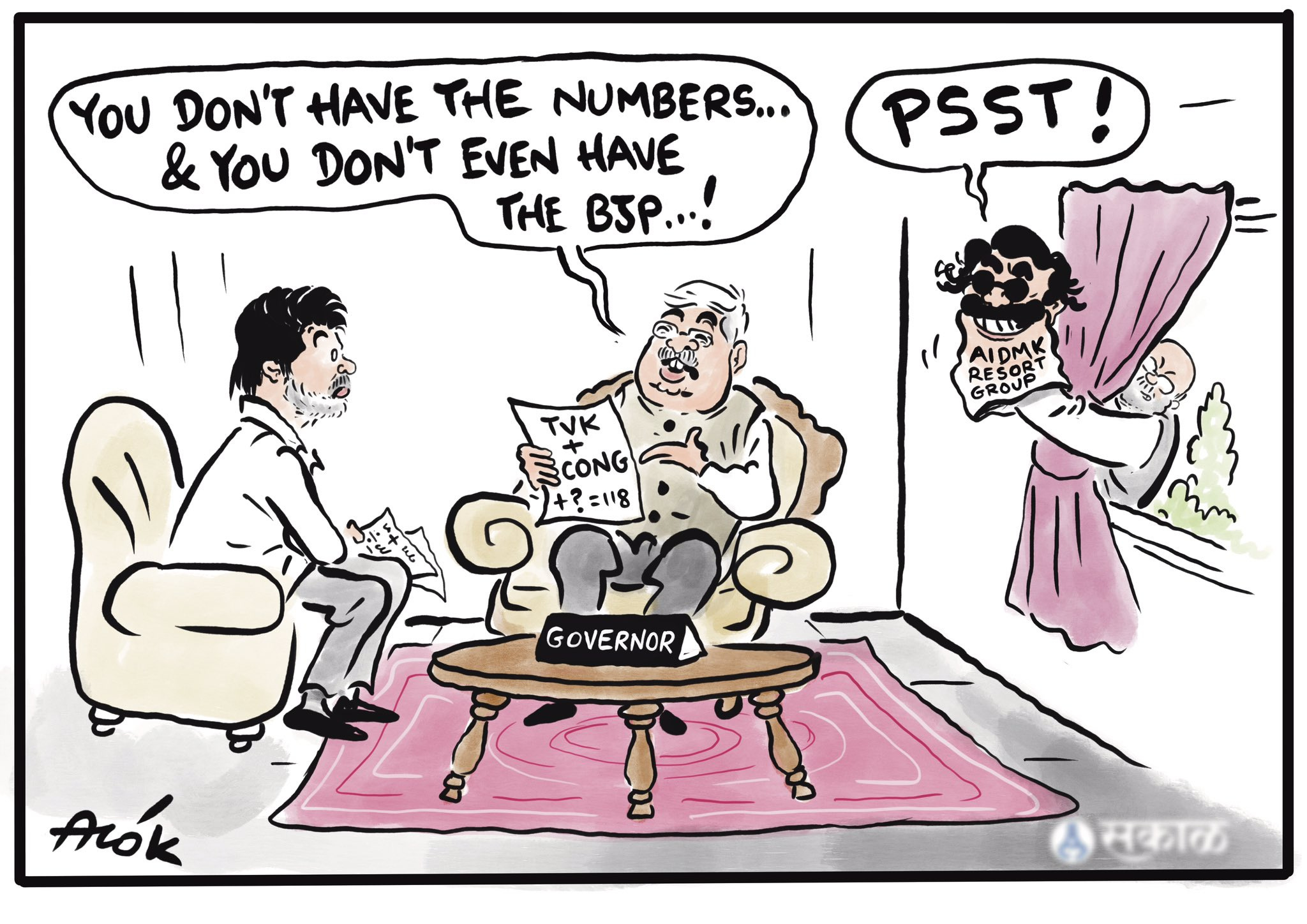
In Tamil Nadu, Governor Rajendra Arlekar continues to prevaricate over Joseph Vijay’s claim – as the single largest party – to form the government. Vijay’s TVK won 108 seats (actually 107, since Vijay won from two constituencies) and is 11 seats short of the majority mark of 118. He has the formal support of the Congress (5 MLAs) and the Left (4 MLAs) but the governor says he has yet to receive any formal communication from VCK, an erstwhile ally of the DMK that has two seats. On his part, DMK chief MK Stalin today urged the governor to “take immediate action to form a new administration in accordance with the Constitution, in order to avoid any delay in the formation of the government”.
Two Chinese aviation personnel have come on record speaking to state broadcaster CCTV saying that China provided on-ground technical support to Pakistan during its military conflict with India last year following Operation Sindoor. The South China Morning Post says both mentioned the Chinese-made J-10CE multi-role fighter jet, with one of them saying of its “outstanding results” that “we weren’t very surprised”. This would mark the first confirmation of on-ground Chinese assistance to Pakistan during the conflict. China has claimed, indirectly mentioning the Indo-Pakistani conflict, that the jet “successfully shot down multiple enemy aircraft” in mid-May 2025. Pakistan is the only country other than China known to operate the platform.
As we mark the passage of one year since India launched Operation Sindoor, there are two more, ignominious, anniversaries that occur alongside: one is of Madhya Pradesh minister Vijay Singh’s proclamation that Indian Army Colonel Sofiya Qureshi was akin to a ‘sister of the terrorists’ across the border and that the Modi government had made her a spokesperson as some means to humiliate the terrorists. Today solicitor general Tushar Mehta submitted before the Supreme Court that in his personal view, “possibly he [Singh] wanted to praise the lady [but] he could not articulate [it] properly”. Chief Justice Surya Kant was not convinced: “Political personalities are very articulate … If it was a slip of tongue, he would have immediately apologised.” Asked if the state government has decided on whether to provide sanction to prosecute Singh, Mehta responded in the negative, seeking more time.
The other ‘anniversary’ is that of Indian news channels falsely proclaiming that India had invaded Pakistan and attacked the Karachi port. There have been no consequences for this, it has been noted.
India’s LPG consumption was “choked” in March and April as the West Asia war and the closure of the Strait of Hormuz disrupted supplies from Gulf nations, the Economic Times reports. Consumption fell sharply to 2.2 million tonnes in April, a decline of more than 16%, marking the steepest year-on-year decline in at least four years even as commercial LPG prices were hiked.
At the same time, pressures are building across the wider economy. India’s once-rich market premium is beginning to erode as oil shocks combine with slowing growth, while the lack of AI-driven momentum – a major driver of global investor enthusiasm elsewhere – continues to weigh on foreign appetite for Indian equities, says Nikkei Asia.
The shift is also reshaping investor behaviour at home. Long focused almost entirely on domestic markets, Indian investors are increasingly moving money abroad in search of diversification and stronger returns amid persistent foreign outflows and a rupee hovering near record lows. Indians invested more than $2.2 billion in overseas equities and debt in the 11 months through February – a 60% jump from a year earlier – while assets in global feeder funds run by local money managers hit a record $4 billion in March, highlighting growing unease over domestic market prospects.
Meanwhile, Cognizant is reportedly preparing to cut between 12,000 and 15,000 jobs globally, with India expected to bear the brunt of the layoffs. Industry analysts say the company’s heavy reliance on its Indian workforce, coupled with significantly lower salary costs than markets such as the US, makes the country the primary target for the planned reductions.
Two Indian nationals are among crew members aboard the Dutch vessel MV Hondius, where a hantavirus outbreak has infected five people and claimed three lives. India Today reports that there is no information yet on the roles of the Indian nationals aboard the ship, their medical condition, or whether they had any interaction with infected passengers.
More than 250 children reportedly fell ill after consuming a mid-day meal at a government school in Bihar’s Saharsa district, where a baby snake was allegedly found in the food served to students. The affected children were rushed to nearby hospitals and health centres for treatment.
The controversial bird specialist Tony Silva had his cell phones and computer seized by Brazil’s Federal Police at Guarulhos Airport, in São Paulo. Silva is “suspected of coordinating the purchase of illegally traded animals for Vantara, a private mega zoo in the state of Gujarat, India, run by billionaire Anant Ambani, son of India’s richest man,” reports Mongabay.
The Tangkhul Naga Long organisation has said that a group of armed insurgents belonging to the Kuki National Army (Burma) crossed over from Myanmar and attacked three Naga villages in Manipur‘s Kamjong district early on Thursday. They fired indiscriminately, tortured some residents and set 18 houses on fire, the organisation said. There does not appear to be a police statement on the incident yet. Tensions between Manipur’s Kukis and Nagas have erupted into violence in recent weeks. This comes on top of the already festering ethnic conflict between the state’s Meiteis and Kukis that has carried on for over three years now.
Yesterday the Bombay high court upheld the 2018 acquittal of 22 accused in the staged encounter of Sohrabuddin Shaikh, his wife Kausar Bi and his associate Tulsiram Prajapati in Gujarat in 2005 and 2006. “The foundation of the prosecution story is not established at all” and it failed to prove that the trio was abducted, illegally detained and extrajudicially killed, the high court said. Union home minister Amit Shah, then a minister of state in Gujarat, was accused of orchestrating the encounters but was acquitted in 2014.
Cuttack resident Soumya Ranjan Swain was accused by two women of attempting to sexually assault them. An irate mob tied him up and lynched him on the street. The police are accused of standing by as Swain was beaten but have denied this.
In some parts of Rajasthan caste panchayats are very much a thing of the present, ordering social boycotts and levying fines on villagers they indict of various ‘offences’, which have included refusal to acquiesce to child marriage and disagreeing with them in disputes. The Rajasthan high court took note of the issue last year and police have more actively pursued them, but panches have adapted by terming their ‘punishments’ and ‘honours’ instead and misusing local community norms, reports Sreeparna Chakrabarty, who spoke to several people who have suffered the boycotts ordered by these panchayats. One problem is that there is no all-India law to tackle such boycotts.
Last July a Betul, Madhya Pradesh school teacher posted a WhatsApp status of himself reciting Shoaib Kiani’s acclaimed Urdu poem ‘Behaya’ (‘Shameless’), prompting the local police to lodge an FIR against him alleging that his video was misogynistic, ‘unbecoming of a teacher’ and hurt the sentiments of a particular community. The Madhya Pradesh high court quashed the FIR, noting in a recent order that the poem “is a satirical and thought-provoking commentary on the issue of human rights violations against women”. “The allegations are couched in general and subjective terms, devoid of any particulars as to how the essential ingredients of the alleged offence are satisfied,” it said.
If you think majoritarianism is not deeply entrenched in India – especially in the “model state” of Gujarat – think again. The short clip of policemen brutally beating a Muslim man over cow slaughter charges appears to have been blocked in India so we are posting the video here:
Modi government quietly moves to reset ties with Turkey
A year after the ‘godi media’ went berserk criticising and boycotting Turkey, the Modi government is now quietly moving to mend ties with Ankara after relations between the two countries remained effectively frozen for nearly a year amid tensions over Pakistan.
Reporting on the development, the Middle East Eye notes,
“Last month, India unexpectedly invited Turkey for the 12th round of bilateral consultations. Ankara dispatched Turkish Deputy Foreign Minister Berris Ekinci, who co-chaired meetings with Sibi George, secretary (West) at India’s Ministry of External Affairs. Turkish officials told MEE the meetings went very well, with both sides expressing an interest in maintaining healthy dialogue.
An Indian official told MEE,
“We have decided to mend bilateral ties … We believe dialogue is better than not talking and deepening disagreements and misunderstandings. And the conversations have been satisfactory.””
India still hedges on BrahMos sale to Vietnam amid China sensitivities
Will India end up selling the BrahMos missile to Vietnam? That question has been live for the last 12 years and Vietnamese President To Lam’s visit to New Delhi this week did not provide any clarity, with the external affairs ministry only indicating that talks are on. Despite the rhetoric of the Modi government’s Act East policy, its hesitation to sell the missile to Hanoi reflects its “broader strategic restraint in managing ties with China”, Rahul Bedi explains. Vietnam has its own border disputes with China and had fought a war with it too, and India exporting BrahMos to the Southeast Asian nation could, as one Army veteran put it, “represent a calculated strategic assertion that India too was willing to … impose strategic costs on China in its own neighbourhood”. But Beijing, which has transferred materiel and even nuclear know-how to Pakistan, has publicly cautioned against an Indian BrahMos sale to Hanoi.
RSS chief gets government security, taxpayers get a secret
The home ministry under Amit Shah and the Central Industrial Security Force (CISF) have refused to disclose how much public money is being spent on the security of Rashtriya Swayamsevak Sangh (RSS) chief Mohan Bhagwat in response to RTI applications seeking the information. While the ministry invoked exemptions related to security and privacy, the CISF claimed immunity under the RTI Act. Bhagwat holds no constitutional office, yet continues to receive lavish state-funded protection shielded from public scrutiny. Ankit Raj asks: if taxpayers are footing the bill, why should the amount remain a secret?
The Long Cable
One Year After Pahalgam, the Questions That Won’t Go Away
Sanjiv Krishan Sood
April 22 marked one year since the terrorist attack at Pahalgam that killed 25 tourists and one local pony rider. It triggered “Operation Sindoor” — a four-day kinetic conflict between India and Pakistan from 7–10 May that ended in a ceasefire whose origins are mired in controversy, and handed Donald Trump a platform from which to repeatedly claim credit. A year on, several questions remain unanswered.
The most fundamental: have we learned anything?
Reports at the time indicated that the gunmen crossed the Line of Control from approximately 200 km away and withdrew to Pakistan-occupied Kashmir after the attack. How intelligence agencies failed to detect their movement — electronic or otherwise — is a question that has received no satisfactory answer. The failure recalls Pulwama, where 350 kg of explosive was smuggled in without triggering any alert, and the human bomber — already on the radar of investigative agencies — was not monitored. Add to this the failure to act on the purchase of satellite imagery of the Pahalgam area by a firm linked to a person of Pakistani origin, acquired from a US company in the period before the attack, and a damning pattern takes shape. Uri, Pathankot, Kaluchak — the list of intelligence lapses is long.
That no lessons were learnt from Pahalgam was made apparent by the car bomb which exploded near the Red Fort in November 2025. Intelligence agencies again failed to detect the purchase and storage of large quantities of ammonium nitrate by radicalised youth, despite the material being restricted. A reported statement by Maulana Masood Azhar of the Jaish warning of a major attack went unconnected to the threat that materialised. Only the fortunate discovery of subversive posters in Srinagar, and the subsequent investigation and arrests, prevented what could have been a far larger catastrophe. A dozen lives were still lost.
The intelligence failure at the Red Fort also highlights a broader societal complacency. The bomber reportedly sat in his vehicle for several hours in a parking lot close to the site of the blast. No police beat officer, no parking attendant, no member of the public raised an alarm. Security consciousness in this country remains dangerously low.
The establishment shares the blame. The deployment of over 2.5 lakh troops to conduct elections in West Bengal and other states has meant significant withdrawals from border areas and internal security duties — including from Manipur, where the security situation remains volatile. Withdrawal from borders is reported at over 50 per cent in some areas, creating openings for infiltration and border criminals. Security cannot be a lower priority than electoral management.
There is also the recurring ugliness that follows each attack: the demonisation of Kashmiris and Muslims at large. After both Pulwama and Pahalgam, Kashmiri students at institutions across the country were harassed and assaulted. After the Red Fort bombing, the targeting grew uglier still. The Mata Vaishno Devi Medical College in Katra was stripped of its recognition because some of the suspects had studied there — never mind that its students had earned their seats through NEET. The labelling of an entire community as “white-collar terrorists” on the basis of religion or regional origin is not security consciousness; it is communal bigotry.
The media, too, has a case to answer. Outlets that deliberately give such attacks a communal colouring — knowing the history of communal violence in this country — bear responsibility for the social fallout that follows. That this continues to happen, attack after attack, is a failure of professional standards and editorial judgment alike.
One year after Pahalgam, India remains vulnerable in ways that have not been honestly accounted for. The intelligence apparatus needs to overhaul the way it gathers, shares, and acts on information. The political establishment needs to treat security as a permanent priority, not a variable adjusted to electoral calendars. And the public conversation needs to resist, rather than amplify, the communal reflex.
Between two nuclear-armed neighbours, a single intelligence failure can be catastrophic. We have had several. The questions that Pahalgam raised are still waiting for answers.
Sanjiv Krishan Sood was additional director general of the BSF.
Reportedly
Now that Suvendu Adhikari is going to be the BJP’s pick for chief minister of West Bengal, Modi’s 2016 video taunting Adhikari – then a Trinamool Congress minister in the state – for getting caught on camera accepting a Rs 5 lakh bribe is going viral.
Drawn and quartered
Deep dive
Aparna Bhattacharya analyses how the BJP leveraged communal tensions in Bengal in the recently concluded polls, with the party making its strongest gains in districts where communal incidents had recently occurred or were repeatedly highlighted in campaign narratives.
Prime number: 7
Sravasti Dasgupta counts the cost in seven ways that the SIR in Bengal and delimitation in Assam have altered the country’s electoral playing field forever.
Opeds you don’t want to miss
Recent assembly elections cannot be understood without recognising the role of majoritarianism, argues Suhas Palshikar.
A year after Operation Sindoor, India remains “stuck in the tactical narrative” while Pakistan has quietly secured “strategic gains,” writes Pravin Sawhney. Meanwhile, Lt Gen H S Panag (retd) warns that “Operation Sindoor 2” could unfold within the next five years, with Pakistan increasingly “learning from Iran.” Unable to match India economically or militarily, Islamabad is likely to invest in “select technologies” aimed at offsetting India’s conventional advantage. “The asymmetric trigger for Operation Sindoor will become enmeshed with the conflict itself at a much larger scale in Operation Sindoor 2,” Panag writes, warning that it could “engulf the whole of the nation,” even without major ground operations.
Yamini Aiyar warns that the SIR’s greatest danger lies in how ordinary state processes can be turned into instruments of exclusion:
“To understand the full effects — and dangers — of the SIR, we must look beyond electoral math. Its real impact and its most enduring consequence lie in the countless stories of State harassment: the endless chase for documents to ‘prove’ one’s identity; the callousness of algorithmic decisions; and the sharply differentiated ways in which this burden of proving identity are experienced across religious lines — differences that were unmistakable in the voices we heard during our travels. Taken together, these accounts reveal that the West Bengal SIR is a case study in how long-established, routine bureaucratic procedures — verifying documents, cleaning up ‘lists’ — can be weaponised and folded into a dangerous political project of exclusion.”
Nilanjan Mukhopadhyay writes that the Election Commission’s sweeping voter-roll revision disenfranchised millions, deepening concerns that Hindutva politics and electoral engineering are steadily reshaping the Indian republic.
Why isn’t India Inc investing in the India growth story? Vivek Kaul says that the problem isn’t a shortage of capital, but the mindset of those who control it. “The bottleneck isn’t money — it’s where the money wants to go. Those who control capital in this country are, by instinct or origin, financiers: even the ones in the manufacturing industry tend to think like bankers. And bankers don’t wait. They want returns that are large and fast. Manufacturing — which demands patience, tolerates ambiguity and pays out slowly if at all — is exactly the wrong pitch. So the capital flows elsewhere, and manufacturing remains just a talking point”
G. Sampath, at his satirical best, explains why India supposedly has no option but to immediately cut down one crore trees on Great Nicobar Island in order to checkmate China.
Listen up
On The Equator Podcast, Pankaj Mishra discusses how journalism in both the US and India has declined in parallel, as Siddhartha Deb argues that newspapers, much like universities, have cravenly surrendered to the Trump administration – much as they did under earlier presidents.
Watch out
Is it time to bring diplomacy back into India’s relationship with Pakistan? Former diplomat, ex-High Commissioner to Pakistan, and author T. C. A. Raghavan makes a compelling case.
Over and out
State dinners at Rashtrapati Bhavan in Naya Bharat have become ‘pure veg’ affairs but a recent list of the fare served to the President of Viet Nam prompted a social media history buff to dig up the menu for the Indian Republic’s first state banquet…

Put it down to waiting time at the Emergency section or the mobile obsession of young Indian males but a video of a man with a machete in his head at Sion Hospital in Mumbai scrolling through his phone as we waits his turn has stunned people around the world. The man, Rohit Pawar, was successfully operated on and is said to be fine.


Machete man (needs confirmation)
That’s it for today. We’ll be back with you on Monday, on a device near you. If The India Cable was forwarded to you by a friend (perhaps a common friend!) book your own copy by SUBSCRIBING HERE.