
A newsletter from The Wire | Founded by Sidharth Bhatia, Siddharth Varadarajan, Sushant Singh, Seema Chishti, MK Venu, Pratik Kanjilal and Tanweer Alam | Contributing writers: Kalrav Joshi, Anirudh SK
If you like our work and want to support us, then do subscribe. Sign up with your email address by clicking on this link and choose the FREE subscription plan. Do not choose the paid options on that page because Stripe – the payment gateway for Substack, which hosts The India Cable – does not process payments for Indian nonprofits.Our newsletter is paywalled but once a week we lift the paywall so newcomers can sample our content. Today is that day. To take out a fresh paid subscription or to renew your existing monthly or annual subscription, please click on the special payment page we have created – https://rzp.io/rzp/the-india-cable.Snapshot of the day
February 6, 2026
Siddharth Varadarajan
Indian parliamentary discourse reached a molar high with the ruling coalition alleging that opposition women MPs were poised to bite the prime minister.

The Supreme Court on Friday declined to hear the Jan Suraaj Party’s plea to have the Bihar elections set aside on the grounds that the transfer of Rs 10,000 to certain women voters shortly before the polls was a violation of the model code of conduct, and said the high court may be a better forum to go to. However Chief Justice Surya Kant also orally suggested that the Prashant Kishor-led party may have had another motive for its petition: “How many votes your party got? If people reject, then you approach the judicial forum to get popularity,” Debby Jain quotes him as saying.
A suicide bombing at a Shiite mosque in Islamabad today has killed at least 31 people and injured 169 others. No group immediately claimed responsibility for the bombing that came less than a week after the coordinated attacks in Balochistan, but “suspicion is likely to fall on militants such as the Pakistani Taliban or the Islamic State group, which has been blamed for previous attacks on Shiite worshippers”, Munir Ahmad writes. Pakistani officials have blamed “India and its proxies” for the carnage, a charge the Indian government has rejected.
At least 18 men died inside an illegal mine in Meghalaya‘s East Jaintia Hills district yesterday after an explosion occurred inside of it; the coal mine is one among the many ‘rat-hole’ mines operating in the state that are characterised by their extremely narrow tunnels that miners must crawl through. A search is on for missing miners inside the two foot-by-three foot tunnels 100 feet underground but increasing water levels are hindering the operation, Sukrita Baruah reports. Two people alleged to have run the mine have been arrested. A retired judge of the Gauhati high court who has officially monitored illegal coal mining in Meghalaya told Baruah that
“While this continues unabated, with a lack of serious action, this was an incident waiting to happen. While this is the most major such incident, there have been many smaller ones, and it is very likely that there have been many more which have gone unnoticed.”
Markets in Manipur’s Churachandpur were closed, roads saw little vehicular movement and schools and offices too recorded low attendance as two tribal groups announced a ‘shutdown’ in protest against Nemcha Kipgen taking oath as deputy chief minister earlier this week, reports PTI. Thursday evening saw a clash between demonstrators and police and the atmosphere remains tense, with additional security personnel deployed. Many Kuki groups had opposed legislators from their community joining a popular government unless an assurance for a ‘separate administration’ for their people in the strife-roiled was provided.
The Maldives has announced plans to expand its Special Economic Zone (SEZ) to include waters around the disputed Chagos Archipelago, months after India agreed to support Mauritius in monitoring its expanded territorial claims in the area. The move highlights competing assertions over the strategically located region in the Indian Ocean. Maldivian President Mohamed Muizzu on Wednesday withdrew a 2022 letter sent by the previous government to Mauritius that had backed a UN resolution seeking an International Court of Justice opinion on the archipelago’s separation from Mauritius in 1965. India’s support for Mauritius, a long-standing strategic partner, has been seen as deepening New Delhi’s role in the dispute.
Nearly 7,000 Indian nationals have had to be rescued from cybercrime compounds in Cambodia, Myanmar and Laos between 2022 and 2025 – a grim tally that the Union government itself placed before Parliament on Thursday. In a written reply, Minister of State for External Affairs Kirti Vardhan Singh acknowledged that “dubious firms” have been openly operating fake recruitment rackets, luring Indians abroad with sham job offers only to force them into cyber fraud from scam centres across Southeast Asia. Despite the scale of the problem, the Modi government admitted it does not even know how many Indians remain trapped in these countries, citing the use of “fraudulent/unscrupulous recruitment agents” and illegal routes. Singh said 2,533 Indians were rescued from Cambodia, 2,297 from Laos and 2,168 from Myanmar – figures that read less like a success story and more like an indictment of how easily thousands slipped through the cracks before the state stepped in.
Meanwhile, the US Drug Enforcement Administration (DEA) has shut down more than 200 website domains linked to an India-based transnational criminal network accused of flooding the American market with illegal and deadly drugs. The seizures, carried out under “Operation Meltdown”, target a sprawling web of fake online pharmacies allegedly tied to at least six fatal overdoses and four non-fatal cases in the US. According to the DEA, the sites processed hundreds of thousands of orders for diverted pharmaceuticals and counterfeit pills, routinely bypassing any requirement for valid prescriptions. Many of the pills, sold to customers who believed they were dealing with legitimate pharmacies, were allegedly laced with fentanyl.
While senior leaders in the BJP have at times professed their admiration of Gandhi’s assassin Nathuram Godse, the saffron party’s Karnataka unit has now suggested that Gandhi would himself be driven to violence by the Congress “looting in my name for 60 years” and “spreading misinformation about the VB-G RAM G scheme implemented by the Modi government to make my dream of gram swaraj come true”. Gandhi may have carried a stick but everyone knows he radically chose not to wield it – or any other weapon – even when confronted with the far more pressing issue of fighting for India’s independence.

The Maharashtra government has announced a new rate card for medical care services, under which it will now charge patients for every single service provided at government-run hospitals. Free treatment will be limited to a select group, including MPs, MLAs, judges, government employees and their dependents, as well as medical officers, nursing staff of government hospitals and medical students, among others – making “public healthcare” increasingly public in name, but not in price.
Madhya Pradesh Chief Minister Mohan Yadav on Thursday offered a brisk tour of Indian history, philosophy and geography, declaring that Hindutva is not just an ideology but the very essence of nationhood – conveniently compacted into a single speech. Speaking at a “Sant Sammelan” in Haridwar during the Pratima Pran Pratishtha ceremony at the Gurudev Samadhi Mandir, Yadav invoked Adi Shankaracharya adding that he took Sanatan culture to “new heights” and, in a historical coincidence no state tourism department could ignore, also shared a “special bond” with Madhya Pradesh.
The New York Times’s correspondent covering misinformation and disinformation has a piece today on how Hindutva fabulists are questioning the provenance of the Taj Mahal and have even made a movie to (unsuccessfully) press their case.
India’s stock market continues to trail the broader economy, and the latest signals from currency and capital flows underline the disconnect. The rupee did log its “biggest one-day gain in seven years” following the trade deal announcement, but the bounce proved short-lived and failed to gather momentum, notes Veena Venugopal in The Financial Times’ India Business Briefing newsletter. Currency dealers blame a “lack of follow-through buying by overseas investors”, a sign that foreign institutional investors are “not returning any time soon” to Indian markets, she adds.
On Pakistan, the boycott underscores a growing divide between cricket’s commercial interests and political reality, The Guardian notes adding that “those worldwide have watched the game grow toxic courtesy of the jingoism at play. Take Narendra Modi, India’s prime minister, comparing their Asia Cup victory last year to Operation Sindoor, a series of military strikes on Pakistan and the Pakistan-administered Kashmir”.
The home ministry, Nagaland’s government and the Eastern Nagaland Peoples’ Organisation – an umbrella body of eight Naga tribes – signed a tripartite memorandum of understanding yesterday providing for a ‘Frontier Nagaland Territorial Authority’ to encompass six eastern districts of the northeastern state and that is to bring them more autonomy.
Officials of the social justice ministry recently told community leaders in north India that the registrar general’s office has agreed to enumerate denotified, nomadic and semi-nomadic tribes or DNTs in the second phase of the census next year. But B.K. Lodhi, one of the leaders who was present in the meeting, said that “we have no idea how they will do this”. Abhinay Lakshman reports that DNT leaders from various parts of India are pushing to have their own ‘column’ in the census. Some are also pushing for sub-classification within DNTs – most but not all of whom have been absorbed into the SC, ST and OBC categories – in order to reflect “the graded backwardness between settled and nomadic denotified communities”.
The BBC visited Umri, a village near Uttar Pradesh’s Moradabad where an inter-faith couple – Kajal and Arman – were slain recently in a suspected ‘honour killing’ allegedly by the former’s brothers. Umri has had warm Hindu-Muslim relations, residents said, and although “it’s not that men and women in the village have suddenly started feeling unsafe”, now “there is a silence that hangs over us”, shared one Arif Ali.
‘Mohammad’ Deepak vs Bajrang Dal: The FIR against Hindutva activists who protested against Deepak for standing by a Muslim shopkeeper mentions unidentified individuals. Alt News helps Uttarakhand Police by identifying 5 of them. Will the police act? Seems unlikely.
Recalling how Ajit Pawar had stepped in on multiple occasions to help Muslims affected by riots, cattle vigilantes and economic difficulties, Jyoti Punwani writes that he had played the “essential role of a bridge between the Muslim community and an administration indifferent, if not hostile to it”. “Through words and gestures, he reassured them,” she says, and although “these reassurances were not fake … they also cost him nothing”.
The layoffs at The Washington Post are not merely a financial story; they point to a deeper uncertainty about the value of journalism itself. Aban Usmani argues that the Jeff Bezos chapter offers a cautionary tale about media ownership – one with clear and troubling implications for India.
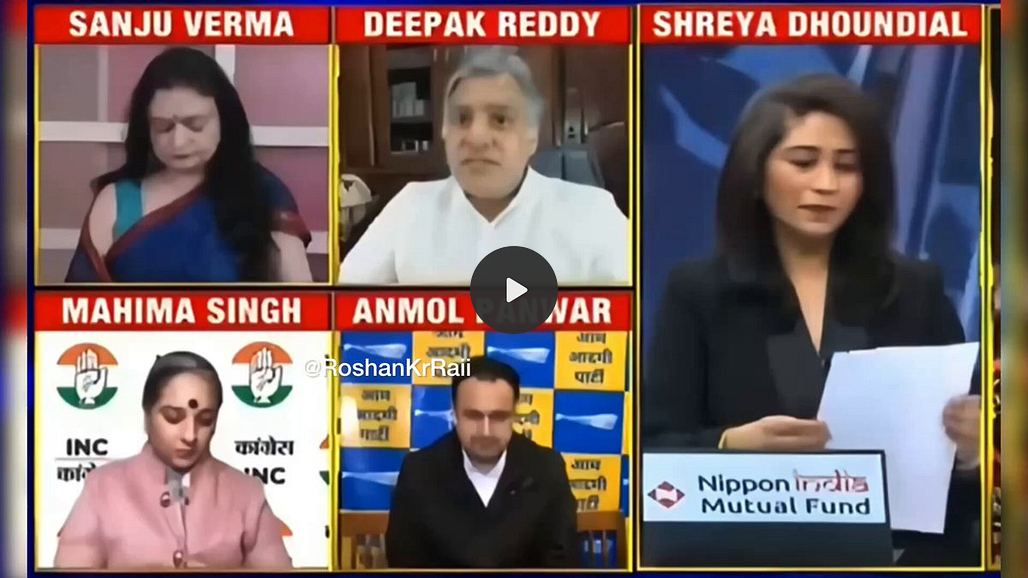
But the ‘Godi media’ continues to do what it does best: embarrass itself, again and again.


Nearly three-fourths of Air India’s 267 planes identified for repetitive defects since Jan 2025, claims govt data
Around half the aircraft examined for technical deficiencies across Indian carriers have shown recurring defects, with Air India Group and IndiGo accounting for the largest share, according to data tabled in the Indian parliament yesterday. The Union government said 754 aircraft from six scheduled airlines were analysed for repetitive snags since January last year. Of these, 377 were flagged for recurring defects. The figures, presented in the Lok Sabha by Minister of State for Civil Aviation Murlidhar Mohol, reveal that 191 of the 267 aircraft operated by Air India Group were identified with repetitive defects during inspections conducted since January last year.
FIR against film ‘Ghooskhor Pandat’ for allegedly hurting religious sentiments
The Uttar Pradesh police has filed a first information report (FIR) against ‘Ghooskhor Pandat’ director Neeraj Pandey and members of his team for allegedly hurting religious sentiments and disturbing social harmony. The film, starring Manoj Bajpayee, Nushrratt Bharuccha and Shraddha Das, was criticised by some groups for its title that allegedly vilified the Brahmin community. The use of the word “pandat”, associated with the Brahmin community and also meaning a priest, with “ghooskhor”, a term for someone who accepts bribes, sparked the uproar. A petition was also filed in the Delhi High Court seeking a stay on the film for alleging that its title and the content were defamatory and communally offensive.
Following the controversy, Pandey said on Friday that the film was a fictional police drama, adding that the term “pandat” had been “used simply as a colloquial name for a fictional character”.
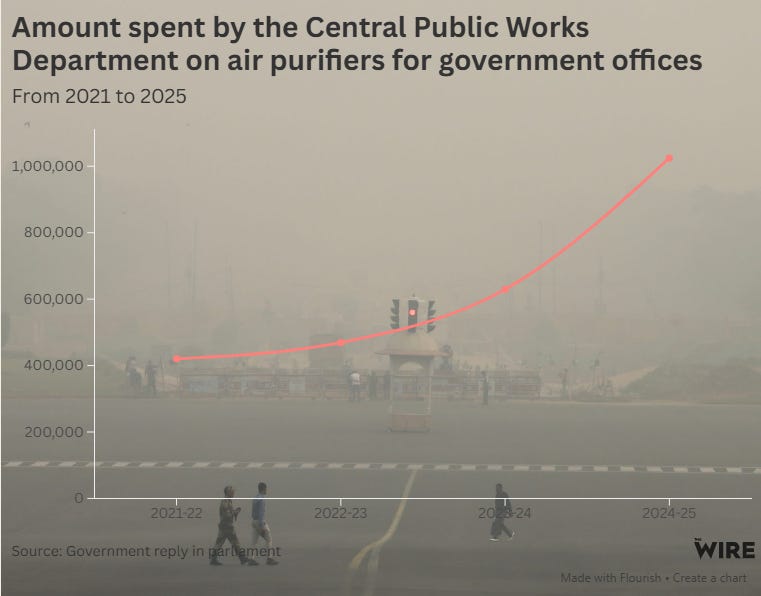
How Modi govt spending on air purifiers for its offices rose
The Central Public Works Department (CPWD) procured a total of 405 air purifiers for Parliament, Central government offices and the Supreme Court over the last four years, the government informed the Lok Sabha on Thursday. Replying to an unstarred question, Minister of State for Housing and Urban Affairs Tokhan Sahu said the procurement rose from zero in 2020–21 to 24 units in 2021–22, 81 in 2022–23, 144 in 2023–24 and 156 in 2024–25, reflecting a steady increase in purchases across key government institutions.
The Long Cable
Rechin La and the Limits of Buck-Passing
Col (Retd) Alok Asthana
Recent attention has returned to the events surrounding the Rechin La episode of August 2020, particularly the claim that India’s political leadership sought to shift responsibility for that episode onto the then Chief of Army Staff, Manoj Mukund Naravane. The criticism is familiar: civilian leaders mishandled a military crisis and later sought cover behind the uniform.
That criticism is not misplaced. It is also incomplete.
What the political leadership did was wrong. This is no way to manage a professional army, either during a crisis or afterwards. Much has already been written on this aspect, and repeating it adds little. What remains insufficiently examined are the deeper institutional failures that made such buck-passing possible in the first place.
To understand those failures, one must look not at personalities but at time, terrain, and doctrine.
When the Rechin La incident occurred on the night of 31 August 2020, it did not take place in a strategic vacuum. More than two and a half months earlier, on 15 June 2020, B. Santosh Babu and 19 soldiers of 16 Bihar were killed in the Galwan Valley in a violent confrontation with Chinese troops.
Galwan was not an aberration. It was a declaration of intent.
By mid-June 2020, Chinese behaviour in eastern Ladakh had crossed from coercive signalling into open physical confrontation. The willingness to escalate was clear. From that point onwards, no senior military commander could plausibly claim uncertainty about Chinese intent in that sector.
Yet when tensions resurfaced at Rechin La in late August, Indian forces were still operating under restrictive rules that limited a commander’s freedom to respond decisively to a hostile advance. This was not a failure of courage on the ground. It was a failure of institutional adaptation.
This geography has been understood for decades. starting 1962. Both Major Shaitan Singh and Major Dhan Singh Thapa were awarded the Param Vir Chakra for separate actions in Ladakh during the 1962 Sino-Indian War, fought weeks apart but within the same strategic theatre.
The importance of the ground had not diminished. What had changed was the latitude granted to those ordered to hold it.
The late-August operation by Indian forces to occupy the Kailash Heights was tactically imaginative and operationally bold. It altered the local balance and surprised the PLA. That initiative deserves recognition.
But capturing ground is only half the problem. Holding it requires clarity of intent and freedom of action.
This leads to the most uncomfortable question of all: how was a feature of such importance left under rules of engagement that constrained a commander’s right to fire in self-defence?
In his memoirs, General Naravane suggests that the government was casual about developments in eastern Ladakh, even recalling him from a planned visit only at the last moment. If that assessment is correct, it raises a basic issue. If the civilian leadership was complacent, whose responsibility was it to correct that complacency?
In a democracy, politicians decide. But they do not generate ground truth. They depend on professional military advice to understand urgency, risk, and consequence. If urgency is not conveyed, it is not because politicians failed to imagine it, but because military leaders failed to insist upon it.
The most troubling aspect of the Rechin La episode concerns the rules of engagement themselves. At Galwan, Indian troops were ordered to enforce disengagement without firearms. The result was catastrophic. One might accept such restrictions once — under protest. After Galwan, however, no professional commander could reasonably defend a doctrine that required soldiers to await permission before defending themselves against a hostile advance.
Rules of engagement are not immutable law. They are operational tools. Between Galwan and Rechin La, more than two months elapsed. What lessons were learnt? Were the rules revised in a manner consistent with demonstrated Chinese intent? If restrictive rules persisted, why were they accepted?
There is no precedent in military history for asking troops to hold tactically decisive ground while awaiting permission to defend themselves. If such rules were imposed, the moment to challenge them was before contact, not years later in memoirs.
It is tempting to reduce Rechin La to a morality play — politicians as villains, generals as reluctant intermediaries, soldiers as victims. Such narratives are emotionally satisfying and analytically hollow.
Galwan was the warning. Rechin La was the test.
That the debate today revolves around memoirs rather than reform is itself revealing. The deeper failure lies not in who passed the buck, but in a system that made buck-passing inevitable.
Until that is confronted honestly and institutionally, the cost will continue to be paid by soldiers standing on cold ridgelines, constrained by rules written far from the ground they are asked to hold.
That is the failure that ultimately matters.
If we Indians are very proud how the 120 Bahadurs (name of the famous movie) fought till the end- with rifles - they must ask as to why the same sector was later defended with sticks nails embedded with nails, or a ROE ‘No firing without my orders’.
Alok Asthana is a retired Indian Army officer
Reportedly
Roshni Nadar is CEO of HCL Corporation and has been posting a series of photographs – on her verified Instagram handle – of her meetings with prominent global personalities. The list includes the UK PM Keir Starmer and Ukrainian president Zelenskyy. In a recent post she claimed she met the LG of Delhi, prompting the latter’s office to issue a denial. So what’s going on here?


Drawn and quartered
Deep dive
Johanna Deeksha reports that many debt-laden persons – largely women – in Tamil Nadu’s Namakkal district have been selling their kidneys in order to make ends meet. In one municipality in the industrially declining Namakkal, Deeksha found that “everyone we met knew someone who had sold a kidney”. “Sometimes, it was strangers who would approach them, at a tea shop, at a bus stop. They would overhear the women cry or complain about their debt in public spaces,” she writes.
Prime number: 📉92%
Official procurement of minor forest produce across 19 states went down sharply from 51,400 tonnes (worth Rs 124.3 crore) in 2023-24 to 3,920 tonnes (worth Rs 16.68 crore) in 2024-25, i.e. by 92%, Union tribal affairs minister Jual Oram said in parliament – he did not explain why the figure had plummeted.Opeds you don’t want to miss
Pointing out Pakistan cricket’s manifest dysfunction does not justify India’s actions, writes Sushant Singh:
“If Pakistan’s problem is chaos and incompetence, India’s is something more sinister, systematic, and corrosive to the sport itself. The Board of Control for Cricket in India is no longer a sporting body. By aligning its conduct with the political mood of Narendra Modi’s regime, the BCCI functions largely as an arm of the Hindutva state, a sophisticated instrument of majoritarian politics. But its actions are now undermining international cricket’s long-established institutions. Pakistan’s chaos is a tragedy for its own fans; the BCCI’s calculated weaponisation of the sport is a global threat.”
India ought to have challenged the economic ans moral foundation of Trump’s tariff tantrum, writes Sanjaya Baru:
“All these developments suggest that President Trump’s overall foreign economic policies and his new national security strategy place India in a position of relative disadvantage, compared to what was the case even a decade ago, and not in any great position of advantage. How this implies any return to a relationship of the early 21st century, as claimed by some in India, is not at all clear. It is misplaced enthusiasm masquerading as expertise.”
The Deccan Herald notes regarding the Four Stars of Destiny controversy that “it is for the government to clarify the delayed go-ahead for the book”, that the “prime minister should disclose whether the conversation [between him and General Naravane via Rajnath Singh] took place”, and that calling “Rahul Gandhi or others who demand a response from the government anti-national aligns with a familiar pattern of deflection and outrage”.
A buried line in a cricket annual report flags a 30% ICC revenue drop in 2028 media renewals. Some insiders fear a 50% hit - $1.5bn over four years. Seismic for world cricket, writes Tim Wigmore in this piece on how cricket is being killed by geopolitics.
The latest India Human Development Survey, which covers 41,000 households, found 95% of marriages continue to be arranged by families, says Namita Bhandare, citing the data as evidence of the Indian fear of love marriages.
Listen up
Nasser Hussain and Michael Atherton on Sky Sports’s Cricket Podcast talk about “the ‘crisis’ in cricket following boycotts ahead of the T20 World Cup and the repercussions it may have for the future of the game”, as well as how the England team may fare and the “questions surrounding the behaviour of captain Harry Brook”.
Watch out
Sushant Singh’s reporting on former army chief General MM Naravane’s account of events during the Chinese advances in Ladakh in August 2020 has triggered a storm in Parliament. Naravane’s memoir suggests that the prime minister left the army chief holding the bag at a critical moment. Singh joined Karan Thapar today to discuss what the memoir reveals about Narendra Modi’s handling of the crisis. He also explained why the book’s publication has been delayed for nearly two years. The conversation examined why the media has done little to cover the memoir, even though it had been unofficially available for much of this time.
Over and out
Close to a year after the CBI exonerated her and several years after she was brutally trolled following the suicide of her then-partner Sushant Singh Rajput, Rhea Chakraborty has come to believe that ‘trolling is the perfect vaccine against the bottomless pit of external validation’, finds Priya Ramani. In this piece about her new clothing line and changed goals among other things, Ramani writes that Chakraborty’s “learnings from this trauma are worthy of our attention”.
That’s it for today. We’ll be back with you on Monday, on a device near you. If The India Cable was forwarded to you by a friend (perhaps a common friend!) book your own copy by SUBSCRIBING HERE.