
A newsletter from The Wire | Founded by MK Venu, Pratik Kanjilal, Sidharth Bhatia, Siddharth Varadarajan, Sushant Singh, Seema Chishti, and Tanweer Alam | Contributing writers: Kalrav Joshi, Anirudh SK
If you like our work and want to support us, then do subscribe. Sign up with your email address by clicking on this link and choose the FREE subscription plan. Do not choose the paid options on that page because Stripe – the payment gateway for Substack, which hosts The India Cable – does not process payments for Indian nonprofits.
Our newsletter is paywalled but once a week we lift the paywall so newcomers can sample our content. Today is that day. To take out a fresh paid subscription or to renew your existing monthly or annual subscription, please click on the special payment page we have created – https://rzp.io/rzp/the-india-cable.
Snapshot of the day
August 21, 2026
Sidharth Bhatia
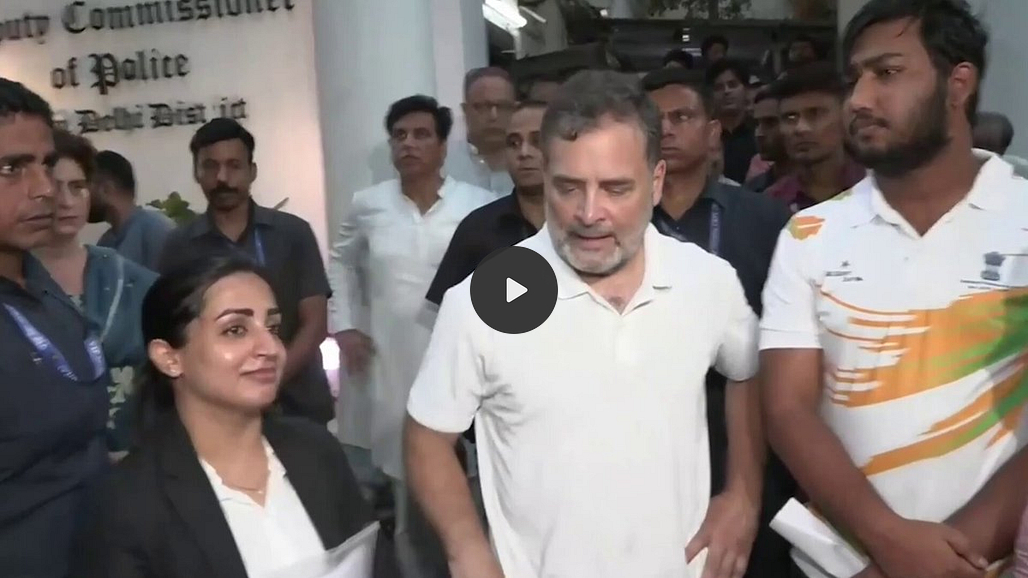
Four weeks after more than 200 pellets were fired into Sahil Lochab’s body during the July 20 Jantar Mantar crackdown, Delhi Police was forced to register an FIR – after his family says it spent a week trying, and only after Leader of Opposition Rahul Gandhi sat outside Parliament Street police station for nearly seven-and-a-half hours. Doctors have warned that the 19-year-old may lose sight in one eye and he is hardly the first person to suffer from blindness due to the use of this indiscriminate weapon: among the thousands of its victims in Kashmir are individuals who have lost vision in one or both of their eyes.

The FIR leaves the Modi government’s insistence that no shots were fired looking increasingly untenable. Medical records and reporting have documented pellet injuries, while an RTI response has since shown that ten people were injured by pellet guns on July 20. Yet the Monsoon Session ended without home minister Amit Shah answering for the actions of the Delhi Police, which reports to his ministry.
“Final approval had to come from home secretary and Amit Shah. Only then the FIR was lodged. So you can understand who was stopping the FIR,” said Gandhi upon receiving information regarding the FIR.

The Modi government has denied political clearance for Telangana chief minister A. Revanth Reddy’s proposed US visit, saying his programme there was not “to the office held and the purpose of the visit”. His UK trip, incidentally, was cleared. Reddy says the US leg was meant to pursue partnerships with institutions including Harvard and MIT and bring leading educational institutions to Telangana. “The only purpose of the visit,” he said, “was…to bring the world’s best institutions to India, to Telangana, to Hyderabad.” The MEA didn’t see it quite that way.
A total of 22 Indian sailors are aboard two vessels that pirates have hijacked this week. In the first instance pirates on Monday hijacked the M/V LUTUF with six Indians on board that was carrying Turkish weapons to Mogadishu, and instead directed the ship elsewhere off the coast of Somalia’s Puntland. In the second incident, armed pirates yesterday hijacked an oil products vessel with 16 Indian occupants some 56 kilometres off the Yemeni coast in the Gulf of Aden. Today the external affairs ministry confirmed both incidents and said the 22 Indian mariners are safe.
Confusion continues to prevail about Bangladesh Prime Minister Tarique Rahman’s India visit.
Today the Rashtrapati Bhavan announced that its change of guard ceremony scheduled for Saturday afternoon will not take place in view of a “full rehearsal for the ceremonial welcome” of Rahman but then withdrew its post. He will not visit New Delhi this weekend but a later date is not off the table. Asked about this, the MEA said it has no comments to offer right now. Rahman’s press secretary has told Reuters that no decision has been made on his visit and that Dhaka is waiting to hear back from Raisina Hill over the extradition of Sheikh Hasina and ‘other fugitive criminals’.
Dhaka earlier said that Hasina’s giving a public address from Delhi earlier this month had ‘vitiated’ talks over Rahman’s visit. The Modi government has continued to seek an early visit, but the Bangladeshi PM faces burgeoning anti-India sentiment and home as well as criticism from political groups who say Dhaka should secure more assurances before such a high-level meeting.
Meanwhile, Mirza Fakhrul Islam Alamgir – who held the Bangladesh Nationalist Party together on the ground while Khaleda Zia was under house arrest, Rahman was in London and Sheikh Hasina’s government “sought to crush the party – has his reward: he is the new president of Bangladesh.”
Pakistan’s former Prime Minister Imran Khan is back in Adiala Jail after a brief medical check-up at a state-run PIMS, citing security concerns, declared him “medically fit” and returned him to prison within hours. Khan’s family and PTI accuse the government of defying the court order and say they will challenge the move.
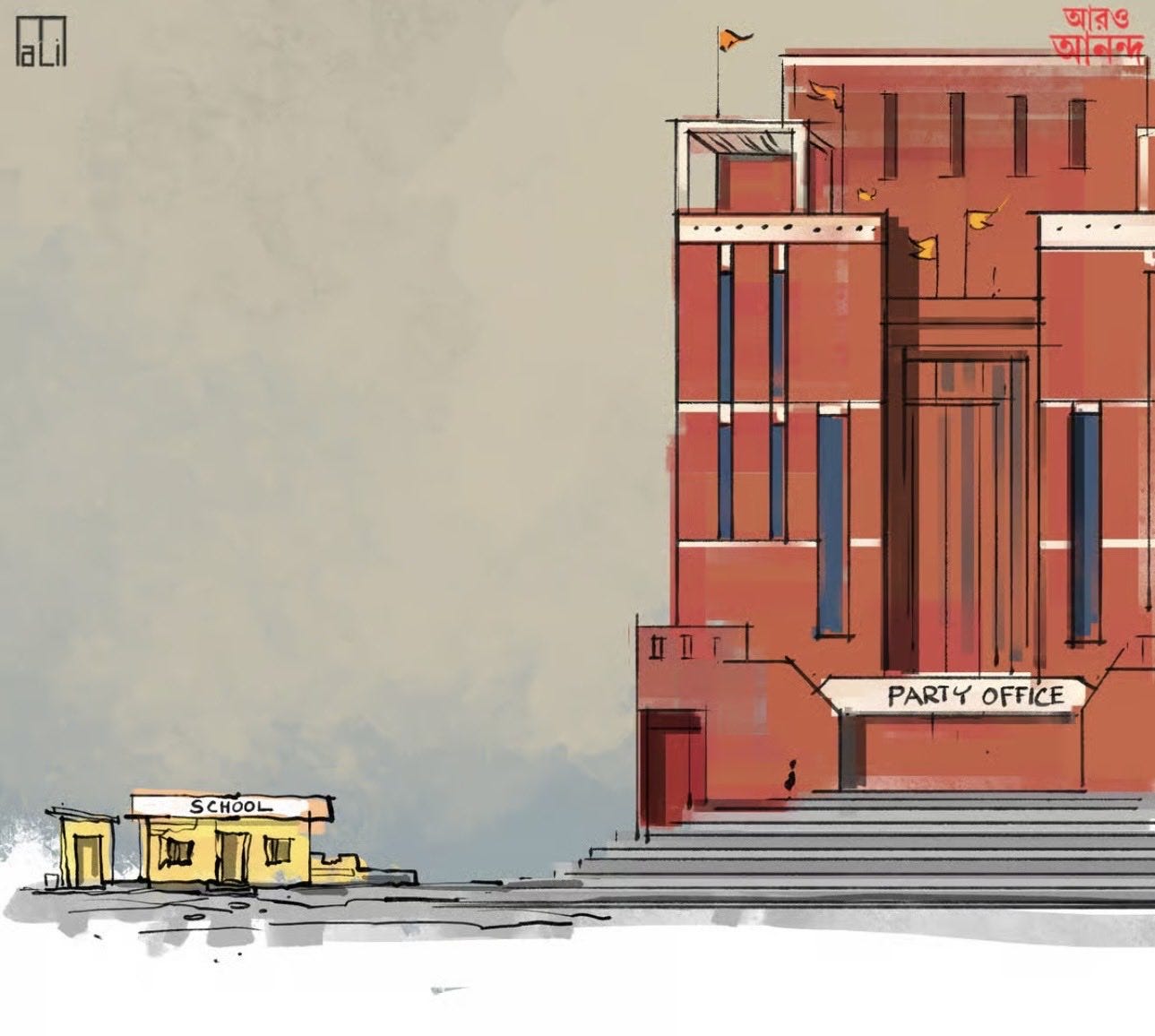
When a team of the Cockroach Janta Party attempted to enter a village near Jaipur to visit a government school that they said ‘has been running in a buffalo shed’, they were stopped by another group of people and a scuffle broke out. These individuals – the CJP has called them goons sent by Rajasthan school education minister Madan Dilawar and not local residents – are seen breaking the windows of vehicles the CJP team arrived in. The incident comes days after the Rajasthan government barred ‘outsiders’ from entering government schools without permission. Abhijeet Dipke has threatened to “go to Jaipur if the school repair work doesn’t begin and the BJP goons are not arrested within the next 48 hours”. In other news, the CJP has alleged that school administrators in Telangana have also prevented its volunteers from inspecting schools.
Meanwhile, CJP spokesperson Saurav Das has moved the Delhi High Court against Abhijit Iyer-Mitra, LawBeat, The Pamphlet, The Jaipur Dialogues and The Sunday Guardian, alleging that his residential address and personal information were publicly disclosed and sought a permanent injunction restraining the defendants from publishing, circulating or disclosing his personal details.
In the wave of Gen Alpha-led protests, particularly at Jai Prakash Narayan Sarvodaya Schools, over lack of basic facilities, infrastructure and teaching staff, Uttar Pradesh’s BJP government has issued a 14-point checklist covering more than 40,000 primary and secondary schools. Turns out the children had done some inspection of their own.
Ahead of RSS chief Mohan Bhagwat’s US visit, members of the US Commission on International Religious Freedom have urged American officials not to extend high-level meetings or diplomatic courtesies to Sangh leaders – and instead reiterated calls for sanctions against RSS members found responsible for religious-freedom violations. Earlier this year USCIRF called for sanctions and travel bans targeting the RSS for its “responsibility [for] and tolerance of severe violations of religious freedom”. It had also called, for the seventh consecutive time, on the US government to designate India as a ‘country of particular concern’ alongside North Korea, Pakistan and others under the International Religious Freedom Act. New Delhi has repeatedly dismissed the bipartisan US government commission’s assessments as “biased and politically motivated”.
‘Industry’ as interpreted by the Supreme Court in its 1978 Bangalore Water Supply and Sewerage Board judgment will not apply to the 2020 Industrial Relations Code, one of the four labour codes brought in by the Modi government, a nine-judge bench of the apex court ruled yesterday. This interpretation of industry was rather broad, bringing within its ambit a wide range of jobs and enabling employees in these fields to avail of legal recourse against unfair practices by their employers. “The judgment had brought even hospitals, educational institutions and municipalities within the fold of ‘industry’,” notes Krishnadas Rajagopal in The Hindu. Justice B.V. Nagarathna however disagreed with this view, arguing that the broad definition was necessary to protect workers’ rights in an increasingly privatised landscape.
Yesterday the Supreme Court set aside an Allahabad high court order and quashed proceedings under the SC/ST (Prevention of Atrocities) Act against a school manager accused of using casteist abuses against the father of two students. It does not emerge from the case, the apex court said, the school manager hurled these abuses ‘within public view’, if he made them at all; he was held to have made them in an enclosed room with no public access. Sections 1(r) and 1(s) of the SC/ST Act criminalise humiliating insults and casteist abuses against Dalit and Adivasi people ‘within public view’.
Shiromani Akali Dal (Amritsar) has rejected any move to treat ‘Vande Mataram’ as a national song or obligatory chant, saying the Sikh community would not accept it in such a form.
A rare collection of 688 handwritten reflections by M.K. Gandhi on truth, non-violence and service was sold for $1.69m (£1.3m) at a Saffronart auction in Mumbai – a world record for an Indian historical document at auction. Written over two years for his close aide and friend Anand T. Hingorani after the death of Hingorani’s wife Vidya, the reflections offered spiritual guidance and consolation, and were later published as the book, A Thought for the Day.
Vishwaguru meets the Global South’s reality
The latest Pew survey delivers an awkward report card for India’s claim to be the voice of the Global South. China is viewed more favourably than India in every lower-middle-income country for which comparable data is available – Bangladesh, Ghana, Kenya, Nigeria and Pakistan – and leads in most upper-middle-income countries too, including Indonesia, Malaysia, Thailand, Turkey, South Africa and every Latin American country surveyed. India does better largely in richer countries such as Germany, Sweden, Japan, Israel and the UK, while Sri Lanka and the Philippines are notable exceptions in the Global South.
So much for Vishwaguru and leader of the Global South: China appears to have won more of the Global South’s public than the country claiming to speak for it.
India’s rocket launches are among the most expensive
So much for India’s famed space frugality. A peer-reviewed study in Economics Letters finds India the most expensive of six major rocket-launch markets, with satellite launches costing Rs 12.7 lakh ($13,302) per kg at the end of 2025 – more than four times the Rs 3.1 lakh ($3,225) cost in the US. India was also costlier than Europe, Russia, China and Japan.
“What India needs is an inherent, recurring customer, which in most cases is the government. Commercial clients, to be sure, would be far and few – that’s true for all rocket operators worldwide. What India should work toward is to try lowering its launch costs to match the EU first, and then Japan, to levels of about $7,000 per kg. Rivalling the US is too far into the future, we don’t have the technical capabilities to do that,” said Chaitanya Giri, space fellow at think-tank Observer Research Foundation, reports Livemint.
BJP ally says Manipur’s ethnic conflict has set state back a decade
Manipur’s prolonged ethnic conflict has pushed the state’s economy back “by at least a decade”, Ram Muivah, a Naga People’s Front legislator and former Indian Administrative Service officer, told Vijaita Singh of the Hindu. Muivah – whose party is an ally of the BJP government in Manipur – says repeated blockades, poor road connectivity and disruption of key highways have stalled development projects across the hill districts and compounded the hardships faced by ordinary people since the violence began in 2023.
The Long Cable
GenZ has awakened us to our history’s enduring pluralist legacy
Harbans Mukhia
Perhaps the greatest lament emanating over the dozen years we have been through has been the apprehension of the loss for ever of the legacy of pluralism that our long history had bestowed on us which had survived even the traumatic shock of the Partition not to speak of the much older shocks of upheavals, invasions, migrations, colonial divide and rule policy etc. The current assault on it was on one hand organized at the base by multiple arms of the Hindutva brigade and on the other by the state with all its might which also turned venerable constitutional institutions like the Election Commission into the ruling party’s agencies. The media played a decisive role in maligning the very notion of pluralism. The certainty of BJP’s rule over the next some decades seemed to have become commonsense with an attitude of welcome. Even the numerous faux pas and the near illiteracy at the highest levels did not evoke any strong revulsion.
The pluralist ethos has taken centuries to evolve though never in a straight line. It has evolved through intellectual constructs like ‘sarva dharma sambhav’ (like treatment of all religions), social movements like Jainism, Buddhism and Bhakti and birth of ever new local deities and sects or through state action like Asoka’s insistence on social harmony and peace and Akbar’s state policy of sulh-kull (universal or absolute peace).
Bhakti saints had indeed challenged the existing dichotomies of denominational religions like Hinduism and Islam with their varying concepts of God as rival, competing entities and forms of prayers by postulating the concept of one universal God and substituted one universal religiosity in lieu of rival denominational religions and by striking down rival rituals of worship. This displacement did not erase differences of identities but diminished their transformation into hostilities. A strong evidence of this is the absence of any record of communal rioting between the Hindu and Muslim communities in medieval India over the long period of five centuries from 1200 to 1700 CE even as bloodshed in the battlefields among stakeholders of the maintenance of existing states and their challengers was common. The first genuinely communal riot for which we get evidence occurred in 1714 -- seven years after Aurangzeb’s death -- in Ahmedabad over a cow slaughter incident on the day of Holi. The riot was brought to cessation in two days by the administrator (faujdar). We must keep in mind that possessing a religious/community identity is not tantamount to being communal; it is the transformation of one’s community identity into communal identity for a social or political or even economic objective by an agency other than oneself that difference is turned into adversity; it implicates surrendering of the self to someone other. After almost every communal riot we come across very devoutly religious persons and families giving shelter and support to persons of the other community; they have retained their religious/community identity but have refused to let some others of their own group transform it into communal identity. There is willing acceptance, even celebration of diversity/plurality here. It was this historical legacy of the acceptance of plurality that has been seen by the Hindutva Parivar and its offshoot, the current regime, as the main roadblock to the creation of a singular, uniform Hindu Rashtra.
It was this unforced acceptance of plurality without ever bothering about the ‘what and why and how’ of it all that had marked the GenZ protests and still marks the ongoing students’ protests everywhere. History has a universal habit of reasserting itself when the regimes have put tons of garbage on it.
(The author taught history at JNU.)
Reportedly
Champat Rai, whose name was prominently mentioned in the Ayodhya Temple embezzlement case, but was given a clean chit by the Special Investigation Team (SIT) has now pointed a finger at Nripendra Misra. Misra, who was Principal Secretary to the prime minister from 2014 and was the most powerful bureaucrat in the country, took a very keen role in the construction of the temple, Rai said in a nine page letter. Misra,“always considered himself the primary decision-maker for all temple construction decisions,” Rai said. He said Misra inducted people of his choice into the construction committee and that one of them came to Ayodhya only twice in six years. The letter is unsigned, but Rai confirmed to the Hindustan Times that he had indeed written it. Misra was the secretary of the temple trust. Though Rai has praised Misra’s efforts in getting the temple constructed even during the Covid lockdown, this sudden outburst seems mystifying.
Drawn and quartered
Deep dive
“Mumbai’s is not the kind of heat that lodges itself in the foreign correspondent’s imagination or recalls Kim Stanley Robinson’s novel in which more than 20mn people die in the furnace of a heatwave.” Read Aruna Chandrasekhar’s essay on Mumbai heat. “Unlike viral videos of a flash flood punching through a dam, the impact of heat can be hard to see with the naked eye, let alone capture on camera. But thermal imagery tells a story that ordinary pictures can’t.”
Prime number: 60
Per one estimate Indians generate 66,000 Facebook statuses and photos, 14,5000 tweets, 8,2000 Instagram images and reels, and 94 hours worth of YouTube content – every 60 seconds. That’s a lot of content for Takedown Baba to keep track of.
Opeds you don’t want to miss
In ‘Cast(e)ing the Census’, Surinder S Jodhka notes: “When the NDA government announced the enumeration of caste, it was presented as a major political decision. However, the proposal to count caste appears to be a mere symbolic gesture, a reluctant bureaucratic process.”
As the establishment continues to be duplicitous on Vande Mataram, Shuddhabrata Sengupta draws on correspondence by Tagore, Nehru and others and recalls unequivocally that “it was not Nehru, and it was not Subhas Bose, nor any other member of the 1936 CWC [Congress working committee], who proposed limiting Vande Mataram to its first two stanzas. It was Rabindranath Tagore”. So if Amit Shah should call anyone an ‘OG dimagi Naxal’ it should be Tagore, says Sengupta.
The Economist on the politics of Vande Mataram: India’s national song was once passed over for anthem status partly because its invocation of Hindu deities was seen as excluding Muslims. For the BJP, it notes, that is “no longer a concern”. Yet the British magazine argues that while the party “may have saffronised India. But its revisionism has failed to take. That much was clear during protests for education reform last month in Delhi. Students carried copies of the constitution. They displayed photos of B.R. Ambedkar, its architect; Bhagat Singh, an anti-colonial revolutionary; and Gandhi. They chanted slogans dating to the freedom struggle. Despite having spent most of their conscious lives in the second republic, their symbols were those of the first. Building a nation is no easy task. Retrofitting one is harder still.”
This year marks the 500th anniversary of Babur defeating Ibrahim Lodhi at Panipat and creating the Mughal empire, but this is hardly being recognised. T.C.A. Sharad Raghavan makes a case for India not to discard this aspect of its history, against the background of the upcoming Shanghai Cooperation Organisation summit in Kyrgyzstan. “The Mughals enjoy a certain cachet across Central Asia, and we will not be doing ourselves any favours by distancing ourselves from them,” he says, illustrating the fascinating ways in which that is the case.
The stigma around divorce in India means that spouses are condemned to stay in failed marriages or must die (at their own hands or someone else’s) in order to escape marital cruelty. “Contrarian as it may sound, perhaps the best way to save the institution of marriage is by strengthening its exit option: namely, divorce,” writes Anindita Chakrabarti in this perceptive article. She has a few ideas on how India can start doing that.
Listen up
Kerala is renowned for its high literacy rate and robust public education system but the state’s tribal communities have persistently faced barriers in obtaining education – for instance, Priya Baburaj points out, the Cholanaickan community has a literacy rate of just 15%. She speaks with anthropologist Pradeep Kumar in this episode of InFocus about “which tribal communities are most affected by school dropouts, the reasons behind children leaving school, and the stages at which they are most vulnerable”.
Watch out
Understanding a new phase in Indian politics: Oxford scholar Amogh Dhar Sharma speaks to Seema Chishti about how political consultants, data, technology and professionalised campaigning are reshaping elections – and democracy itself.
Over and out
Pallavi Aiyar writes on China’s Luckin Coffee, which is overtaking Starbucks with a potent brew of “low prices, app-based convenience and local flavours driving rapid growth.”
If that’s not quite your cup of tea, you may be interested to know that the Sri Lankan tea giant Dilmah is set to enter the Indian luxury market – it is planning to launch its ‘Thambapanni’ collection of Indian teas in premium hotels, including fine dining restaurants and speciality cafes, in the form of pyramid bags and loose leaf.

That’s it for today. We’ll be back with you on Monday, on a device near you. If The India Cable was forwarded to you by a friend (perhaps a common friend!) book your own copy by SUBSCRIBING HERE.