
A newsletter from The Wire | Founded by MK Venu, Pratik Kanjilal, Sidharth Bhatia, Siddharth Varadarajan, Sushant Singh, Seema Chishti, and Tanweer Alam | Contributing writers: Kalrav Joshi, Anirudh SK
If you like our work and want to support us, then do subscribe. Sign up with your email address by clicking on this link and choose the FREE subscription plan. Do not choose the paid options on that page because Stripe – the payment gateway for Substack, which hosts The India Cable – does not process payments for Indian nonprofits.
Our newsletter is paywalled but once a week we lift the paywall so newcomers can sample our content. Today is that day. To take out a fresh paid subscription or to renew your existing monthly or annual subscription, please click on the special payment page we have created – https://rzp.io/rzp/the-india-cable.
Snapshot of the day
August 28, 2026
Siddharth Varadarajan, Anirudh SK and Kalrav Joshi
In line with earlier Trump administration announcements about Indian compliance with American diktats on which countries it can and cannot buy oil from, US Ambassador Sergio Gor today revealed that India plans to buy Javelin anti-tank guided missiles from the US. While he hailed this decision as a “great step forward” in defence ties and flagging possible co-production, the government of India has yet to make public its decision or even comment on Gor’s announcement.
The Javelin is a man-portable, “fire-and-forget” anti-tank missile used by the US military, NATO partners and countries including Ukraine and Saudi Arabia. Gor’s announcement comes months after India and the US signed a 10-year framework for their “major defence partnership” in October 2025. India first sought to buy the weapon in 2010, Rahul Bedi reports, “only for the effort to flounder on technology-transfer disputes, bureaucratic inertia, competing procurement priorities, and the lure of alternative and indigenously developed systems.” The Javelin’s return, he notes, says less about the missile itself than about a recurring feature of Indo-US defence and technology cooperation: “that US arms transfers, along with the tightly-controlled technologies that accompany them, remain among the most heavily regulated in the world, subject to extensive governmental, commercial, and legislative scrutiny, often resulting in procurement timelines measured in decades rather than just years.”
Sonia Gandhi’s forthcoming memoir is to be published by Knopf in the United States and Penguin Random House India was expected to bring out the Indian edition. It now turns out Penguin will not be publishing the book in India after all. Ritu Sarin reports that the publisher took this decision following Gandhi’s refusal to accept changes and deletions it had wanted. On its part, Penguin issued a statement that purports to contest this report but which actually broadly confirmed it.


So what might these ‘recommendations’ have been that Penguin made and Gandhi rejected? Quoting “Gandhi aides”, Sunetra Chaudhary reports that the book deal fell through “as she refused to make changes or deletions of references to Prime Minister Narendra Modi, the Rashtriya Swayamsevak Sangh (RSS), the ruling Bharatiya Janata Party (BJP)’s ideological fount, and Chinese intrusions.” Specifically:
“One of Gandhi’s aides told HT about some of the sections that PRHI wanted removed. Primary among them were her recollections and observations about her meetings with Modi. The aide confirmed that she has gone into details about his comments about her and cited one calling her a “Jersey cow” at a public rally in Gujarat in 2004.”
In February 2014, Penguin withdrew Wendy Doniger’s The Hindus because of objections from a right-wing Hindu outfit. It now partners with BlueKraft Foundation, which publishes books promoting the personality cult of Modi. Last year, to mark Modi’s 75th birthday, Penguin published a four volume hagiographic photobook, priced at Rs 6999, titled Sewa Hi Sankalp Rashtra Pratham Hi Prerna : Narendra Modi. Someone, somewhere must now be mightily pleased that Modi will not have to share space with Sonia Gandhi on Penguin’s shelves.


The United States Commission on International Religious Freedom (USCIRF), an independent bipartisan US federal agency, has again put the Modi government’s record under the scanner, citing violations of religious freedom, crackdowns on faith-based organisations, especially with the push for FCRA Bill and what it describes as “continued acts of transnational repression targeting religious minorities abroad”.
The report’s assessment is stark. It says the “systematic and ongoing persecution of multiple minority groups including Christians, Dalits, Muslims, and Sikhs—including denial of citizenship and voting rights, enforcement of harsh anti-conversion and cow slaughter laws, restrictions on the activities of NGOs, censorship, and transnational repression—continue to impede religious freedom in India and diaspora communities,” the report concluded. Hindu nationalist mob activity, it adds, is “rampant and occurs with impunity, with little or no accountability for violent attacks against religious minority communities. It referred to the cases of Umar Khalid, Sharjeel Imam, Jagtar Singh Johal and Ali Khan Mahmudabad in discussing India’s use of controversial anti-terror laws against critics and members of minority communities.
In Bharatiya Janata Party-ruled Uttarakhand, the Special Intensive Revision is throwing up some revealing arithmetic. Across five assembly constituencies, just five men – all linked to the BJP – filed 6,500 objections seeking the deletion of voters. Every name on their lists is Muslim, Ashwine Kumar Singh and Basant Kumar find in the second part of their investigation.
“In the Kichha assembly constituency of Udham Singh Nagar district, 4,857 objections were filed, 4,855 of them from just one man: Rajesh Tiwari, whom a report in the Hindustan Times identifies as a BJP booth level agent.” His entire list was Muslim. The revision may be ‘special’ and ‘intensive’; who is being singled out based on religion looks rather less mysterious.
Remember the six-year-old boy in Bihar who became an unlikely face of the protests over the Bihar Public Service Commission (BPSC) examinations earlier this week and demanded the resignation of the chief minister? Police subsequently said he had been handed over to his parents, who were advised to be “more careful with him”. It turns out there was rather more to that handover. His parents told Umesh Kumar Ray that the family was kept at the police station for at least six hours and that they were beaten. “They beat us for 15 minutes. They treated us as if we were hardened criminals,” his father said. The parents appear worried. Their six-year-old, less so. He says he intends to keep joining protests. “Ye humare bhavishya ki baat hai” – this is about our future – he said, sitting beside his mother.
A Dalit man in Maharashtra’s Jalna has alleged that a group of ‘Bajrang Dal’ members waylaid a vehicle he was carrying cattle in, slapped him, insulted him with casteist language and forced him to consume cowdung while threatening to do the same to his 11-year-old boy. Police have lodged an FIR against six persons; they have also filed a Prevention of Cruelty to Animals Act against the man, one Parameshwar Hiwale.
The death toll from the devastating flash flood in Nepal is now 579. Nepalese and Chinese authorities put their rescue missions on hold after a lake that formed at the site of the floods threatened to overflow and unleash more destruction, but resumed them today after the risk was assessed to be manageable – for now. A Chinese team was able to reach the hardest-hit area on their site, the Gyirong border port that visuals had captured on Wednesday. Hospitals in several districts in Nepal are unable to accommodate all the bodies they are receiving. The external affairs ministry in Delhi said this afternoon that 320 Indian nationals are among those who are currently uncontactable.
The consensus now is the cause was a glacier collapse. Subeksha Poudel writes in the Kathmandu Post:
“The US Geological Survey at first suggested that a 4.4 magnitude earthquake triggered the floods. But satellite imagery from Planet Labs found that a large section — about 600 metres (2,000 feet) wide — of glacier and rock had collapsed from an altitude of 5,200 metres, falling 1,200 metres into the valley. The USGS later revised its assessment, concluding that the massive collapse of the glacier itself had generated a seismic signal of 5.2 magnitude.
“Scientists believe a glacier and rock collapse sent ice and debris into the Lhende valley, blocking the river before a massive surge of water and debris travelled downstream into the Bhotekoshi and Trishuli.
“Nepal’s Department of Hydrology and Meteorology, drawing on satellite images shared by the Chinese side, reached a similar conclusion. Binod Parajuli, a senior divisional hydrologist at the department’s Flood Forecasting Division, said the imagery pointed to a combination of an ice avalanche, permafrost movement and a rockslide.”
The flood also severely damaged at least 13 hydropower projects situated along the Bhotekoshi and Trishuli river valleys – has travelled downstream into Sikkim’s hydropower debate. The Sikkim Bhutia Lepcha Apex Committee (SIBLAC), a body representing two of the state’s ethnic communities, has urged the Modi government to freeze all new hydropower initiatives in the state and commission an independent, time-probe investigation into projects already operating there. “The disaster in Nepal highlights the vulnerability of the Himalayan region, requiring a fresh assessment of development activities,” according to Tseten Taski Bhutia, convenor of SIBLAC and, notably, chief adviser to the BJP’s Sikkim unit.
The two additional meeting points that India and China have agreed to set up in the central and eastern sectors of the Line of Actual Control will be located in Joshimath and Tawang respectively, Snehesh Alex Philip reports, citing sources. The two sides had announced the meeting points, as well as the establishment of two hotlines in the same sectors, in their rare joint statement a day after the latest round of special representatives’ talks. The idea behind having corps commander-level talks in the central and eastern sectors, as in the western sector of the LAC, is to allow the two sides to discuss issues quickly on the ground rather than send them higher up the military and diplomatic chain every single time.
Twenty-four-year-old Himanshu Thakur was recently granted bail in two cases against him lodged after the Noida labour unrest: in one case the Allahabad high court noted that though the prosecution alleges he was ‘instrumental in spreading violence through social media’, no specific role has been attributed to him. His family has said that he was arrested without a warrant or cause being furnished, and his devices confiscated without the production of a seizure memo. A NET-qualified student, Thakur was arrested only because of his association with fellow accused Aditya Anand, they said.
The Congress has urged President Droupadi Murmu to dismiss the Madhya Pradesh cabinet, alleging that the BJP-led state government had blocked judicial proceedings against minister Vijay Shah for his derogatory and communal remarks against Colonel Sofiya Qureshi, one of the faces of the Operation Sindoor briefings along with Wing Commander Vyomika Singh. In a letter to Murmu, state Congress chief Jitu Patwari said the government’s refusal to sanction Shah’s prosecution amounted to political protection for a “loudmouth” minister and an obstruction of the judicial process.
The BJP’s newly appointed IT cell co-convener Priti Gandhi gets the Alt News treatment and the digital trail is quite a CV. From expressing her “highest regards” for Nathuram Godse to a sustained record of pro-BJP misinformation, Gandhi has repeatedly figured in fact-checks over the years. Back in 2014, even WikiLeaks called her out for circulating a fabricated Julian Assange quote praising PM Modi.
Abhinay Deshpande travelled to the Karregutta hills along the Telangana-Chhattisgarh border that was one of the last bastions of the Maoists until ‘Operation Kagar’. See his dispatch for a snippet of the state of affairs, past present and future, in this troubled region.
Why India seems immune to global warming
While the rest of the world is experiencing a pronounced version of global warming, the rise in average temperatures in India has been slower. If India is indeed “immune to global warming”, as Hayley Bennett puts it, the two main reasons for this could be the extensive use of ground water for irrigation and the high levels of air pollution – both of which serve to keep the surface temperature down. But there’s bad news. She quotes Harvard climatologist Dan Schrag:
“Those effects are going to be diminished in the next 50 years… And that means from India’s perspective, they’re likely to warm faster than the rest of the world, just because they’ve suppressed it.”
Angered by Anne Frank and Malala, Hindutva goons in Gujarat assault book reading event
Right-wing Bajrang Dal thugs disrupted a silent reading meeting organised in Ahmedabad where the selected books included Anne Frank’s Diary of a Young Girl and Malala Yousafzai’s I Am Malala, and allegedly assaulted its participants with sticks and bats in full public view and in front of police officers too. The meeting’s organisers alleged that the saffron goons shouted Jai Shri Ram, chanted provocative communal slogans, called attendees ‘terrorists’ and said that some attendees ought to be undressed so it could be determined whether they are Muslim. They also claimed that when they were being beaten in front of the police, an officer said that “we do not know these people, they can even kill you”.
The organisers, the Student and Youth Collective Ahmedabad and the Gujarat Reads Anyway groups, were protesting a local school’s decision to remove these two books following opposition from (again) right-wing groups. The local police have lodged an FIR against two individuals and a ‘mob of 18 other persons’.
Fun Fact: Only two places in the world restrict Malala’s book – Taliban-ruled Afghanistan and BJP-ruled Gujarat.
The plight of Kashmiri families whose homes were demolished in ‘anti-terror’ campaign
The families of Haroon Ganaie and Adil Thokar have had their homes destroyed twice – once after the Pahalgam terror attack and next after the murder of a policeman in Anantnag last month – on the pretext that the duo are with the Lashkar-e-Tayyaba, even though they say they haven’t heard from him since 2018. Now, report Junaid Dar and Pragya Singh from Anantnag, after the authorities have subjected the two families to collective punishment, even their friends and relatives are wary of associating with them even as they’ve been rendered homeless.
Peace activist Kapil Kak notes: “There may be a sense of normalcy, but the hearts and minds of the people have been further alienated. That alienation could trend towards people adopting paths like joining militancy as a result of the resentment against the state.”
The Long Cable
Finally, a Proposal to Decide the Fate of Sri Lankan Tamil Refugees in India
M.R. Narayan Swamy
For decades thousands of Sri Lankan Tamils have lived as refugees in India, their pleas for citizenship rebuffed by a country they embraced to escape violence in their land. Now, a prominent Sri Lankan leader has called for a referendum to decide once and for all if they wish to remain in India or return to Sri Lanka.
Mano Ganesan, an outspoken opposition leader who heads the Tamil Progressive Alliance (TPA), said the issue of refugees has remained unresolved since 1983 when the first boatloads fled to India following anti-Tamil violence in the island nation.
“The refugee population in India, including those who have lived there for generations after migrating from Sri Lanka, many of whom are of Indian Tamil ancestry, face an uncertain future,” the MP said. “Their lives and citizenship cannot continue to be determined by the political whims of politicians on either side of the Palk Strait.”
This is the first time a leading Tamil leader has advocated a referendum among the estimated 89,000 Tamil refugees in Tamil Nadu, the bulk of whom live in more than 100 designated camps spread across the southern state.
Ganesan, whose forefathers hailed from India and who champions the interests of the so-called ‘Indian Tamils’, underlined that the refugees, almost 40 per cent of whom have been born on Indian soil, must be given the right to choose between Indian and Sri Lankan citizenship.
The problem, he said, “must now be settled once and for all through a humanitarian, rights-based and mutually agreed process…
“A free, fair and independent referendum should be conducted among these refugees to determine whether they wish to return to Sri Lanka or obtain Indian citizenship and continue their lives in India.”
A staggering 300,000 Tamils reached Tamil Nadu, separated from Sri Lanka by a strip of sea, during different years from 1983, when Tamil militancy began taking the shape of an insurgency.
While many went on to migrate to Western countries to start life anew, a small section returned home after a period of time.
As of now, at least 89,000 – some reports place the figure at over 100,000 – Sri Lankan Tamils live in Tamil Nadu. Around 60,000 are packed in refugee camps, partly on doles provided by Indian authorities. The rest, relatively better off economically, live in rented accommodation in in the state.
Some refugees have complained that their lives are shackled because of their uncertain status and they and their families find it both a pain and an insult that their repeated requests for Indian citizenship have been ignored.
“How long can we continue to be a refugee?” asked a Tamil in his 50s who lives in Chennai. “Frankly, it is very demeaning.
“Sri Lankan Tamils who chose Western countries got citizenship within a specified period,” he added, requesting that he should not be named. “Only India refuses us citizenship. Is this fair?”
In February this year, the then Tamil Nadu Chief Minister MK Stalin urged Prime Minister Narendra Modi to grant Indian citizenship or long-term visas to the refugees.
In an open letter to the PM, Stalin urged the Union government to find a “humane and pragmatic” resolution to the limbo over their citizenship and legal status. He also pressed Modi to rescind an Indian government rule blocking citizenship applications from Sri Lankan Tamils.
While Stalin was voted out in May, there was no response from the Union government to his demand.
Ganesan, who recently visited India, said any outcome of the referendum he has suggested should be respected. “Those who choose to return to Sri Lanka should be facilitated with dignity, security and full rights. Those who want to remain in India should be given a clear pathway to Indian citizenship.”
While some leaders of the Janatha Vimukthi Peramuna (JVP), Sri Lanka’s present dominant ruling party, earlier called upon the refugees to return to the island, they have become seemingly indifferent since taking power in Colombo in 2024.
Indeed, the Sri Lankan government has now announced that Tamil refugees who desire to return to their country must undergo scrutiny by the Sri Lankan intelligence. Earlier, police verification was deemed enough.
Even as some Tamil leaders want the refugees to return so as to bolster the dwindling Tamil population in Sri Lanka, young Tamils continue to quit the country for Canada, Europe and Australia, which are together home to a mammoth Tamil diaspora.
Unlike in India, where the refugees have been left hanging, innumerable Tamils of Sri Lankan origin have done well in the West, achieving success in various fields ranging from politics to multiple professions.
Shanthan K Thambiah, one such Tamil who lives in London and is a UK citizen, said that in most countries, the refugees, once they are accepted, have access to children’s education, health services, social security, employment rights and housing assistance.
“This enabled them to start rebuilding their lives and gave them a feeling of security,” he said. In the process, members of the second generation Tamil diaspora are making enormous contributions in every sector.
“In contrast, the status of Tamil refugees in India is very vulnerable. That they have remained refugees for so long is unacceptable.”
There was a time when many of the refugees in India may have thought of returning home if there was peace. But Ganesan pointed out that a majority of those now in Tamil Nadu have no great desire to return to Sri Lanka since economic conditions are much better in India.
“So many Tamils have spent their entire adult lives in India or were born there. They studied there, they work there. Do they want to give up all that and return to an uncertain future?”
The MP added: “The situation in Sri Lanka is such that if, say, Canada were to send a ship to Trincomalee or Jaffna and grant visas to Tamils, thousands will gladly take up the offer. This is the unfortunate reality.”
Another refugee, who too did not want to be named, said it was a great pity that no one in authority in India appeared to be genuinely interested in their welfare.
“We become a talking point during elections; then we are forgotten,” he said. “For all practical purposes, most of us are already Indians, emotionally. Why not give us Indian citizenship?”
M.R. Narayan Swamy is a veteran journalist.
Reportedly
Even by the abysmal standards of the Big Media in India, the fact that reporters in major outlets confused Iftikhar Gilani – the senior Indian journalist now working in Ankara – for Barrister Iftikhar Gilani, the newly elected ‘prime minister’ of ‘Azad Jammu Kashmir’, as one part of Pak-occupied Jammu and Kashmir is called in Pakistan, marks a new low…

Drawn and quartered
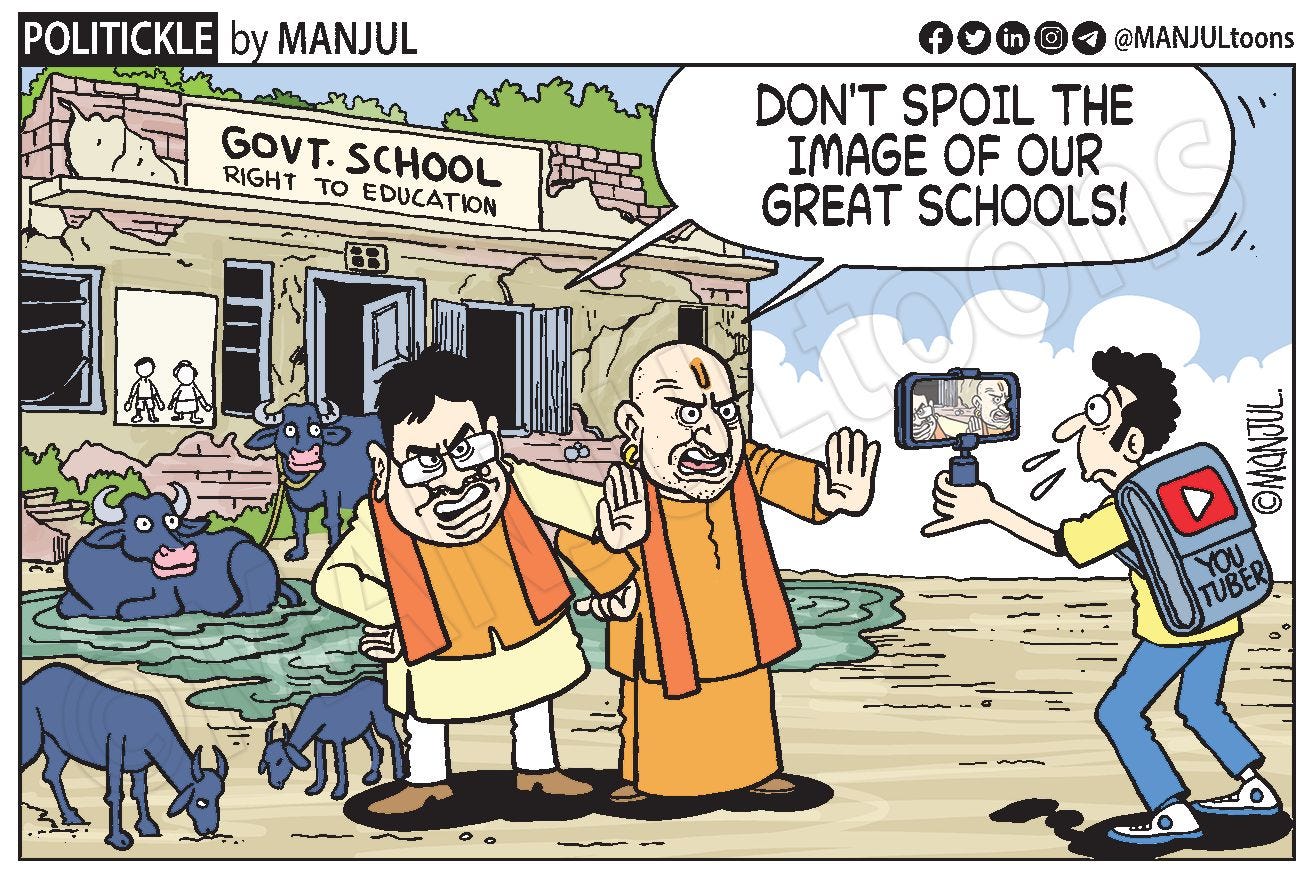
Deep dive
Sumit Baudh looks at a recent Supreme Court judgment on who belongs to the Scheduled Castes and Scheduled Tribes and who does not.
Prime number: Seven lakh
West Bengal’s SIR had the unprecedented effect of leaving 27 lakh people ineligible to vote and giving the vast majority of them inadequate time to get back on the rolls in time for the assembly elections. At any rate though, only about seven lakh people actually moved the (glacially progressing) appellate tribunals to be restored to the rolls, Aparna Bhattacharya reports. That means over 20 lakh individuals (74.23% of those removed during the under-adjudication process) did not approach a tribunal at all.
It also means that 31 lakh of the 38 lakh appeals pending before the tribunals are those seeking people’s deletion from the rolls. Additionally, a total of 75,443 people have been restored to the rolls so far.
Opeds you don’t want to miss
Former CDS Gen. Anil Chauhan’s explanation that an Indian loitering munition inadvertently hit Pakistan’s Kirana Hills highlights the huge risks of any military conflict between the two sides, and how easily “an initially limited conventional conflict might begin to take on a nuclear dimension”, warns Sushant Singh. “The priority should be to institutionalise restraint rather than celebrate brinkmanship,” he writes, spelling out what that would entail.
Worth reading is this deeply felt dispatch from Nepali journalist Shreejana Shrestha, reporting from a camp housing survivors of the catastrophe.
Mohan Bhagwat's global gambit may prove costly for the RSS as it involves the secretive ‘cultural organisation’ shifting from under the radar to coming under global fire, writes Bharat Bhushan:
“In seeking high-profile engagements in North America, Bhagwat may have walked into a reputational trap. Within India, he enjoyed the protection of the RSS protégés in governments at the Centre and states. They ensured friendly media coverage. That protection vanishes on the global stage, exposing his organisation’s strategic vulnerabilities.”
Maharashtra food administration chief Tukaram Mundhe’s crusade against eatery hygiene is a good thing but it points to the heap of work that remains to be done, in the areas of product labelling and reining in ultra-processed foods, says Vir Sanghvi. “… Judging by the public anger about food safety and health, any government that ignores these issues risks damaging itself. No nation should sit back and let itself be poisoned,” he writes.
The logic behind Agnipath – to make the military younger and leaner – is still solid but the scheme’s implementation could use some fixes, Lt. Gen. (retd.) HS Panag writes now that the first batch of Agniveers is about to complete service. The government must train Agniveers for longer, enforce a variable retention based on specific branches’ needs, ensure full parity in pay and compensation between Agniveers and regular soldiers, and ensure that every Agniveer knows their career options before they join, he recommends.
Skilling alone won’t solve the job problem, writes Ajit Ranade. The economy needs to create far more productive work, backed by a robust social security system, he says.
Increasing the Lok Sabha’s size by 50% is not an optimal way of ensuring better representation for a larger Indian population for a variety of reasons, argues SY Quraishi. But there is a way: “Retain the Lok Sabha at 543; preserve the present inter-state distribution of seats; undertake delimitation within states on updated population figures; implement women’s reservation within that structure; and expand the vidhan sabhas to absorb the accessibility pressure that population growth has created.”
Listen up
Is English a foreign language in India? Apoorvanand and Ganesh Devy discuss the question in a conversation moderated by Priscilla Jebaraj for The Hindu’s ‘In Focus’ podcast.
Watch out
The opening day of England’s Lord’s Test against Pakistan nearly acquired a political subplot after Sky Sports aired Michael Atherton’s interview with Imran Khan’s sons, Suleiman and Kasim, during the lunch break. ESPNcricinfo reports that the Pakistan Cricket Board threatened to keep its players off the field for the afternoon session, while The Guardian says the PCB lodged a formal complaint with Sky. Watch the interview below:
Over and out
Utkarsh Saxena, the queer lawyer and petitioner who led one of India’s most prominent legal battles for same-sex marriage recognition, has made TIME’s list of the 100 most influential people in AI for 2026. Saxena founded “Adalat AI, a legal tech nonprofit training its speech recognition models specifically on Indian languages, dialects, and legal jargon. It now runs in 5,500 courtrooms across 11 states. Kerala mandates it for recording witness testimony statewide; Sikkim uses it to require paperless filing; Andhra Pradesh will require Adalat across its entire courtroom workflow from October.”
Gujarat never fails to surprise. An entrepreneur is selling rakhis made with cowdung. Why? “To defeat China, as it counters radiation”, to promote love for the cow, to further the demand for an end to the slaughter of cows across India, and other imperatives of Naya Bharat.
That’s it for today. We’ll be back with you on Monday, on a device near you. If The India Cable was forwarded to you by a friend (perhaps a common friend!) book your own copy by SUBSCRIBING HERE.