
A newsletter from The Wire | Founded by Sidharth Bhatia, Siddharth Varadarajan, Sushant Singh, Seema Chishti, MK Venu, Pratik Kanjilal and Tanweer Alam | Contributing writer: Kalrav Joshi, with additional inputs by Anirudh SK
If you like our work and want to support us, then do subscribe. Sign up with your email address by clicking on this link and choose the FREE subscription plan. Do not choose the paid options on that page because Stripe – the payment gateway for Substack, which hosts The India Cable – does not process payments for Indian nonprofits.Our newsletter is paywalled but once a week we lift the paywall so newcomers can sample our content. Today is that day. To take out a fresh paid subscription or to renew your existing monthly or annual subscription, please click on the special payment page we have created – https://rzp.io/rzp/the-india-cable.Snapshot of the day
December 26, 2025
Sidharth Bhatia
When Prime Minister Narendra Modi attended the Christmas service at the Cathedral Church of the Redemption at Raisina Hill yesterday he hoped that the festival will “inspire harmony and goodwill in our society”. That’s an agreeable message, but clearly not everyone from his Sangh parivar was willing to say an amen. In the Nalbari town north of Guwahati, three people from the Vishva Hindu Parishad and one from its youth wing the Bajrang Dal were arrested for allegedly barging into and vandalising the St Mary’s School on Wednesday; they also went after shops selling festival items nearby. They shouted ‘Jai Shri Ram’ and one of them allegedly warned the school to stop Christmas celebrations, reports the Times of India.
Attacks like these have thrown a spanner into the BJP’s attempts to make inroads into the Christian community – including Modi’s church visits over the last three years – the newspaper notes: such efforts “have been met with limited success as a section of the community continues to harbour distrust due to the Sangh parivar’s antipathy to conversion”, which has manifested in the extremely stringent anti-‘unlawful conversion’ laws enacted in BJP-ruled states.
For some others, like Churachandpur natives ‘Mary’ and ‘John’ who hail from the Kuki-Zo community, Christmas was a stingingly lonely affair in Delhi, where they have taken refuge from ethnic violence and tension back home in Manipur. The festival resembled a “grand celebration” in their villages but in the capital they find that their “zeal is gone”. Returning to Manipur still seems too dangerous a prospect to consider over 31 months after the violence broke out, they told Syed Abubakr and Sumit Singh.
Another group that has faced the violent ire of certain sections of society are Bengali-speaking Muslims. In Odisha’s Sambalpur on Wednesday, construction worker and Murshidabad native Juel Rana was lynched by a group of people after work. While the local police have said that Rana’s killing was “related to sudden provocation”, his contractor told Satyasundar Barik that “the miscreants called workers Bangladeshis, sought Aadhaar proof to prove their nationality and launched sudden attack from behind when they were about to show their Aadhar card”. Per a photo of his Aadhaar card shared with Alishan Jafri, Rana was all of 19 years old.
In Bangladesh, another Hindu man was lynched on Wednesday. The Daily Star reported that Rajbari resident Amrit Mondal was beaten to death by a mob that accused him of extortion. However Dhaka has said that Mondal’s murder was “in no way a communal attack”. Meanwhile the Indian external affairs ministry on Friday once again decried the mob lynching of garment worker Dipu Das in Mymensingh. “The unremitting hostility against minorities in Bangladesh, including Hindus, Christians and Buddhists at the hands of extremists is a matter of grave concern. We condemn Das’s gruesome killing” and “expect that the perpetrators of the crime would be brought to justice,” spokesperson Randhir Jaiswal said.
And Bangladesh Nationalist Party de facto leader Tarique Rahman has returned to the country from his self-imposed exile of 17 years in London. Rahman received a rousing welcome upon his arrival in Dhaka on Thursday; his BNP is expected to win the upcoming general elections scheduled for February.
Kashmir’s chief cleric Mirwaiz Umar Farooq said he removed his designation of chairman of the All-Party Hurriyat Conference from his X account lest it be taken down after being “pressed by the authorities”. This was in light of the constituents of the conference being banned under anti-terror law, he wrote. The conference, recalls PTI, was founded in 1993 and “was once the [Kashmir] Valley’s primary separatist conglomerate”. Meanwhile, Mirwaiz’s office said on Friday that he was kept under house arrest and prevented from offering prayers at Srinagar’s Jamia Masjid.
The army has relaxed its restrictions on social media use by personnel. They can now use Instagram in addition to certain other social media platforms like YouTube and X but may only view content and not visibly engage with it, nor can they upload anything onto them. WhatsApp, Signal and Telegram may be used to share “unclassified information of a general nature” with “known individuals”, Saurabh Trivedi reports.
A day after India criticised the toppling of a Vishnu statue by Thai forces along their border with Cambodia, Bangkok said its actions were “not motivated by religion” but by security imperatives, including “preventing the use of structures and symbols that could be exploited to lead to further tension” after it took control of the land around the statue. New Delhi had said on Wednesday that although the statue was demolished during the border conflict between the two Southeast Asian nations, “such disrespectful acts hurt the sentiments of followers around the world and should not take place”.
Beijing rejected the Pentagon’s assessment in its annual report that China is “probably [seeking] to capitalise on decreased tension” along the Line of Actual Control in order to “prevent the deepening of US-India ties”. “The Pentagon’s report distorts China’s defence policy, sows discord between China and other countries, and aims at finding a pretext for the US to maintain its military supremacy,” the Chinese foreign ministry said Thursday.
Amazon, Microsoft and Google have in the last three months announced investments in India totalling $67.5 billion, a good chunk of which is proposed to be used to build big data centres that would help run chatbots. While Silicon Valley is eyeing India – whose large population is already ChatGPT and its rival Claude’s second-largest user base – as a “must-win market”, such an expansion would be fraught with environmental and labour concerns, notes Pranshu Verma. For instance, the “massive amounts of power and water” that such data centres guzzle “could lead to shortages in Indian communities already facing a resource crunch”, while AI stands to supersede the entry-level call centre and software work that many Indians take up when they graduate, Verma writes.
Tech is just one of many industries that tap into or propose to tap into the water supply in India, which accounts for 17% of the world population but only 4% of its freshwater. Another is the alcoholic beverages sector. Reuters has a report on how in Rajasthan’s Alwar – where groundwater is extracted at almost twice the rate at which its aquifers can replenish themselves – beverage giants like Heineken, Carlsberg and Diageo “face the additional challenge of securing and managing dwindling water supplies while navigating strict government rules and grievances of some local people who only get the resource piped-in once a week”.
Between Operation Sindoor, changes of guard in South Asia and rising nationalism in Indian movies, much has happened in 2025 that merits a year-end recap. Jahnavi Sen and Sravasti Dasgupta roped in Siddharth Varadarajan and Sushant Singh to do that in this episode of The Wire Wrap titled ‘Whither Vishwaguru’:
Environment ministry tries to navigate uproar against new definition of Aravali hills
Although the Union environment ministry announced on Wednesday that it would look into ways of further reducing the area of the Aravalis where mining may be permitted, it had just a week prior directed the Survey of India to work with the relevant states to implement the controversial new definition for the range – that includes hills at least 100 metres above the local relief (among other things) – Ipsita Pati notes. Its announcement on Wednesday also said, amid the uproar over the new definition, that it has directed the states to effect a “complete ban” on new mining leases in the Aravalis, but it has been pointed out that this is merely what the Supreme Court had asked it to do last month. Plus, this definition is not new and had been opposed by the Geological Survey of India back in 2003, Aksheev Thakur recalls.
In Assam, tribal Karbis and Bihar-origin settlers nurse grievances after violent episode
Rokibuz Zaman reports on the anxieties that built up before culminating in the hunger strike and subsequent fatal violence in Assam’s West Karbi Anglong district earlier this month: tribal locals allege that Bihar-origin residents received land rights and trading licences despite the region falling under the Sixth Schedule, that they feared turning into a minority, and that the Himanta Biswa Sarma government did not vacate ‘encroachers’ from grazing land due to its ‘vote bank politics’. After the violence, the Bihar-origin residents have also alleged that the police and the administration stood by passively when their homes and shops were selectively set ablaze.
Court acquits five Delhi riots accused, points to police’s apparently ‘mechanical’ probe
Citing inconsistencies in testimony and the possibility that the police conducted their investigation “in a mechanical manner”, a Delhi court recently acquitted five accused in a 2020 Delhi riots case pertaining to alleged arson and stone pelting at a petrol pump in the Bhajanpura neighbourhood. Nirbhay Thakur reports. He also notes that of those matters that have been decided out of the 695 total cases lodged in connection with the riots, more than 80% have resulted in acquittals.
The Long Cable
Remove the rapists, not the stray dogs from the streets
Badri Raina
In her unimaginable anguish, the survivor of the rape in the abominable Sengar case has made a searingly telling suggestion to the honourable Supreme Court of India: do not remove the stray dogs from India’s streets, remove the rapists A stray dog is often a woman’s best friend, a stray male never.
The writer knows of quite a few neighbourhoods in Delhi wherein stray dogs not only remain devoted to single working women who feed them and look after them, but are often a guarantee against stay male menace that lurks in the dark lanes of such colonies.
It is much to be hoped that when the case of the heartless release of the predator, Sengar, comes up for reversal in the top court, as it should and will, the justices will accord credence to the argument proffered by the heroic and creative survivor.
And a further observation may be also made for the deliberation of the all-powerful Sanatan priesthood establishment: all those so-called Hindus found culpable be it in heinous sexual crimes against women or in other forms of gender-related oppression be debarred from worshipping the pantheon of Hindu goddesses in their homes or in temples, or be formally excommunicated from the Hindu faith with formal notice to society at large.
In its largesse of metaphysics, surely Hinduism must not allow this duopoly of worshipping women as goddesses and trashing them in flesh and blood.
The time has come when this unendurable and blasphemous hypocrisy must be terminated as anathema both to moral piety and doctrinal consistency.
To the best of our theological knowledge, there is no text in the Hindu faith that says you may pay obeisance to goddesses and do dirt on women.
If Duryodhana paid for this folly, why not all the Sengar’s who patronise religious institutions, climb to power in their name, even as they rape defensible minor girls, and never express contrition even to their own wives , mothers, and daughters.
It is of course another unique feature of our social order that the said wives, mothers, daughters more often than not think they must shield their Sengars from the comeuppance they richly deserve.
That those pillars of society who go to marauding lengths to have grand temples built, and shoot arrows into Ravana’s effigy for abducting Sita, (although never once laying hands on her), think it kosher to protect from such retribution the living Ravana’s within their own political/ social formations who do not stop at abduction but inflict life-long ruin on women.
Tailpiece
In the case of Sengar, it turns out that within the definitions of the Pocso Law, elected representatives of people such as members of a legislative assembly do not qualify as “public servants.
Remember that when the Sengars of this land go campaigning they never tire of describing themselves as selfless citizens out to do public service and public good.
Thus, clearly, if we are not to think the law an ass (as did the merry Dogberry in a Shakespeare play), either electoral contestants must henceforth be debarred from calling themselves servants of public causes, or the said law must be rectified forthwith to make of it a law rather than a cruel gimmick to protect the Sengars of Bharat.
(Badri Raina taught at Delhi University.)
Reportedly
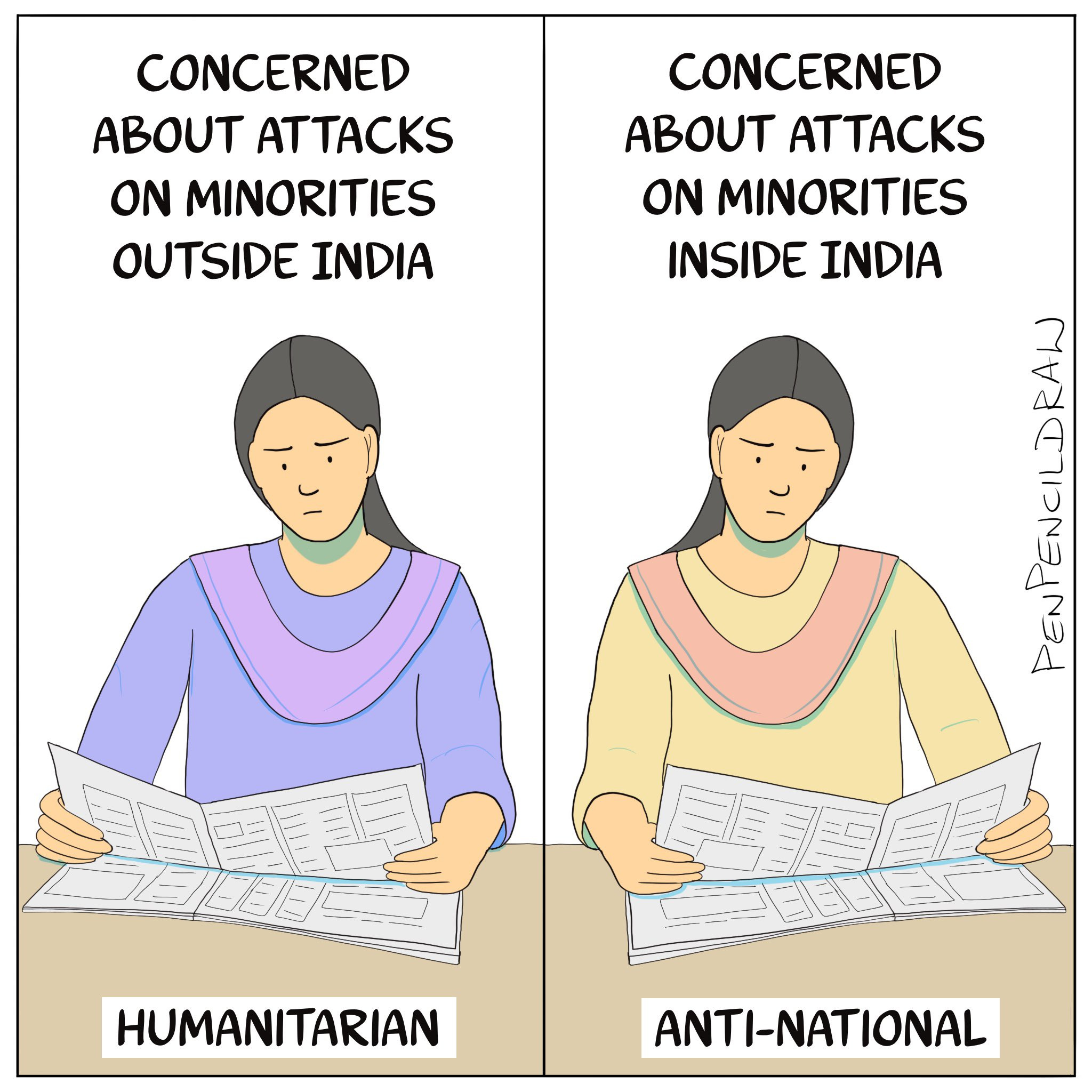
We’ve been used to performative displays of regime-aligned talking points for some time now but the manner in which some Bollywood celebrities have sought to pit the dastardly lynching of Dipu Chandra Das, a Hindu in Bangladesh, against the Israeli genocide of Palestinians in Gaza marks a new low. Das was murdered by a mob on the false charge of blasphemy. But this is no way to show solidarity. This is using one horrific murder to make light of the large scale killing of a people by an ideological ally of Narendra Modi. The fact that NDTV sought to amplify this illogical and distasteful comparison suggests a broader agenda at play.
Ironically, the accusation of hypocrisy being levelled against Israel’s Indian critics fits these celebrities like a glove. More than a hundred Muslims have been targeted and murdered in India because of their religion since Modi became Prime Minister. The most recent killing happened this week, when Juel Sheikh, a migrant worker from West Bengal, was lynched in Odisha on suspicion of being a ‘Bangladeshi’.
Predictably, many of the same voices now demanding ‘Hindu solidarity’ have stayed quiet when Muslims are lynched in India. If mob violence truly offends our humanity, it cannot matter who the victim is or which side of the border the crime occurs on.
Drawn and quartered
Deep dive
Andy Mukherjee sizes up Bollywood’s ongoing change of tongue: while the ‘old’, predominantly Hindi industry “remains mired in an existential crisis”, a “new, multilingual Bollywood” serving up “fresh stories set in new cinematic universes” is ascendant. At the same time there is a third section of the industry – exemplified by the likes of Homebound – that “is straining to be seen”.
Prime number: 5%
A PIL petition in the Delhi high court has sought that GST on air purifiers be reduced from 18% to 5% by classifying them as medical devices in light of their “essentiality” due to the capital’s polluted air. Today the Union government opposed the plea in court, arguing that entertaining it would “open up a Pandora’s box”. “We are scared from the constitutional perspective, it is doctrine of separation of powers … There is a process involved. How can this process be scuttled through a court process?” it asked.Opeds you don’t want to miss
The Supreme Court has a ‘great opportunity’ to prevent and stop the injustices caused to detenus under various preventive detention laws, writes Justice Madan B. Lokur who retired from the Supreme Court. He writes this specifically in the context of the preventive detention of activist Sonam Wangchuk. There is a clear difference between preventive and punitive detention but of late this is getting blurred, “perhaps deliberately so,” he says. Wangchuk was detained three months ago, but is it preventive or punitive, he asks.
The appointment of Nitin Nabin as the working president of the Bharatiya Janata Party demonstrates that decision making in the party has moved away from “collective structures to a narrow powerful centre,” writes Nilanjan Mukhopadhyay. “The party structure has been completely hegemonised by the one, who wields almost absolute control”, he writes. The party now resembles the structures in the Congress during the Indira Gandhi and Rajiv Gandhi years.
“The recent killing of a Dalit youth in Nanded, Maharashtra for being in a relationship with a dominant-caste woman once again exposes how caste continues to operate through the control of bodies, emotions and desire,” writes Akhilesh Kumar. A casteist society is built on boundaries, which are “moral and symbolic”. Kumar says it is disturbing how quickly these killings disappear from public memory.
In an open letter to Bangladesh leader Mohammed Yunus, Gopalkrishna Gandhi, former governor of West Bengal appeals to him to bring the killers of Dipu Chandra Das to justice in the Mymensingh region. “Bhai, you and I and millions of others like you and I on our subcontinent are under the notice of death hanging from the tree of intolerance, of a civil war, no less, unless… India and Bangladesh and Pakistan retrench the ogre of hate and the spiral of vengeance in their systems,” he writes, urging him to prevent that.
The fiscal situation in Indian universities is dire, writes D.P. Singh. He quotes a Vice-Chancellor as saying that if all faculty positions were filled, then the institution would be in no position to pay salaries and meet other financial obligations. Faculty members on contract therefore was a matter of “survival”. Financial vulnerability increased susceptibility to external pressures. It leads to the weakening of the intellectual core.
Listen up
Pronoti Datta’s new book In the Beginning There Was Bombay Duck: A Food History of Mumbai is about how the city’s “cuisine has been shaped by its migrants, not just from other parts of India but also from different countries”. She elaborates on this in a conversation with Sidharth Bhatia on The Wire Talks.
Watch out
Film historian Ashish Rajadhyaksha curates an exhibition at the Arthshila arts centre “around film posters, and more complexly, around the elusive histories of cinema”. He recently spoke to The Wire about these posters, the films “and the world around them”.
Over and out
Modi had once dismissed MGNREGA as ‘condemning millions of impoverished people to survive by digging ditches’. But MGNREGA workers whom Harsh Mander had visited in Rajsamand, Rajasthan “spoke with pride of their collective contributions to slowly build … village infrastructure”, how it afforded them the unprecedented right to bargain with their upper caste landlords, and how it put money into the hands of landless women. Indeed, when Mander and his colleagues hazarded half a day of MGNREGA work, they felt a “strange sense of pride … achievement and dignity”.
“Grassroots activists are often journalists’ best friends”, acting as interlocutor and intermediary but not necessarily figuring in article bylines. The Hindu‘s M. Kalyanaraman pays a touching tribute to one Rajan, an itinerant activist who had helped him break a story in the aftermath of a caste riot in rural Tamil Nadu back when he was a greenhorn reporter.
That’s it for today. We’ll be back with you on Monday, on a device near you. If The India Cable was forwarded to you by a friend (perhaps a common friend!) book your own copy by SUBSCRIBING HERE.