
A newsletter from The Wire | Founded by Sidharth Bhatia, Siddharth Varadarajan, Sushant Singh, Seema Chishti, MK Venu, Pratik Kanjilal and Tanweer Alam | Contributing writer: Kalrav Joshi, with additional inputs by Anirudh SK
If you like our work and want to support us, then do subscribe. Sign up with your email address by clicking on this link and choose the FREE subscription plan. Do not choose the paid options on that page because Stripe – the payment gateway for Substack, which hosts The India Cable – does not process payments for Indian nonprofits.Our newsletter is paywalled but once a week we lift the paywall so newcomers can sample our content. Today is that day. To take out a fresh paid subscription or to renew your existing monthly or annual subscription, please click on the special payment page we have created – https://rzp.io/rzp/the-india-cable.Snapshot of the day
December 5, 2025
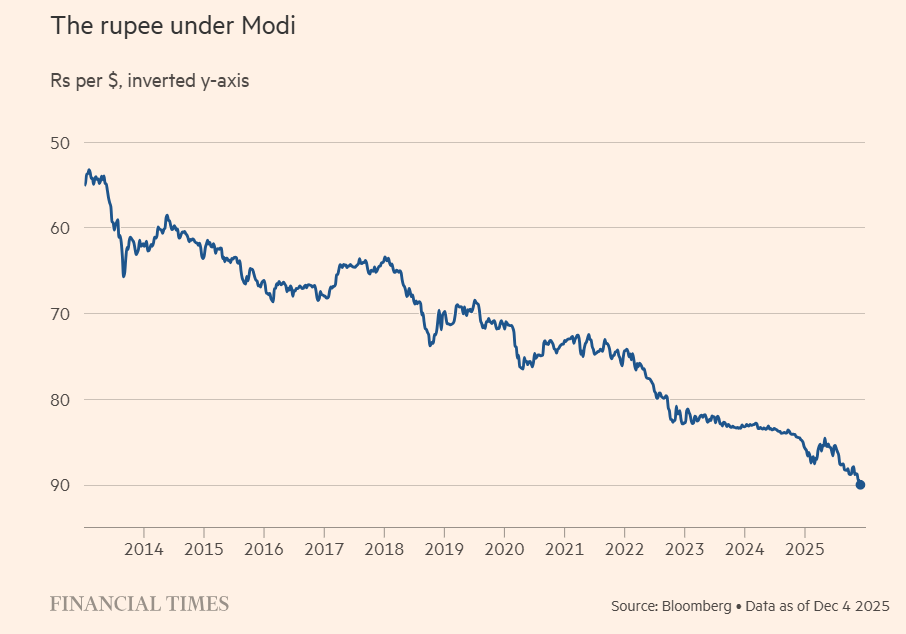
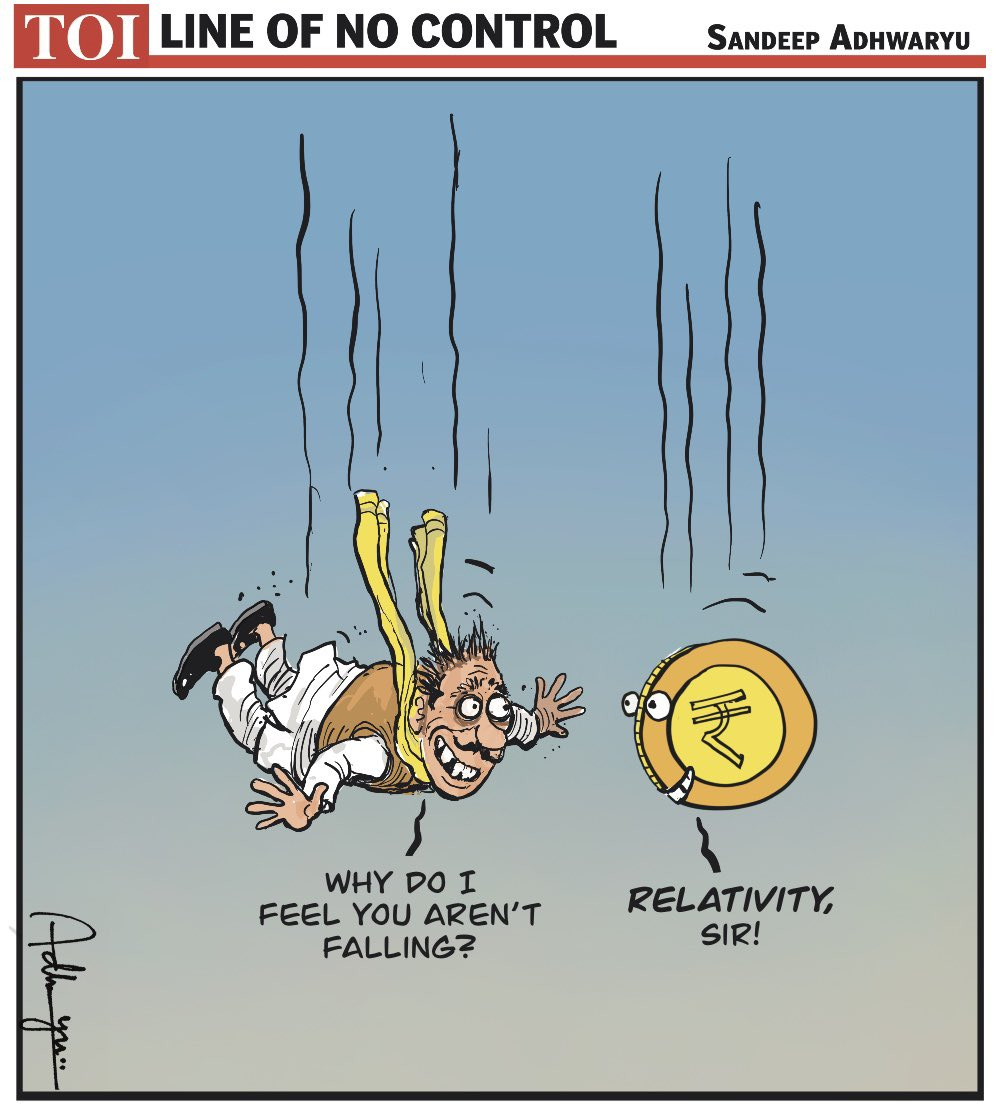
India’s currency has tumbled past the psychologically critical 90-per-dollar mark, plunging to an all-time low and showing no signs of stopping, rattling financial markets and amplifying concerns over the country’s fragile macroeconomic landscape. A fall of more than 5% has made the “the worst-performing Asian currency,” says the Financial Times. The newspaper notes that the primary reason — apart from the trade stalemate with the US, which continues to bite — “is the Indian stock market, which has underperformed other emerging markets by the widest margin since 1993. The MSCI India index’s dollar return this year was 2.5%, while the larger emerging markets index returned 27.7%. As a result, foreign portfolio investors have moved $16bn out of the country and into better performing markets.”
Even as the rupee’s relentless slide has left financial markets uneasy, India’s chief economic adviser, V Anantha Nageswaran, claims — rather proudly — that he is “not losing sleep” over the plunge. Furthermore, the Reserve Bank of India’s (RBI) lack of forceful intervention with regard to interest rate in recent weeks have only deepened the currency’s woes. “While weakness of the rupee was one of Narendra Modi’s big campaign talking points ahead of his first prime ministerial run, his government has subsequently brushed off the economic impact of the declining value of the currency. (The rupee was 60.5 to the US dollar in 2013 when Modi was campaigning and 61 the year he took office),” reminds FT.
While India’s reported 8.2% Gross Domestic Product (GDP) growth for July–September 2025 looks strong on paper, the gap between nominal GDP (8.7%) and real GDP (8.2%) suggests very low inflation of 0.5%, while net sales of over 3,400 non-financial firms have lagged nominal GDP growth for 11 consecutive quarters, indicating that the benefits of growth are not reaching households, argues Vivek Kaul. Retail loan growth has slowed from over 25% to 11.8%, Fast-Moving Consumer Goods (FMCG) volume growth remains weak, two-wheeler and small car sales are below 2018-19 peaks and affordable housing has stagnated even as premium and super-premium housing segments expand.
The warmth of the encounter between the Kremlin leader and Indian Prime Minister Narendra Modi is likely to ruffle feathers in the US President Trump administration, who wants Putin to agree to a peace deal in Ukraine and India to stop buying Russian oil, in an effort to raise pressure on Moscow even as it holds “a hard line in talks on the resolution of the war despite optimistic pronouncements from Washington,” says The Washington Post. Next week, the US is sending negotiators to New Delhi for yet another round of trade talks, reports Reuters citing government sources. The talks have dragged on all year, producing little progress since Trump slapped 50% tariffs on Indian goods in August.
Speaking after the annual Indo-Russian summit in Delhi today, the Russian president promised “uninterrupted fuel supplies” to an India that has cut back on its record purchases of Russian crude – indeed, Reuters has reported that Indian imports of the commodity are projected to plumb a three-year low this month. Kpler has predicted that while Russian oil supplies to India probably won’t dry up, they will likely be channelled through non-sanctioned entities and “opaque trading channels”.
Some of the agreements finalised before the US delegation’s arrival are unlikely to sit well with Washington. India and Russia today signed some 16 memoranda of understanding or agreements, and Modi announced that the two countries will achieve their Rs 100 billion trade target ‘well ahead’ of its 2030 deadline. Among other dealmaking on the table was also an “agreement that would clear the way for India to sell more shrimp and agricultural goods to Russia. That would be a bailout for two Indian sectors that used to rely heavily on the US,” notes Dan Strumpf.
According to the joint statement issued after the summit, the two sides “noted the importance” of further talks on a site for a second jointly built nuclear power plant in India – the first being the Kudankulam plant in Tamil Nadu. These talks, notes Bloomberg, will occur as New Delhi considers opening up its nuclear power sector to private players. Indian law as it currently stands opens up suppliers, not just plant operators, to liability, which has kept talks on ice; Kudankulam is the only plant “hosting foreign reactors as it predates the rollout of the liability law”, recalls the news agency. Other outcomes include a framework on the movement of skilled Indian workers to Russia and MoUs on media collaborations (which, as today’s Reportedly shows, will perhaps add on to an existing axis of ‘collaboration’ between sections of the Indian press and Moscow). But do not miss the outcome of India-Russia relationship that is in a “high in symbolism, low in substance” phase, as exhibited here. Vishwaguru Diplomacy, indeed.
Meanwhile, as the Coda Story newsletter notes, Putin and Modi’s parallel surveillance state continues …
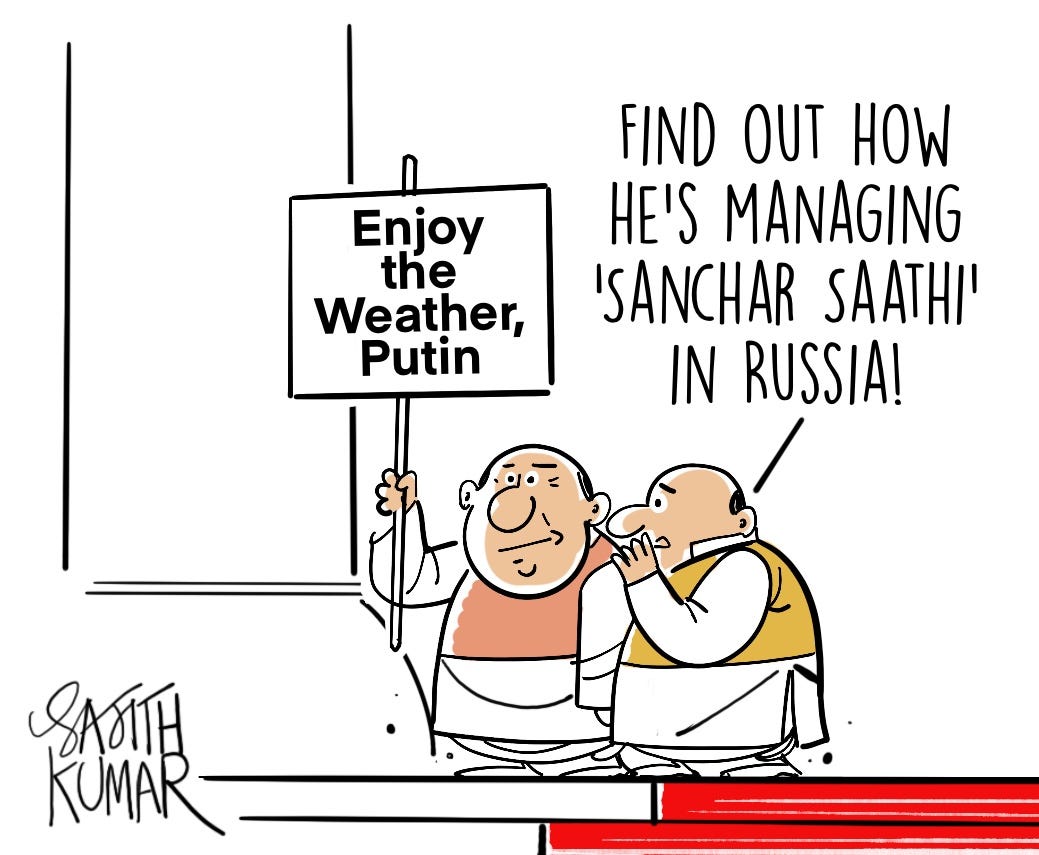
Speaking of which, the Modi government – which just backed down from its direction mandating the irreversible installation of its Sanchar Saathi app on smartphones amid outrage – has been considering a proposal by telecom operators that would entail requiring phones to always have their location on, reports Reuters. One of New Delhi’s concerns has been that investigation agencies do not get precise location data from telcos, so the latter proposed to it that this precise data ‘only be provided if the government orders smartphone makers to activate A-GPS technology’, which uses a mix of cell tower- and satellite-based signals. This would require that phones always have their location on, something that smartphone manufacturers have pushed back against and experts are obviously bearish about: the Electronic Frontier Foundation’s Cooper Quentin for instance called it unprecedented and “pretty horrifying”.
India’s aviation regulator on Friday granted IndiGo a one-time exemption from night-duty limits for pilots and eased weekly-rest rules after the airline cancelled hundreds of flights amid operational disruptions, reports Reuters. The move follows four days of nationwide disruption, with more than 1000 cancellations reported with India’s busiest airports witnessing scenes of growing chaos, especially New Delhi (cancelling all its departure flights from Delhi’s IGI airport till midnight), Mumbai and Chennai hitting the hardest. Videos of stranded passengers and piles of baggage have filled social media, prompting calls for accountability from an airline known for its punctuality. Meanwhile, airlines’ on-time performance crashed to 8.5% on Thursday, an unprecedented low for a carrier that markets punctuality as its core brand. According to The Hindustan Times, the crisis began earlier in the week after an Airbus A320 software-update advisory triggered cascading delays that pushed flights into late-night operations and strained IndiGo’s network.
But did India’s largest airline, long thought untouchable, come crashing down in barely three days? asks Prince M. Thomas:
“Coupled with Air India’s ongoing struggles, IndiGo’s meltdown marks a sensitive moment for Indian aviation. Between them, the two carriers control 80% of the domestic market, leaving Indian travellers at the mercy of a shaky duopoly. The events of the last few days will only deepen doubts about the sector’s resilience.
The Modi government’s flagship UMEED Waqf portal is collapsing in spectacular fashion, exposing a catastrophic failure in digital governance. With the Supreme Court refusing to extend the December 5 deadline, Waqf boards across India are scrambling to upload centuries-old property records, battling a portal that crashes repeatedly, inconsistent land-measurement systems, and a chronic shortage of digitally trained staff. Uttar Pradesh, home to the most Waqf land, has managed only 36% of registrations; Bengal trails at 12%, notes The Indian Express. Officials report working through the night on rented mattresses, catching the portal in fleeting windows of functionality before it crashes again.
The Supreme Court said that it would appoint the Vice Chancellors (VCs) of two Kerala State Universities — APJ Abdul Kalam Technological University and the University of Digital Sciences, Innovation and Technology — if Chief Minister Pinarayi Vijayan and Governor Rajendra Arlekar do not resolve their differences over the recommended candidates and reach consensus. Observing that it would step in and make the appointments if no consensus is arrived at, Justice J.B. Pardiwala, heading a bench also comprising Justice PB Varale, has posted the matter for Thursday.
Nepal’s new 100-rupee banknote, featuring a map including Lipulekh, Kalapani and Limpiyadhura, has sparked a fresh border dispute with India, says Nikkei Asia. India, which claims these territories, termed Nepal’s move “unilateral” and stated it “does not change the ground reality.”
As promised in the controversial 27th amendment, Pakistan’s powerful army chief, Field Marshal Asim Munir, now has an additional role as the country’s first chief of defence forces – in a significant amping up of his powers. This appointment effectively resets Munir’s tenure, with his five-year term as ‘CDF-cum-COAS’ commencing yesterday, till 2030.
External Affairs Minister S. Jaishankar yesterday confirmed in the Rajya Sabha that 73-year-old Indian woman, Harjit Kaur, was maltreated in US detention before being deported to India, adding that the government has taken up the issue with the US. During Question Hour, Jaishankar said that all deportees are interviewed upon arrival by Indian immigration officials. In Kaur’s case, he clarified that she had not been handcuffed, countering certain claims, but reaffirmed that she had indeed faced mistreatment while in US custody. His remarks came on the same day he informed parliament that 18,822 Indian nationals have been deported from the US since 2009, with the numbers rising sharply in 2025.
In a stark reminder of its seismic vulnerability, the Bureau of Indian Standards (BIS) has now slapped the entire state of Uttarakhand into seismic zone 6 – the highest risk category for earthquakes. The new map spares no part of the state, covering both the plains and the treacherous mountainous regions. Previously, Uttarakhand was split between Zone 4 and Zone 5, a classification that at least offered a semblance of regional differentiation. “The implication of being placed entirely in Zone 6 is that infrastructure damage, should an earthquake strike, will be uniform across every region,” an official familiar with the development strategy told The New Indian Express. Earlier, the older building bylaws offered slight concessions for development in areas classified under Zone 4. The fact that the building codes will have to be standardised to withstand the highest seismic risks, even up to magnitude 8, means that it will also cost substantial financial resources of the state, which already operates under constrained economic resources.
Marking the first use of its domestic anti-terror sanctions regime against the Sikh extremist Babbar Khalsa group, the British government on Thursday imposed an assets freeze on 34-year-old Leeds resident Gurpreet Singh Rehal and one Babbar Akali Lehar organisation for alleged terrorist activity in India. Both entities had allegedly ‘promoted or encouraged’ Babbar Khalsa – infamous for the Air India flight 182 bombing in 1985 that killed all 329 people on board – and recruited for the group, the UK treasury said.
Several British universities have suspended their student intake from Pakistan and Bangladesh due to concerns over visa abuse along with a new Home Office rule that institutes must not have more than 5% of their visa applications turned down (the bar was earlier 10%). Pakistani and Bangladeshi student visa applications had average rejection rates of 18% and 22% in the year ending September 2025, and asylum claims by nationals from either country have risen, mostly on the back of study and work-visa holders, reports the Financial Times.
Bhutan’s journalists are increasingly struggling to access information, hindered by bureaucratic hurdles, unclear rules and pervasive self-censorship – even as the Constitution promises press freedom.
When Hyderabad-based paediatrician Sivaranjani Santosh first raised the issue of electrolyte drinks marketed as ‘ORS’ – even though their composition doesn’t adhere to the WHO’s formula and their sugary nature means they can worsen diarrhoea symptoms in children – in 2018, her cause did not receive much traction at all. But she persisted, raising more awareness and moving the judiciary, which finally led to the FSSAI issuing strict guidelines in October. Satviki Sanjay reports on her journey.
Modi talks peace as India abstains on UN resolution demanding Russia return deported Ukrainian children
Modi said during his joint press statement with Putin that India “has consistently advocated for peace” when it comes to “the situation in Ukraine”, but just a day before the Russian president arrived in Delhi, India abstained from a UN General Assembly resolution demanding that Russia return Ukrainian children forcibly deported or moved during its invasion. India didn’t provide an ‘explanation of vote’ but it has consistently abstained from resolutions explicitly condemning Russia’s actions since the invasion. Incidentally, the International Criminal Court had issued its arrest warrant against Putin in 2023 for his alleged role in illegally deporting children from Russian-occupied areas in Ukraine. The split of votes on Wednesday (91 in favour, 12 against and 57 abstentions) also marked a decline in support for Kyiv compared to the immediate aftermath of the invasion.
Opposition leaders question Law Commission chief on utility of ‘One Nation, One Election’
Members of the opposition yesterday questioned 23rd Law Commission chairperson Dinesh Maheshwari on the usefulness of the proposed “one nation, one election” (ONOE) law, with several leaders expressing concern over the lack of broad public consultation. Congress MP Priyanka Gandhi Vadra asked Maheshwari to explain how simultaneous polls would benefit the country and sought three concrete examples to justify the proposal. His remark that citizens should focus on voting rather than the timing of elections also faced a string of questions. The committee will meet again next week, when Rajya Sabha MP and senior advocate Kapil Sibal is scheduled to depose.
Were the Bihar elections really rigged? The data itself says no
How can the Election Commission’s granular Bihar election data help us understand the opposition’s allegation of vote theft? To the extent that Scroll pored through the data, “nothing significant stood out”, Ayush Tiwari writes. For instance, ‘close contests’ – where the winning margin was <2% of votes cast – were roughly evenly split between the NDA (50%) and the Mahagathbandhan (46.4%). In the top ten seats in terms of votes added between the special intensive revision and the polls, seven were won by the NDA and two by the MGB, but of the two of these ten seats where the additions exceeded the victory margin, the NDA took one and the opposition the other.
Former RBI governor Rajan says global order weakening over inequality, not trade
Former Reserve Bank of India governor Raghuram G. Rajan cautioned that rising global trade tensions are amplifying domestic economic vulnerabilities, arguing that the rules-based international order has been eroding for years not solely because of trade disputes but due to policymakers’ failure to confront the unequal distributional effects of globalisation. Speaking as India and the United States continue negotiations on a potential trade deal and tariff war, Rajan noted that political polarisation – rather than tariffs themselves – may represent the deeper, longer-term threat to economic stability.
The Long Cable
Subtitles Could Do for India What Schools Haven’t
Brij Kothari
Globally, including in India, all English language content on streaming or Over-The-Top (OTT) platforms offers English captions. We owe this to the National Association of the Deaf (NAD) in the US. In 2012 NAD reached a settlement with Netflix to provide captions on 100 percent of its streaming content within two years of the settlement date.
Back then, it was a momentous win for the cause of media access for the Deaf and Hard of Hearing (DHH). For future generations of DHH people who could communicate in and understand English, it made all English entertainment accessible.
What those without a hearing disability – many of us reading this op-ed – may not fully acknowledge that the captions contributed to our own media access and more. People lose their hearing as they age. Entertainment is often consumed in conversational or noisy environments. English is spoken in a variety of unintelligible accents. Viewers have picked up and sharpened their language abilities with the help of captions and translated subtitles. Everyone seems to have a subtitle story of how it helped them or their children.
The number of people in the US who consume streaming content in English with English captions is extremely high and growing, driven by reasons beyond just hearing impairment Seventy percent of Gen Z uses captions most of the time.
Accessibility in Indian languages
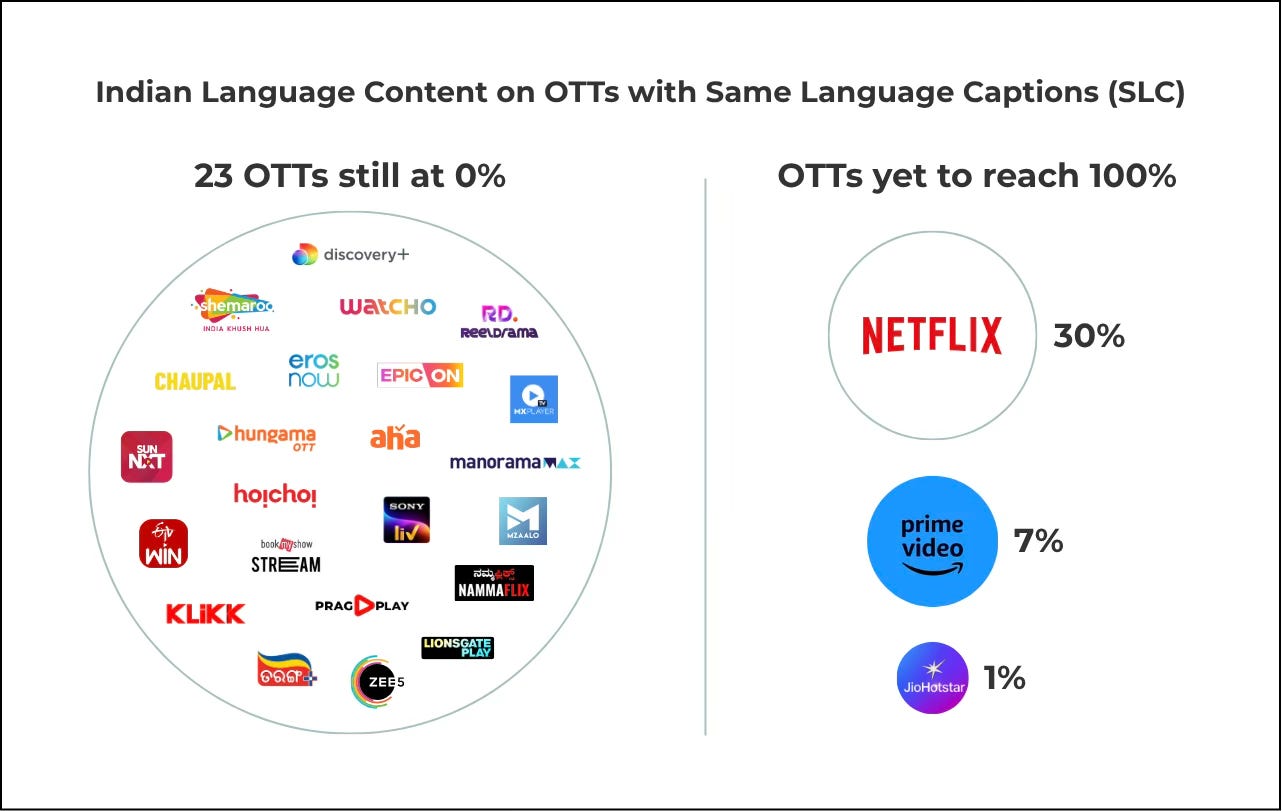
In India, close to 85 percent of the total video content viewing pie is in Indian languages and only 15 percent is in English. What then is the percentage of Indian language content with captions in the ‘same’ language as the audio? We conducted a primary analysis of 1000 Indian language titles sampled from 26 OTTs. We found (Chart 1) that the top three OTTs offering Same Language Captions (SLC) on their Indian language content library are: Netflix (30 percent), Amazon Prime Video (seven percent) and JioHotstar (one percent), with a combined 70 percent market share. The provision of Audio Description (AD) for the Visually Impaired (VI) is significantly lower. JioHotstar has AD on 17 percent Indian language content and Netflix and Amazon Prime Video tied at 7 percent. The remaining 23 OTTs have no Indian language content with SLC or AD.
OTT guidelines
Thirteen years after NAD vs. Netflix in the US, history is repeating itself in India, sparked by Akshat Baldwa, a young law graduate in his twenties who is blind. He has notably filed two major Public Interest Litigations (PILs) in the Delhi High Court, eventually compelling the film industry and the Ministry of Information and Broadcasting (MIB) toward a mandatory adoption of accessibility standards for all entertainment content.
MIB recently issued time bound draft guidelines to mandate SLC or Indian Sign Language (ISL) and AD on all new OTT content within six months of notification and on all content within two years. This builds on another pathbreaking policy, the “Cinematograph (Certification) Rules, 2024” that mandates film producers to deposit accessibility files for SLC or ISL and AD at the time of certification. All Indian language films will have to comply starting in March 2026.
The new guidelines have catapulted India at the forefront of media accessibility on OTTs globally. All countries that are richly multilingual will be watching how India achieves quality implementation and, importantly, for what purposes.
Purpose matters
The purposes for which India frames and implements the OTT guidelines will ultimately guide and determine the importance, resources, design, quality, popularity and ownership by all state and central government, industry and civil society stakeholders. Benefiting the estimated 65 million DHH and 70 million VI is purpose enough, yet, if we limit our understanding to just that, the industry will continue to seek custom solutions for a “narrow” slice of consumers, a cost but not an opportunity.
Remember though that Netflix fought English captions on English content in 2012 and is now reaping the benefits of that. They probably never anticipated that the majority of viewers who are hearing and who speak English fluently, like in the US, have a demand for English SLC on English content. Why wouldn’t the same logic apply to Indian language content, for Indians in India and the large Indian diaspora seeking effective resources to pick up an Indian language, for example?
In public interest, a critically important purpose of accessibility features and especially subtitles in the ‘same’ language on Indian language content is reading literacy. For nearly two decades since the reading skills of school children have been measured nationally, we know that half of India’s rural school children in Class 5, cannot read at Class 2 level.
Enter SLC on any entertainment content that a billion children, youth, and adults consume for an average 3-4 hours every day on a screen. Consider the massive number of matching text-sound exposures they would get throughout their life, in their language and content of choice, which they watch with some passion. The question then is, how can anyone not become a fluent reader in life with 70-odd years of reading along?
Based on primary surveys, it is clear that school children and youth in rural areas are hungry for opportunities to advance their literacy and language ability in their Indian language and in English. Adults too want to advance their literacy skills, if they could privately, and go to any extent to advance their children’s reading skills and education.
In a world that has come to expect corporate responsibility, there sometimes comes an opportunity that allows for public interest to meld with corporate interest. The OTTs that contemplate, design and implement at quality for the confluence of purposes, from accessibility, to literacy, to language learning, will win the national embrace. The ones that want to check a box will likely check out.
Brij Kothari is an Adjunct Professor at IIT-Delhi’s School of Public Policy and Leads the Billion Readers (BIRD) initiative. E-mail: brijmohan@iitd.ac.in
Reportedly
Read the transcript of the India Today group’s interview with Vladimir Putin and watch the post-interview ‘interaction’ to get a sense of how the Indian Big Media’s cheerleading for Modi is getting in the way of their journalism. Putin’s answers are also instructive. He is happy to be fawned over but is careful not to reduce Russia-India relations to ‘Modi’:
Kalli Purie: We’ve been watching you for three days now, and we saw that you worked tirelessly exactly like our Prime Minister. Do you ever have a rest? Are you planning to have some rest on the New Year or Christmas holidays?
President Vladimir Putin: Who has worked in the intelligence agency, me or you? You have been watching me for three days.
And then there is this:
Geeta Mohan: I like it because we are going to talk about longevity but before there is a very important question. You are going to India. Prime Ministers of India had a huge, huge role to play in strengthening India-Russia ties. Who do you think in you span of being a leader of Russia really made that difference, since you have been in power enhancing India-Russia ties? Which of the prime ministers?
Vladimir Putin: Well, you have already asked me to characterise other leaders of other countries. I do not think it is very polite….
Drawn and quartered
Deep dive
Amrita Singh profiles TV anchor Rajdeep Sardesai in Caravan’s latest media issue and charts his contribution to the collapse of news that he laments today – his failure to evolve, access journalism, spiking stories and more.
Prime number: 200,000
More than 200,000 cases of acute respiratory illnesses were recorded in six state-run hospitals in Delhi between 2022 and 2024 as the Indian capital struggled with rising pollution levels, according to the union government. More than 30,000 people with respiratory illnesses had to be hospitalised in these three years because of the toxic air, especially in winter.Opeds you don’t want to miss
It’s nearly unheard of for the Modi government to heed middle-class outrage. Yet, the sudden reversal on the phone-snoop app suggests a pivotal moment: it shows that protests can make even this proud and inflexible government reconsider, writes Vir Sanghvi.
India’s initial optimism about Trump’s return has faded as US tariff hikes, H-1B restrictions and a tilt toward Pakistan undermine trust, writes Paul Staniland. With Washington’s policy driven by Trump’s whims and possible China deal-making, India is reassessing its strategy, hedging globally and preparing for a less reliable American partnership.
Restrictive labor laws are not the reason why the share of manufacturing in Gross Domestic Product fell from 18% in 1995 to 12.5% last year, the lowest since at least 1960. New labour codes convey that the onus is on workers, argues Andy Mukherjee. “Now that advances in AI have sped up the innovation cycle, and Trump is squeezing India on trade, they want to extract more juice out of labor. Ultimately, though, no country is going to get rich in the 21st century by taking away more hours of the day from working-class families. India is no exception.”
India is having to deal with being an onlooker than a major player in world affairs, writes MK Narayanan:
“India today — and despite its highly regarded diplomatic skills — increasingly appears more like an ‘outlier’ than a major player in world affairs. It has been virtually sitting on the sidelines when it comes to issues involving peace and order in different regions of the globe, especially in West Asia and Europe. It is also a virtual onlooker as far as the emerging situation in the Indo-Pacific is concerned. Seldom indeed has India faced a situation of this kind.”
The next (much-delayed) census must cover four bases: it ought to be “comprehensive (including caste), accurate (counting people where they live), transparent (giving states data access) and protected (ensuring enumeration doesn’t become surveillance),” writes former Chief Election Commissioner S.Y. Quraishi. Caste data must not only be collected but released for “data should not be weaponised or selectively released”, he reminds us.
“On the face of it, it would appear that a radical disjuncture has been brought about by Operation Sindoor. But only on the face of it,” writes Ali Ahmed.
Listen up
Noting that Zohan Mamdani’s election as mayor of New York City has drawn attention to the invisibility of his counterparts in Indian cities, former IAS officer T. Raghunandan and urban researcher Anant Mariganti on The Hindu‘s InFocus discuss whether “we need to change how cities are governed in India” and why “citizens in urban areas of India have no elected official to turn to in times of crisis or to help improve civic infrastructure and amenities”.
Watch out
Mehdi Hasan, editor-in-chief of Zeteo, shares a personal message following the passing of his father — a proud Indian immigrant to the UK — and offers a timely reminder of why the bigots and xenophobes are wrong about immigration, multiculturalism and so-called “identity politics.”
Over and out
A new statue of Shah Rukh Khan and Kajol was unveiled in London to mark 30 years of Dilwale Dulhania Le Jayenge. Khan joked about marriage advice, reflected on Bollywood’s global appeal, and celebrated the honour alongside fans. The film’s stars joins other iconic characters in Leicester Square’s sculpture trail – Harry Potter, Paddington and Bridget Jones.
That’s it for today. We’ll be back with you on Monday, on a device near you. If The India Cable was forwarded to you by a friend (perhaps a common friend!) book your own copy by SUBSCRIBING HERE.
Where there is a will, there is a way