
A newsletter from The Wire | Founded by MK Venu, Pratik Kanjilal, Sidharth Bhatia, Siddharth Varadarajan, Sushant Singh, Seema Chishti, and Tanweer Alam | Contributing writers: Kalrav Joshi, Anirudh SK
If you like our work and want to support us, then do subscribe. Sign up with your email address by clicking on this link and choose the FREE subscription plan. Do not choose the paid options on that page because Stripe – the payment gateway for Substack, which hosts The India Cable – does not process payments for Indian nonprofits.
Our newsletter is paywalled but once a week we lift the paywall so newcomers can sample our content. To take out a fresh paid subscription or to renew your existing monthly or annual subscription, please click on the special payment page we have created – https://rzp.io/rzp/the-india-cable.
Snapshot of the day
June 17, 2026
Siddharth Varadarajan
Narendra Modi and Donald Trump met each other today on the sidelines of the G7 summit at Evian, France and appeared briefly before reporters. The interaction confirmed the US President’s reputation for dishing out bluster, flattery and insensitivity, while refusing to concede any ground on issues of concern to India. Modi, too, lived up to form. He seemed happy with the over-the-top praise Trump heaped on him and failed to directly raise the illegal American attack on civilian ships in international water near the Hormuz Strait that killed three Indian sailors. Worse, he sat silently as Trump made light of the crime:

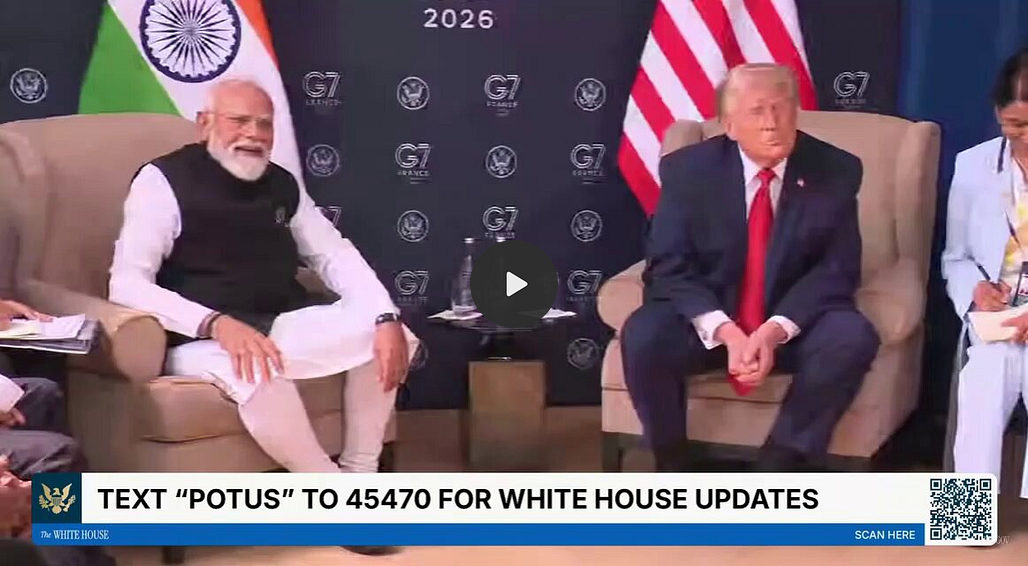
In his brief opening remarks, this is all that Modi had to say about the sailors killed by the US military, i.e. nothing:
“India has consistently emphasized the importance of ensuring freedom of navigation, and we should work together and place a particular emphasis on that. Mr. President, you are aware that across the world, Indian seafarers and hundreds of thousands are working and performing their duties across global maritime trade routes, including the Strait of Hormuz, and their safety is of utmost importance to us. Mr. President, you made tremendous efforts towards reaching this understanding and this agreement, and I’m confident that the issue of seafarers will receive the highest priority during the implementation of this agreement.”
The interaction was notable on other counts. In his opening remarks, Trump said that Modi “is building a lot in the United States. He’s spending a lot of money in the United States, and we appreciate that job.” Asked about the fate of trade negotiations with India, Trump’s praise for Modi echoed his usual hyperbole:
“He’s the most beautiful-looking man. He looks so nice. He’s like an angel. But actually, he’s as tough as – he’s a killer. I don’t want to – he’s a killer. He’s as tough as they come. But he looks so good. So he gets you by surprise. But there’s few people like this. People say, he’s such a nice man. I say, he’s very tough. He’s a tough trader. And he loves the Indian people. But he also loves the U.S. We had Howdy Modi in Houston, remember?”
Modi too sought to flatter Trump – by praising him for his “efforts towards restoration of peace and stability in West Asia”. Not only was this praise misplaced – Trump was the person who actually disrupted peace and stability in West Asia in the first place by attacking Iran. – it also underlined the fact that India under Modi has no independent vision for the region. When an Indian reporter asked Trump whether he expects India to play any role in West Asia, the US President camouflaged his answer with flattery:
“Yeah, I do. I do. I think India plays a big role in everything. As long as he’s the leader, India is going to play a big role.”
To be clear, the ‘big role’ Trump has in mind is for India to sit on the sidelines and for Modi to go along with whatever the US does.
So central is Modi to Trump’s sidelining of a country that once took pride in the independence of its foreign policy that he even cracked a tasteless joke about this:

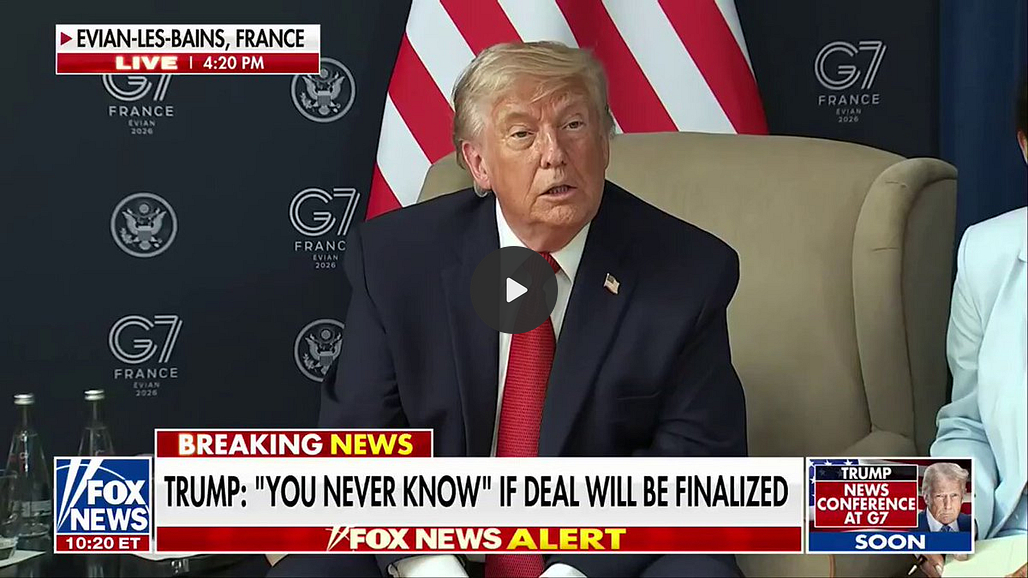
On the eve of the G7 meeting, Washington announced that it was dropping the prefix ‘Indo’ from its military’s Indo-Pacific Command (INDOPACOM) and reverting to PACOM (Pacific Command), reversing a 2018 decision that was (erronerously) seen in New Delhi as affirming India’s burgeoning role in America’s strategic ambitions in Asia and the Indian Ocean region. The move also comes amid the Trump administration’s greater engagement with China – Trump actually spoke of G2 in Modi’s presence today – and the continuing delay in the Quad leaders’ summit.
When viewed in conjunction with a number of other signals over these 16 months, former foreign secretary and ambassador to Washington Nirupama Menon Rao notes, the issue at hand has become “whether Washington still sees India as a co-architect of regional order or simply as one useful actor among many in advancing American objectives”.
A day before Telegram moved the Delhi high court to challenge the Union government’s decision to temporarily restrict access to the messaging platform in India till June 22, its CEO Pavel Durov alleged that Reliance Group, in which Meta holds a partial stake, and WhatsApp may have lobbied to
