
A newsletter from The Wire | Founded by Sidharth Bhatia, Siddharth Varadarajan, Sushant Singh, Seema Chishti, MK Venu, Pratik Kanjilal and Tanweer Alam | Contributing writers: Kalrav Joshi, Anirudh SK
If you like our work and want to support us, then do subscribe. Sign up with your email address by clicking on this link and choose the FREE subscription plan. Do not choose the paid options on that page because Stripe – the payment gateway for Substack, which hosts The India Cable – does not process payments for Indian nonprofits.Our newsletter is paywalled but once a week we lift the paywall so newcomers can sample our content. Today is that day. To take out a fresh paid subscription or to renew your existing monthly or annual subscription, please click on the special payment page we have created – https://rzp.io/rzp/the-india-cable.Snapshot of the day
January 23, 2026
Sidharth Bhatia
The rupee is teetering on the edge of the psychologically fraught 92-per-dollar mark, having already sunk to a record low of 91.99 on Friday. A brutal equity market selloff – stretching losses across four of the past five sessions – has battered the currency, compounded by month-end dollar hoarding from importers and relentless foreign outflows from Indian stocks.
At the same time, India has been quietly bleeding its stash of United States Treasuries, with holdings slumping to a five-year low, reports Bloomberg. As policymakers scramble to prop up the rupee and talk up reserve diversification, the numbers tell a harsher story: long-term US debt holdings have fallen to $174 billion, a steep 26% drop from their 2023 peak, according to US government data released last week – raising uncomfortable questions about how much firepower is really left to defend the currency.
The Bombay High Court on Friday granted bail to cultural activists Sagar Gorkhe and Ramesh Gaichor in the 2018 Elgar Parishad case. Arrested on September 2, 2020, the two had remained incarcerated since then. A division bench of Justices A.S. Gadkari and S.C. Chandak allowed their appeal against a February 2022 order of the special NIA court in Mumbai.
Gorkhe and Gaichor are among 16 individuals arrested at various stages of the case. Of them, 84-year-old Jesuit priest and activist Father Stan Swamy died in custody in 2021. With this order, human rights lawyer Surendra Gadling – arrested in June 2018 – remains the only one still in jail, while Mahesh Raut and Jyoti Jagtap are currently out on interim bail.
With barely a month left before Manipur completes a full year under President’s Rule, the Union Ministry of Home Affairs has belatedly moved to fast-track negotiations – an effort that comes after months of drift and criticism over New Delhi’s handling of the crisis, reports The New Indian Express. The talks involve representatives of civil society organisations and political parties from the state’s two warring ethnic groups, the Meitei and the Kuki, ostensibly to explore the formation of a popular government. Critics, however, see the outreach as reactive damage control rather than the result of any sustained political strategy by the Modi government.
If the need to verify electors’ citizenship is an imperative for the Election Commission in its special intensive revisions due to the 2003 amendments to the Citizenship Act, then the poll body’s SIR order does not clearly reflect this, the Supreme Court said yesterday. Justice Joymalya Bagchi orally said that while the order mentions ‘frequent migration’ as one of the reasons justifying the SIR, “when it is migration simpliciter we will interpret it as inter-state migration” as opposed to undocumented inter-country migration, Krishnadas Rajagopal reports. However the EC’s lawyer, who conceded that the order’s language could be clearer, disagreed with this interpretation.
The Washington Post has published a report, based on a “leaked audio” of conversation between an American diplomat and some “female journalists”, where the diplomat reportedly has publicly pronounced Washington’s willingness to be “friends” with Jamaat-e-Islami, Hefazat-e-Islam and other Islamist forces in Bangladesh but if Jamaat-e-Islami advocates radical measures, US would tariff Dhaka “100 percent the next day.”
Speaking of tariffs, Congress leader Rahul Gandhi flagged a growing crisis in India’s textile sector, blaming high US tariffs and policy uncertainty for job losses and shrinking export orders. In a video posted on X, the leader of Opposition in Lok Sabha spoke to people in a garment manufacturing unit in Haryana, which employs around 500 workers across three facilities. He wrote on X, “50% US tariffs and uncertainty are badly hurting India’s textile exporters. Job losses, factory shutdowns and reduced orders are a reality of our ‘Dead Economy’. Mr. Modi has offered no relief or even spoken about tariffs, even though more than 4.5 crore jobs and lakhs of businesses are at stake. Modi ji, you are accountable; please direct your attention to this matter!”
Bengaluru’s garment factories are also facing the brunt of cancelled orders or orders that may never come because of tariffs, creating greater insecurity in an already insecure employment terrain, writes Swathi Shivanand.
In what can only be called a much-needed course correction, Justice C. Hari Shankar of the Delhi High Court clarified remarks he made yesterday in the case involving Newslaundry journalist Manisha Pande. The Court expressed clear displeasure at certain media platforms for sensationalizing its oral observations, which were taken wildly out of context to generate clickbait headlines, especially by the right-wing media organisations. While Justice Shankar emphasised that the Court never intended to initiate proceedings against Pande, some of his words were ripped out of context, turned into posters, and circulated on social media – sparking a wave of hateful comments directed at the journalist.
“I want to make certain clear statements here. Yesterday in the course of a hearing, where we came across certain expressions used by journalists, which, according to me, were not in keeping with the best tenets of journalism, I made certain strong remarks about what I felt was the manner in which those comments were made.
So that’s all, but we clarify that we are not going, we don’t intend to take anything against the journalist.
Certain colleagues of mine who have now decided not to speak in court.... But you can tell the journalist concerned that she need not be worried about it.”
A Delhi court on Thursday cleared former Delhi chief minister and Aam Aadmi Party (AAP) convenor Arvind Kejriwal – which he reacted on X saying ‘Satyameva Jayate’ – of allegations that he wilfully disobeyed official orders by failing to appear before the Enforcement Directorate (ED) in response to six summons linked to the agency’s investigation into the Delhi excise policy case. Additional Chief Judicial Magistrate Paras Dalal held that absence pursuant to summons, by itself, does not amount to an offence, observing that “mere non-appearance (following the summons) is not intentional disobedience.”
Members of the Tribal Council of Little and Great Nicobar Island said that the Andaman and Nicobar administration has asked them to surrender their ancestral lands – which are villages in which they used to live before the 2004 tsunami – for the slew of infrastructure projects being planned by the union government on the island. The Hindu reports that members of the Tribal Council had said in an online briefing to journalists that they had been called for a meeting with Nicobar district administration officials earlier in the month. At this meeting, they were orally asked to sign a “surrender certificate”, giving up their ancestral tribal lands, they said, the report said.
A Delhi court on Thursday acquitted former Congress MP Sajjan Kumar in a case related to the alleged instigation of violence during the 1984 anti-Sikh riots. Special Judge Dig Vinay Singh of the Rouse Avenue Court acquitted Kumar after noting that the prosecution had failed to prove his guilt beyond reasonable doubt. Shortly after the verdict, senior advocate H.S. Phoolka, who has been fighting for justice for the 1984 riot victims for decades, said that the court’s order will be challenged in the Delhi high court, reports The Tribune. Phoolka also accused the Congress of conspiring and deliberately prolonging proceedings to benefit the accused.
India’s official entry, Homebound, has failed to secure a nomination at the 98th Academy Awards, in the Best International Feature Film category after making it to the Oscars shortlist. The film, which had emerged as one of India’s strongest contenders in recent years, did not make the final cut when the final nominations were announced on January 22.
The US giant Apple has asked an Indian court to stop the country’s antitrust watchdog from seeking its global financial records as part of an investigation into its app store policies, while it challenges the underlying law’s validity, reports Reuters citing court papers.
Stricter visas and rising costs are draining momentum from Indian students’ overseas ambitions. Regulatory pushback against agent-driven systems has narrowed pathways further, with no real substitutes for the big four destinations – the US, UK, Canada and Australia. What was once a tightening noose is now firmly in place. There has been a rise in the number of refusals on account of forged academic degrees, fake financial records and alleged misuse of visas to get PR. Yet this growing hostility is also an indictment of the Modi government’s failure to regulate education agents, clean up credentialing, or protect students’ credibility abroad, writes Muskaan Gupta.
Mumbai’s new motorway is a symbol of the divide between rich and poor, The Guardian notes that “today, Mumbai resembles a big construction site. Tower cranes fill the skyline. The unusually high levels of pollution are in part the result of the frenzied construction of high-rises, either on land freed up by demolishing old, low-rise buildings or land created along the coastal road.”
Udham Singh Nagar in Uttarakhand’s terai has outright banned the cultivation of paddy in the dry February-April period in light of the region’s declining water table, and a number of farmers are going along with the move despite expectations of lower earnings: one of them asked “if we have to continue farming, where will we get the water from?” But they continue to hope that the government will support diversification of crops, such as to the less-intensive sugarcane and corn, Vaishnavi Rathore reports.
If anyone believes caste vanished with religious conversion, the reality tells a different story. It has followed Dalits into churches, marriages, and even burial grounds. In Kerala, Dalit Christians have for years been converting back to Hinduism – not out of faith, but out of necessity, as reservation benefits are denied to them once they become Christian. Haritha John’s ground report traces how caste, law, and survival intersect to shape these choices.
Elections are won on vikas not on tall tales of vote-chori. Yet, some Indian accounts go ahead and pass off a Chinese bridge as being in Jammu & Kashmir. That awe-inspiring bridge they have been hyping? It’s the Dafaqu Super Major Bridge… in Guizhou, China. Not India. But why let geography ruin a good brag, right?
The Wire cuts through the spin on the so-called vikas in Varanasi – what is the truth about the Manikarnika ghat and the destruction of structures? Vipul Kumar goes and examines what is going on.
Proportions of candidates shortlisted in J&K judicial service exam triggers row
Jammu and Kashmir’s latest judicial services examination is embroiled in controversy after a seemingly disproportionate number of Kashmir-based candidates were shortlisted for the interview stage. Per figures shared with Jehangir Ali, of the 1,016 candidates who made it to the process’s ‘mains’ stage in November, 621 were from Jammu and 385 were from the more populous Kashmir. And now, of the 124 who’ve been selected to give interviews, 98 are from Jammu as opposed to 25 from Kashmir. The public service commission has denied allegations of bias or of irregularities. The controversy, notes Ali, occurs as some Hindu groups backed by the BJP are calling for Jammu to be separated from J&K, and adds fuel to a fire started by the closure of a medical college in Reasi.
‘Kumbh of the south’ takes place along vital – but weakening – river in central Kerala
Kerala’s Tirunnavaya town on the banks of the Bharathapuzha river is busy amid the Maha Magham festival that some call the ‘Kumbh of the south’. But unlike its northern counterpart in the Ganga, the Bharathappuzha is a smaller and a season river, and the fact that even the larger of these rivers takes a hit every time such large gatherings take place is a warning that must be heeded at a time when the Bharathappuzha is declining, Devaki Menon points out. She writes:
“Hindu philosophy has long held rivers as sacred, but respect for tradition and reverence for rivers now seem contradictory … the Bharathappuzha sustains the land. Its decline threatens farmers, fishers, believers and future generations equally. Safely undertaking cultural events requires environmental responsibility as a foundational principle, not an afterthought.”
Assam residents say their names, details were misused to seek others’ deletion from voter rolls
Sumona Choudhury, a booth-level officer in Assam’s Sribhumi (formerly Karimganj) district, was amid her state’s special revision exercise asked to process several Forms 7 that challenged the inclusion of 133 people – all Muslim – in her booth. She told Rokibuz Zaman that she had verified a number of these people during the enumeration phase; plus, the man in whose names these forms were filed denied submitting them at all. Zaman reports that there are six other instances where Assam electors said their names and details were fraudulently used to file forms seeking others’ deletion. BLOs like Choudhury sometimes return such dubious forms but note that they are instructed to process them anyway and dispose of them only after a hearing – which would be unfair to a summonee if they have been named with malicious intent.
The Long Cable
Yogi’s actions betray conflict among the Hindus
Badri Raina
Now what right-minded Bharati does not know is that the great goal of realising Vishwaguru status can happen only when the realm first becomes a full-blown Hindutva theocracy.
To this end, the exertions of the saffron-clad, clerical chief executive of the largest, hallowed state of Uttar Pradesh have been exemplary, down to coining the ringing slogan “batoge tou katoge” (thou shalt be mauled should thou be divided), since the godless forces of secularism are ever waiting to strike at the Vishwaguru cause by engineering such a calamitous division among Hindus in treacherous league with the sons of Babar.
Thus do wail, O progeny of Sanatan, at what folly has been issued from the administration of the saffron-clad chief minister of Ayodhya state.
A superior saint who claims to have been duly designated the Shankaracharya of one of the four Matths which constitute the religious scaffolding of the Sanatan at the pinnacle of the Hindutva edifice, and is so acknowledged by vast numbers of followers, was prevented by the Yogi police from taking that so-holy Maag mela (festival) dip in the sacred waters of the Ganges at the Sangam and asked to prove his credentials of being a Shankaracharya within twenty four hours. Additionally, his devotees, young and old, clad in saffron, were mercilessly belaboured to the point of their ritual tresses being pulled.
It is the case proffered by the state that Avimukteshwaranand Sarawaati’s claims of being a Shankaracharya are unsubstantiated , and apparently the matter is now before the top court of the wretchedly still-secular republic.
But, the unthinkable injury vented upon Avimukteshwaranand Maharaj has been received as a last straw that has broken the back of devotees who have hitherto refrained from ever letting the unlovely cat of the internal goings-on of the saffron establishment out of the bag.
The cry of trahi trahi (curse the unendurable) can be heard loud and clear.
The question is begging itself: look who is dividing Hindus in Bharat, and at the level of the pulpit too?
The dastardly secularists of course are seizing the opportunity to say “we told you so”--that this notion that all Hindus are one has always been a made-up story.
See for yourself how open is the wrangling among the top of the caste heap, namely the Brahmins.
Then of course there is the canny speculation that what is on show may seem an internecine religious imbroglio , but is at bottom a no-holds-barred fight for political spoils preparatory to the Assembly elections in Uttar Pradesh which houses Maryada Purushottam Ram.
Grapevine has it that at the centre of that fight is the future of the clerical head of the state, namely Yogi Adityanath.
It is speculated that the mainstream Hindutva establishment led by the RSS has little love lost for Yogi ji, since his religious moorings belong away from the authorised Sanatan establishment in what is called the Nath Panth.
It is their wish therefore to see that Yogi’s ambition to succeed Narendra Modi as prime minister is stopped in its upstart tracks by having him defeated in the next assembly election in Uttar Pradesh.
Thus, such intra-church contention fuels the rumour that the political forces who now stand with the claims of Avimukteshwaranand Saraswati who has been so humiliated by the Yogi dispensation may comprise more than just the anti-BJP parties, drawing breath from another puissant claimant from the Hindutva right-wing to the legacy of Shri Modi.
Whereas most media outlets and channels do their best to play down, if not obliterate, the damaging goings on along the banks of the holy Ganges, sadly there still are one or two media channels who seem to take delight at highlighting the ruckus.
It remains to be seen how soon these anti-Hindu mavericks may receive that gentle nod from above to suspend coverage of the so entertaining contention.
I take the opportunity in the meanwhile to register my deep hurt and chagrin as a top dog Kashmiri Brahmin at the so-injurious fracturing of the forces of the Sanatan.
Clearly, my dream of being witness to Vishwagurudom in my lifetime may, alas, remain but a dream.
(Badri Raina taught at Delhi University.)
Reportedly
Aditya Singh’s appointment as the chief judicial magistrate (CJM) in Uttar Pradesh’s Sambhal lasted less than 48 hours before he was transferred back as civil judge (senior division) in Sambhal. Singh is the same judge who ordered an advocate commissioner’s survey of Sambhal’s Jama Masjid in 2024, which later led to violence. The latest reshuffle of judges in Sambhal is seen as the Allahabad high court conceding to widespread criticism over the transfer of judge Sudheer, who had ordered the registration of FIRs against policemen on two separate occasions during his short three-month stint as the CJM of Sambhal.
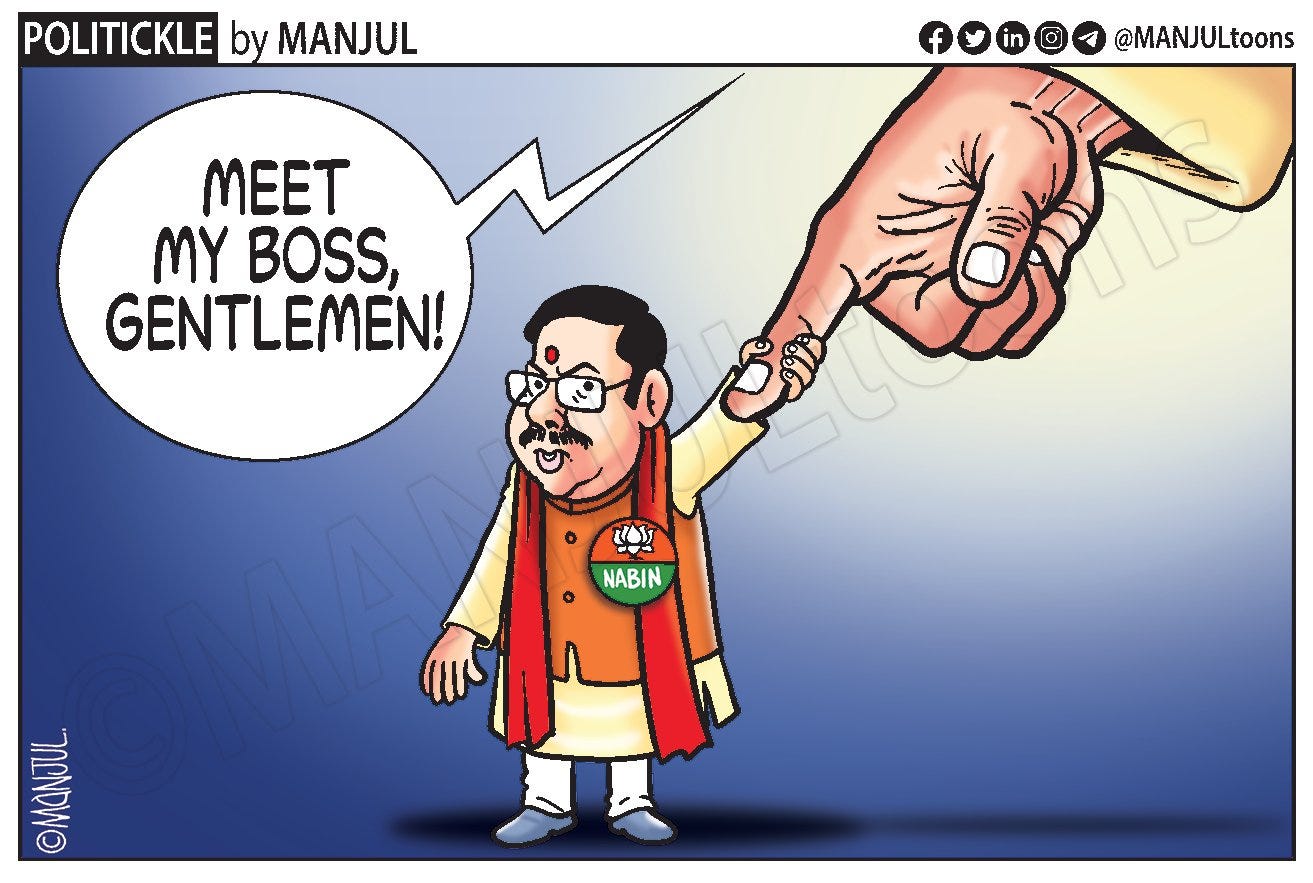
Drawn and quartered
Deep dive
The Economist argues that neither India nor Pakistan can credibly claim victory, as both sides walked away with sharply different – and potentially dangerous – interpretations of last year’s May clash. The British magazine warns that mutual bravado, misread red lines and opposing lessons drawn from the skirmish may make the next confrontation far more unpredictable and perilous:
“Indian officials do not dismiss the risk that a future conflict turns nuclear. But they insist they have a good grasp of where the limits lie. India has an “escalation matrix”, explains one official, spelling out in detail which targets might prompt what sort of response, and which might cross a red line. “One thing we take as an important lesson” from those days of fighting, says another senior official, “is that there is space between conventional and nuclear. Plenty of margin to play with.”
Some of this might be bravado, of course. In any war, each side has an incentive to play up its successes and play down its losses, if only to bolster deterrence. But the chasm between Indian and Pakistani perceptions of their skirmish is gaping. Pakistan may have come away with the view that India is likely to blink first in another conflict, that America will quickly step in and that post-war diplomacy will once again settle in Pakistan’s favour. Some Indians believe that the country erred in agreeing to a ceasefire on May 10th, and that it should have pressed on. All this suggests the next showdown could be more unpredictable—and a lot more dangerous.”
Sameer Lalwani, Shailender Arya and David Brostoff distill five key lessons from the four-day war, offering a clear-eyed assessment of how based on their private discussions that “India assessed that China used drones to probe the India-China border while India was fighting the Pakistan military last May. Additionally, … multiple cyber-attacks on Indian systems originated from China.”
Prime number: 1,118
In October 2021, the Modi government had notified its flagship Advanced Chemistry Cell (ACC) Production Linked Incentive (PLI) scheme – in line with the government’s slogan of “Make in India” – with an objective to build a domestic battery manufacturing ecosystem. Two key objectives of the scheme included generating employment and investment. However, more than four years later, the ACC PLI scheme has generated only 1,118 jobs so far, which translates to just 0.12% of the estimated target of 1.03 million jobs. Similarly, investment commitments amount to around Rs 2,870 crore, which is just 25.6% of the targeted Rs 11,250 crore, a new assessment by JMK Research and the Institute for Energy Economics and Financial Analysis (IEEFA) has found, reports Financial Express.Opeds you don’t want to miss
Pratap Bhanu Mehta on the little Trumps who can’t stand up to the big one. “We are not resisting him because we relish the permissions he is putting in place … all risks damned.”
“Led by Prime Minister Narendra Modi, the Lok Sabha discussed Vande Mataram for 10 hours. But the ruling party allowed only a fraction of that period of time to discuss the nuclear legislation, without really allowing any kind of in-depth examination of the problems identified by many Members of Parliament,” writes Bahaar Abbas and M V Ramana on India’s new thrust to nuclear power prioritising private profit over safety. “As the historical record in India and the rest of the world shows, nuclear reactors provide only a small and declining fraction of all electricity and energy used around the world. Newer reactor designs, such as small modular nuclear reactors, will not change this picture.”
A piece of board: The Hindu editorial on why India should steer clear of Trump’s ‘Board of Peace.’ “Neither pragmatism nor principle dictates taking such a decision in haste, a country of India’s standing cannot act based on the fear of missing out on a position of influence, or fear of punishment by the US.”
If India must have a shot at becoming viksit by 2047 then cordial relations with our neighbours – something conspicuously lacking at the moment – “are a sine qua non”, Air Vice Marshal (retired) Manmohan Bahadur says. To achieve this, he writes, will involve reflecting on whether we have “jumped the starter’s gun and are confusing influence and weight with power?”
Mallika Bhanot and C. P. Rajendran warn that the current trajectory amounts to a perilous march toward ecological catastrophe in the Himalayas:
“The vulnerability of the Himalayan — one of the world’s most climate-sensitive landscapes — is escalating. The current snowless winters and raging forest fires in this area resonate with the conclusion of a recent study, revealing that high-altitude areas have been warming 50% faster than the global average since 1950. This accelerated warming means extreme weather events such as the Dharali disaster will become increasingly frequent and severe.
If border security, connectivity and national interest are our true objectives, then disaster resilience must take precedence over disaster-prone infrastructure. This is not a matter of ideology; it is a scientific, ecological, and economic necessity.”
Unlike its busy counterparts within the Supreme Court complex, Court 10 is always empty and closed, an “oasis of silence which has nothing to offer to the scribe and [is] easily overlooked”, observes Krishnadas Rajagopal, who centers his musings on being an apex court reporter on this enigmatic courtroom.
Listen up
The sort of flak A.R. Rahman faced for saying there may have been a communal element to his not getting offers from Bollywood is a symptom – and a heartbreaking one at that – of “a much larger problem of what is happening in our society … [of] a kind of epidemic of hate speech”, Harsh Mander told Sidharth Bhatia on The Wire Talks.
Watch out
Women in Himachal’s high-altitude Kibber village were key contributors to the state’s recent snow leopard survey, installing camera traps, conducting fieldwork and analysing thousands of pictures on computers. Get a glimpse of a day in their lives through this BBC report.
Over and out
Brother-sister duo Backstage Siblings’ ‘India Bhajan Jamming’ tour – whose repertoire goes beyond Hindu devotional songs to include Sufi and pop music too – is new in that “economic elites are excited about singing devotional songs in public”, Menaka Doshi notes. The same desire for “a return-to-Indian-roots style experience” behind these ‘bhajan clubbing’ events (here is one example from Chennai) is also “also showing up in the reappearance of baithaks, or home concerts”, she recalls.
The New York Times reports on a striking home in India built like a bridge, suspended over a 23-foot-deep gorge. After searching across multiple cities for land to create a farmstead, two business owners finally found a suitable site – only to face an unexpected architectural challenge that reshaped their plans.
That’s it for today. We’ll be back with you on Monday, on a device near you. If The India Cable was forwarded to you by a friend (perhaps a common friend!) book your own copy by SUBSCRIBING HERE