
A newsletter from The Wire | Founded by Sidharth Bhatia, Siddharth Varadarajan, Sushant Singh, Seema Chishti, MK Venu, Pratik Kanjilal and Tanweer Alam | Contributing writers: Kalrav Joshi, Anirudh SK
If you like our work and want to support us, then do subscribe. Sign up with your email address by clicking on this link and choose the FREE subscription plan. Do not choose the paid options on that page because Stripe – the payment gateway for Substack, which hosts The India Cable – does not process payments for Indian nonprofits.Our newsletter is paywalled but once a week we lift the paywall so newcomers can sample our content. Today is that day. To take out a fresh paid subscription or to renew your existing monthly or annual subscription, please click on the special payment page we have created – https://rzp.io/rzp/the-india-cable.Snapshot of the day
January 30, 2026
Sidharth Bhatia
Ruling on a petition pointing to a lack of measures to manage menstrual hygiene in schools across India and how this leads to girl students skipping or dropping out of school, the Supreme Court today held that such deficiencies violate the students’ fundamental rights. “Dignity cannot be reduced to an abstract ideal; it must find expression in conditions that enable individuals to live without humiliation, exclusion or avoidable suffering … In such circumstances, the lack of resources cannot be permitted to govern her autonomy over her own body” a bench of Justices J.B. Pardiwala and R. Mahadevan said. It ordered states and Union territories to ensure that oxo-biodegradable sanitary napkins are made available in all schools free of charge, that the schools have gender-segregated bathrooms and that they provide spare innerwear, uniforms and disposable bags in dedicated spaces. Krishnadas Rajagopal reports.
Police officers cannot shoot accused persons in the leg – as they often do in Uttar Pradesh – as a way of serving justice because doing that is solely in the judiciary’s domain in a democratic country, the Allahabad high court has said. Police in such cases have been observed to “unnecessarily use fire arm and [cause] fire arm injury on the leg of the accused just below the knee” with the aim of getting a promotion or attracting fame, Justice Arun Deshwal said.
The US court for the eastern district of New York is due today to rule on the Securities and Exchange Commission’s plea to serve summonses to Gautam and Sagar Adani by email in its civil bribery case against them in light of the Indian government’s lack of cooperation, Bloomberg notes. The news agency also recalls that the senior Adani’s lawyer in the matter, Robert Giuffra Jr – who requested the federal court not to adjudicate on the matter until the two sides hammer out an arrangement – is also representing US President Donald Trump in his attempt to have set aside his 2024 criminal case for falsifying records to cover up payments made to adult film actor Stormy Daniels.
Yesterday’s Economic Survey endorses the government’s decision to repeal MGNREGA, arguing that the job guarantee programme contained “deep structural issues” and that demand for the scheme had declined alongside a “broad-based strengthening of rural economic fundamentals”. However, notes Sobhana Nair, activists have argued that demand for MGNREGA was ‘artificially suppressed’ by “low budget allocations and technological hurdles such as mandatory digital attendance”.
In another section the Survey says the RTI Act needs “re-examination” because the scope of disclosures it permits is “particularly broad”. “The concern is predictable: if every draft or remark might be disclosed, officials may hold back, resorting instead to cautious language and fewer bold ideas,” it says, citing exemptions to this effect in the US, UK and Sweden’s RTI Act-equivalents. Such a ‘re-examination’ ought to “keep it firmly anchored to its original intent”, which per the Survey is “enabling citizens to demand accountability for decisions that affect them, while also ensuring that space for candid deliberation and respect for privacy remain protected”.
It also says that an age limit for using social media platforms is worth considering. “Policies on age-based access limits may be considered, as younger users are more vulnerable to compulsive use and harmful content,” it says, with chief economic adviser V. Anantha Nageswaran during a presser yesterday accusing the platforms of adopting a “predatory” approach to cultivating user engagement, especially among youthful users.
Weeks after it was reported that the RSS had, via a company named State Street Strategies, hired the lobbying firm Squire Patton Boggs to lobby the US Congress, the lobbyist terminated its campaign, report Prism‘s Meghnad Bose and Biplob Das, who had first reported on the matter. SPB also “filed several amendments to its lobbying registration and quarterly reports that retroactively changed details about its client”, replacing the RSS’s name with that of pharma executive Vivek Sharma, they write.
Advocate Kapil Sibal continued his arguments in the Supreme Court against Sonam Wangchuk’s detention under the National Security Act. Wangchuk, who has been in jail since September, did not threaten to overthrow the government or insult Hindu deities in his remarks, Sibal said, adding that ‘anti-government sentiment does not affect the security of the state’.
Rajasthan’s governor Haribhau Bagade returned a Bill seeking to punish honour killings that was passed during former chief minister Ashok Gehlot’s tenure in 2019. The Bill does not pass muster as it refers to sections of the Indian Penal Code that was superseded by the Bharatiya Nyaya Sanhita in 2024, the governor said, adding that the latter’s provision to punish murder in section 103 is ‘sufficient to deal with honour killing’, reports Hamza Khan.
The Maharashtra government’s proposal to use AI tools that will reportedly analyse “speech patterns, tone and linguistic usage” to identify undocumented Bangladeshi immigrants and Rohingya refugees is fraught with danger, experts speaking to Tabassum Barnagarwala said. For starters, as an anthropologist pointed out, “accent and dialect comes from geography not religion” and AI is not infallible, which could put Bengali-speaking Muslim migrants from the districts bordering Bangladesh at risk of being wrongfully deported.
International relations scholar Chietigj Bajpaee writes that his conversations with Chinese interlocutors during a recent visit to China revealed “entrenched friction in the China-India relationship despite the ongoing reset”. “Most surprising,” he writes, “was that my Chinese counterparts felt differences between the countries had deeper philosophical roots.”
With the rupee hitting 92 against the dollar yesterday and being dubbed the ‘worst performing currency in Asia’, here is a throwback to what Prime Minister Narendra Modi had said as chief minister of Gujarat in 2012 when the currency was similarly in ebb.
All five full trials under Uttarakhand’s conversion law resulted in acquittals
Of the five cases that completed a trial under Uttarakhand’s Freedom of Religion Act – its law against ‘unlawful’ conversions – all of them resulted in an acquittal, reports Aiswarya Raj. At least seven other cases, she writes drawing from records obtained via RTI, were “dismissed mid-way largely due to complainants turning hostile, lack of corroboration and failure by the prosecution to establish coercion or inducement”. Of the 39 remaining cases for which data was provided, “the accused are out on bail in three-fourths … in many cases, bail was granted … after noting consensual relationships, contradictory statements or procedural lapses”.
Amendments to Water, Air Act guidelines relax permit requirements for industries
Although the Union government says that its emendation of guidelines to establish industries under the Water and Air Acts of 1981 and 1974 respectively will – by removing the requirement that industries renew permissions repeatedly – aid the ‘ease of doing business’, Aathira Perinchery recalls that this is the same reason it has offered when diluting various environmental laws in the past. She also explains why environmentalists think the government’s rationale that the changes will strengthen compliance “is questionable given existing concerns about implementation and enforcement that India is witnessing at the moment, particularly when it comes to tackling pollution”.
Visit to Telangana village hit by mass dog killings throws up ‘dog lovers’ vs ‘actual sufferers’ dichotomy
What do villagers in Telangana feel about the mass killings of stray dogs that have come to light over the last two months and which are believed to be linked to recently elected gram panchayat officials? Travelling to Yacharam, a village 50 kilometres from Hyderabad where some such killings occurred, Swathi Vadlamudi finds that “many residents argue that those least exposed to the daily risk of attacks should not dictate terms to the ‘actual sufferers’,” reflecting a sentiment seen elsewhere in the country too. “For villages like Yacharam with unsafe waste disposal practices and no mechanism to manage strays, mass extermination is often viewed as the only option”.
The Long Cable
SC stay on UGC regulations shows the power of Brahmins’ wrath
Apoorvanand
The Supreme Court has effectively rescued the Bharatiya Janata Party from the ‘divine’ wrath of the Savarnas. It has also given it a shield to save itself from the surging indignation of the Dalit and Backwards communities, which are essential if it wants numbers to be in power. While staying the implementation of the University Grants Commission’s (UGC) new regulations against various forms of discrimination, the Court aired a dire apprehension: a fear that such measures for ending discrimination might deepen and widen social divisions, perhaps leading to a state of affairs reminiscent of the old America, where Black and White children attended separate schools.
This order is not the final word, though. Yet one finds it curious that it comes from the same bench of the Court that had asked the UGC to formulate these rules, as it found that the previous 2012 rules had not been effective in curbing discrimination. It could not ignore the data given by the state itself, which showed that there was a staggering 118% increase in the cases of discrimination. Most of them are related to caste. Yet, the same bench lost that sense of urgency when it saw the fury of the Savarna community. Even when small in number, the sheer might and influence of the Savarnas are laid bare by this judicial intervention. How interesting it was to see the media covering it as a popular revolt!
To understand these regulations, one might begin with a story—an entirely true incident of which I was a witness. I shall withhold names for obvious reasons. In a certain university, after interviewing candidates for a teaching position, the selection committee sat down to draw up the list of those deemed fit for the posts. The moment we—the two experts—mentioned the name of the candidate at the top of our list, the third member of the committee lost all composure. He declared he would not, under any circumstances, approve that name. The reason? During the interview, the candidate had discussed Brahminism critically. The learned expert argued that this person was unfit to be a teacher because if they could speak thus in an interview, they would surely “spew venom” in the classroom. We tried to reason with him—that Brahminism is an ideology, one that can be found in individuals of any caste or community; to critique it is not to oppose every person born into a Brahmin family. But he refused to concede. You can guess the outcome in the pursuit of “consensus.” I finally told him: it is proven that even in this Kaliyuga, there is no sanctuary from Brahmkop (the wrath of the Brahmin).
The Court has proven the same. In this democracy, Brahmkop remains the most formidable of wraths.
It was a coincidence that all three experts on that board were Brahmins. One of them decided to penalise the best candidate for critiquing Brahminism. Others fell in line. Should we see this as an instance of discrimination? Or should we view it not as caste discrimination, but as a matter of ideological divergence?
In recent years, to take care of this prejudice, observers from every community have begun sitting on selection committees, reducing the possibility of overt caste-based discrimination. But why was the need for such observers felt at all? Is it not because, even 78 years after Independence, most committees are still dominated by the upper castes? And is it not true that among them, if not outright hostility, there exists at least a general prejudice toward the Scheduled Castes, Tribes, or Backward communities? This is why “General Category” experts require monitoring. Is this not an insult to them? Why have the “upper castes” never raised their voice against this or boycotted these committees? But this has not happened. They, too, understand the logic of this system. Discrimination based on caste is embedded in the very nature of our society; it operates incessantly, directly or indirectly. Its redressal is essential because it not only harms the marginalised but also weakens democracy by violating the idea of equality.
The reality of our educational institutions remains that the highest academic and administrative posts are occupied by the “upper castes.” Consequently, certain caste prejudices operate without ever being voiced. One such prejudice concerns the ‘General Category.’ One must repeatedly explain that ‘General Category’ does not necessarily mean an ‘Upper Caste Category,’ but rather a space where anyone who secures marks or grades above a certain threshold is entitled to a seat. Yet, it is often observed that candidates from Scheduled Castes, Tribes, or Backward classes are pushed into reserved categories even when they secure equal or higher marks. What shall we call this? Is this discrimination or not?
With its decision, the Supreme Court has poured cold water on the anger of the upper castes and doused it. These groups claimed that under the guise of these regulations, ‘upper caste’ students, teachers, or administrators could be targeted. They took to the streets, created mayhem on the social media platforms, showered abuses on the chosen leader and the BJP, threatening them that the ‘general category’ support should not be taken for granted by the leader and the party. It was natural for the party to run for cover. The SC order came just when it was most needed by the BJP.
It is fascinating that ‘upper caste’ people refer to themselves as the ‘General Category.’ This is legally incorrect, as the General Category can include people from every caste and community. By hiding their real identity—the ‘upper caste’—and calling themselves the ‘General Category,’ it becomes evident that the truth is something that causes them a sense of embarrassment. Those who have traditionally enjoyed privilege now wish to call themselves ‘General’ (normal), while labelling those who were deprived of rights and are now staking a claim to them as ‘Special.’ They are thus framing the marginalised as the ones possessing ‘privilege.’
Even if we ignore this linguistic disingenuity, it is difficult to understand why upper castes are so enraged. The regulations announced by the UGC to end campus discrimination and establish equality are not entirely new. In 2012, the UGC had formulated regulations for this very purpose. The new rules are merely a modified version or improved version of the 212 rules. If one reads them carefully and compares the two, it becomes clear that the new regulations are actually weaker than the 2012 version in many respects.
Secondly, the new regulations include ‘upper castes’ among the groups that can be potentially discriminated against. The categories facing unequal treatment include the disabled, women, and the Economically Weaker Sections (EWS). It goes without saying that these categories include upper-caste individuals; in fact, the EWS category is composed entirely of the upper castes. According to the regulations, if people from any of these categories experience unequal treatment or discrimination due to their condition, they can complain, and action must be taken. This clarifies that the regulations are not biased against upper-caste groups. They were created to identify and redress various forms of discrimination.
My colleague, the political scientist Dr. Sukumar, pointed out that this list includes all those groups often derisively called “Kotawale“ (the quota people). Reservation based on religion or region is rare, but the rest are all “quota people”: the disabled, EWS, OBCs, SCs, and STs. Beyond these, discrimination based on gender, sexual orientation, region, and religion persists in society, so its presence on campus cannot be denied. We must note that even in these categories, upper-caste people are included. If an ‘upper caste’ person is discriminated against for being a ‘Bihari,’ they too are a victim, and their complaint will be heard. People from the Northeast face discrimination in Delhi or Bangalore; similarly, I have heard from Biharis that they feel discriminated against on campuses in states like Kerala. These forms of discrimination can be subtle.
Either we assume that no discrimination exists in educational institutions, or if we accept the fact of discrimination, we must find a way to redress it. The business of education cannot function with people suffering from a sense of discrimination. It is a source of mental agony that weakens both student and teacher. It is difficult to survive in education with a sense of humiliation and inferiority. Suicide is the extreme reaction to this insult. Can this be permitted?
Of all forms, caste discrimination is the most prevalent and is an all-India problem. Ostensibly, such discrimination can only be practised by those placed higher in the caste hierarchy. A Dalit is hardly in a position to discriminate against a Savarna; merely being at a higher level in an institution is not enough for that. Therefore, the argument of those calling themselves Savarna—that they too could face caste-based discrimination—will seem laughable to anyone who knows this society.
Furthermore, the ‘upper castes’ allege that these regulations treat them as criminals. From which part of the regulations can this be concluded? If anyone feels discriminated against due to disability, gender, region, religion, race, or caste, they have the right to complain. That complaint must be heard immediately and acted upon without delay. Action, in this case means an inquiry where both sides get a full opportunity to present their case and evidence. Any objection to the committee’s decision can be sent to an Ombudsman.
The way a social community has flared up shows as if the UGC has done something unheard of that suggests they were entirely unaware of the 2012 regulations. It also suggests that, in truth, no effective action was ever taken under the 2012 anti-discrimination rules. Had there been any punitive action, it would have been impossible for it to pass without discussion or uproar. Even after the 2012 rules, students in higher education have committed suicide due to the sense of insult and harassment rooted in their caste status. Why is there no expression of pain for that among the ‘upper caste’ communities? Why was it that after Rohith Vemula’s suicide, all the influential sections of the upper-caste community busied themselves trying to prove that Rohith was not a Dalit and that his mother was lying?
Sociologist Satish Deshpande wrote that the 2026 regulations establish the fact of discrimination in education for the first time. With a slight correction, one could say the fact of discrimination was first registered in 2012. The 2012 regulations identified the forms of discrimination more precisely but failed to create an effective mechanism for redress. The 2026 regulations moved forward in this direction, though they did not define the forms of discrimination as accurately. They are also not adequate as institutions like IITs and professional institutions are not covered by them. Most of the suicides have taken place in these institutions.
Just as the 2012 regulations could hardly do anything substantial to address discrimination, our education system possesses enough high caste resistance to render the 2026 regulations ineffective. This is because its leadership is still ‘upper caste,’ and it refuses to accept the fact of social discrimination. This same leadership has been trying for the last 11 years to remove the mention of caste or discrimination from the curriculum, syllabus and textbooks. They argue that mentioning caste creates division in society, whereas the purpose of education is to establish harmony. But we know when division exists and discrimination is rampant and ignoring it does not create harmony; it breeds bitterness.
(Apoorvanand teaches Hindi at Delhi University.)
Reportedly
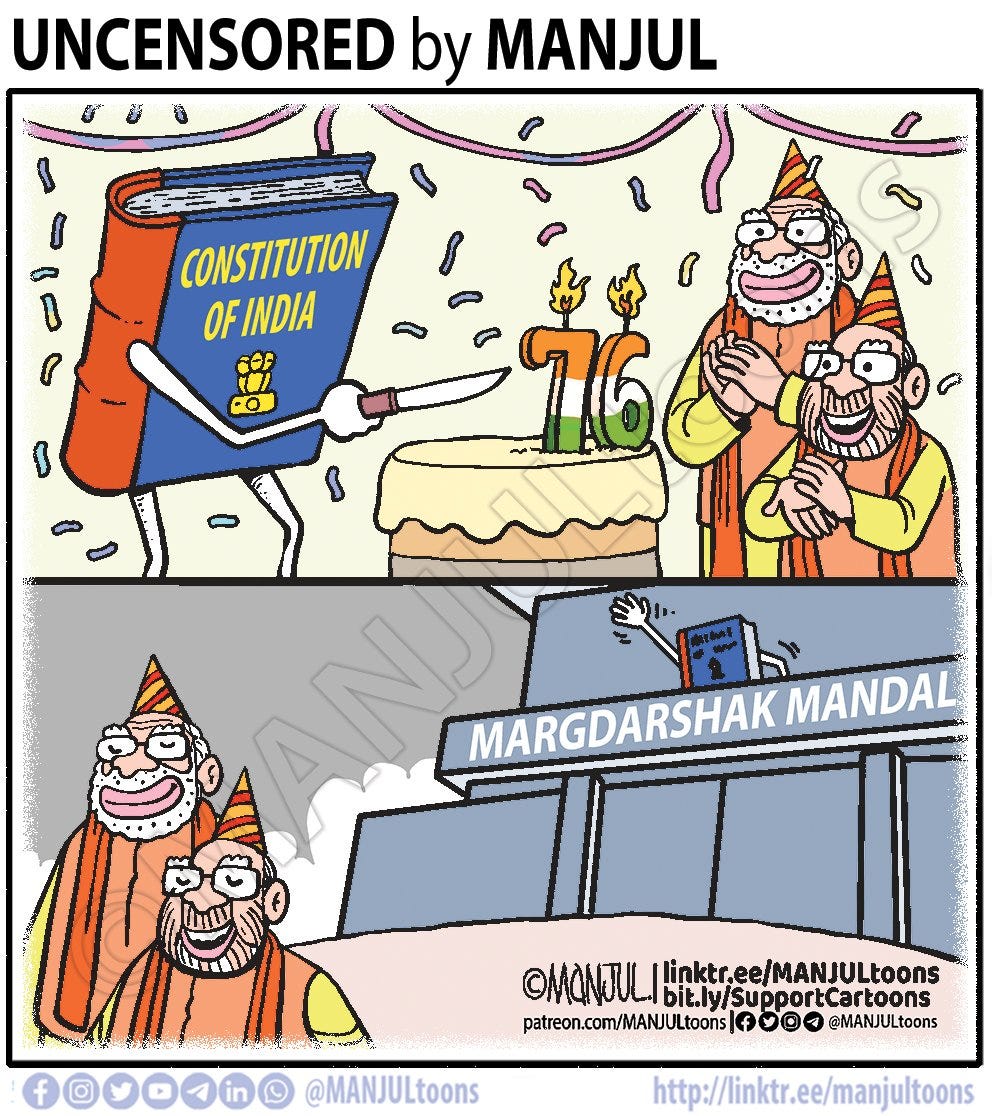
Is a raise in the retirement age of Supreme Court judges to 70 years and of High Court judges to 65 on the cards? A little bird tells us that some judges in the apex court certainly believe they could have more time with the gavel, beyond the current retirement age. Periodically, this does come up for discussion and is seen by some as the perineal carrot being dangled by the executive to keep incumbent judges happy and pleasantly disposed towards the ruling lot. The thing is, should this age be raised, it will completely upend the succession path currently in place.
Drawn and quartered
Deep dive
A further blurring of work and personal time during the COVID-19 pandemic plus concerns over disruption due to AI have meant that workers in swathes of the Indian IT industry are unprecedentedly stressed, reports Parth M.N. in this story centred on the suicide of a 25-year-old software employee hailing from Maharashtra’s Jalgaon.
Prime number: Rs 4,69,04,976
Initially saying that Prime Minister Modi during his visit to Ghana in July was a guest of that country and thus the expenses of his trip would be borne by Accra, the external affairs ministry has acknowledged in response to an RTI appeal that New Delhi spent almost Rs 4.7 crore on the visit. Ankit Raj reports.Opeds you don’t want to miss
Why does the gig economy turn the clock back on progress, asks Satyajit Das. He writes,
“The platform companies illustrate how modern digital innovation enriches a small group of promoters while leaving others to struggle in what former US Labour Secretary Robert Reich called the “share the scraps” economy. It does not engender progress, instead taking society back to earlier exploitative times and condemning most to piecework labour.”
Patralekha Chatterjee writes:
“The uproar over Gita Gopinath’s remarks came because she bluntly stated at Davos 2026 that pollution is a bigger economic threat to India than tariffs, challenging the dominant political narrative that focuses more on trade wars and external pressures. The fact is health issues are rarely just about health; they are windows into politics, economics and community priorities. India’s pollution crisis -- air, water, garbage -- has become a prism through which political and economic priorities are being judged.”
Veteran commentator and reporter on defence matters Rahul Bedi looks back on his 35 years of writing and wearily says, “I have reached a point where even my most vivid superlatives fall grievously short of conveying the extent and urgency of the enduring institutional deficiencies that continue to plague India’s Ministry of Defence, the armed forces, and their modernisation efforts. What were once viewed as isolated shortcomings have, in recent decades, hardened into a pattern of chronic dysfunction.”
“That what was always regarded as the ‘elixir of life’ is now invariably also interpreted as a crucible of our collective egotism. If at one point in history, holy rivers were supposed to wash away our sins, today they accumulate them, serving as silent witnesses to an existence gone awry, says Siddharth Pandey.
“Who can forget those haunting images of dead bodies floating in the Ganges during the Covid pandemic or the persisting visuals of the toxic Yamuna in Delhi, with its lethal froth and foam resembling snow? There is no denying that water and waste have assumed a shocking synonymity with each other in the present age.”
Anurag Minus Verma writes about the shoddy and uncivil behaviour of Indian tourists when they travel, both within the country or abroad. Shirtless men dancing on icy mountains, defacing milestones with stickers, blasting music in monasteries. “The image of the brash, loud, disorderly Indian, cutting queues, speaking over others, and behaving like a nuisance, now circulates endlessly on the internet.” He gives several examples of boorish behaviour. “Even on the day I am writing this article, a video is going viral on X, reportedly from Almora, Uttarakhand. A local citizen tried to stop people from throwing garbage on the road. An argument followed. International boxer Sweety Boora then slapped the local resident.”
Listen up
India has bilateral and transactional relations with all Gulf countries, so there is no question of taking sides in the tensions between the UAE and Saudi Arabia, says Ambassador Talmiz Ahmad in this podcast conversation with Sidharth Bhatia. India has its citizens in both countries and also investments and strong economic ties. He analyses the very brief visit of the UAE President and Abu Dhabi ruler Sheikh Mohammed bin Zayed al Nayan to New Delhi a few days ago and says that Saudi Arabia “sees itself as not a first among equals” but “as the leader of the GCC [Gulf Cooperation Council]” and the leader of the Arab world”, he says.
Watch out
While the developed world “has gone a long way towards phasing coal out of its energy mix”, for India that has been “a much more complicated task”, says the Financial Times in this film about the “true cost of coal” for Indians.
Over and out
Read this profile of architect Vikas Dilawari’s work to restore Mumbai’s heritage buildings and structures, among them Flora Fountain, the Chhatrapati Shivaji Maharaj Terminus, the Bhau Daji Lad Museum and, his favourite building in the city, Hira Baug.

That’s it for today. We’ll be back with you on Monday, on a device near you. If The India Cable was forwarded to you by a friend (perhaps a common friend!) book your own copy by SUBSCRIBING HERE.