
A newsletter from The Wire | Founded by MK Venu, Pratik Kanjilal, Sidharth Bhatia, Siddharth Varadarajan, Sushant Singh, Seema Chishti, and Tanweer Alam | Contributing writers: Kalrav Joshi, Anirudh SK
If you like our work and want to support us, then do subscribe. Sign up with your email address by clicking on this link and choose the FREE subscription plan. Do not choose the paid options on that page because Stripe – the payment gateway for Substack, which hosts The India Cable – does not process payments for Indian nonprofits.
Our newsletter is paywalled but once a week we lift the paywall so newcomers can sample our content. To take out a fresh paid subscription or to renew your existing monthly or annual subscription, please click on the special payment page we have created – https://rzp.io/rzp/the-india-cable.
Snapshot of the day
June 26, 2026
Siddharth Varadarajan
In a setback to both the Adani group and the Trump administration, a federal judge in the United States has refused to approve the US government’s request to terminate criminal proceedings against Gautam Adani and seven other defendants, directing the US Department of Justice (DOJ) instead to provide a detailed factual explanation for its abrupt decision to abandon one of its highest-profile foreign bribery prosecutions. The judge has set July 13 as the date for the next hearing.
The Adani group is accused of bribing public officials in India. Though the Modi government has shown no interest in investigating or prosecuting the company, the DOJ had indicted Adani and the others in 2025. Earlier
All eight persons whom the Ayodhya police accused in its FIR in the Ram Mandir embezzlement case yesterday – lodged a full 18 days after the allegations blew up and 12 days after a special investigation team began its probe – have been remanded to police custody until Monday. The FIR, registered against the complaint of temple trust member Krishna Mohan, invokes sections of the BNS including theft in a place of worship, criminal breach of trust and dealing in stolen property. There are reports that general secretary of the temple trust Champat Rai has resigned – one of the rare resignations in a decade under the Modi government – on ‘moral grounds’, as has trust member Anil Mishra.
Rai has been with the Vishva Hindu Parishad for decades, including as its international vice president. He was associated with the movement that illegally demolished the Babri Masjid in 1992 and later built the Ram Mandir on the same spot. Though he has also faced allegations in the donations embezzlement matter, he is not a named accused. However, the VHP has distanced itself, saying it has “no knowledge” of Rai’s resignation.
Mishra on the other side is “the biggest name in the Sangh in the Awadh region,” writes Ayush Tiwari. “Think of him as a child of the Sangh. Anything that happens to him will reflect badly on the Rashtriya Swayamsevak Sangh. This is why this matter will be suppressed.”
Among the eight accused are two men in their 20s, Lavkush Mishra and Anukalp Mishra. Though the judicial magistrate has said that Rs 79.85 lakh was recovered from seven of the accused including Lavkush and Anukalp (earlier, reports had said the SIT recovered Rs 2 crore based on information given by five of the main accused, again including the duo), they hail from rather modest backgrounds. Akanksha Kumar visited their native villages in eastern Uttar Pradesh to find out what their families – and their neighbours and associates – have to say about the high-profile case.
An Indian Express report said that the temple has outsourced the management of its donations and temple funds to a bank, which in turn hired “a private agency” to do this work. It is unclear if any of the arrested accused were part of this outsourced team or temple trust employees.
Speaking of temple money, or ‘hundi’, Cartoonist R Prasad has fun with the VHP’s favourite slogan, ‘Hindu khatre mein hai’… [‘Hindus are in danger’]


Even the SIT’s job is not yet over. Headed by Vijay Vishwas Pant, Lucknow divisional commissioner, Kiran S., the inspector-general of the Lucknow range, and Neel Ratan, a special secretary in the finance department, it has only handed over preliminary findings to the chief secretary to the chief minister, so far. The full contents are not known to the public.
Iran’s National Iranian Oil Co as well as a number of middlemen are offering Iranian oil to Indian refiners now that the US has issued its first sanctions waiver for the crude, Nidhi Verma reports. NIOC is telling Indian buyers that Iranian oil will be $3-$4 cheaper than similar regional grades, Verma cites sources as saying, but refiners here “have limited scope to absorb Iranian crude in the near term because most have already secured supplies through August” and West Asian suppliers are keen that their annual contracts are honoured. Iran was not so long ago the second-biggest source of crude oil for India but the latter reduced and eventually stopped purchases in compliance with the US’s unilateral sanctions. [Despite brent crude oil dropping to pre-war levels, fuel prices for Indian consumers remain unchanged see item below]
The death toll in the Taratala warehouse collapse in south Kolkata rose to 15 on Friday after two more bodies were recovered from the debris, and two injured workers succumbed to their injuries at the state-run SSKM Hospital, even as rescue teams from multiple agencies – including the Army, Kolkata Police, the National Disaster Response Force (NDRF) and the state disaster management group – continued intensive search operations for a third consecutive day.
Bloomberg reports that India is set to clear a roughly $370 million investment from Horse Powertrain Ltd, a hybrid engine venture backed by China’s Geely and France’s Renault – in what would be one of the largest Chinese-linked manufacturing investments since 2017, and the first since the Modi government relaxed foreign direct investment (FDI) restrictions in March this year, following deadly border clashes in the Himalayas’ Galwan Valley, after which all Chinese investments required strict security clearance. Horse Powertrain was created in 2024 as an equal joint venture between Geely and Renault, and Saudi Aramco subsequently took a 10% stake in the company. Geely and Renault now each own 45% of the London-headquartered business.
The Chinese have it good here too even as a striking paradox is emerging in India’s automotive sector. While the Modi government maintains strict barriers preventing Chinese electric vehicle makers from directly investing in or establishing manufacturing bases in the country – largely driven by the intense border tensions – their technological influence is still deeply embedded in the domestic market. Despite the restrictions on Chinese brands, advanced engineering, battery architectures, and platform technologies are actively driving India’s domestic clean energy transition, notes Reuters. A key example of this strategy approach is the manufacturing partnership between China’s Chery and Tata Motors, India’s leading electric vehicle manufacturer.
A cyberattack that crippled Jaguar Land Rover – owned by the Indian conglomerate Tata Group – in August last year following which the company had to halt production at its factories in England, as well as in Brazil, China, India and Slovakia, had a “potential involvement of the Russian state” – raising “the possibility that this was no typical ransom attack,” as per a fresh UK and US analysis, reports NYT.
Sharad Pawar, leader of his eponymous rump faction of the Nationalist Congress Party, and his deputy and daughter Supriya Sule have denied that any legislators from their party are looking to jump ship. Dharmarao Atram, MLA with the breakaway Ajit Pawar faction, had claimed – in the wake of the Shiv Sena (UBT)’s latest wave of defections – that five of the NCP (SP)’s eight MPs were going to cross over.
After journalists staged a boycott in protest against his use of abusive language and threats during a media interaction, Shiv Sena MP Sanjay Dina Patil was forced to release a video statement expressing regret and tendering a public apology.
According to CTV News, Canada rejected 71% of visa applications submitted by Indian nationals who were seeking to travel to watch the 2026 FIFA World Cup. Out of 1,225 applications filed by Indian citizens, only 355 were approved. Indians were the fourth-largest applicant group for these visas, following applicants from Ghana, Colombia and Pakistan.
The sharp decline in global oil prices has yet to translate into relief at the pump. Brent crude has fallen back to around $72–73 a barrel from wartime peaks near $120, but petrol and diesel prices remain unchanged. The Modi government has, however, restored commercial LPG supplies to pre-war levels, offering some respite to restaurants, hotels and other businesses.
Ali Ahmed argues that the ‘Indian army’s new found love for Hindi and Hindutva has serious consequences.’
The names of five Indian Army soldiers and one Indian Air Force airman – Subedar Major Pawan Kumar, Rifleman Sunil Kumar, Lance Naik Dinesh Kumar, Agniveer Murali Naik, Havildar Sunil Kumar Singh and Sergeant Surendra Kumar – who were killed during Operation Sindoor were published in the Roll of Honour section of the National War Memorial website on Friday, marking the first time the Indian government has officially disclosed the identities of armed forces personnel killed in the operation.
Weak monsoon casts long shadow over India’s economy, after oil
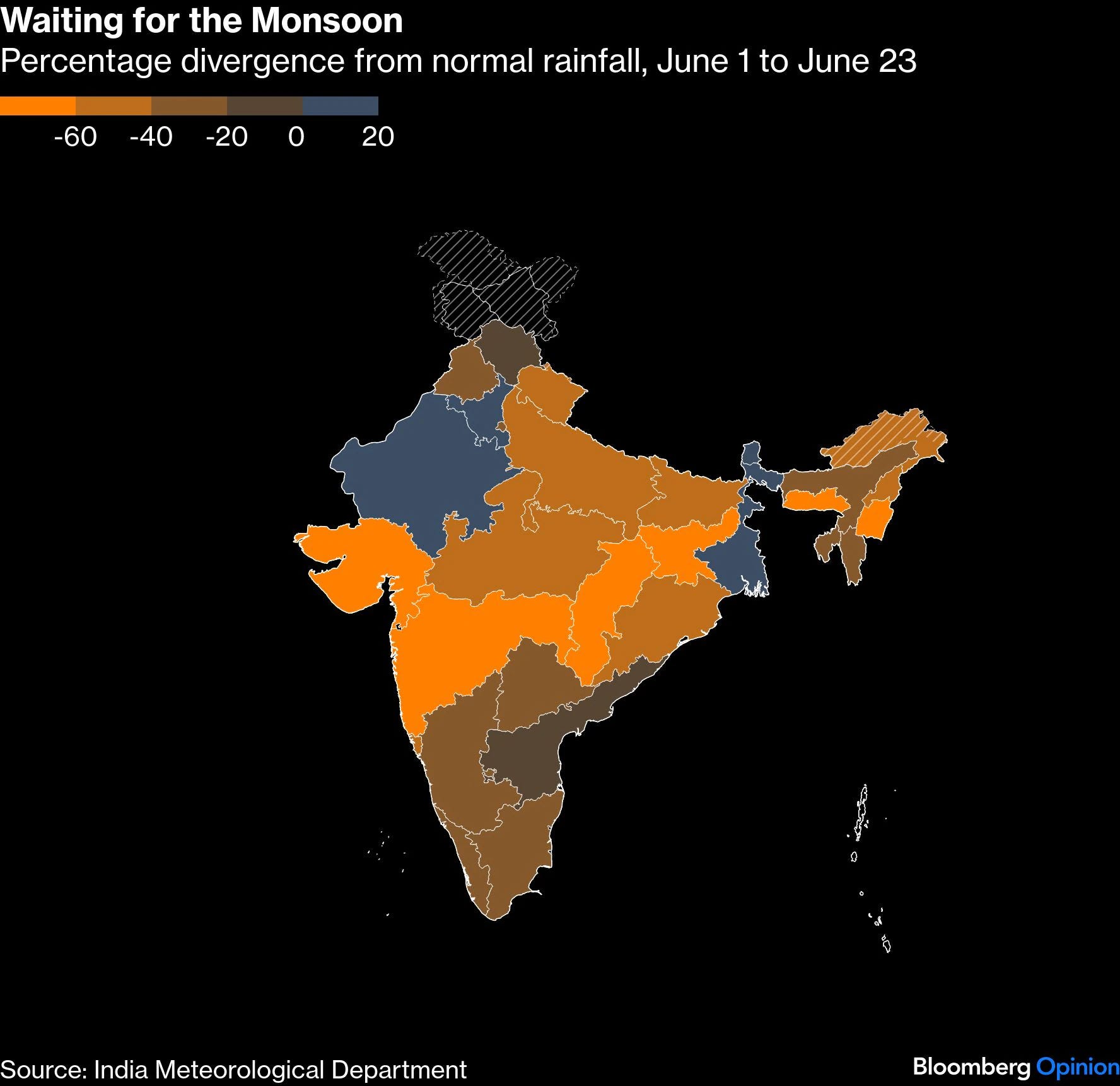
Just as India appeared to be emerging from the shadow of an oil-price shock, a new threat is gathering strength: a weak monsoon. With rainfall running 43% below normal and a developing El Niño raising fears of further disruption, economists warn that poor rains could reignite inflation through higher food prices. A 10% rainfall deficit alone could add as much as one percentage point to headline inflation, potentially undoing some of the relief from falling crude prices, says Bloomberg.
The timing is particularly challenging. While the Reserve Bank of India has kept interest rates steady and inflation remains within its target range, officials are closely watching weather developments as extreme heatwaves grip much of South Asia, with the heat “killing an unprecedented number of workers who have no choice but to work under the blazing sun,” notes Jacobin.
Data belies BJP propaganda on ‘demographic invasion’ in border districts
Even as the BJP alleges that undocumented immigration is driving demographic shifts in West Bengal and Assam, fuelling political polarisation and stricter state policies targeting Muslims, Abhishek Shaw and C. Rammanohar Reddy sift through the data and find that “district-level data from West Bengal and Assam show only modest and uneven growth in Muslim populations in border districts between 2001 and 2019. The evidence does not support political claims that undocumented migration has been significantly altering border district demographics.”
Speaking of which, a month after the BJP government in West Bengal revoked the Mamata Banerjee administration’s decision to include several Muslim communities in the OBC list, it has also slashed the allocation for the Minority Affairs and Madrasah Education (MAME) Department by 62% in the 2026–27 Budget, reducing it from Rs 5,713.61 crore in the interim Budget to Rs 2,175.43 crore.
Tension in Manipur still running high
More LPG will reach commercial buyers now but none at all has reached Manipur’s Kangpokpi district since the 13th of last month; those cylinders that are still here are selling for Rs 5,000 on the black market, Vijaita Singh reports. That’s because the arterial NH-2 that connects the hilly district to Dimapur has remained blocked by Naga groups; their blockade intensified after the six Naga men whom Kuki groups took captive during the state’s hostage crisis were found dead. People have switched to induction tops, leading to power cuts of up to eight hours, according to a civil society leader. A litre of petrol here can cost as much as Rs 280, they said.
Yesterday Henlianthang Thanglet, the chairman of the Kuki-Zo Council civil society body, acknowledged that Kuki groups had killed their six Naga hostages and condemned what happened – his statement marks the first public expression of regret by a Kuki leader or group over the killings. The influential All Naga Students’ Association of Manipur has rejected Thanglet’s remarks and also accused the KZC of using a derogatory word to refer to the slain Nagas. Manipur’s Kukis and Nagas have been embroiled in ethnic strife, which has turned deadly on more than one occasion, since February.
The Long Cable
When it comes to arms sales, India and its European friends are equally transactional
Anita Inder Singh
Official utterances usually conceal more than what they reveal, so it is hard to understand why recent statements by External Affairs Minister S Jaishankar only tacitly referred to European arms sales to Pakistan, while participating in the Kultaranta Talks in Finland on 11 June. The discussion was about ‘A World in Transition: Global, Regional and Local Perspectives’. “No European country has been attacked with Indian weapons,” asserted Jaishankar. “I wish I could say that for Europe weapons vis-à-vis India…. We Indians have never done anything to endanger Europe.”
His seemingly strong statement sounded rather vague for two reasons. First, he did not explain why India has never sold matériel to any state attacking a European country. The fact is that as a lower middle income country, India is a nascent arms manufacturer which is not self-sufficient in weapons. It therefore cannot sell much to European countries (or their enemies), some of which have well-established arms manufacturing industries going back at least to the 19th century. And, after the First World War, many European countries perceived a national defence industry as an element of their national sovereignty and also the path to gaining strategic leverage over buyer countries. Surely the last two reasons also account, in part at least, for contemporary India’s wish to manufacture and sell arms?
At the moment, howeber, India does not even rank in the list of top 25 arms exporters. Its Asian arch-rival China stands at number five, above most European countries, except France, Russia and Germany. (The United States is the world’s top arms exporter).
Generally, economically advanced countries spend considerable amounts on research and development because they have made more social and economic progress. One doesn’t have to go as far as Europe to realise that. Asian countries including China, Japan and South Korea also establish that fact. India, the economic slowcoach, spends a measly 0.6 to 0.7% on research and development.
Some European countries, including France, Sweden, the Netherlands and Italy, have sold arms to India’s neighbour, Pakistan, which has launched attacks on India, the last being in 2025. But France and Sweden have also sold arms to India. Currently, France is India’s second-largest arms retailer (29 %) after Russia (40 %). And India is the largest customer of France and Russia.
Sweden is Pakistan’s third largest arms retailer and 12% of its arms exports go to that country. Sixteen per cent of the arms exports of the Netherlands go to Pakistan.
Even Russia, the expansionist power that India wrongly claims “has never hurt our interests”, started selling arms to Pakistan in 2014, after Moscow’s first invasion of Ukraine, when it annexed Crimea.
At another level, having two neighbours who have fought territorial wars with it, India is the world’s second-largest arms buyer and imported 8.2 % of the global share between 2021 and 2025. That is because it is far from the ‘self-reliance’ it aspires to achieve.
On another plane, how many Europeans would agree that “We Indians have never done anything to endanger Europe”? In the name of strategic autonomy, India has helped Moscow to keep its defence industry well-oiled by purchasing a larger percentage of weapons from Russia than from any other European country. And its past and ongoing collaboration with Russia helps to keep Moscow’s defence industry running, especially at a time when Russia’s victory against Ukraine looks uncertain. More than that, its refusal – like Pakistan’s - to condemn Russia’s illegal invasion of Ukraine, has confirmed that it neither sympathises with, nor understands, why some European states are terrified that they might be next on Moscow’s ‘hit list’ - given Putin’s delusion about rebuilding Russia’s large 18th -20th century empires, as a 21st-century imperialist version of Peter the Great. Ask Poland, Estonia, Latvia, Lithuania, and Finland. They could tell India why they think it is dangerous to ignore the Kremlin’s delusion.
By styling itself as a ‘Vishwaguru ‘and preaching that the world is a global family (Vasudhaiva Kutumbakam), characterised by trust, New Delhi misleads itself and India’s citizens. Given that states have fought wars for centuries, no arms-manufacturing country believes in the global family – each believes in upholding its respective intertwined national military and commercial interests. In any case, who are the Vishwaguru’s students? Definitely no major arms-exporting country, whether Asian or European.
India should not be deluded by its own hypocrisy. New Delhi is aware that transactionalism, rather than trust, is a dominant characteristic of international and regional power politics. That is why it aims to establish itself as the world’s largest arms manufacturer in the first place. Even its long list of Free Trade Agreements, including an unratified one with the European Union, highlights the reality that transactionalism is a characteristic of global and national politics – and India and the EU clearly accept and practice that reality.
Merely blaming Europeans for double standards and sermonising about ‘trust’ will not suffice to establish India as a major, transactional arms retailer – or as an equally transactional global player.
(Anita Inder Singh is a founding professor of the Centre for Peace and Conflict Resolution in New Delhi. She has been a Fellow at the National Endowment for Democracy in Washington DC and has taught international relations at Oxford and the LSE.)
Reportedly
The youth in India may be united around the demand that Union education minister Dharmendra Pradhan must quit because of the NEET exam paper leak but Narendra Modi is showing no signs of being willing to let the man go. Today, he tweeted effusive birthday greetings for Pradhan, rubbing salt into the wounds of lakhs of students by praising the minister for “making commendable efforts towards the implementation of the National Education Policy, which seeks to make India a hub for knowledge, learning and innovation.” Predictably, Modi’s tweet has triggered a social media backlash.
At the same time, Delhi is abuzz with speculation about an imminent cabinet reshuffle in which – it is said – Pradhan could well be ousted.
Drawn and quartered
Deep dive
India switched off Telegram in June for a week, with the Delhi High Court later upholding the move. The restriction has since expired but the precedent remains: the state now holds stronger leverage over digital platforms in censorship negotiations and advances in AI-driven reasoning may make it harder to contest orders on procedural grounds. As Apar Gupta of the Internet Freedom Foundation writes: “In the past, it has been argued that government malevolence is limited only by its competence. Put simply, the sloth of a government office is the best democratic safeguard. That comfort is gone. The orders that used to arrive half-finished now arrive polished,” thanks to AI.
Prime number: 18
BJP-ruled Maharashtra recorded 6,669 farmers and agricultural workers dying by suicide in 2023, even as crop insurers made Rs 6,944 crore in profits, a state minister confirmed in a disclosure reported by the New Indian Express. The figure – roughly 18 farm deaths a day – underscores a crisis that generates annual shock but has failed to trigger the kind of systemic policy overhaul that could bend the curve downward, even in a so-called “triple engine” BJP state.
Opeds you don’t want to miss
The Modi government’s ‘passport madness’, writes Siddharth Varadarajan, is propelled by the BJP’s politics of demographic insecurity and is part of the wider process already underway of redefining citizenship on the basis of politically-driven administrative arbitrariness so that specific sections of the population can be disenfranchised and deprived of their fundamental rights.
Laurie Watkins writes on why Narendra Modi’s attempts to isolate Pakistan over the past year have backfired:
“The key takeaway from the post-Pahalgam period is that isolation strategies are difficult to sustain in a fragmented international order. States with strategic geography, security relevance, economic connections and multiple diplomatic partnerships cannot easily be pushed aside. India sought to narrow Pakistan’s options, but instead, the campaign revealed why Pakistan remains too strategically important to be sidelined.”
Taking stock of Tarique Rahman’s visit to China – his first overseas trip as Prime Minister of Bangladesh – M Humayun Kabir says this should not be seen as a departure from Dhaka’s ‘established way of doing things’, which is to focus on financial support, investment and infrastructure development:
“It is more bilateral than geopolitical, aimed at addressing domestic challenges, and it will be cautious. Most of the understandings will be in infrastructure, employment, financial support, and energy, the areas where we need urgent help and where China has the capacity we would like to tap. Nothing very large in geopolitical terms should be expected.”
‘Feels like a direct shot at India,’ says US Admiral (Retd) James Stavridis on the dropping of ‘Indo’ from the US Indo-Pacific Command.
The Uttar Pradesh police’s much-delayed FIR in the Ram Mandir theft names low-level temple employees and does not make any overarching, trust-level allegations. Given that the Ayodhya temple is “unambiguously a BJP/RSS/VHP/Modi project”, Bharat Bhushan explains the saffron establishment’s predicament moving forward:
“… If people perceive that low-level functionaries are being sacrificed while those at the helm escape unscathed, there will be political, moral and organisational costs … Fence-sitters may doubt the BJP’s already eroding corruption-free governance model. The RSS’s image as an austere, disciplined, incorruptible organisation will also suffer if those in charge of the trust go unpunished, potentially fracturing the RSS ecosystem.”
Iran’s ‘Hormuz Gambit’ has a precedent in the Portuguese empire’s Cartaz system in the 16th century, writes Sunjoy Joshi:
“In a war of chokepoints, Iran’s appeal for regional goodwill—the Hormuz Peace Endeavor (HOPE)—now stands weaponised as the opening bid for a de-facto Hormuz Convention that can ultimately hand the sovereign keys of the strait to Iran and Oman, leaving the US and Israel sulking in the wake of a changing global order.”
Shalini Saboo looks at the demands being raised by Adivasi organisations for a separate religion code for their faith, Sarna, in the latest Census:
“Article 8 of the United Nations Declaration on Rights of Indigenous People states that ‘Indigenous peoples and individuals have the right not to be subjected to forced assimilation or destruction of their culture’. The moot question is how far does the government’s denial to allot a separate religion code to Adivasis align with the provisions of the UN Declaration?”
In a personal essay that vividly brings alive Delhi’s urban history and design, Mukul Kesavan reflects on how cities can be both sublime and tragic.
Listen up
Youtube channel Gagan Afzal has revived Vidushi Madhuri Mattoo’s wonderful rendition of Raag Kamod. Listen here.
Watch out
The Financial Times investigates the human workers being used in India to train AI robots,
Over and out
The New York Times food critic is excited by the explosion in regional Indian cuisine in the city: “OK, I admit it: I’ve fallen for many of the new Indian restaurants around town. It’s hard not to when they serve Hyderabadi biryani, Maharashtrian mutton and other regional dishes that are increasingly easy to find.”
What is scholar, student activist Umar Khalid, arrested under the Unlawful Activities (Prevention) Act (UAPA) in 2020, reading in jail? In detention for over 5 years, repeatedly denied bail, facing long delays in trial, Khalid shares his reading list with the Hindu.
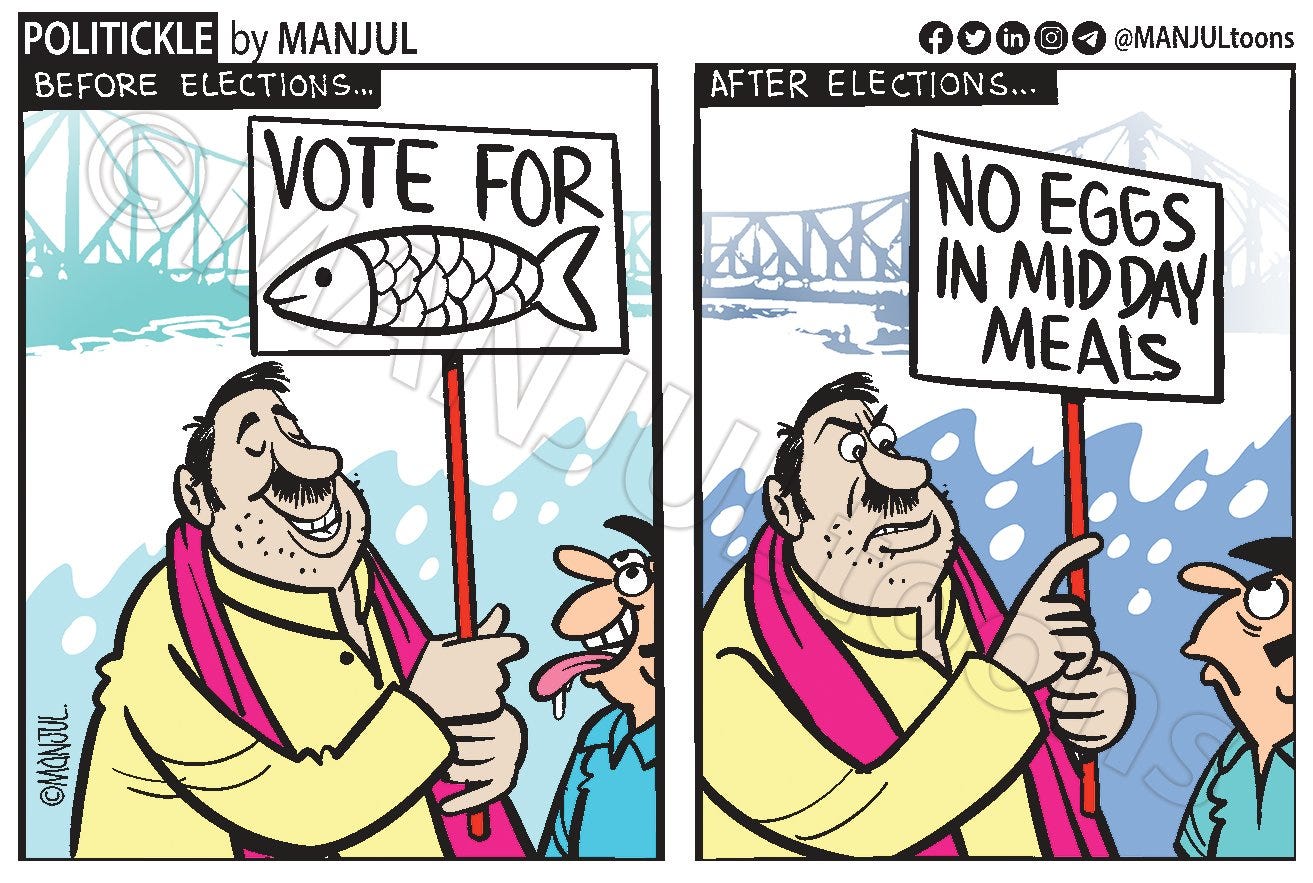
There’s an interesting suggestion on the ridiculous Egg-versary.


That’s it for today. We’ll be back with you on Monday, on a device near you. If The India Cable was forwarded to you by a friend (perhaps a common friend!) book your own copy by SUBSCRIBING HERE.