
A newsletter from The Wire | Founded by MK Venu, Pratik Kanjilal, Sidharth Bhatia, Siddharth Varadarajan, Sushant Singh, Seema Chishti, and Tanweer Alam | Contributing writers: Kalrav Joshi, Anirudh SK
If you like our work and want to support us, then do subscribe. Sign up with your email address by clicking on this link and choose the FREE subscription plan. Do not choose the paid options on that page because Stripe – the payment gateway for Substack, which hosts The India Cable – does not process payments for Indian nonprofits.
Our newsletter is paywalled but once a week we lift the paywall so newcomers can sample our content. Today is that day. To take out a fresh paid subscription or to renew your existing monthly or annual subscription, please click on the special payment page we have created – https://rzp.io/rzp/the-india-cable.
Editor’s note: This post may be cut off in your inbox due to length. Click on the title above to read it in full on Substack.
Snapshot of the day
October 9, 2026
Kalrav Joshi, Anirudh SK, Siddharth Varadarajan
It is neither 1857 nor 1942 though it feels like that for those protestors facing the might of a state apparatus determined to ensure no gathering takes place in Delhi on October 10. “History is repeating itself. Just like in 1942, the arrest of leaders could not stop the Quit India movement; this movement will also not stop,” said Neha Bora, the student leader who has emerged as one of the key faces of the protest against the Election Commission’s deletion of millions of voters. “As they replicate the playbook of the British, we replicate the freedom struggle!”

The capital is under siege in bizarre ways – to prevent lakhs of citizens from coming together in peaceful, non-violent protest against the alleged illegality of the Special Intensive Revision (SIR) and to demand the resignation of Chief Election Commissioner Gyanesh Kumar Gupta. Falling victim to the absurdity and brutality of the times, the yellow barricades – emblematic of the BJP, or Barricade Janata Party – have themselves been chained and tied down, as if even these inanimate objects might be tempted to let democracy pass through. Gyanesh Kumar, meanwhile, remains firmly in place and conspicuously out of sight.
And some of you reading this from Delhi may not even be able to access it, as devices go dark under an ‘unpublished’ (read top-secret) internet shutdown order, effective until further notice. The restrictions reportedly cover Jantar Mantar, Connaught Place, India Gate, Parliament, the Supreme Court, the Delhi High Court, New Delhi Railway Station and hospitals, including Ram Manohar Lohia and Lady Hardinge. Add to this reports of journalists being threatened by Delhi Police and the telling picture is one of an increasingly heavy-handed and panic-stricken response and the continuing ‘Kashmirisation of India’. For context, the internet shutdown reportedly covers seven times the area affected by the October 2 restrictions around Jantar Mantar and lasts twice as long.
Though the state may have pulled the plug on the internet, protestors are already circulating alternative ways to connect, agitate and gather in large numbers despite the blockade.
With just a couple of hours to go before the nationwide protest called by the Cockroach Janta Party and the youth wings of Left parties at Jantar Mantar, the Delhi Police has denied permission for the demonstration, closed metro stations [See Prime Number] and ordered that trains from across the country will not enter central Delhi for 10 hours, citing “anticipated road traffic congestion”. Apparently, the greatest threat to the smooth functioning of the capital is not the suspension of democratic freedoms, but the possibility that its very own people might actually turn up to exercise them.

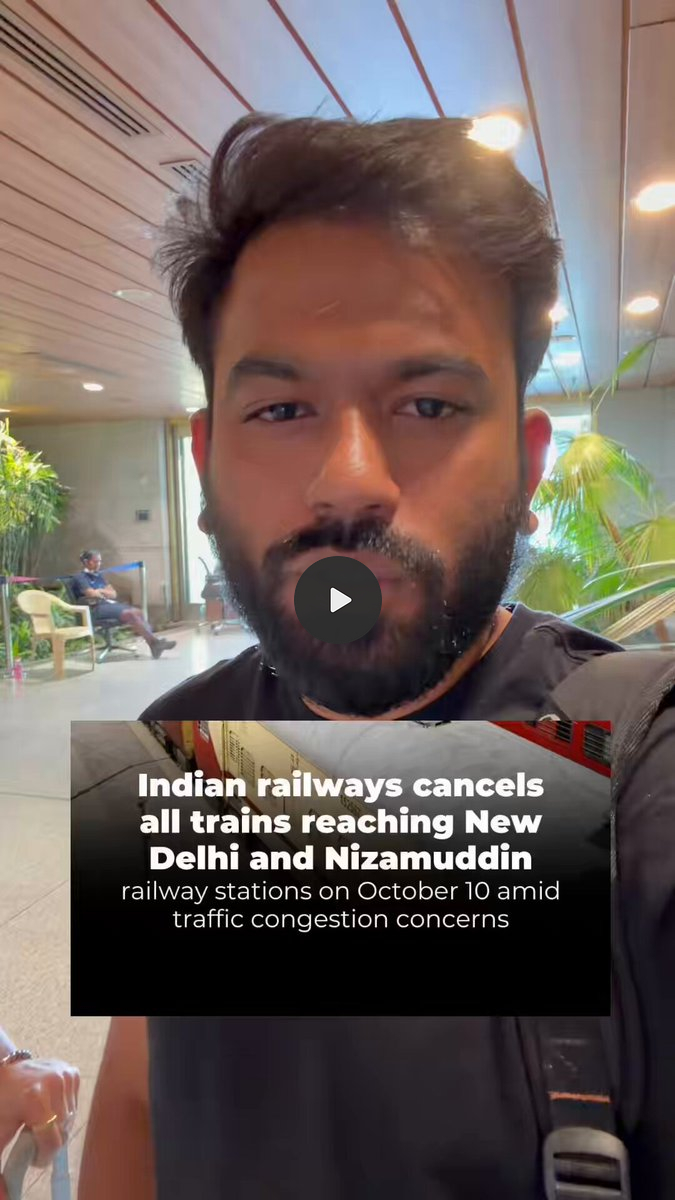
Around 110 companies of security personnel, 23,000 CAPF personnel and 20,000 Delhi Police officials have been deployed across the capital. One might mistake a peaceful protest for an invasion, as police in Delhi and Mumbai reportedly send WhatsApp messages urging parents to keep their children away from Jantar Mantar today, apart from outrightly threatening ‘We The People’.
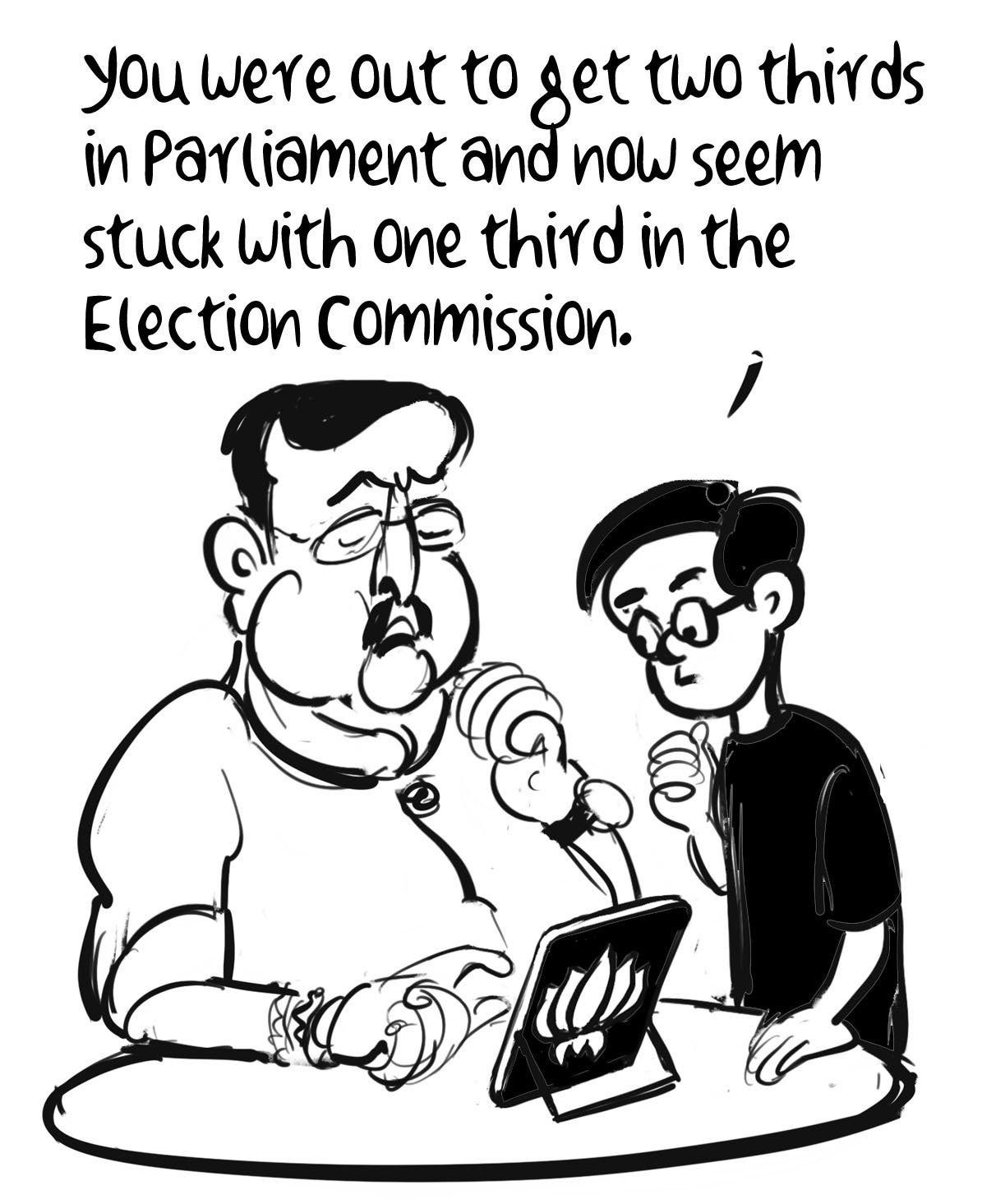
On Friday night, MPs from the INDIA bloc met President Droupadi Murmu to demand the removal of Chief Election Commissioner Gyanesh Kumar, presenting what they described as “incontrovertible proof” of ‘vote chori’. They urged the President to initiate steps towards repealing Assembly election results from the past two years, removing the CEC, suspending the SIR and restoring ballot papers. After the meeting, Leader of Opposition in Lok Sabha Rahul Gandhi told reporters he was “shocked and stunned” that the President had, in his account, neither denied nor questioned their claims, even as she asked the delegation to provide evidence to substantiate them.
To unpack the fast-evolving situation and the political implications of the protests, watch the Wire’s latest discussion, featuring Saurav Das, Neera Chandhoke, Srijan, Seema Chishti, Sravasti Dasgupta and Jahnavi Sen.
Amidst all the restrictions on travel announced today, it was heartening to hear Yogi Adityanath announce that Noida airport has been renamed Narendra Modi International Airport.
Perhaps those West Bengal residents who have petitioned the state’s appellate tribunals for inclusion on to the voter rolls should be heard first, before others who have approached the bodies seeking the deletion of names, said petitioners who’ve moved the Supreme Court today. Some 27 lakh Bengal residents who were excluded from the voter rolls after the SIR never had a chance to appeal their removal in time for the elections because too little a gap was left between the revision and the polls – as a result they could not vote. Of them, around 22 lakh people have approached the tribunals seeking inclusion, and they are set to wait for several years because of these bodies’ high workload.
Earlier this week Ayushi Kar and Sumedha Mittal of the Reporters’ Collective had pointed out that though Uttar Pradesh’s electorate saw a net increase of 84.3 lakh voters between the draft and final rolls, state electoral authorities had only made public 71.38 lakh applications for inclusion on to the list. Over 16 lakh Forms 6 were filed before the publication of the draft roll itself, whose details are not available to the public, they had reported.
Now the state’s chief electoral officer Navdeep Rinwa has confirmed this. The authorities under his command did not make the details of these 16.18 lakh inclusion applications public because Nirvachan Sadan asked them to only make public those applications that were filed during the claims and objections period (after publication of the draft roll), Rinwa has said. But Kar and Mittal note that the EC’s internal directives say that Forms 6 must only be accepted during the claims and objections phase – as opposed to before it. All of their details must be made public, they add.
The New York Times reports on the SIR deletions and the trauma it has unleashed among people.
US Vice President JD Vance’s use of the term “indentured servants” to describe foreign workers while discussing restrictions on five Indian IT firms and other companies yesterday was “unwarranted” and “deeply hurtful”, the Ministry of External Affairs said yesterday in a rare rebuke. That term “carries painful historical and colonial legacy connotations”, the MEA said, adding that Washington’s move with the IT companies does “not advance the shared ambitions of both countries”. Now Tata Consultancy Services, Infosys, Cognizant, Wipro, HCL Technologies, Microsoft, Adobe and Capgemini have been suspended from filing applications under the US’s PERM scheme, through which firms can nominate H-1B visa holders for employment-based permanent residency. This move, though the most sweeping of its kind yet, is unlikely to add to Indian workers’ woes all that much, writes Reuters, noting that Indian IT companies accounted for less than 2% of PERM applications between October 2024 and September 2025.
The Modi government has notified its controversial Central Armed Police Forces (General Administration) Act, challenges and contempt petitions against which are pending before the Supreme Court. Through this law, the government seeks to legislatively get around last year’s apex court ruling directing that the deputation of IPS officers to CAPF ranks up to the inspector general rank be progressively reduced. Vijaita Singh has a helpful summary of the various developments that have transpired in the Supreme Court over the last few weeks over the challenges to the law. Before that, parliament had passed the law amid opposition walkouts; the government had also sought to be exempted from introducing the Bill two days before its consideration in the House per the rules.
Sushant Singh says that ‘South Asia remains the world’s likeliest nuclear flashpoint.’ Nikkei Asia, meanwhile, reports that a ‘new China–Pakistan border protocol could give Beijing greater sway in the Delhi-Islamabad ‘bilateral matter.’
The Pakistan Super League is heading for another scheduling collision with the Indian Premier League which will begin on March 18, 2027 and run until May 2, putting the tournament on a potential collision course with IPL 2027 for the second successive season.
Congress MP for Inner Manipur and JNU professor Angomcha Bimol Akoijam has been fired by his university, which was seized by complaints by at least ten students that he sexually harassed them. He denies the allegations. The state Congress unit is yet to say anything publicly.
Activist Umar Khalid who has been jailed since the last six years under the controversial UAPA has won the 2026 Front Line Defenders Award for Human Rights Defenders at Risk. A special ceremony was held at the Trinity College in Dublin, to honour all the recipients. Khalid was represented by his father, Syed Qasim Rasool Ilyas.
Navi Pillay wins Peace Nobel, her Gaza report caps lifetime devoted to human rights
South African jurist Navanethem “Navi” Pillay, a former UN human rights chief whose work helped shape international law on genocide and sexual violence, has won the 2026 Nobel Peace Prize for her efforts to promote peace and international law. Deccan Herald has a profile of Pillay here, who was also part of the 2025 UN commission that investigated and found that Israel was committing genocide in Gaza. Read her NYT essay here. She is the sixth person from the Indian diaspora to win a Nobel.
Punitive powers under GST to go
Over a year after its last meeting, the GST Council convened in Delhi yesterday and amended various rules pertaining to the tax, notably curbing officials’ punitive powers over some offences. The council, which includes Union and state officials, has recommended removing the powers of arrest under GST; raising the threshold for prosecution from Rs 1 crore to Rs 5 crore; and lowering the general penalty from Rs 25,000 to Rs 10,000.
Saudi-Houthi fighting puts Pakistan in difficult spot
As fighting between the Houthis and the Saudi-backed military coalition in Yemen escalates – Houthi strikes killed three people in the kingdom yesterday – Pakistan is finding it must now walk a fine line. Its ‘Mecca pact’ with Riyadh and Ankara stands activated but is treading carefully so as to not damage ties with Tehran, which backs the Houthis. Citing an anonymous Pakistani source, the New York Times reports that Pakistan Air Force jets are being used to strike the Houthis, though Islamabad has strenuusly denied this. Some eight thousand Pakistani troops are estimated to be stationed in Saudi Arabia, though they are unlikely to directly face off with the Houthis.
Pakistan’s parliament meanwhile has not voted on this deployment of personnel and materiel. It is worth recalling that when Riyadh had asked for Pakistani troops, jets and warships for its Yemen campaign in 2015, the National Assembly had unanimously decided to stay neutral. Today’s circumstances highlight the power that the military and Field Marshal Asim Munir in particular have come to wield over the country’s affairs. As KCL professor Andreas Krieg told Reuters: Rawalpindi’s partners “do not create Pakistan’s civil-military imbalance, but they can reward it”; and a system with weak counterbalances is “good at entering commitments and worse at correcting them once costs emerge”.
The Long Cable
India’s ‘proposals' will not bring peace to Ukraine
Anita Inder Singh
India’s ‘peace proposals’ on Ukraine, though welcomed by Ukraine’s foreign minister Andrii Sybiha on October 3, will not end Russia’s ongoing invasion of his country. Indeed, the initial wonder is that India has moved away from its old position that the Russia-Ukraine war is Europe’s concern and has suggested peace talks involving the Black Sea, energy, foodgrains and fertilisers.
But while sharing the scope of the peace proposals, New Delhi did not even mention the word ‘invasion’, reaffirming India’s decision to abstain from supporting UN General Assembly resolutions condemning the violation of international law, and Russia’s annexation of Ukrainian territory.
Generally, Ukraine welcomes any peace plans. President Vladimir Putin has appreciated the ‘peace-bringing’ ideas of Russia’s friend, Prime Minister Narendra Modi. But not once will Putin admit that he has blithely ignored Modi’s earlier calls for peace. No doubt, he will ignore those made by for External Affairs Minister Subrahmanyam Jaishankar, too.
In fact, Moscow’s intention to continue its expansionist war was conveyed to Germany’s Chancellor Friedrich Merz when he visited Kyiv on September 23, by the all-day bombing of the capital and other Ukrainian cities.
Significantly, Russia made clear at a UN Security Council meeting on September 23 that Russia does not intend to pause military operations during negotiations with Ukraine “in any format”. This highlights Moscow’s determination to achieve its core objectives – control over all of Donbas in eastern Ukraine, which borders Russia, and subjugating Ukraine.
This rules out any chance of Moscow engaging in the dialogue and diplomacy favoured by India. Instead, Russia has pledged to intensify strikes on Kyiv and other Ukrainian cities. Additionally, Moscow has raised defence spending by 27% and cut down expenditure on education and healthcare, implying that the war could last indefinitely.
Russia has also threatened nuclear war several times since 2022 and did so again on September 30, after Jaishankar’s meeting with Putin in Moscow on August 24, and Modi’s with the president on the sidelines of the BRICS summit in New Delhi on September 11.
When Jaishankar met Ukraine’s President Volodymyr Zelenskyy in Kyiv on September 3, the latter urged India and other major buyers of Russian oil to cut back or halt their energy trade with Russia, maintaining that reducing Moscow’s oil revenues is crucial to stopping the conflict.
Jaishankar has defended India’s ongoing purchases of Russian crude, stating that stopping energy imports from Moscow will not end the Russia-Ukraine war. He is right – but Russia’s belligerence and imperial ambitions, to which he doesn’t refer, leaves India building ‘peace castles’ in the air.
The minister stressed that the Indian government’s responsibility is to supply affordable energy to its 1.4 billion citizens amid a volatile global market. He made an analogous statement in 2022, soon after India decided to buy Russian crude after Russia’s invasion started – some four years before the Israeli-US attack on Iran provoked Tehran to close the Strait of Hormuz, through which much of the world’s oil passes. India hasn’t condemned any of these illegal invasions or explained why the upholding of international law is essential to end the growing global energy crisis.
Instead, India maintains that it is exercising its sovereign right to buy Russian oil.
What New Delhi doesn’t say is that it is selling refined Russian oil to Moscow, while the Indian consumer pays more for petrol. The transactional nature of Russian oil buys is unclear or unknown to many Indians.
Russian crude is refined by India’s Nayara Energy (partly owned by Russia’s Rosneft), which is based in Modi’s home state of Gujarat. As Ukraine hit Russia’s oil refineries, Russia imported a record 172,000 tonnes of oil products in August 2026; India accounted for almost 70% of the total.
Russia’s determination to wage war was ignored by India as Jaishankar recently defended New Delhi’s controversial stance at the Munich Leaders’ Meeting on October 4, by saying that Russia was the only country which backed India against Pakistan in 1971.
Presumably, he was referring to the humanitarian consequences of Pakistan’s genocidal war in what was then East Pakistan, and the possibility of a two-front war with Pakistan and China. However, at no time did China offer, or assure Pakistan, of support for a war against India, although Islamabad helped to bring about a rapprochement between Richard Nixon’s US and Mao Zedong’s China.
Taken together with Jaishankar’s statement in December 2023, that the tie with Russia had “saved us many times”, his reference to the 1971 war does make India look like a country that was (and is?) unable to save itself. Whatever her flaws, Indira Gandhi didn’t make India look pathetic at any time in 1971.
International politics is not played by any ideas about gratitude or about one country “saving” another, which is how India defends its ties with Russia. Putin has not gifted oil – or weapons – to India as a favour. Moscow has sold that oil, sometimes at prices higher than those set by the G7, and demanded payment in US dollars and Chinese yuan. Moscow has no use for Indian rupees, whether as payment for oil or arms.
New Delhi is aware that India lags behind China economically. Why it has not crafted strategies to win friends who could have offered it more than Russia economically is a puzzle. So it avoids telling India’s citizens inconvenient facts by harping on India’s thanks to Russia, rather than how much money it has spent on Russian oil, as a result of which it has a huge trade deficit with Moscow.
Clearly, Russia enjoys a seller’s market with India, which has nothing to do with gratitude but its national interest, which will remain defined by its illegal warmongering in Ukraine.
Anita Inder Singh is a founding professor of the Centre for Peace and Conflict Resolution in New Delhi. She has been a Fellow at the National Endowment for Democracy in Washington DC and has taught international relations at Oxford and the LSE.
Reportedly
“Dear Prime Minister Ambani,” writes US oligarch Elon Musk on X in another scathing dig at Indian oligarch Mukesh Ambani. Musk’s post about the lack of internet access in parts of India takes on a whole new significance when the government has shut down internet services in the heart of the national capital, a city of 18 million people. Is Musk taking on Ambani to win the Starlink race in India before Jio catches up? BBC decodes the reason behind it.
Drawn and quartered
Deep dive
When Air Marshal Ashutosh succeeds Air Chief Marshal Amar Preet at the end of this month he will take over a fighter force that faces a fork in the road, and alongside it three distinct dilemmas, says Rahul Bedi. He fleshes out what these are and what is at stake.
Prime number: 57
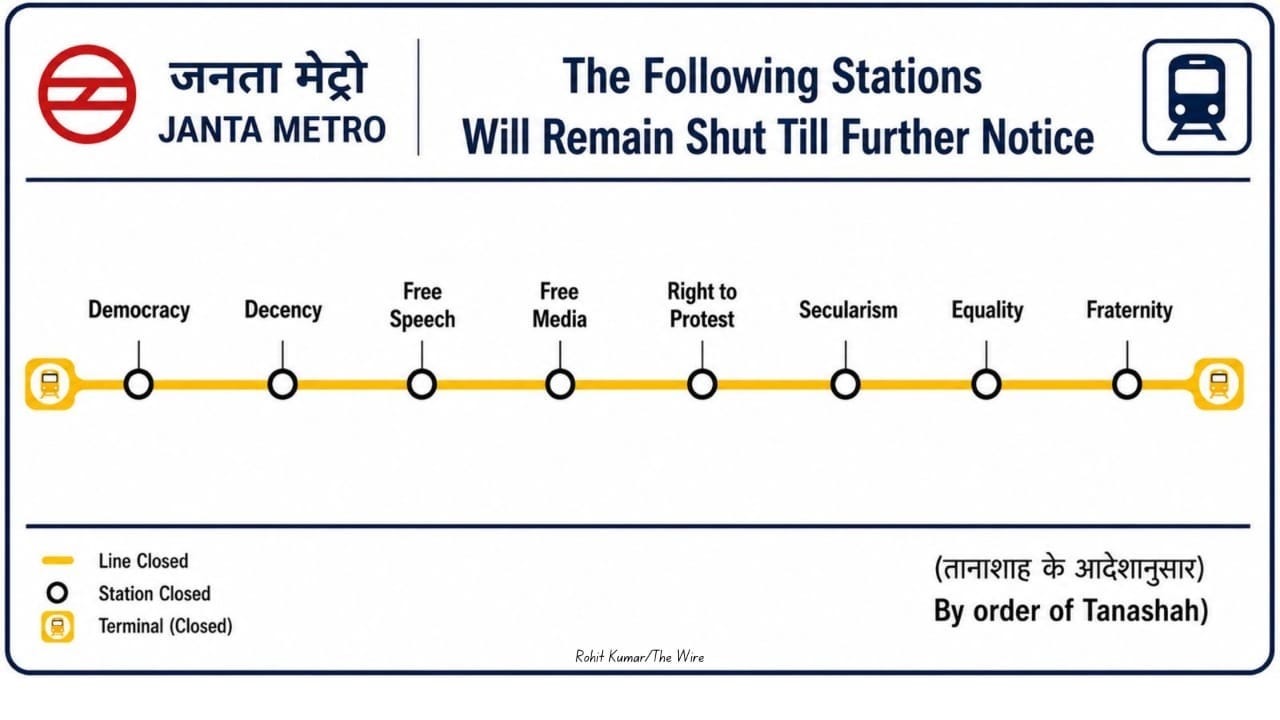
Despite the Supreme Court asking the Centre to allow services to operate in a regulated manner so that the public is not inconvenienced, 57 metro stations have been shut in the capital ahead of the protest against ‘vote chori’.
Apart from that, it is also …
Opeds you don’t want to miss
Pratap Bhanu Mehta, writing on the possibility of a new movement emerging from the Jantar Mantar protests, warns:
“We also know from history that the grammar of social movements is often determined by unpredictable events, an act of violence by the state that sparks outrage, a moment of courage that captures the national imagination. Every managed protest acquires a life of its own. We may only be a slender thread away from that moment.
…The only way out of a protracted, exhausting, and potentially volatile limbo is this: Society will have to speak loudly and clearly, leaving the government no room to evade the message or misrepresent the stakes. For now, the state thinks it can ignore or intimidate its citizens into compliance.”
Its heavy-handed and dystopian tactics ahead of the CJP’s protest are only worsening the Delhi police’s public image. At this point it badly needs a “democratic reset”, says Vikash Narain Rai, former director of the National Police Academy; fortunately for the cops he has many salutary ideas on how they can do that.
Rahul Gandhi’s flash protests and visible, physical confrontations with the police are more effective than the traditional political rally, especially in courting younger Indians, because of their virality factor. But the Congress must go further if it is to make a mark with its latest campaigns, advises Bharat Bhushan:
“‘Vote chori’ must become more than a highly recognisable slogan for the Congress … The protests must be accompanied by party cadre helping citizens whose voting rights have been denied by documenting their problems and getting them re-registered as voters … on as large a scale as possible and in a non-partisan manner …”
Now that a larger bench is to hear the challenge against the election commissioners’ law, V. Venkatesan argues that the court must define what it means for the appointment process to be neutral rather than just prescribe which authorities sit on the selection committee. “It could consider whether the government must obtain the concurrence of at least one selector who is neither part of nor nominated by the executive, while leaving parliament room to choose the institution or office-holder supplying that safeguard,” for instance.
It would be a serious error to turn Operation Sindoor into a vision of future war, writes Lt Gen (Retd) DS Hooda. “Success in a deliberately limited operation does not tell us what will be required to prevail in war,” and especially in “an extended continental conflict.”
Listen up
Akhila Yechury dives deep into the relatively less spotlit history of French India in this episode of Boatcast. She and Zahir Mirza “explore the fierce competitive landscape between corporate titans like Dupleix and Clive, the massive geopolitical shocks of the Napoleonic Wars that rattled Indian shores, and how French enclaves like Mahé, Karikal, Yanam and Chandernagore became hotbeds for cross-border smuggling and legal evasion” – for starters.
Watch out
There is a long way to go to restore free and fair elections in India, a path that will go much further than just CEC Gyanesh Kumar’s resignation. Ayush Tiwari, who has covered electoral malpractice and the EC’s capture in quite some detail for Scroll, explains just why that is.
Over and out
Paroma, an iconic Kolkata sculpture that disappeared suddenly in 2014 and was replaced by a Trinamool Congress symbol, was saved (though not entirely) by Hui Hao Howard Lee, a member of the city’s Chinese community, it turns out. Chandrima S. Bhattacharya in this thoughtful piece reflects on what the recovery of the sculpture – made by Shanu Lahiri – says about public art in Kolkata and where its arc could be going next.
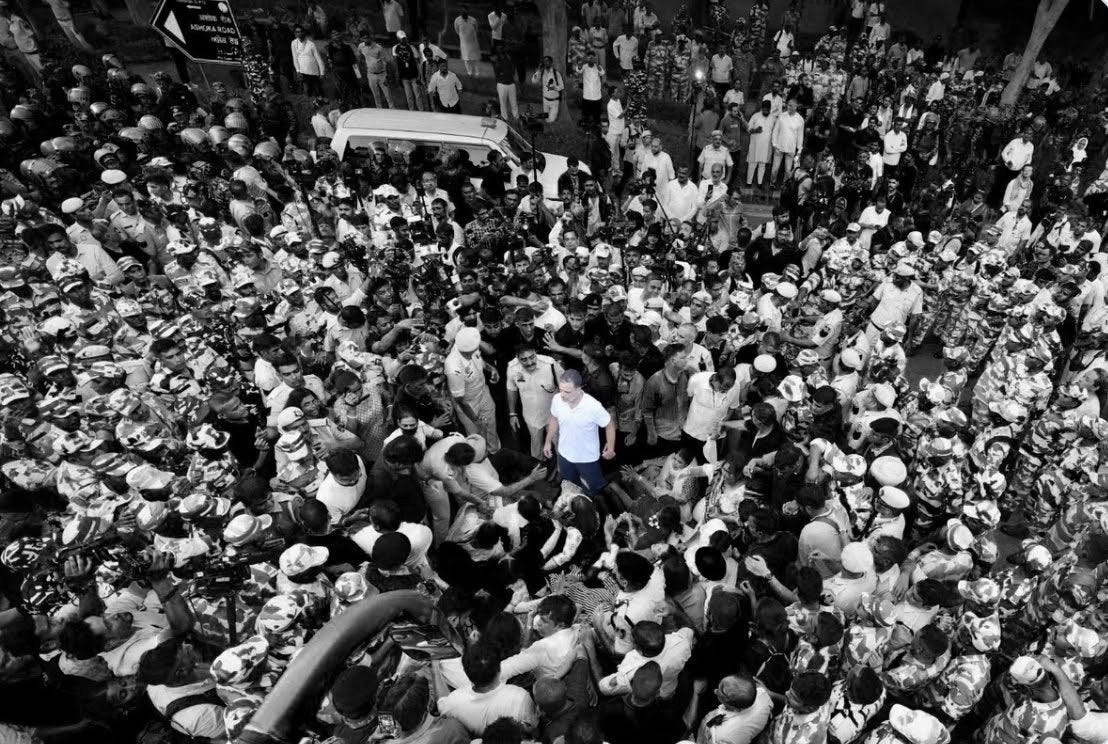
An image worth a thousand words.
That’s it for today. We’ll be back with you on Monday, on a device near you. If The India Cable was forwarded to you by a friend (perhaps a common friend!) book your own copy by SUBSCRIBING HERE.