
A newsletter from The Wire | Founded by Sidharth Bhatia, Siddharth Varadarajan, Sushant Singh, Seema Chishti, MK Venu, Pratik Kanjilal and Tanweer Alam | Contributing writers: Kalrav Joshi, Anirudh SK
If you like our work and want to support us, then do subscribe. Sign up with your email address by clicking on this link and choose the FREE subscription plan. Do not choose the paid options on that page because Stripe – the payment gateway for Substack, which hosts The India Cable – does not process payments for Indian nonprofits.

Our newsletter is paywalled but once a week we lift the paywall so newcomers can sample our content. TODAY IS THAT DAY. To take out a fresh paid subscription or to renew your existing monthly or annual subscription, please click on the special payment page we have created – https://rzp.io/rzp/the-india-cable.
Snapshot of the day
March 13, 2026
Sidharth Bhatia
Iranian president Masoud Pezeshkian said that Prime Minister Narendra Modi described India as a “friend of Iran”, but the bit that big Indian media is trying to paper over and underplay is that Tehran has urged New Delhi that BRICS, which India currently chairs, should play a “strong” and “constructive” role in addressing the escalating West Asia conflict that has disrupted global energy and shipping routes. India has yet to condole the assassination of the Iranian Supreme Leader let alone the unprovoked attack on Iran by the United States and Israel. It is the BRICS chair, and the one association that has yet to issue a statement. Iran has been a member since 2024 and India claims to speak for the Global South. All other founding members of the grouping – Brazil, China, Russia and South Africa – have individually condemned the US-Israeli attack.
That India has co-sponsored the resolution passed by the UNSC condemning Iran’s attacks on the Gulf, but has not criticised the US-Israeli strikes on Iran and Lebanon, has clearly been noticed and certainly by the Iranians. The bone of contention in issuing a joint statement is also given the sharp differences between Iran and the United Arab Emirates (UAE).
The Modi government, feeling the pinch (and punch) of the energy squeeze, appears to be continuously calling up Iranians. India’s foreign minister S. Jaishankar and his Iranian counterpart, Abbas Araghchi, held their fourth phone call since the start of the war on Thursday evening. India is desperate “to secure safe passage to the Indian-flagged merchant vessels through the strategic shipping route of Strait of Hormuz that has been partially blocked by Tehran”.
Iran’s ambassador in New Delhi Mohammad Fathali told reporters on Friday afternoon that his government would soon clarify whether India will be allowed transit through the Strait of Hormuz, which Iranian forces have blocked in retaliation to the US-Israeli attacks. More details will follow in “two to three hours”, Fathali said, adding that India would “help” Iran in “different fields” “in this situation” and “after the war”, though he did not elaborate. Asked about the same matter on Thursday, the Indian government had demurred. Reuters on the other hand now reports that Tehran has allowed two Indian-flagged LPG carriers to sail through the chokepoint. “Separately, a crude tanker is expected to arrive in India on Saturday carrying Saudi Arabian oil after sailing through the Strait,” Nidhi Verma and Jonathan Saul write.
Earlier this week, a Liberian-flagged ship bound for India, loaded with crude oil from the Saudi port of Ras Tanura, passed through the strait after reportedly briefly ‘going dark’ to travel undetected and arrived in Mumbai.
India has asked China to allow the sale of some urea cargoes as the war in West Asia curtails the nation’s gas supplies, threatening fertiliser production, reports Bloomberg.
Fearing that they will have to bear the brunt of the LPG shortage, as restaurants may shut down, menus be curtailed and deliveries would drop, gig workers have made an urgent appeal for relief. Being the most precariously placed, they are always on the frontlines. “Cities like Delhi, Mumbai, Bengaluru, Chennai, and Pune appear to be among the most affected because a large number of restaurants, cloud kitchens, and street food vendors in these cities rely heavily on commercial LPG for cooking,” said Nitesh Kumar Das, the organising secretary of the Gig Workers Association, a collective of app-based and platform workers across India.
But the BJP propaganda cell whirs along, never short of gas. Stencilled, copycat tweets were filling the net.


The Chinese have it good here too as India struggles with gas. Eateries may be planning to shift to Chinese cuisine as it needs less fuel than Indian dishes, it seems. “Big fat weddings” have also been hit, fearing the shortage. A shortage of petro-derivatives leading to high polymer prices are impacting small but critical things, like caps of mineral/packed water bottles in India, reports Reuters.
India’s imports of crude oil from Russia jumped by 50% in the first week of March, rising to 1.5 million per day, up from 1.04 million in the first 11 days of February. Imports from Russia could rise further if oil supplies from the Gulf through the Strait of Hormuz are not restored soon. About half of India’s total oil imports are from the UAE, Saudi Arabia, Kuwait and Iraq transited through the Strait of Hormuz. Estimates are that about 130 million barrels of Russian crude are currently on ships across the Indian Ocean and heading to Indian ports.
However, guess who seems to be the winner even without participating? “Russia is earning as much as $150mn a day in extra budget revenues from its oil sales, making it the biggest winner from the ongoing war in West Asia,” reports The Financial Times. It has so far earned an estimated $1.3bn-$1.9bn windfall from taxes on oil exports after the effective closure of the Strait of Hormuz led to rising demand for Russian crude from India and China. Earlier today, the US also eased its sanctions on Russia and relaxed pressure worldwide to avoid purchasing Russian oil and petroleum in yet another attempt to curb the economic impact of the US-Israel war with Iran.
India is set to “hold off” on the US trade deal amid a new probe, reports Reuters, citing sources. Counter-government sources have appeared online and claimed that it is not true. [After missiles and drones, the one thing flying about the most, are comments from ‘sources’.]
Sporadic protests continued to break out in parts of Kashmir today against the US-Israel military aggression in Iran. So authorities closed the Jamia Masjid, Kashmir’s largest mosque in Srinagar, while restrictions were reportedly imposed in the Shia-dominated areas of the valley amid apprehensions of law and order breakdown. People protested, nevertheless, even though they could not offer Friday prayers in the mosque. Mirwaiz was angry, especially as this happens to be the month of Ramzan. No reasons were cited by the authorities in the Union territory.
Back in the Speaker’s chair in Lok Sabha in New Delhi after the ‘no-confidence’ motion moved against him was defeated, by a voice vote, no more. Om Birla yesterday returned to business as usual, of stifling the Opposition’s voice, effectively resuming much of the actions that had led the opposition to move the no-trust resolution against him. The day began with Birla adjourning the House within two minutes of proceedings starting, reports Sravasti Dasgupta.
The Supreme Court of India has yesterday agreed to examine what constitutes ‘personal data’ under India’s new controversial digital personal data law, which critics say, is “cynically using data privacy to block the right to information.” A three-judge Bench headed by Chief Justice of India Surya Kant said the need to define ‘public data’ and ‘personal data’ has arisen following the implementation of the Digital Personal Data Protection (DPDP) Act, 2023 and its corresponding rules.
In a landmark ruling, the Supreme Court has decreed that parental income alone cannot decide OBC creamy layer status. The fact of ignoring social discrimination, because there is a certain degree of economic security achieved has been a sore point with marginal communities and this order has come as a relief. Tamil Nadu chief minister MK Stalin welcomed it, he called it “a victory for social justice” as did the main opposition Congress party. Gurdeep Sappal called it a “historic decision.”
In an interview with The Wire’s Devirupa Mitra, Shisir Khanal, a two-term RSP member of parliament from Kathmandu and the party’s lead negotiator who brought together Balen Shah and Rabi Lamichhane, said the RSP’s victory has been “beyond our expectation”. He also said the new government intended to move away from treating the border issue as a flashpoint.
Among those whom India Today has invited for its ongoing Conclave in Delhi is Trump ally and far-right politician Laura Loomer. Social media users have been quick to point out that she has said openly racist or hateful things about India in the recent past.
Maharashtra’s cabinet has greenlit a draft anti-unlawful conversion Bill but there is still no concrete information on what necessitated it, PUCL lawyer Lara Jesani says. The draft remains unavailable to the public too. What we do know is that similar laws in other BJP-ruled states have precipitated police crackdowns on Christians and interfaith couples, and that the run-up to the cabinet’s move saw a “vitriolic campaign against minorities, including propaganda about alleged cases of ‘love jihad’ by Muslim men and “forced conversions” by Christians”, she told Jyoti Punwani.
The ancient site of Manikarnika Ghat in Varanasi is “not a protected monument” under the Archaeological Survey of India, the government told parliament, amid controversy over the ongoing redevelopment work “aimed at restoring the strength of the Ghat”.
The Communist Party of India (Marxist) censured its senior Telangana leader Tammineni Veerabhadram earlier this month for allegedly putting its state unit at existential risk and failing to recruit fresh faces while he led the state unit until early last year. Seen in conjunction with its poor performance in the recent local body elections, Tammineni’s censure points to the Telangana CPM’s declining support and its inability to convert grassroots supporters into voters, M. Rajeev writes.
The Board of Control for Cricket in India (BCCI) vice-president Rajeev Shukla has said the BCCI cannot do anything about the Sunrisers franchise in the United Kingdom, bringing in Pakistan spinner Abrar Ahmed for the upcoming edition of the Hundred, the IPL counterpart in the UK. Hindutva trolls have been going blue in the face asking how that is happening, as all franchises in the Hundred, owned or part-owned by IPL-team owners have been instructed by BCCI to not buy Pakistani players. But the English Cricket Board (ECB) has put out a statement insisting that franchises cannot discriminatory and must abide by UK law and rules of fair play. BCCI has got bad press ever since BBC Sports reported this drive by IPL-owning teams to carry the ‘no-Pakistani’ IPL rule to the UK recently, making something hush-hush a matter of record. Tantrums by trolls may not make a difference.
Himanta Biswa Sarma’s divisive speech flows on
Everything about the BJP’s video portraying him as shooting Muslims was kosher except that it did not label those Muslims as Bangladeshis, Assam chief minister Himanta Biswa Sarma declared yesterday. “To see to it that Bangladeshis do not come through the border with Assam, the Assam CM will of course have to fire bullets symbolically,” Sarma claimed while speaking to Aaj Tak’s Anjana Om Kashyap. Then why was the video deleted, he was asked. “Because the word Bangladeshi was not written on it. So it became wrong constitutionally,” he said. In fact he is willing to reupload the video from his account with this ‘correction’, Sarma said (he did not say, nor was he asked, what part of the constitution makes it ‘right’ for a CM to glorify violence against any community). Amid the backlash against that hateful video last month the BJP’s Assam chief had called it “immature”.
Marginalised students’ scholarships hit
Ramdas Athawale, the union minister of state for social justice and empowerment, told the Rajya Sabha about the various scholarship schemes for Scheduled Castes, Other Backward Classes, Extremely Backward Classes and Denotified Tribes (or SC, OBC, EBC and DNT) students in higher education, and the allocation and utilisation of the scholarship funds. “Thousands of crores meant for SC, OBC, EBC and DNT students’ scholarships remain unspent,” CPI(M) MP, John Brittas alleged. According to the data provided, the Department of Social Justice and Empowerment was allocated Rs 14,164.42 crore but only Rs 8,679.02 crore was spent in 2024-25.
Scheduled Caste or SC pre-matric scholarship beneficiaries fell from 31.22 lakh in 2020-21 to 21.65 lakh in 2024-25, while SC post-matric beneficiaries declined from 50.16 lakh to 48.04 lakh. The drop was steeper among OBC/EBC/DNT students: pre-matric beneficiaries fell from 54.95 lakh to 20.61 lakh, and post-matric beneficiaries from 45.45 lakh to 24.53 lakh.
“Millions of students have simply disappeared from scholarship rolls. For marginalized students, this is not just a statistic – it is a lost opportunity,” said Brittas.
Urbanisation up, allocations at five-year low
Urbanisation is on the rise and there is increasing demand for housing, water supply, sanitation and transportation but the Union housing and urban affairs ministry’s share of the budget outlay has decreased to a five-year-low of 1.6%, the departmentally related standing committee has pointed out in a report. That is in addition to the ministry’s allocations often lagging behind its projected outlays and its revised estimates and budgetary utilisation lagging behind its allocations, the panel noted. Meanwhile, a Reuters poll of 14 analysts forecasts that average home prices in India will go up 5% annually through 2028 “as developers double down on high-end projects in a market increasingly shaped by rich buyers”.
The Long Cable
Speaker Om Birla must allow opposition voices for legislative process to serve the cause of liberty
S.N. Sahu
The resolution sponsored by opposition parties in the Lok Sabha for removal of the Speaker, Om Birla, in terms of the provisions of Article 94 (C) of the Constitution was the first such resolution during the last forty years flagging partisan behaviour of Birla. Predictably it has been defeated by voice vote. And yet its contents underlined the crucial point that the legislative intent of the House arising out of deliberations taking place there has been systematically eroded because leaders of opposition parties charged that Birla did not allow them to exercise their legitimate right to speak and leaders of ruling party, representing the executive, got preferential treatment. Such preferential treatment for the executive has led to the predominance of executive intent over legislative intent which often are looked upon by judiciary to determine validity of law.
Deliberative process muzzled
Law Making powers of the Parliament is based on a deliberative and consultative process. The instance of three farm bills passed by Lok Sabha in September 2020, when Om Birla was Speaker, without consulting stakeholders and adequate deliberations of their provisions in the House represented the triumph of executive intent. The fact that farmers were not consulted for framing those Bills was flagged by the Supreme Court while adjudicating the constitutional validity of those laws. Repeated pleadings of the opposition parties for adequate discussion of those bills in the Lok Sabha were not heeded to by Birla and the Modi regime eventually tendered an apology and repealed those laws following the resilient non-violent protests by farmers lasting for a year.
Opposition voices got muzzled in the House and what happened at the time of passing of those farm laws got replayed in subsequent years.
Rahul Gandhi’s case
Therefore, the resolution of opposition parties remains extremely relevant and it was more poignantly underlined when on 12th March leader of opposition Rahul Gandhi was not allowed to speak in Lok Sabha when he cited Petroleum Minister Hardeep Puri’s dealings with convicted American sex offender Jeffrey Epstein while raising India’s energy crisis in the wake of the conflict in West Asia. Gandhi claimed that the US humiliated India after permitting it to buy Russian oil for thirty days because of a “compromise” which Gandhi traced to Puri’s relations with Epstein whom he publicly claimed as a friend.
Such prevalence of the executive intent in the Parliament by stifling opposition voices negates its seminal role as a deliberative chamber. That Om Birla had done it a day after the resolution for his removal was defeated testified to the stand taken by the opposition in that aforementioned resolution.
Ambedkar’s vision
What he did is inconsistent with the vision of Ambedkar who while unveiling the portrait of L R Gokhale in Poona District Law library on December 22, 1952 said, “There must be people in the Parliament immediately ready there and then to challenge the government.”
“Now, if you understand what I am saying,” he remarked, “democracy means that nobody has any perpetual authority to rule, but that rule is subject to sanction by the people and can be challenged in the House itself.”. He then added with emphasis, “You will see how important it is to have an opposition. Opposition means that the government is always on the anvil. The government must justify every act that it does to those of the people who do not belong to its party.” He also said that the opposition is a condition precedent for democracy.”
Those words uttered a few months after the first Lok Sabha commenced its functioning in 1952 resonate today when opposition as precedent to democracy is struggling to voice its opinion in the deliberations of the Lok Sabha as part of its mandate to fashion the legislative intent based on deliberation and discussion.
US Supreme Court upholding legislative process
By not allowing the opposition to speak the deliberative aspects legislative process is being undermined by the Speaker who is custodian of the House, repository of its dignity and rights and privileges of all members be they from treasury or opposition
On February 21 this year the US Supreme Court declared the decision of President Donald Trump in imposing tariffs on other countries as unconstitutional on the ground that it bypassed the deliberative process of the American Congress.
It stated that “…most major decisions affecting the rights and responsibilities of the American people (including the duty to pay taxes and tariffs) are funnelled through the legislative process for a reason”. Flagging the key point that “deliberative nature of the legislative process ….can tap the combined wisdom of the people’s elected representatives.. and not just that of one faction or man” it very profoundly observed, “ There, deliberation tempers impulse, and compromise hammers disagreements into workable solutions”. It further added, “And because laws must earn such broad support to survive the legislative process, they tend to endure, allowing ordinary people to plan their lives in ways they cannot when the rules shift from day to day. In all, the legislative process helps ensure each of us has a stake in the laws that govern us and in the Nation’s future. For some today, the weight of those virtues is apparent. For others, it may not seem so obvious. But if history is any guide, the tables will turn and the day will come when those disappointed by today’s result will appreciate the legislative process for the bulwark of liberty it is.”
The words “…the legislative process for the bulwark of liberty” cannot be a reality if opposition voices are shut in the Lok Sabha or Rajya Sabha. Speaker Om Birla must be mindful of the legislative intent his actions are producing and it must be consistent with the Constitution, liberty and will of the people which the Lok Sabha as a representative body represents.
Gandhi’s vision
No wonder that Mahatma Gandhi in his article titled ‘Speakers and Politics’, published in the Harijan on July 17, 1938, very sensitively observed “… [T]he speaker’s position assumes very high importance, greater than that of the Prime Minister”.
It is clear that Om Birla cannot afford to make legislative intent subservient to executive intent.
(S.N. Sahu served as an officer on special duty to former President K.R. Narayanan.)
Reportedly
While Indians are suffering because of the shortage of cooking gas, with domestic consumers waiting for LPG cylinders and restaurants shutting down, there is no shortage of humour. A restaurant bill is doing the rounds which shows an extra charge of Rs 9.52 for gas. And memes and cartoons have sprung up around Modi’s old speech where he spoke about drawing gas from a gutter to make tea. A film poster mimicking the hit film Dhurandhar has been converted to a cylinder. More serious are images of long queues of consumers with cylinders, somewhat like during the Covid pandemic, and the lack of clarity on when the situation will improve. One person has reportedly died waiting for a cylinder. Already there are reports of cylinders being sold at exorbitant prices in the black market.
Drawn and quartered
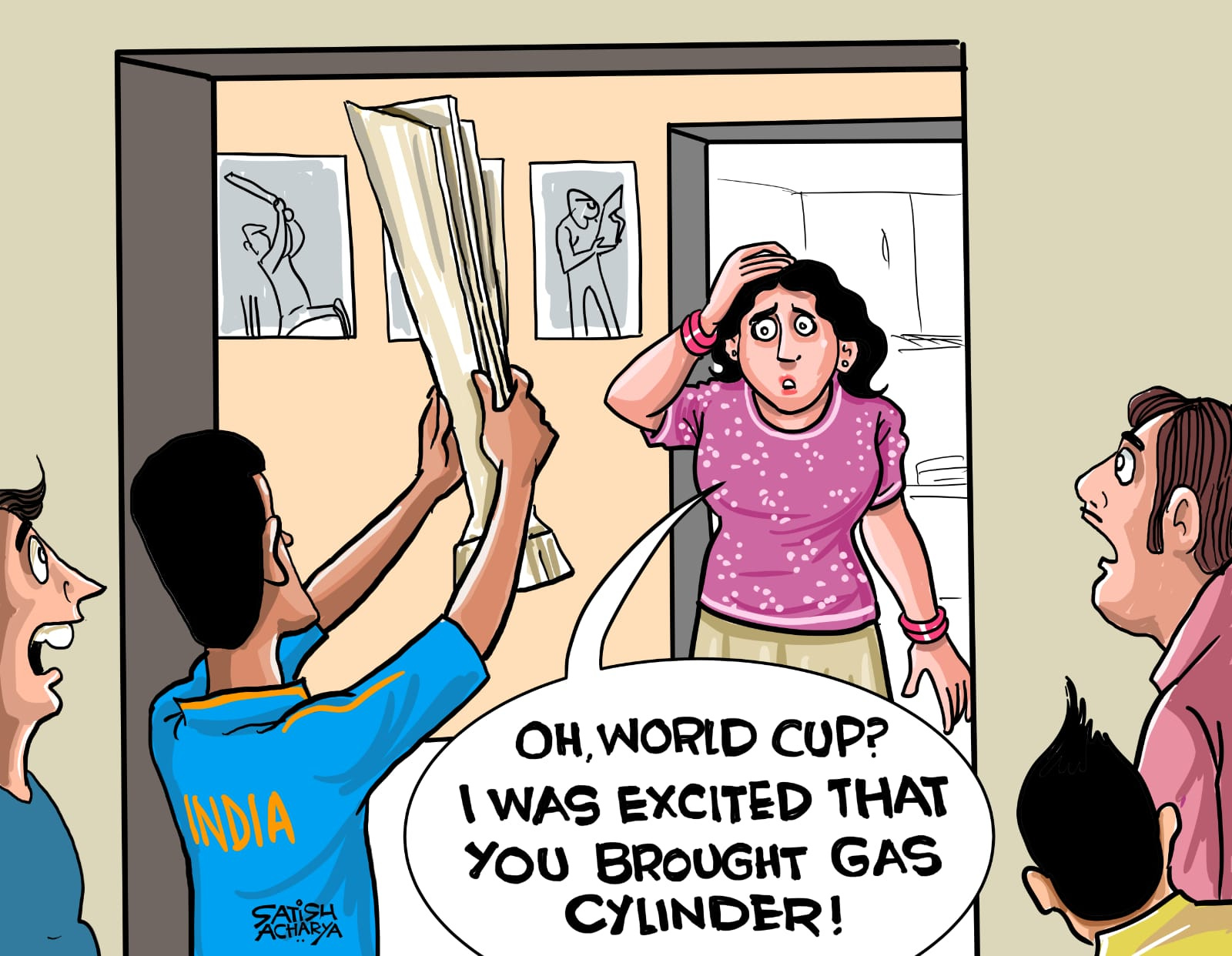
Deep dive
The constellation of entities that the Rashtriya Swayamsevak Sangh is at the centre of is commonly described as a parivar or family but perhaps it is better called an “ecosystem”. There are many aspects to it, including its 36 affiliate organisations, its relationship with and influence over the BJP, and its longue duree vision of India as a Hindu rashtra. The folks at The Hindu managed to fit all of these and more in this interactive map of the RSS ecosystem.
Prime number: 2
There are indications that the Tamilaga Vettri Kazhagam (TVK) chief, cine-star Vijay will contest from one of two constituencies, either from Perambur in North Chennai or Tiruchirappalli (East), reports The New Indian Express. Both are small and may make it easier for the hoping-to-be-disruptor actor to campaign.Opeds you don’t want to miss
Andy Mukherjee writes on how the Iran war has exposed the most-populous nation as a vulnerable commuter on the world’s energy highway.
An idealised nationalism, Hilal Ahmed argues, has its pitfalls. “The suggestion of the political philosopher, Sudipta Kaviraj, thus, becomes very relevant: one must always disbelieve the autobiography of nationalism and the ideal kind of history it gives to itself.”
Sanjaya Baru cuts straight to the heart of the matter: India’s march toward a Viksit Bharat is being undermined from within. He warns that an increasingly communalised ruling dispensation, pushing policies that stifle growth and deepen inequality, is fundamentally at odds with the country’s own constitutional vision of progress.
Kadira Pethiyagoda aptly sums up the cravenness of Modi’s response to the war in Iran, placing him in a political and diplomatic minefield. “Indian voters, however, including BJP voters, are becoming increasingly discerning. They may not see the Iran war as simply “standing up to Islamism”. They may identify a contradiction between a political platform of Indian greatness and actions that facilitate continued U.S.-led unipolarity.”
Although the Right to Education Act mandated 25% reservation for economically weaker-section students in private schools, no such provision exists for private colleges, which “are free to charge the fee they want” and where “merit … goes with the paying capacity of parents”. Against such a background, says former NCERT director Krishna Kumar,
“it is hard to imagine a brilliant Dalit boy or girl entering the gates of a high-fee-charging private university. No doubt, some private universities have provisions for subsidised fees and other systems of support for the needy … [But in] any case, the entry of a handful of underprivileged students in the portals of private universities is no answer to the vast, negative echoes of a divided education system.”
Listen up
What dangers do Digambar monks – who give up their clothes as part of their renunciation of all possessions – face as part of their travels across India? What do villagers think of these monks, whose presence has grown unexpectedly in recent times? And how do female Jain believers feel about them? Rajesh Joshi spoke to these groups of people for the BBC. Tune in here.
Watch out
The son of a couple killed in the Air India Flight 171 crash last year has said he has still “heard nothing” from the Indian authorities since the incident took place in June 2025 in an exclusive interview with ITV News.
Over and out
Rajmohan Gandhi has written a new book titled James Lawson: Teacher of Satyagraha, a central part of which is about the civil rights leader’s three-year stint in Nagpur in the ‘50s where, “steeped in [Mohandas] Gandhi’s ideas and friendships with Indian and African students, he refined the methods of nonviolent direct action he would later teach in Nashville”. Read this excerpt published in Scroll about why Lawson was keen on coming to India and how he grappled with the views of his fellow missionaries, but also about some of the senior Gandhi’s interactions with the US civil rights struggles of the time.
On the saga of stealing …
That’s it for today. We’ll be back with you on Monday, on a device near you. If The India Cable was forwarded to you by a friend (perhaps a common friend!) book your own copy by SUBSCRIBING HERE.