
A newsletter from The Wire | Founded by Sidharth Bhatia, Siddharth Varadarajan, Sushant Singh, Seema Chishti, MK Venu, Pratik Kanjilal and Tanweer Alam | Contributing writers: Kalrav Joshi, Anirudh SK
If you like our work and want to support us, then do subscribe. Sign up with your email address by clicking on this link and choose the FREE subscription plan. Do not choose the paid options on that page because Stripe – the payment gateway for Substack, which hosts The India Cable – does not process payments for Indian nonprofits.
Our newsletter is paywalled but once a week we lift the paywall so newcomers can sample our content. Today is that day. To take out a fresh paid subscription or to renew your existing monthly or annual subscription, please click on the special payment page we have created – https://rzp.io/rzp/the-india-cable.
Snapshot of the day
April 10, 2026
Sidharth Bhatia
Two days after Israel struck targets across Lebanon, killing more than 300 people, India on Friday said it was “deeply concerned” about civilian casualties and that observing territorial integrity was “essential”. Addressing an inter-ministerial briefing on developments in West Asia, MEA spokesperson Randhir Jaiswal said, “As a troop contributing country to UNIFIL that is invested in Lebanon’s peace and security, the trajectory of events is very disturbing”.
The rupee has finished its second straight week of gains against the dollar, propelled by the RBI’s curbs on foreign exchange arbitrage and a fall in oil prices triggered by the West Asia ceasefire; the currency clocked in at 92.755 on Friday. However some warn that the RBI’s move is not without cost. “Banks are staring at potential losses running into the hundreds of millions of dollars”, “hedging costs have jumped, making it harder for investors to buy protection” and “foreign investors meanwhile have slashed their bond holdings”, Bloomberg reports.
After it was ‘allowed’ by the US to buy floating Russian oil in view of the closure of the Strait of Hormuz, India purchased 1.98 million barrels of the commodity every day in March on average, the highest volume since June 2023, report Rakesh Sharma and Rong Wei Neo. While Indian refiners expect Washington to extend its sanctions waiver set to expire soon, “purchases are unlikely to drop back even without that, given a dearth of supply options”.
The Federation of European Business in India, which includes alcoholic beverage firms Pernod Ricard, AB InBev, Heineken and Carlsberg, has asked the Union government to waive a 10% import duty on glass bottles and aluminium cans because of higher costs owing to the West Asia war. Since most Indian states require government approval for changes in the retail price of alcoholic beverages, these firms face an additional hurdle in that they cannot pass on extra costs to customers, Aditya Kalra notes.
India accounts for the biggest number of passengers using the Dubai International Airport and so Indian airlines stand to be hit hardest by the airport’s decision to let foreign carriers operate only one round-trip flight per day between April 20 and May 31. Indian airlines have written to the Union government asking it to lobby the Dubai airport to lift the restriction and, if that doesn’t work, to consider retaliatory measures on Dubai-based carriers like Emirates and flydubai, who will not be impacted by the flight cap. Abhijith Ganapavaram and Aditya Kalra report.
During the third day of the Supreme Court’s Sabarimala hearings on Thursday the Nair Service Society and a few Ayyappa devotees’ bodies argued that when the apex court in 2018 said it was unconstitutional for the temple to prohibit entry to menstruating women, it did not apply the “sampradaya [sect] test”. Its ruling was incorrectly based on the ‘essential practices test’ that is shaped by the Abrahamic religions, senior advocate C.S. Vaidyanathan argued. Justice M.M. Sundresh said that while “you may have your own personal belief … you cannot try to change the practice or sampradaya followed in a temple … Either you adhere to it or leave it.” Krishnadas Rajagopal reports.
Kunal Kamra on Thursday appeared before the Maharashtra assembly’s privileges committee, which had summoned him after he called deputy chief minister Eknath Shinde a traitor for heading the split of the Shiv Sena (and after which Sena workers vandalised the comedy club where he made these remarks). In his written submission to the panel, the comedian argued that it does not have the jurisdiction to hold these proceedings as he is not a member of the legislature, his show was not related to the business of the assembly, and his show did not affect the proceedings of the House. In fact, Shinde himself had told the press that his work was unaffected, Kamra said. And Bal Thackeray, the Sena’s most prominent figure, had satirised and criticised those on high without facing such proceedings, he pointed out. Vinaya Deshpande Pandit reports.
Later, Kamra also recalled that he was asked by the committee whether he felt any remorse and if he would consider issuing an unconditional apology for his remarks. “No I can’t as the apology would not be sincere. Also it would set a terrible precedent for other artists & their freedom,” he wrote on X.
With people losing money to fraudulent call centres and the scary digital arrest scams, which are enabled by transactions routed through mule accounts, the RBI is considering requiring a one-hour delay in high-value transactions through fast payment channels as well as extra checks for payments made by senior citizens, Ashwin Manikandan and Surbhi Misra report. They recall that the amount of money lost to such scams went up almost forty times between 2021 and 2025 to $2.49 billion.
Although Tata Consultancy Services reported a net increase of over 2,000 employees in the last quarter of FY2025-26, the firm over the course of the entire financial year found itself short of more than 23,000 workers on the net.
Why has the much vaunted joint venture between the world’s largest fund manager BlackRock and India’s Mukesh Ambani not taken off? Assets under management have fallen to Rs 175 billion from Rs 178 billion raised for three funds last year. “The company, which argues that its technology can lower costs, has struggled to make major headway against an entrenched network of distributors that dominate India’s asset management industry.” Analysts say that the joint venture did not follow the standard distribution model.
Proposed amendments to IT Rules will enable Modi govt to remove fact-checking Community Notes from X
The Modi government claims to champion transparency and free digital discourse, but its latest moves suggest otherwise. After X’s Community Notes flagged posts by Modi and other BJP leaders, including Union education minister Dharmendra Pradhan and Union minister Ashwini Vaishnaw, New Delhi is formally proposing to bring Community notes – the user-generated fact-checking tool on X – under the ministry of information and broadcasting’s regulatory remit through amendments to the IT Rules, potentially enabling the Union government to seek removal of notes that correct official claims, reports The Hindustan Times, citing an official who is aware of the issue. Under the expanded framework of the proposed amendments, a community note that starts looking like it’s dealing with news, politics or public policy, could come under scrutiny, a ministry of electronics and IT (Meity) official told the newspaper.
This comes alongside a broader push to extend digital regulation to influencers, podcasters and independent journalists, reinforcing criticism that the Modi government’s instinct is not to answer scrutiny, but to regulate and suppress the platforms that enable it.
Justice Yashwant Varma, embroiled in cash-at-home scandal, resigns
Justice Yashwant Varma of the Allahabad High Court has resigned, submitting his resignation to the President a year later while facing an in-house inquiry over allegations linked to a cash discovery at his residence and impeachment process The development comes at a sensitive time, with the possibility of further proceedings, including parliamentary action, still under consideration. Justice Varma had earlier been transferred from the Delhi High Court to the Allahabad High Court following the controversy.
Centre’s ‘U-turn’, Congress demands apology to women of India
The Congress has accused Modi of reversing his stand on the implementation of women’s reservation and attempting to claim sole credit for a policy shift driven by political compulsions ahead of key elections. In a statement, Congress general secretary Jairam Ramesh alleged that Modi had begun writing articles in the media to project himself as the “sole champion” of women’s reservation in the Lok Sabha and state Assemblies from 2029, while ignoring the government’s earlier stance that delayed its rollout. “Actually, he owes an apology to the women of India,” Ramesh said, referring to the Nari Shakhti Vandan Adhiniyam in 2023, which provides for 33% reservation for women in Lok Sabha and state Assemblies, was passed unanimously in Parliament, but the Congress had demanded its implementation from the 2024 elections itself.
The Long Cable
US-Israel’s Iran Misadventure Is Pushing The World In A Diametrically Different Direction From Where 9/11 Took It
Seema Chishti
Any rudimentary assessment of the US and Israel’s Iranian misadventure immediately brings to mind the US and the UK’s 2003 invasion of Iraq.
But a more pertinent point in the timeline, at least more relevant today, may be the US invasion of Afghanistan, as retaliation for the September 11, 2001 attacks on New York.
But it is not as if the US-Israel Iran attack parallels Afghanistan. In fact, 25 years on, it appears that the circle that started to be drawn in the 9/11 moment may be closing.
The events that followed the 9/11 tragedy and the response of the US in Afghanistan went on to shape the world and dominate political and cultural global narratives for over two decades. The US and Israel’s war on Iran is having consequences, mostly unintended, which are taking the world in a completely different direction.
The audacious terror attacks that destroyed the two World Trade Centers in New York stunned the world and quickly made Islamophobia mainstream. Samuel Huntington’s “clash of civilisations” was the go-to text and phrase.
The US’s sympathetic view of Islamic militancy, driven by a utilitarian view, took a beating. It may have helped the US bring down the USSR, but after 9/11, it was a different story, and the tables had turned. It was a while before Mahmood Mamdani’s Good Muslim, Bad Muslim could breathe on bookshelves.
Many reports have documented how crude, anti-Muslim sentiment got a big fillip. A 15-country report from Europe spoke of it as a phenomenon in as early as 2002. Lines around this got hardened globally. Contrast that with the US now attacking Iran, and Trump and his Secretary of Defense, Pete Hegseth, using every metaphor in the book to make it sound like a crude Crusade redux. This is not cutting any ice. No leaf has been left unturned to make it blatantly about Christianity and Christian Zionism (recall Mike Huckabee’s interview with Tucker Carlson?).
As most allies of the US in the region are also Islamic countries, the US administration has tried to make the attack’s purpose ‘Judeo-Christian’, but has been constrained in not making it ‘anti-Islam’. Trump called Iranians “animals”, but global opinion has never been so anti-war in a long time, and the polling bears testimony to that. Support for the war on Afghanistan in 2001 (termed “barbarians”) was 92% in the US. The numbers, at 41%, are at the lowest ever for a war waged by the US. The MAGA base, otherwise proudly racist, has been stridently unsupportive on this.
Globally, most parts of the world, even India (which was an outlier to global support on the Gaza question and it became entangled with anti-Muslim sentiment in the country) have shown visible support for an Iran, which has surprised with its sophistication, resilience and ability to say boo to a bully. Shahed drones along with extremely effective and on point messaging, communication and diplomacy in the face of Trumpian Truth Social posts threatening doomsday, have struck a chord globally.
A ‘western alliance’ was something the global map had assumed as a given, ever since the end of World War II. But as Shyam Saran has pointed out, this is the first time since, that the US was unable to get either NATO or Europe onboard. “This confirms the perception of there not being a West with a coherent identity and shared values,” Saran writes.
The attack on Afghanistan in 2001 drew each one of its allies to the US’s side. Something has fundamentally broken on that. This is not a temporary ‘out to lunch’ rupture. The presence of China, with an overwhelming transformation as not just a factory of the world, but as the technological powerhouse, the builder of bridges globally, literally and metaphorically with a new push to BRI, makes consequences of that break look far more serious. The US’s dependability, even for its closest allies, is no longer a given for them. If MAGA’s resentment towards Trump for threatening the end of a “whole civilisation” is refreshing, so is Italian far-right PM Meloni and even France’s far-right Marie Le Pen’s assertion that the war must end, and that attacks on Lebanon by Israel are unacceptable.
A corollary to the deep fracture in the ‘West’ is the loss of the West’s status as the standard dispenser of ‘values’ and consequently soft-power that the West was able to deploy. Countries so far content to treat ‘sanctioned’ Iran like a pariah state, are rushing envoys there. Even Iran’s neighbours, not its friends, are taking it seriously, studying not just its gumption, but its low-cost drones, its science and its deep manufacturing base that made its resilience possible.
This is a different world from what was ushered in the face of the 9/11 tragedy. The West as a know-all, whether on how to organise the economy, finances (even currency), its films or even agit-prop is no longer the default position. Soft Iranian power is unintentionally on display even when you re-read the assassinated Ali Larijani’s CV with his two serious papers on Immanuel Kant - or hear from Iranian interlocutors on social media, articulating firm and coherent points of view and their goals. As Bobby Ghosh wrote on his Substack, the Iranian foreign minister, Abbas Aragchi, has “even written a book called The Power of Negotiation outlining his philosophy of the craft”.
So Chinese EV vehicles, Iranian drones or degrees possessed by their leaders, have suddenly put many more dishes on the global table. There are many that want to be seated there. There is no automatic deference to the US or Western supremacy that the West can take for granted any more.
25 years ago, as the planes crashed into the twin towers, Pakistan, by virtue of its mistaken pursuit of ‘strategic depth’ with the Taliban, immediately took the hit and got hyphenated, away from India, with Afghanistan as one of the two ‘Af-Pak’ countries. This pushed Pakistan down diplomatically and detracted from its stature.
More so as neighbouring, but plural, diverse India was to emerge as a true showpiece of South Asia at the time and gain economic heft and prestige all the way till at least the middle of the 2010s. Pakistan has broken free of ‘AfPak’, as political scientist Niloufer Siddique argued in Chalkboard Politics. The way the war on Iran has unfolded, that is no longer where Pakistan sits. Following Pakistan and India’s four-day war in 2025, the then unpopular Pakistan military establishment has emerged on the right side of the Trump administration and slowly boosted itself domestically and internationally. But as the Iran war unfolded, Pakistan has seen an exponential leap in its stature.
Analysts like Sushant Singh have written in Foreign Policy that this may also result in a formidable new regional block consisting of Pakistan, Saudi Arabia, Turkiye and Egypt. Pakistan would be central to that new architecture. Also, Kaiser Kuo in a new series, Missing Voices: Critical Thinking in the Time of a Polycrisis, says, “any talk of post-Western plurality has to be tempered by the reality of Chinese centrality” to what will emerge. There is no doubt about that.
All this is happening in India’s backyard. The reconfiguring of its immediate universe has serious implications for India today and there are many lessons lying there to be learnt. What is not clear is if they will be. Already, apologists for the Modi government trying to shield vishwaguru from the obvious marginalisation, are saying that this is “not our war”. But India has not been ‘neutral’. Modi’s sudden visit to the reviled and controversial prime minister of Israel, Bibi Netanyahu, just 48 hours before Tehran was attacked by Israel and the US has made it clear that India had actually picked a side, even if it meant embracing a war criminal and getting a fake medal.
‘New’ India’s own politics makes its acceptance of this nascent new world difficult. As that would mean the Modi government saying goodbye to its own ideologically driven agenda to use Zionist principles to fundamentally recast plural India.
Contrary to what Indians close to the establishment would like to project as ‘strategic autonomy’, this has been about the Modi government choosing not autonomy, but the wrong side of history. Strategic ‘silent embarrassment’ was the only outcome possible from its choices. This war has many losers. But India must course-correct and now not lose the peace.
Reportedly
A number of those discharged in the Delhi liquor policy case have sought high court Justice Swarana Kanta Sharma’s recusal from hearing the CBI’s challenge against the discharge order, alleging that she is biased. But it has been pointed out that there is another layer to the whole matter: Justice Sharma’s son and daughter are both lawyers who have been empanelled by the Union government, with the legal journalist Saurav Das arguing that Ishaan Sharma has “[accumulated a] large number of panels within a relatively short post-enrolment period as an advocate”. Das asks: can Justice Sharma really
“continue to hear a politically sensitive challenge brought by the CBI, while her kin hold multiple Union government panels and receive work from the same legal establishment whose top officers allocate cases to them and are now appearing before her?”
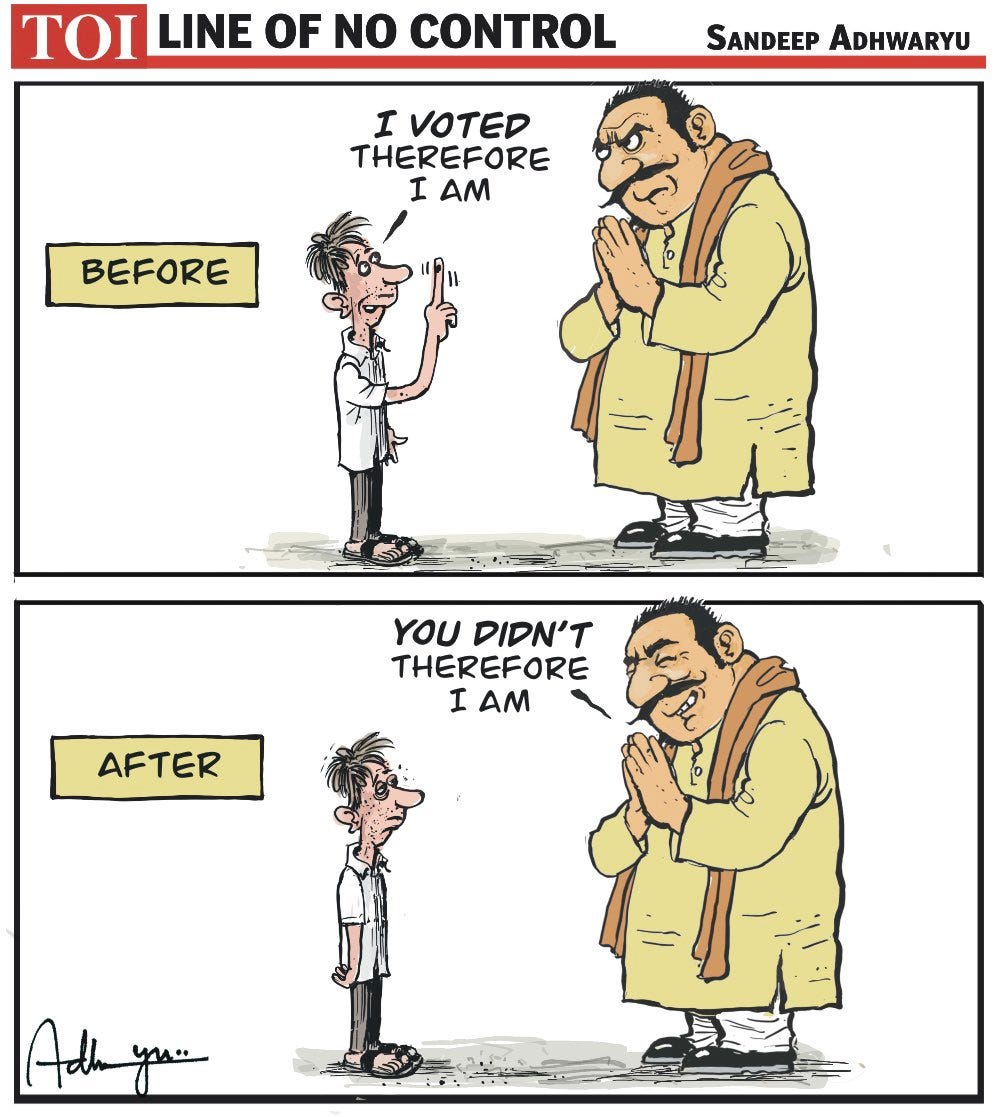
Drawn and quartered
Deep dive
Reporting for Data for India, Nileena Suresh tackles the following questions: “what is India’s healthcare professionals to population ratio, where does this number come from, what does it cover and what does it miss, how does it compare with the world, and how is it changing?”
Prime number: 11,000 litres
That much milk was poured into the Narmada river in Madhya Pradesh’s Sehore earlier this week as part of a mahayagna. “Such large quantities of organic matter can deplete dissolved oxygen in water, adversely affecting the river ecosystem” and in turn those who depend on it for water and livelihood, environmentalist Ajay Dube told PTI.
Opeds you don’t want to miss
Andy Mukherjee warns that India’s homegrown equity boom may be running into trouble as excessive financialisation begins to show its costs. For a while, he writes, the shift of deposits into markets created a wealth effect and sustained optimism, but much of the bank-funded money flowed into “a speculative frenzy in low-quality, small-cap stocks”. Now, with lenders facing liquidity strains, retail participation slowing, and three-year equity returns evaporating, he argues that both investors and intermediaries “may have a tough slog ahead” and that even a ceasefire in West Asia may not improve the arithmetic of shrinking returns.
While there are “wide gaps between the American and Iranian positions” that will be exchanged in Islamabad this weekend, “Iran will arrive with far greater leverage than it had in the pre-war talks in Muscat and Geneva”, Stanly Johny writes in this assessment. “During the pre-war talks, the US used the threat of an attack to demand concessions from Tehran. After 40 days of war, that threat is now a spent force,” he notes.
How did Pakistan emerge as the key facilitator between Iran and the US, moving into a peace space that India used to occupy at one time, asks Bharat Bhushan. “Pakistan demonstrated tactical agility by engaging Washington and Tehran simultaneously. As an Islamic country, it had credibility in the Muslim nations of West Asia. It also shares a border with Iran, as well as deep cultural, religious, and economic ties.” On the other hand, “India’s feebleness in the international arena was clearly constrained by its loyalty to the US and Israel, its election cycle, bureaucratic risk averseness of its foreign policy framers, and its compromised global image.”
“Indians who once sang [Trump’s] praises” – especially in the BJP – “have now turned viciously against him,” Vir Sanghvi writes. The moral of the story, he says, “is to never personalise diplomacy.”
India’s long delays in conducting and publishing the census underscore the urgent need to overhaul the country’s statistical architecture as the world undergoes a “great global demographic u-turn,” says Pramit Bhattacharya. With a stronger and more unified statistical agency, he writes, India would not have to wait 16 years for basic demographic estimates and could generate annual district-level population data by pooling census, survey, administrative, and satellite inputs. “Contrary to the fables being spread on social media,” he adds, AI will not fix flawed data systems – “we need human thought and action to reconfigure India’s statistical architecture.”
Listen up
Niloufer Siddiqui and Sushant Singh in this latest episode of the Chalkboard Politics show analysed the “causes, escalation and aftermath” of the India-Pakistan clashes in May last year and also its “broader implications for regional and global politics”. They also spoke about Islamabad’s unexpected role in mediating the West Asia ceasefire this month.
Watch out
“From Ambedkar’s vision to contemporary issues such as bulldozer politics and weakening institutional checks,” Gautam Bhatia and Kunal Kamra in this episode of the latter’s show Nope “critically [assess] the balance between authority and liberty” and “[examine] the foundations of centralised power in India”.
Over and out
India was home to over 4,000 Iranian nationals by the early ‘60s, a time when New Delhi was keen to establish stronger ties with Tehran. One question the Indian authorities grappled with was to what extent this diplomatic outreach should extend to allowing Iranian citizens to settle in a newly independent India. Ajay Kamalakaran takes us through archival documents to find out.
That’s it for today. We’ll be back with you on Monday, on a device near you. If The India Cable was forwarded to you by a friend (perhaps a common friend!) book your own copy by SUBSCRIBING HERE.