
A newsletter from The Wire | Founded by Sidharth Bhatia, Siddharth Varadarajan, Sushant Singh, Seema Chishti, MK Venu, Pratik Kanjilal and Tanweer Alam | Contributing writer: Kalrav Joshi, with additional inputs by Anirudh SK
If you like our work and want to support us, then do subscribe. Sign up with your email address by clicking on this link and choose the FREE subscription plan. Do not choose the paid options on that page because Stripe – the payment gateway for Substack, which hosts The India Cable – does not process payments for Indian nonprofits.Our newsletter is paywalled but once a week we lift the paywall so newcomers can sample our content. Today is that day. To take out a fresh paid subscription or to renew your existing monthly or annual subscription, please click on the special payment page we have created – https://rzp.io/rzp/the-india-cable.The Long Cable
The Unintended Goodness of Donald Trump
Harish Khare
The Honourable Sergio Gor landed this week in India with the aplomb and cockiness befitting a Political Agent of yore. True to form, Modi establishment managers have felt constrained to fawn over a 39 year old consigliere in the hope that he will restore some kind of warmth to a relationship that has gone cold. It is a different matter that the young man took his own time to assume his ambassadorial duties in New Delhi.
The new envoy is no John Kenneth Galbraith nor is he a Chester Bowles or Daniel Patrick Moynihan. He is neither fascinated nor infatuated with a ‘democratic India.’ He is an unsentimental operative for a brutally unsentimental boss in the Oval Office. He knows that the warmth and the personal chemistry that we in India have attributed to the Trump-Modi ‘huggy’ relationship was a unilateral invention on our part; an invention conjured out of thin air, after spending colossal amounts of Indian taxpayer money, only to sustain the Modi personality cult at home. Our ‘strategic community’ – largely comprising retired and serving diplomats, television anchors and diplomatic correspondents – allowed themselves to be mesmerised by the razzle dazzle of those carefully planned spectacles on foreign soil. The Americans, on their part, remained unimpressed.
The American who remains most unimpressed with Modi’s image making jiu jitsu is none other than the President himself. Without perhaps wanting to do so, Trump has disrupted some of the key elements of the entire Narendra Modi project. In the process, quite a bit of unintended goodness has accrued to the Indian polity.
Let us enumerate a few of the Trump-inflicted blessings.
First, for many years now in India we have not been allowed to criticise – leave alone mock or ridicule – Narendra Modi. Anyone foolish enough to do so ran the risk of inviting a disproportionately coercive response from the authorities; and, the law, as understood and interpreted by the magistrate, invariably, rules against the citizen and in favour of the king.
It has therefore been a bit of an incongruity to see Trump regularly chipping away at Modi’s aura. The US president periodically mimics and mocks or otherwise mauls the dignity and stature of the Indian prime minister; and, even the establishment-oriented media is forced to report the American president’s verbal assault against Modi. He has reduced the prime minister to a Third World leader whose sensitivities and dilemmas are of no concern to Washington. Rather, Trump thinks he has been kind to the Indian PM because he does not want to destroy him politically. Never before has a foreign leader spoken, at least in public, so dismissively and so disparagingly about India’s prime minister.
Second, the recent downturn in US- India ties has brutally exposed the limits and usefulness of the Indian diaspora. The Modi prime ministerial project has been predicated on the presumed heft and clout of the Indian diaspora, willingly and cheerfully available to advance his quest for global stature.
It should be clear to one and all that the Indian diaspora has no interest nor inclination to risk their own status by intervening on behalf of a Naya Bharat.
These successful American-Indians, especially the richest, have sorted out their divided loyalties conundrum. They are Americans citizens and they work for the welfare and prosperity of the country they have chosen to become citizens of. They have no reason to take sides in a Modi-trump ego clash. They have no reason to undermine American foreign policy as defined by an incumbent president. The presence of these high profile Indians and their periodic photo-ops sessions with the prime minister had been used to project a kind of global acceptability for our own strongman, as if they owed their success and achievements to Mr. Modi’s inspirational persona. Now all that carefully staged sleight of hand stands exposed.
For domestic constituencies, particularly the middle classes, Trump’s attitude has weakened the carefully cultivated perception that Modi – as a globally accepted and respected powerful leader – will protect Indians, individually and collectively, from inimical forces inside and outside India. This projected global image had given a sense of comfort and protection to some very dodgy and dubious props of the Modi regime. But not anymore.
More than anything else, President Trump has vastly undermined one great source of comfort — our sense of superiority over Pakistan. We Indians have been made feel that under Modi we are more than a match to Pakistan and that we have the determination and capacity and the leadership to punish that country at will. All that tall talk mocks us after Operation Sindoor. Trump’s extraordinary hospitality for a Pakistani general has punctured more than one such myth. India today stands totally and fully isolated in the region and the US president can take vicarious pleasure in singlehandedly diminishing Modi’s aura among South Asia’s elites.
Of course, it would be foolish and unrealistic on the part of Indian opposition parties to take comfort from the souring of the Modi-Trump relationship. The American president has no interest whatsoever in renewing the health and vitality of Indian democracy or in reducing the democratic deficits we feel. He has no interest in the preservation of civil liberties and human rights. He has no interest in ensuring that the minorities in India are treated fairly. He is not enamoured of being the saviour of Indian democracy He is a transactional man and a businessman who happens to be in the White House. Therefore, it will be shortsighted on the part of the opposition parties to look to Washington for any comfort or assurance as they try to slow down Modi’s totalitarian journey. It is a battle that must be fought on Indian terms by Indian themselves, alone.
Some otherwise sagacious voices have strained themselves to detect a conciliatory inclination on the part of new American Ambassador. Keep your strategic fingers crossed.
There is little doubt that Trump has managed to rattle Modi’s cage. And the prime minister knows it, even if his cheer-leaders pretend not to have noticed the damage. It is no wonder then that Modi finds himself relying on one and only one source of confidence and legitimacy: the Hindutva paraphernalia. He has already traveled to Somnath, tweaking history to his purpose and exhorting all Indians to remain united. And for good measure, he had the richest Indian, Mukesh Ambani, describe the prime minister as India’s ‘invincible wall’ in these times of global uncertainty.
Tell it to the birds, as they say in America.
Snapshot of the day
January 16, 2026
Siddharth Varadarajan
The BJP led National Democratic Alliance, known as the Mahayuti in Maharashtra, swept the civic polls in the state with Chief Minister Devendra Fadnavis proclaiming victory in 25 of the 29 municipalities which were in the fray. This includes the Brihanmumbai Municipal Corporation (BMC), hitherto a stronghold of the Uddha Thackeray-led faction of the Shiv Sena, though the Mahayuti’s victory was not as convincing as the BJP had hoped for.
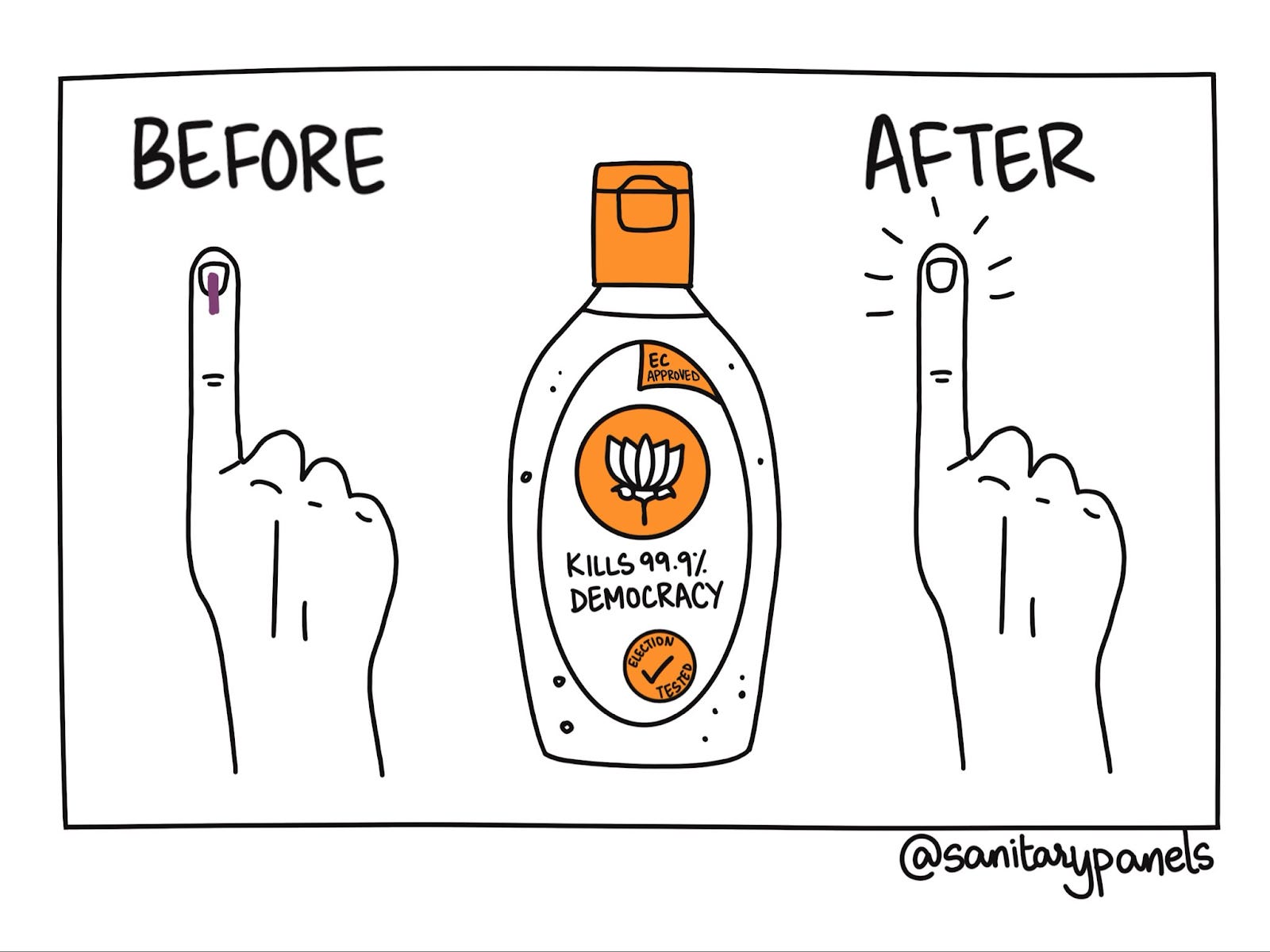
The use of non-indelible ink, voters not being able to find their names on the lists, and allegations of cash distribution were issues of concern in the most keenly watched civic contest in India. As The Wire reported a day ago, polling in the BMC elections sparked controversy after many claimed that officials were using a marker for voters instead of the usual practice of marking fingers with indelible ink. Videos showed voters purportedly removing the marks with sanitiser or nail polish remover. As opposition parties alleged voter fraud, State Election Commissioner Dinesh Waghmare shifted from denial to damage control, promising a probe into ink composition, especially silver nitrate content, and seeking clarification from the ink supplier Kores. He said that procurement details were not immediately available, Midday reported. Opposition leaders called it an attack on democracy, while the BJP and Maharashtra Chief Minister Devendra Fadnavis dismissed the claims as baseless.
Sharing the Midday article on X, Leader of Opposition in the Lok Sabha Rahul Gandhi said, “Election commission gaslighting citizens is how trust has collapsed in our democracy. Vote Chori is an anti-national act.”
But then.
Having anticipated the imposition of sanctions, New Delhi reportedly transferred its $120 million investment in Iran’s Chabahar port to Tehran many months ago, P. Manoj cites an official source as saying. When India received a six-month sanctions waiver for the port in October last year it was premised on its submission that it would “wind down all activities” at Chabahar, Manoj also reports. Asked about this report during the external affairs ministry’s weekly press briefing, spokesperson Randhir Jaiswal only confirmed the waiver and said “we are in talks with the US side to work on this arrangement”.
The Modi government may plan to revise caps for foreign investors in the defence sector. These reforms could come into effect in the next couple of months, Reuters reports, quoting sources. The report also notes that the government is also discussing the removal of conditions that apply to foreign investment beyond 74% from the current 49%. Currently, investments above this level are permitted only if they “result in access to modern technology,” a wording that many experts have described as vague and ambiguous.
After Nobel laureate Amartya Sen and former Navy chief Admiral Arun Prakash, ex-foreign secretary Krishnan Srinivasan has been asked to appear for a hearing under the ongoing special intensive revision of voter rolls. The Kolkata resident was told that he and his wife could not prove they were registered voters in the 2002 electoral rolls. What mischief has Srinivasan been up to? “At the time,” he explained, “I was representing India as the deputy (political affairs) to the secretary-general of the Commonwealth Secretariat in London.” He does not oppose the idea of a ‘re-check’ but is “just disappointed that some common sense could’ve been used to cut this long story short”, he told Meghdeep Bhattacharyya.
Kirti Kumar, a booth-level officer in Jaipur’s Hawa Mahal constituency, is seen in a viral video complaining to BJP councillor Suresh Saini over the phone that his marching order to process a saffron party booth-level agent’s objection to the presence of 470 voters in two days is undoable. He has alleged that these requests target Muslim voters, and so has a neighbouring BLO who received objections from BJP agents. However, BLOs from at least five adjoining Hindu-majority booths said they did not receive any objections, Sumedha Mittal reports. The agent who filed the objections in Kumar’s case told Mittal that “since the colony has mostly Muslim voters … it is obvious that [the] majority of the objections would be against Muslims”.
Elsewhere in the SIR world, a Bulandshahr, Uttar Pradesh resident has alleged that Hindu voters’ names were added to the addresses of Muslim families after the revision exercise. The Supreme Court has also asked the Election Commission to publish the names of those excluded from Kerala’s draft voter rolls if it hasn’t already.
Despite global economic uncertainties and ongoing tariff negotiations with the United States, India’s merchandise exports increased 1.8% year-on-year to USD 38.51 billion in December, according to data released by the commerce department. As per the report, inbound shipments grew 8.8% to USD 63.55 billion. The trade deficit, however, widened to USD 25 billion, compared with USD 20.63 billion in December 2024.
Meanwhile, according to a survey conducted by the European Council on Foreign Relations, Trump’s “America first” agenda is helping to make China great again and ushering in a “truly multipolar world”. “A year on from Trump’s return, in countries across the globe, many people believe China is on the verge of becoming even more powerful,” the think tank said after surveying 21 countries, including the US, China, Russia, Britain and Brazil. However, “this turnaround is yet greater in India. Relations between New Delhi and Beijing have traditionally been rocky; despite this, nearly half of Indians see China as either an ally or a necessary partner,” notes The South China Morning Post.
Speaking of which, things in the foreign relations could not have been more embarrassing.

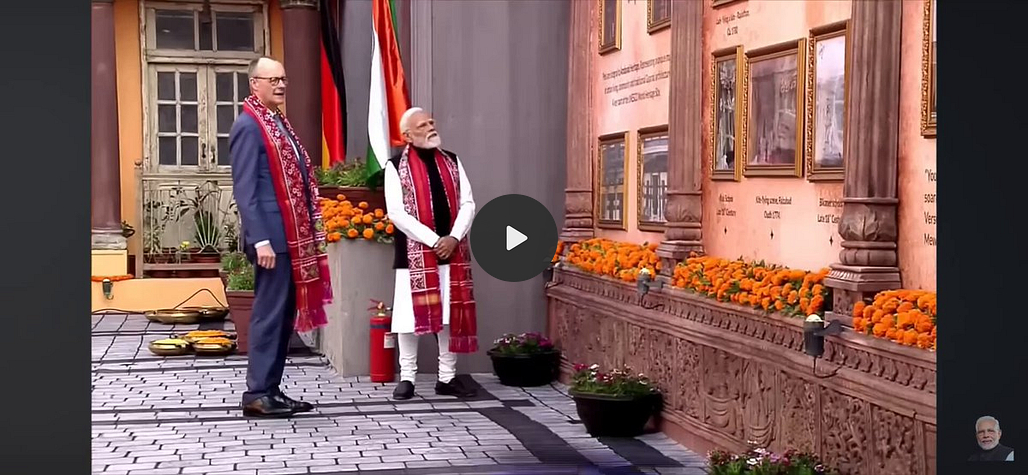
[If readers in India cannot access the tweet above with video of Narendra Modi, Olaf Scholz and Modi’s off-screen chroniclers, try this link]
One way in which Beijing bested Delhi in fixing its foul air was by banning coal and firewood burning. For villagers near the Chinese capital, natural gas became their only option to stay warm during the region’s harsh winters, but now that the authorities have slashed subsidies on gas, many locals have been forced into hardship, Vivian Wang reports.
Madhya Pradesh authorities have informed the high court that they are compensating the families of 23 deceased persons linked to the contaminated water supply in Indore’s Bhagirathpura area. They attribute 15 deaths to the contamination, but chief secretary Anuraj Jain claimed they are compensating even for those related to ‘comorbidities’ in view of “the gravity of the situation and the public discourse”, Anand Mohan J reports.
The Supreme Court rejected Allahabad high court judge Justice Yashwant Varma’s plea challenging the Lok Sabha speaker’s decision to form a committee in the impeachment motion moved against him in connection with the discovery of unaccounted cash currencies at his official residence, LiveLaw reports. A bench of Justices Dipankar Datta and S.C. Sharma observed that the speaker committed “no illegality in constituting the committee”, and that Justice Varma “is not entitled to any relief”.
With the quick commerce business “too sweet to spit and too bitter to swallow” for its major players and with gig workers having to accept gruelling schedules, “the only ones benefiting are the customers – for now,” Veena Venugopal writes. “The platforms’ hope is that once people get used to the ‘convenience culture’ they will be willing to pay more for it. Past experience in other industries (including my own, media) suggests that only a fraction will and even then not over a certain limit.”
The National Human Rights Commission has taken on record a complaint against the detention and arrest of a Telugu TV journalist over allegations of defaming a woman IAS officer. The channel, among others, had reported on an alleged affair between the bureaucrat and a state minister and used sexual innuendo.
Nepal’s largest political party, the Nepali Congress, has split again, with both the breakaway faction led by Gagan Thapa and the establishment faction led by Sher Bahadur Deuba claiming to represent the party’s legitimate leadership. That faction which the Election Commission will not recognise as legitimate is expected to move the Supreme Court, making its participation in the March 5 general elections – the first since the violent ouster of K.P. Sharma Oli’s government last year – as well as the polls’ timely conduct matters of doubt, Kamal Dev Bhattarai reports.
Officials in Poonch have imposed a ban on camping and hiking in the district’s forested and high-altitude areas as security forces have reported sighting drones here as well as in Rajouri and Samba. The ban is the second since the Pahalgam terror attack in April.
Gauri Lankesh murder accused wins Jalna civic poll seat while out on bail
In a not-so-surprising developments, given the contours of New India, Shrikant Pangarkar, an accused in the murdered of journalist-activist Gauri Lankesh and Nalasopara arms-ammunition haul case, has won the elections to the Jalna Municipal Corporation (JMC) as an independent candidate. Pangarkar contested from Ward 13 of the JMC, where he faced the BJP, however, the Shiv Sena, led by deputy chief minister Eknath Shinde, which contested separately in Jalna, did not field any candidate in this seat. As of now, Pangarkar is on bail in both the cases.
Passive euthanasia question returns to Supreme Court in Harish Rana case
Resuming its hearing on the case of Harish Rana, who has been in a vegetative state since falling from a four-storey height in 2013, a Supreme Court bench comprising Justices J.B. Pardiwala and K.V. Viswanathan noted on Wednesday his family’s submission that “if the medical treatment is not making any difference, then there is no point in … making Harish suffer for no good reason”. Rana’s doctors too believe he will “never be able to recover and live a normal life”, said the bench, which reserved judgment on Thursday. Earlier, the Delhi high court had rejected the Ranas’ plea for euthanasia on the grounds that removing Harish’s Ryles tube would constitute active – and therefore illegal – euthanasia. But his family is now arguing before the apex court that his situation has worsened and comes within the remit of passive euthanasia, Advay Vora recalls.
Odisha lynching and beef rumours expose India’s selective outrage on anti-minority violence
Police in Odisha’s Balasore have apprehended five people for allegedly beating to death a Muslim man who was transporting cattle in a van on Wednesday. Balasore Sadar station house officer Ajay Murmu told Ashutosh Mishra that the men allegedly put pressure on Sheikh Mohammad to say ‘Jai Shri Ram’. He died while undergoing medical treatment. Police lodged a case of mob lynching against the men, but also one of cattle theft against Mohammad and another man, which Sujit Bisoyi reports was registered first and did not mention the assault allegation. In the state’s Sundergarh, rumours over the possession of beef triggered clashes Thursday in which at least 12 people were injured; the authorities then imposed a one-day mobile internet ban.
The incidents are the latest among a series of assaults on or intimidation of minorities (and others) by Hindutva goons or cattle vigilantes, and comes even as the authorities in India – not to speak of the Indian big media and Indian celebrities –have been expressing loud concerns about the killing of Hindus in Bangladesh.
Reportedly


Drawn and quartered
Deep dive
In the late 1990s, the landscape in Junnar, Maharashtra began to change as sugarcane cultivation expanded. One unintended consequence was a rise in leopard attacks. When the forest department attempted to manage the situation, its measures only made matters worse. This report by Tabassum Barnagarwala and Vaishnavi Rathore examines how and why.
Prime number: 75%
Even as employability has emerged as a stated priority across Indian higher education, outcomes remain uneven on the ground. Nearly 75% of Indian Higher Education Institutions (HEIs) are still not industry-ready, according to a new TeamLease Edtech report titled From Degree Factories to Employability Hubs.Opeds you don’t want to miss
Until the BJP can parry the “perception [Mamata] Banerjee has created of the Centre’s victimisation of all things Bengali … the current score in the run-up to the state assembly battle indicates she has surged ahead”, Shikha Mukherjee writes. Saffron party leaders in the state “are on the defensive” and “it is as though they are waiting for direction from the high command – which could come this weekend, when Prime Minister Narendra Modi visits West Bengal”.
Writing on the 10th anniversary of Rohith Vemula’s death-by-suicide, Akhilesh Kumar says that what makes caste discrimination in higher education particularly insidious is that it’s rarely spectacular. “Dalit students aren’t always abused openly; more often, they’re quietly diminished.”
Indian outsourcing firms have been through a difficult few years says Andy Mukherjee so is the worst over for them?
“The only way global investors will fall in love again with the outsourcing business is when it can demonstrably extract more productivity per employee. In an AI-dominated technology environment, that might involve more aggressive investment, or bigger reductions in workforce than these companies have delivered so far.”
From Palestine to Prayagraj, we are witnessing ‘State Domicide as Public Spectacle’, says Harsh Mander about the Indian version of Israel’s architecture of Collective Reprisal.
Across South Asia, leaders are promoting hate to distract citizens from economic insecurity, writes Meenakshi Gaguly.
Atul Mishra on why nations around the world need to call out Trump’s transgressions:
“If Trump’s America has felt emboldened to invade and humiliate Venezuela, it is also because a majority of the leading powers of the world — including Europe, Russia, and China — have allowed Israel to get away with a lot worse. Impunity is thriving on impunity. Violation of State sovereignty is facilitating crimes against humanity, and the two could set global geopolitics into a tailspin. Between them, Israel and America have put Colombia, Canada, Greenland (and thus Denmark and Europe), Mexico, Cuba and Iran on notice.”
Listen up
Umar Khalid and Sharjeel Imam have been in prison for the last five years. Their bail has been denied repeatedly. Last week, five co-accused, also arrested in the Delhi riot case of 2020, were granted bail. Why haven’t they? Lawyer Sarim Naved, who fights both civil and criminal cases, analyses this in a discussion with Sidharth Bhatia. While bail not jail is a general principle, “the courts have a lot of discretion in this matter”, he says.
Watch out
Oscar-winning composer A R Rahman has made candid observations about the changing dynamics of Bollywood music. Sharing his views on the BBC Asian Network, he spoke particularly about “the past eight years, maybe, because a power shift has happened and people who are not creative have the power now.” He noted that the situation “might be a communal thing also… but it is not in my face.”
Over and out
The Modi government plans to drop the bandhgala jacket from the formal uniform of Indian Railways staff, saying it reflects a colonial mindset. “The decision sounds simple. The garment’s journey is not. The andhgala’s origins lie in princely Rajputana. The ancient angrakha acquired colonial airs thanks to the tailors of London’s Savile Row, who refined its cut. Today, it blends Indian aesthetics with British formal-wear sensibilities; it’s acceptable as formal Indian attire. That is where the irony rests. Narendra Modi himself renewed its appeal by wearing it in Japan in 2014.”
Cheaper copies from Surat are choking the distinctive Doddaballapur silk sarees business in Karnataka, writes Ashwini M Sripad, pushing weavers to the brink.
That’s it for today. We’ll be back with you on Monday, on a device near you. If The India Cable was forwarded to you by a friend (perhaps a common friend!) book your own copy by SUBSCRIBING HERE.