
A newsletter from The Wire | Founded by MK Venu, Pratik Kanjilal, Sidharth Bhatia, Siddharth Varadarajan, Sushant Singh, Seema Chishti, and Tanweer Alam | Contributing writers: Kalrav Joshi, Anirudh SK
If you like our work and want to support us, then do subscribe. Sign up with your email address by clicking on this link and choose the FREE subscription plan. Do not choose the paid options on that page because Stripe – the payment gateway for Substack, which hosts The India Cable – does not process payments for Indian nonprofits.
Our newsletter is paywalled but once a week we lift the paywall so newcomers can sample our content. Today is that day. To take out a fresh paid subscription or to renew your existing monthly or annual subscription, please click on the special payment page we have created – https://rzp.io/rzp/the-india-cable.
Snapshot of the day
July 10, 2026
Anirudh S.K.
India’s mainstream media, especially the Godi media, continues to present Prime Minister Narendra Modi as the tireless 24×7 leader, turning routine governance into a round-the-clock personality cult. However, New Zealand’s press, not under the ‘control’ of the Modi government, has supplied a more prosaic – rather revealing – picture.
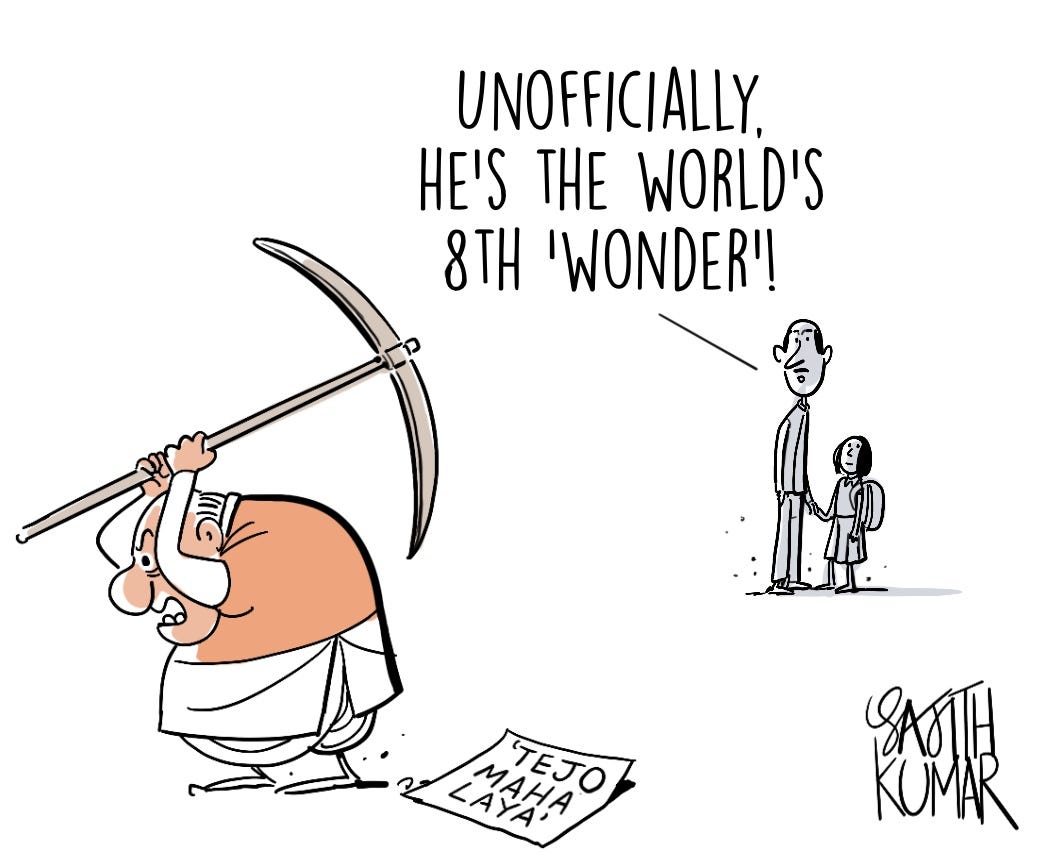
Ahead of Modi’s visit to Auckland today, Stuff reported that the PM’s age – 75 – has created “extra complexities, with requests for his schedule to allow for nap times” as well as a preference for locations without stairs, with this one apparently having to do with his tripping over a staircase six years ago (after which the errant steps were slated for demolition). The website’s Isaac Davison also writes that Modi’s security arrangements – complete with snipers and bomb-sniffing canines – are based on assessments flagging “significantly higher risk than when Chinese Premier Li Qiang visited in 2024”.
Modi’s age has already been a political irritant since he turned 75 on September 17 last year. Rashtriya Swayamsevak Sangh chief Mohan Bhagwat, now 75 himself, said last July that leaders pushing that age should think of retiring and making way for younger colleagues, before later insisting he had not said anyone must retire.
Back to the media – and Modi’s antipathy for it. During the PM’s Melbourne visit, 7News reporter Blake Johnson offered a neat summary of the choreography as Modi walked several feet away in the background: “This is about as close as you would get to Narendra Modi on his trip to Melbourne. He famously avoids unscripted news conferences, preferring instead more stage-managed appearances.” It sat well with the New Zealand logistics file: the leader may travel with heavy security, nap-time planning and no-stairs preferences, but unscripted questions remain the hardest terrain.

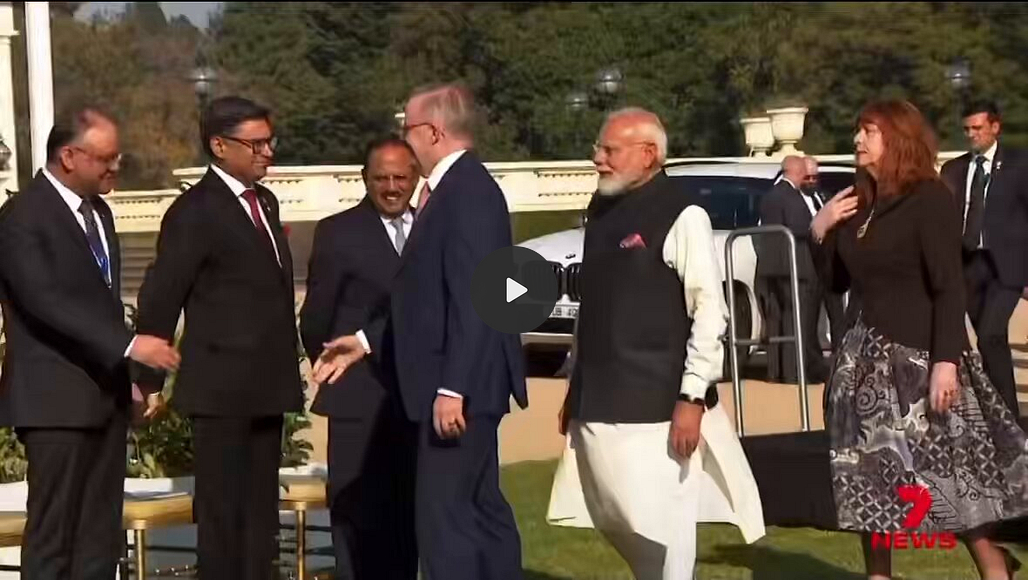
Speaking of which, Modi continues, quite rightly, to meet opposition leaders during his foreign visits, including Australia’s leader of opposition Angus Taylor, with whom he discussed the “growing strength” of India-Australia ties. The curiosity is that the courtesy rarely seems to be reciprocated in New Delhi, where visiting dignitaries no longer meet India’s own opposition leaders with the same ease at the behest of the Modi government. Bipartisanship, it seems, is encouraged abroad but rationed at home.
In Melbourne Modi also praised Australia’s ban on social media access for minors – this, notes Aroon Deep, is the clearest hint yet that New Delhi may be eyeing similar curbs at home. “I have followed you closely, and the way you have legislated and worked to protect society in IT and social media is inspiring the world,” he told Anthony Albanese. The alarm is obvious. With this regime, “protection” is often the polite word for control, and every child-safety law risks becoming another leash on the internet.
The Ram temple donations theft case is now headed to the Supreme Court. LiveLaw reports that on Monday, a bench led by CJI Surya Kant, with Justices Joymalya Bagchi and V. Mohana, will hear petitions seeking an independent probe into the alleged theft of donations at the temple, in addition to a forensic audit of the temple trust’s finances. Two parallel inquiries are already under way – one by a three-member SIT appointed by the Uttar Pradesh government and another by the UP police. Do check out this translated copy of the SIT’s nine-page interim report to hear from the horse’s own mouth what lapses have been unearthed so far.
The complaints, meanwhile, keep coming. An eighth police complaint has now been filed in Ayodhya, this time by Uttar Pradesh Youth Congress vice-president Sharad Shukla, who has sought an impartial inquiry into a security pass being allegedly given in the name of former trust invitee Gopal Rao to a vehicle associated with him, but bearing someone else’s photograph.
Now even the counting room is thinning out. Twenty-three employees tasked with counting Ram Mandir donations have reportedly resigned together, saying that after the theft allegations surfaced, devotees have begun offering far more Rs 10 and Rs 20 notes, slowing the counting process sharply. Earlier, they said, 70-80 bundles of Rs 500 notes could be prepared quickly; now barely 15 such bundles are counted. The shift system has also changed from six-hour shifts to a nine-hour-long 9 am-6 pm stretch, with no commensurate increase in salary. Only 13 counting staff now remain with the bank.
Fifty film journalists and film critics have written to information and broadcasting minister Ashwini Vaishnaw, expressing alarm at the withdrawal of the film Satluj, earlier popularised as Panjab 95, from Zee5, where it was being hosted, shortly after its release. “No law in India requires a film releasing directly on OTT platforms to hold CBFC certification,” the signatories say, drawing attention to the extraordinary silencing of the film. The New York Times has also taken note, asking in its headline ‘why India has spent years blocking the release’ of the film.
Speaking of film censorship, the CBFC has reportedly granted an ‘A’ certificate to Tamil Nadu chief minister Vijay’s film Jana Nayagan, which is expected to screen in theatres starting on the 24th. Among the changes the board has directed, per PTI, are modification of the words ‘TVK’ (Vijay’s party), deletion of visuals showing the national flag falling to the ground, and removal of the words ‘New India’.
Set in motion by Centre for the Study of Developing Societies professor Sanjay Kumar making – and then suo motu removing – a calculation error last year in the context of the Maharashtra assembly polls, an enquiry committee constituted by the Indian Council of Social Science Research has now recommended ‘action’ against the highly regarded institution, alleging ‘irregularities’ in its appointments and finances, reports Vikas Pathak. That action could entail the suspension of ICSSR grants that account for more than 83% of CSDS’s income.
A joint team of the Manipur police, the NIA and the CRPF today arrested a couple for their alleged involvement in the killing by Kuki groups of their six Naga captives during the state’s hostage crisis two months ago.
Recently the Assam Rifles conducted a meeting in Guwahati titled ‘Indo-Myanmar Frontier Issues and Way Forward’ that was co-hosted, curiously, by an RSS affiliate named the Seemanta Chetana Mancha Purvottar. Angana Chakrabarti of The Reporters’ Collective attended the seminar and heard from Sangh members about the ‘original Hinduness’ of the northeast’s scheduled tribes as well as how Myanmar ‘was once part of Bharat but is now a weak, independent country’. People from the security establishment, she writes, were “uncommonly candid” in their presentations.
Abhishek Kumar Sinha, the BJP candidate for the Bankipur assembly seat that went vacant with party president Nitin Nabin’s move to the Rajya Sabha, has suddenly quit the race citing family reasons. His exit has set off much speculation given the high profile of this contest – with Prashant Kishor also joining the fray – and the energetic start he’d given the saffron party’s campaign. He stands replaced by Neeraj Kumar Sinha.
What is going on in the Union environment ministry, which last week fired four close aides of minister Bhupender Yadav all in one day? Yadav’s predecessor and current Congress MP Jairam Ramesh asserts that the unusual development must be viewed in the context of the government’s attempts to change the boundaries of the Sariska Tiger Reserve and the definition of the Aravallis, both allegedly to facilitate mining at the environment’s expense.
Mongabay reports on a proposed solar project in Kutch’s Banni grassland – India’s largest – that has triggered a conflict between renewable energy development and conservation, affecting migratory birds, other wildlife and the local ecology.
The 2023 Silkyara tunnel rescue in Uttarakhand is headed for the big screen. Silkyara 41, a feature film co-production between Aamir Khan Productions, the Australia-based Mind Blowing Films and Kabir Khan Films, will be directed by Kabir Khan and written by Australian screenwriter Andrew Anastasios. The film will recount the operation that rescued 41 workers trapped for over two weeks, including the role of Australian tunnelling expert Arnold Dix.
NDA states and Union-run varsities lodge objections over VBSA Bill’s over-centralising provisions
Three NDA-ruled states – Andhra Pradesh, Madhya Pradesh and Meghalaya – and a number of Union-run universities have written to the joint parliamentary committee examining the Viksit Bharat Shiksha Adhishthan Bill, objecting to various provisions in the legislation that would over-centralise the higher education system, Sobhana Nair and Abhinay Lakshman report. Andhra’s TDP-led government in particular raised strong warnings and demanded consultation; Banaras Hindu University as well as the Congress-run Telangana government both pointed to clause 45, which allows the Union government to issue binding directions to the Viksit Bharat Shiksha Adhisthan that the legislation proposes to replace the UGC, AICTE and NCTE with.
That IAS stuff can come later, first learn to be a mother, says UP governor and former Guj CM
Uttar Pradesh’s governor and former BJP chief minister of Gujarat Anandiben Patel yesterday exhorted her audience of newly minted women graduates in Kanpur to first master becoming a mother before becoming IAS officers or teachers or whatever other hors d’oeuvre they have in mind. “Everyone,” she added, “should know how to cook the food prepared at home.” A couple days prior, she berated youths at another convocation ceremony for abandoning their babies – the idea being that this is what youngsters do after refusing their families’ sage relationship advice. And not very long ago she warned young women of that perturbing phenomenon – the live-in relationship – by advising them to “go and see in the orphanages … 15- and 20-year-old daughters are standing, carrying one-year-old babies.”
Sheikh Hasina declares she will go back to Bangladesh later this year and turn herself in
Sheikh Hasina has in an interview to Reuters claimed that she plans to return to Bangladesh around December and surrender to the authorities there, marking the first time she has given a timeline for her return or spoken about turning herself in. Convicted and sentenced to death for her alleged role in the deadly crackdown on student-led protesters in July-August 2024 before her violent ouster – in a much-criticised trial in absentia – Hasina’s return, notes Krishna N. Das, could exacerbate divisions within Bangladesh but also improve ties with India. “If death comes, I want it to come on my own soil,” she declared, adding that she intends for her return to make “clear to the people how farcical the court is”.
The Long Cable
The MEA’s passport take is incorrect, illogical and inconsistent with global norms
P.D.T. Achary
A few days ago, the Supreme Court of the United States declared that anyone born in the US is a citizen of that country. Such a clear statement of law on a fundamental issue like citizenship is yet to come from India’s Supreme Court, although that issue came before it in the context of the special intensive revision (SIR), where the question of the citizenship of Indian voters was an issue.
A curious situation exists in India where the voters’ list is being revised intensively and voters are being asked to produce documents to prove their citizenship, but the Ministry of Home Affairs, the administrative ministry, has not so far spelt out the documents that citizens are required to produce as proof of their citizenship.
The Election Commission (EC) has made it clear that Aadhaar cards, ration cards, voter ID, passports, etc will not be accepted as proof of citizenship. Then what is exactly the document that should be produced for this purpose? These are the documents that people generally possess, but they are of no use in this case.
It is in this context that a recent statement of an official of the Ministry of External Affairs (MEA) that the passport is just a travel document and not proof of citizenship has attracted a great amount of public attention. The EC has already made it clear that it would not accept the passport as a proof of citizenship, and now the MEA official has endorsed it by terming the passport as a mere travel document.
However, the Passports Act of 1967 presents a different picture. This Act does not treat the passport as a travel document – on the contrary it treats the passport as different from travel documents.
Under section 2(b) of the Passports Act, a passport is defined as follows: “passport means a passport issued or deemed to have been issued under this Act”. Under section 2(e), a travel document is defined as follows: “travel document means a travel document issued or deemed to have been issued under this Act”.
Thereafter, the Act classifies passports and travel documents under section 4 as follows – 4(1)(a) an ordinary passport, (b) an official passport, and (c) a diplomatic passport.
In 4(2), travel documents are classified as follows:
Emergency certificate authorising a person to enter India
Certificate of identity for the purpose of establishing the identity of person
Such other certificate or document as may be prescribed.
It should be clear from the above provisions of the Act that the passport is not a travel document as defined in the Act. Travel documents are in the nature of certificates which are different from passports.
The MEA official’s further assertion that the passport is not a proof of citizenship flies in the face of facts and logic. This assertion has the potential of causing serious problems for Indian citizens who go abroad on the strength of an Indian passport.
An Indian passport specifies the nationality of its holder, which is Indian, and it contains a request to other countries to allow the bearer “to pass freely without let or hindrance and to afford him or her every assistance and protection of which he or she may need”. This request is made by the order of the President of the Republic of India.
Nationality, according to the New Oxford English Dictionary, means the status of belonging to a particular nation. According to the Collins Cobuild English language dictionary, citizenship is “the particular nationality that you have and the official status, rights and duties that you have because of it”.
By this definition nationality can be the proof of citizenship. So, when an Indian national holds a passport, the Indian authorities are announcing to the rest of the world that he is a citizen of India and the world recognises him as such. So, if the whole world recognises an Indian passport holder as a citizen of India, how can we assert that the passport is not a proof of citizenship? It simply defies logic.
A five-judge constitution bench of the Supreme Court in Satwant Singh Sawhney vs D. Ramarathnam (AIR 1967 SC 1836) has elaborately dealt with the legal status of the passport in the context of nationality or citizenship. This judgement quotes certain authors who have defined the passport.
For instance, P. Weis says “in essence a passport is a document which identifies the holder and provides evidence of his nationality”. Author Kenneth Diplock has been quoted as saying, “they [passports] are in the same category as any other evidence of the national status of an individual”.
The above judgement also quotes the Ballentine’s Law Dictionary, which says a passport “is a document issued on behalf of a citizen of the United States by the secretary of state … it is to be considered as a political document by which the bearer is recognised in foreign countries as an American citizen”.
Further, the US Supreme Court has been quoted in the judgement. In Kent vs Dulles, the US Supreme Court has said: “a passport not only is of great value … abroad; it is also an aid in establishing citizenship for purposes of re-entry into the United States.”
Thus, the Supreme Court of India was clear that the passport proves the nationality or citizenship of a person. This is the position in almost all countries. Therefore it is difficult to understand why the MEA has taken a view that the passport is just a travel document and not a proof of citizenship.
Perhaps the MEA did not want to take a position which is at variance with that of the EC, which had refused to accept the passport as a proof of citizenship while conducting the SIR. But it is not in consonance with law, the Supreme Court’s decisions and international practices.
The law on citizenship is a little complex in India. Article 5 of the Constitution starts with a simple and straightforward provision relating to the citizenship of people who were born in India at the commencement of the Constitution. It says that at the commencement of the Constitution, every person who has his domicile in the territory of India and who was born in India shall be a citizen of India.
Subsequent Articles and the Citizenship Act and Rules made thereunder have made it more and more complex. But the most crucial provision is contained in Article 11, which has conferred on parliament unfettered power to make any provision with respect to the acquisition of citizenship.
Thus, from a purely secular base like domicile and birth at the beginning of the Republic, citizenship in India can now be determined on religious grounds also. This transformation is the direct consequence of the untrammelled and unguided powers vested in parliament by the constitution.
When the state displaces a proclivity for excluding people from the electoral list, documents that proclaim the status of citizens like the passport become crucially important. Thoughtless assertions that the passport is just a travel document can create serious problems for Indian citizens within and outside the country. This can now be settled only by judicial intervention.
(P.D.T. Achary is a former secretary-general of the Lok Sabha.)
Reportedly
Yesterday officials of the Enforcement Directorate conducted searches in Mumbai against Kalanee Impex Private Limited, one of whose directors is Dharmesh Sangani, a close associate of actor Shekhar Suman. It just so happens that Suman has been hosting a political satire show and is an advocate of free speech in India — we ought to have “the latitude to talk about anybody”, the one-time BJP member told the Indian Express). In that same interview he cited Atal Bihari Vajpayee as once telling him about his old Movers and Shakers talk show: “This show must go on. When you take on me, I laugh out the loudest!”
Drawn and quartered
Deep dive
Bangladesh has been in the throes of a measles outbreak, with close to a thousand cases and multiple deaths still being reported every day. The BBC in this heartbreaking report writes that “public health experts are warning the outbreak in Bangladesh is proof of the dangers of any interruption in vaccine coverage”.
Prime number: 31% 🥵
Almost a third of single people – 31% – in India surveyed by the dating app happn said they pulled up their stumps for all of this summer because it was just too hot to be outside, while another 21% said they flamed out before their date could even begin. But many others turned to the night among other options to keep things moving. Theres Sudeep reports.
Opeds you don’t want to miss
It is inexplicable that the SIR is taking place in Manipur right now, Gautam Mukhopadhaya says. Tens of thousands of people remain displaced, and among them many Kukis, who have borne the brunt of the violence, will not be able to produce their documents. “… By 2029 we may see a pathway to statelessness not only for the Kuki-Zo but also for other tribal communities in the Northeast, with their plight obscured amid the broader exclusion and disenfranchisement of Muslims …”
What happened with R. Rajagopal (and others) during the SIR, on top of the MEA’s remarks on the passport, raises the uncomfortable question of whether “the Republic trusts its citizens at all”, writes Manoj Jha. Yes, verification is required to maintain the integrity of public institutions, but “documentation serves democracy only when it generates certainty”.
Here is former Navy chief Admiral Arun Prakash’s advice to those on Raisina Hill as the situation in West Asia deteriorates again: “Given its cordial relations with all three belligerents … India must remonstrate strongly with all parties to abandon reckless brinkmanship, cease actions that threaten regional stability and world peace, and return to the negotiating table. The Global South is watching us.”
Between their network providers, UPI platforms, e-commerce choices and ride-hailing services, Indians are surrounded by duopolies. Such systems can and do deliver efficiency but when markets settle into them, note Vasant Hegde and Rati Chandra, “competition becomes a formality. The system works, but less dynamically than it should.” They have some ideas on what the government should do about that.
“Increased diplomacy is all the more urgent because South Asia’s environment is becoming more fragile. Glaciers are melting at an accelerating rate … That can make river flows more erratic, destabilise the rock on which dams and houses are built and increase the risk of flooding. Monsoon rains are becoming less predictable. Rather than suspending or abandoning water accords, countries need to strengthen and update them to reflect this.”
Listen up
Has the time come for India and Pakistan to resume official talks? Kallol Bhattacherjee in this episode of InFocus sounds out Mani Shankar Aiyar and Tara Kartha on the question.
Watch out
A group of blind people in Ranchi has built up an informal settlement in the city and found strength in living together, but their project is under threat by plans to expand the bus stand next to their colony, Nolina Minj and Raghav Kakkar report.
Over and out
Kalki Koechlin and theatre director Sheena Khalid have adapted the former’s book The Elephant in the Womb into a new play entitled Belly of the Beast, which explores the side of motherhood that isn’t all sunshine and rainbows, including postpartum depression and miscarriages. Koechlin noted to the BBC that while “the conversation in India is all about the gift of motherhood … there is a certain part of you that’s also grieving and losing identity, that’s losing who you were before”.
The Economist looks at what Indians are reading, and ‘what that reveals about the self’, noting:
“The observant commuter will spot something else. In a country where only a small minority has any facility with the language, and an infinitesimally tiny one speaks it natively, all the books sold at red lights are in English. So are most of those at roadside second-hand-book dealers, in bookshops and in the top 100 on Amazon India. English-language books make up about half of (non-educational) official sales. For a country as linguistically and culturally kaleidoscopic as India, that makes English books a rare example of common ground. What Indians read offers a glimpse of their hopes and dreams.”
That’s it for today. We’ll be back with you on Monday, on a device near you. If The India Cable was forwarded to you by a friend (perhaps a common friend!) book your own copy by SUBSCRIBING HERE.