
A newsletter from The Wire | Founded by MK Venu, Pratik Kanjilal, Sidharth Bhatia, Siddharth Varadarajan, Sushant Singh, Seema Chishti, and Tanweer Alam | Contributing writers: Kalrav Joshi, Anirudh SK
If you like our work and want to support us, then do subscribe. Sign up with your email address by clicking on this link and choose the FREE subscription plan. Do not choose the paid options on that page because Stripe – the payment gateway for Substack, which hosts The India Cable – does not process payments for Indian nonprofits.
Our newsletter is paywalled but once a week we lift the paywall so newcomers can sample our content. Today is that day. To take out a fresh paid subscription or to renew your existing monthly or annual subscription, please click on the special payment page we have created – https://rzp.io/rzp/the-india-cable.
Snapshot of the day
September 4, 2026
Sidharth Bhatia, Kalrav Joshi, Anirudh S.K.
Delhi police personnel reportedly detained Swatantra Bhardwaj this afternoon as Cockroach Janta Party and Congress members in addition to Aazad Samaj Party (Kanshi Ram) leader Chandrashekhar Azad demanded strict action against him for beating a Dalit protester at Jantar Mantar. Bhardwaj has been in the spotlight after claiming on camera that he grievously injured his victim Sanjay and bragging about avoiding jail as he enjoys the favour of the establishment, including of BJP leader and rabble-rouser Kapil Mishra. After Lok Sabha leader of opposition Rahul Gandhi expressed support to Sanjay’s family yesterday Bhardwaj continued to claim impunity, saying that even ‘Donald Trump, Benjamin Netanyahu or the collective Indian opposition’ cannot land him in trouble:
“Dharmo rakshati rakshitah (dharma protects those who protect it). We will go to jail, we will come back, then someone will say something again, and they will be treated once more.”
The CJP, Congress and Azad went to the Parliament Street police station today to demand that the cops invoke the attempt to murder provision against Bhardwaj in their case against him that was lodged during the protests, in light of both his claim that this was warranted as well as their account of the injuries he inflicted on Sanjay Azad. CJP spokesperson Saurav Das said tonight that the police have now invoked the provision pertaining to criminal intimidation by threatening to cause death or grievous injury, in addition to sections of the SC/ST Act. They will also invoke the attempt to murder provision shortly, he said. Sanjay Azad’s daughter has reportedly said that the police have also registered an FIR against her complaint of receiving rape threats and abusive messages.
Union minister Chirag Paswan, whom Bhardwaj had called his elder brother while claiming state patronage, has said that lack of action against the 21-year-old would set a bad example. “I take responsibility for ensuring justice for the family,” he told mediapersons on Friday.
Meanwhile, at the Press Club in Delhi, the 4PM News Network outlet today reiterated its demand that the Saket police officers who allegedly beat its woman reporters Shaheen Khan and Nafisa Khan yesterday be arrested and suspended. Police picked up the duo yesterday when they were covering an inauguration event involving chief minister Rekha Gupta and Union home minister Amit Shah. Shaheen has alleged that the police beat her more severely when they discovered she is Muslim, and videos shot from inside the station showed bruises and welts on their bodies.
In a miraculous development, Nepalese rescue personnel have recovered alive two workers from a hydel project tunnel on the Trishuli river – they also retrieved a body from the site. The two workers are Kabir Maharjan and Sanjay Sah, with the latter telling reporters he had stayed on at the project’s control room when the flash flood hit last week in order to help evacuate as many people as possible. The flooding near the Nepal-China border is believed to have trapped no fewer than 900 people in the tunnels of six hydel projects in the area.
It has also left more than 5,600 people missing. In Nepal the authorities are facilitating symbolic funerary rites for people who have remained unaccounted for, with relatives setting fire to their kin in straw effigies in a bid to deliver spiritual release in case they are never found. Nepalese authorities have counted 1,294 deaths as of Friday, while on the Tibetan side – where the flow of information is being heavily controlled – 31 people are known to have been killed.
Of the 2,873 individuals whom the Delhi police says have criminal antecedents and claims to have spotted during the youth protests with its facial recognition software are 25 individuals who were in jail at the time on serious charges per official records, Mahender Singh Manral reports in the Indian Express.
The Modi government ultimately decided to record people’s caste in an open-ended fashion during the census, Abhinay Lakshman reports citing official sources, “because the list of OBCs is not a list of castes, it is a list of classes”. The officials said that the open-ended method was cleared ‘at the highest levels’ because the Union and state OBC lists contained categories such as local-born people in the Andaman and Nicobar Islands, and tea workers, which are not castes. Lakshman also recalls that some communities that are OBC in one state may be SC or ST in another. Opposition leaders are critical of the open-ended method because it will probably make caste data unusable, like with the 2011 SECC exercise. Why did the Modi government not anticipate this issue when it promised to enumerate castes last year?
Punjab Police arrested Manjit Singh Bedi on Friday, just hours after the FBI put him on its “Most Wanted” list and offered up to $150,000 for information leading to his arrest. US prosecutors accuse the naturalised American citizen, originally from Jalandhar, of defrauding the US government of at least $600,000 through an alleged food-benefits scam at his Washington state grocery store before fleeing to India earlier in April. Bedi, however, was arrested in a separate Punjab case involving alleged cheating and illegal immigration services.
Ahead of Chinese President Xi Jinping’s expected visit to New Delhi for the BRICS summit, India and China are stepping up economic engagement after years of strategic tension. India is likely to send a high-level delegation to China on September 7-8, possibly led by commerce secretary Rajesh Agrawal, to advance talks on trade and investment, reports the HinduBusiness Line.
HarperCollins will take over Penguin’s mandate to publish Sonia Gandhi’s memoir Belonging in India after the latter allegedly succumbed to pressure from the Modi government. Earlier Sunetra Choudhary of the Hindustan Times had reported that Penguin Random House India’s deal with Sonia fell through because she refused to make changes or deletions of references to Prime Minister Modi, the Rashtriya Swayamsevak Sangh and Chinese intrusions into India.
A nationwide survey of 1,000 platform workers across ten cities offers a grim picture of the labour behind India’s gig economy. The Hindu reports, citing a survey, that among 778 workers exposed to extreme weather, 96.57% said heat affected their ability to work and 75.5% reported a moderate-to-severe impact on productivity and safety even as platform work amounts to long working weeks for many in the country. The survey further revealed that despite the risks involved in the nature of their work, 62.2% of the workers surveyed did not have health insurance while 44.2% did not have accident insurance.
Even as India’s gig workers labour through extreme heat with little insurance or safety protection, the Indian government abstained from voting on “decent work in the Platform Economy” when the ILO adopted the world’s first global labour standard dedicated to the platform economy in June.
There’s barely six months left before Uttar Pradesh is to go to polls but the question of Scheduled Caste reservation for the Nishad OBC community remains uncertain. Now key BJP ally Sanjay Nishad has brought up the issue again, issuing an ultimatum to the BJP double engine government to act, or else. Omar Rashid explains why Nishad’s warning is important – he writes that while the BJP “cannot ignore the Nishads, it is also unable to guarantee [to] them what they want”. The broader eastern UP region is also where the opposition did well in 2022 and 2024, he notes.
After the Modi government summoned Meta’s top global executives over the temporary restriction of PM Modi’s Facebook video last month – eventually extracting an apology from the company – the IT Ministry now says it has no minutes of those meetings.
From ‘dog fruit to darling’: BBC reports on India’s avocado boom, as surging demand has local growers hoping to grab a bigger slice of the market.
Sri Lanka says spare us India’s GDP ‘theatre’
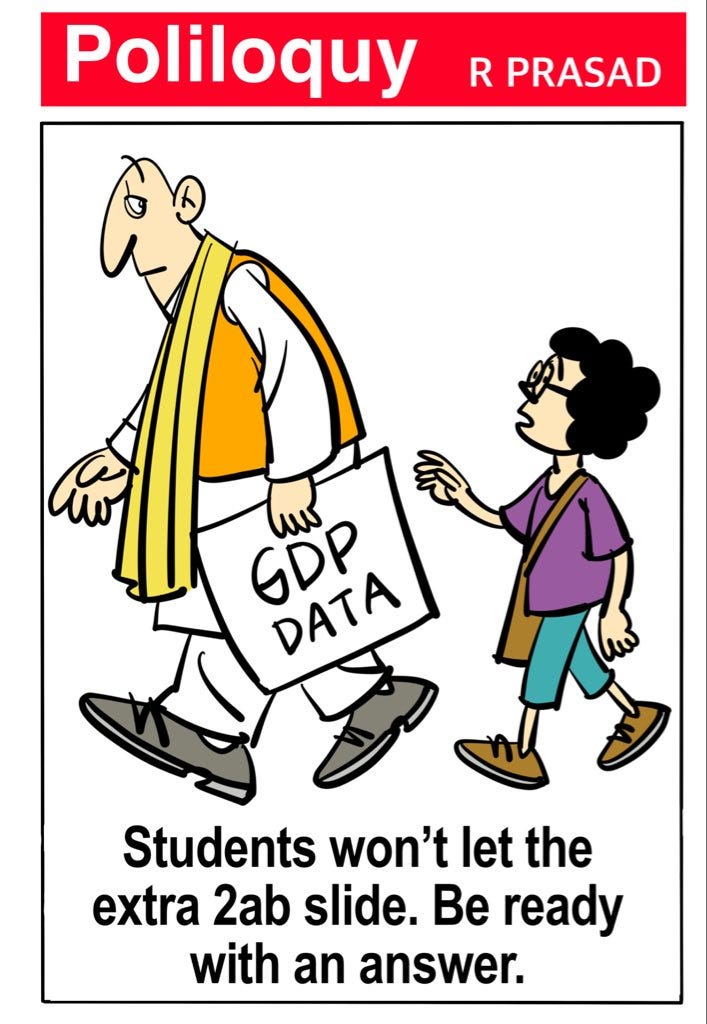
While the Modi government continues to cheer its 7.8% GDP growth figure – and issue clarifications as economists and former senior officials question the methodology – the debate has now crossed the Palk Strait, with Sri Lanka’s own second-quarter GDP figures expected this month.
Sri Lanka’s Daily FT, warning its own policymakers against taking inspiration from the spectacle, writes: “One hopes Sri Lankan policymakers and experts are not watching the theatrics in India with watering mouths and dreaming up smart arguments. Spare us such theatre!”
Over 300 killed in Manipur’s ethnic strife since it erupted 40 months ago
In the 40 months (and counting) since ethnic strife erupted in Manipur on May 3, 2023, the violence has killed a total of 306 people while 49 others remain missing, the state government has said in the assembly. While May 2023 marked the beginning of the Meitei-Kuki violence, another axis of conflict – between Kukis and Nagas – flared up this February. Speaking to Vijaita Singh, deputy chief minister Losii Dikho, a Naga, said that his relationship with his fellow deputy CM Nemcha Kipgen, a Kuki, has completely broken down. He accused Kipgen of not participating in peace efforts apart from alleging her husband’s involvement in the violence. If things go on the way they are now, it will be difficult to hold assembly elections in the hills next year, Dikho also said.
In other news, unidentified individuals triggered an explosion outside Manipur Congress leader Keisham Meghachandra Singh’s house in the Imphal valley yesterday. They are believed to have used a hand grenade. No one was injured in the incident.
Tata gets a Kenyan Ta-Ta
Kenyan President William Ruto has ordered Tata Chemicals to “pack up and leave”, accusing its Lake Magadi operation of extracting Kenya’s soda ash without generating enough jobs or value for the country, amid disputes over local employment and profit repatriation that are also before the courts. “They take our resources to India and other places,” Ruto said, accusing Tata of exporting soda ash rather than processing it locally into glass and chemicals.
Ruto says two new investors will be brought in to take over the Magadi operations and process the mineral locally, amid his wider crackdown on foreigners operating small businesses. Reuters notes that the terms of Tata Chemicals’ possible exit remain unclear.
The Long Cable
After success of EOS-05, seven-month launch hiatus for ISRO is over
Ajey Lele
On 4 September 2026, the Indian Space Research Organisation (ISRO) successfully launched the GSLV-F17/EOS-05 mission. This success comes in the wake of two consecutive failures of the Polar Satellite Launch Vehicle (PSLV). On 18 May 2025, PSLV-C61 failed following an anomaly during the third stage while carrying the EOS-09 satellite. This was followed by the failure of PSLV-C62 on 12 January 2026, shortly before third-stage separation. Following the January 2026 failure, ISRO remained without a launch for nearly seven months.
There could understandably have been some apprehension within the ISRO community about this launch as well, given the historically challenging and unforgiving nature of the Geosynchronous Satellite Launch Vehicle (GSLV) and particularly its cryogenic upper stage. The PSLV, long regarded as ISRO’s workhorse launcher, had experienced two consecutive failures in the recent past. On the other hand, the performance of the GSLV has historically been mixed. The GSLV Mk I, which used a Russian cryogenic upper stage and is now retired, undertook six missions, including two outright failures and two partial failures. The GSLV Mk II, equipped with an indigenous cryogenic stage and still in service, had completed 12 missions, with 10 successes before this mission. Promisingly, the GSLV Mk II’s success rate has been significantly better than that of the earlier Mk I configuration.
Interestingly, ISRO appears to have revised the nomenclature of its GSLV missions, with the earlier GSLV Mk I now being referred to as GSLV Mk II, while the vehicle previously designated GSLV Mk II is now simply referred to as GSLV. Following the failure of the GSLV-F10 mission in 2021, the subsequent four missions of the GSLV have been successful, indicating a period of improved reliability. The previous GSLV mission, GSLV-F16, had successfully launched NISAR (NASA-ISRO Synthetic Aperture Radar) mission, the satellite jointly developed by ISRO and NASA, in July 2025.
The Earth Observation Satellite (EOS) series reflects ISRO’s effort to establish a dedicated constellation of advanced remote-sensing (also known as earth observation) satellites, with most positioned in low Earth orbit (LEO) and some in geostationary orbit (GEO). At present, four EOS-series satellites are operational in LEO. Two of these carry Synthetic Aperture Radar (SAR) sensors, enabling all-weather imaging for applications such as flood mapping, soil-moisture assessment and hydrology. With EOS-05, ISRO is expanding this capability to GEO, where the satellite is expected to provide continuous, near-real-time observation of the area under coverage, with a spatial resolution of about 42 metres. In comparison, the LEO-based EOS series systems offer resolutions ranging from about 6 to 360 metres. Deploying satellites across different orbits allows ISRO to combine the higher spatial resolution of LEO platforms with the wider and more persistent coverage offered from GEO. Although primarily intended for civilian applications, these satellites have significant dual-use potential and are therefore highly relevant to India’s defence requirements. SAR based satellites have major utility for armed forces too. However, India would require a larger and more diverse EOS constellation to adequately meet its growing strategic needs. Notably, EOS-05 is actually a replacement for EOS-03 (GISAT-1), which was lost in a launch failure in 2021. ISRO is planning a few more satellites in this series and a satellite called EOS-10 (Oceansat-3A) could be launched around March 2027.
In regards to the use of satellites in disaster management, there could be one important learning from the recent high-altitude collapse of rock and ice triggering a catastrophic flash flood near the Nepal–Tibet border on 26 August 2026. The NISAR satellite operates in a near-polar, sun-synchronous dawn-dusk orbit at an altitude of approximately 747 km. There are views and counterviews in regards to the capabilities highlighted by NASA and ISRO about this satellite at the backdrop of the recent Nepal disaster. It is obvious that NISAR failed to give any early warning of this catastrophic event. Possibly, the disaster was difficult to anticipate because it resulted from the sudden failure of a high-altitude glacier–rock system in a remote and poorly monitored region. It appears that satellites like NISAR are not designed to detect subtle deformation across thousands of glaciers and unstable slopes.
This clearly demonstrates that even state-of-the-art single satellites may be not sufficient to monitor and respond to major disasters. NISAR does not pass over the Himalayan region on every orbit. While it completes about 14 orbits a day, its polar, sun-synchronous orbit means that each pass covers a different region as the Earth rotates below it. Normally, only a limited number of passes align with the Himalayan region, restricting the frequency of observations over a specific area. This may partly explain India’s efforts to develop a combination of LEO and GEO satellites to minimise data gaps and provide more continuous coverage. Such a multi-orbit satellite architecture would have significant civilian as well as military utility.
The success of the GSLV-F17/EOS-05 mission will undoubtedly boost ISRO’s confidence. It was unfortunate that a globally recognised space agency such as ISRO went through a nearly seven-month launch hiatus. The current situation suggests that all is not well with ISRO.
Shockingly at present India’s space programme faces a paradox of budgetary constraints alongside significant under-utilisation of allocated funds. The Parliamentary Standing Committee in its 410th report on Science and Technology (2026-2027) has expressed concern that the Department of Space has not been able to utilise its allocations effectively. There are issues surrounding fluctuating government resource allocation on one hand and the inability to fully convert available budgetary resources into timely programme expenditure on the other. It is also important to note that currently ISRO is facing its worst human power shortages, with nearly 30% of its sanctioned positions remaining vacant while some top scientists are found leaving for the private sector. India’s private space sector is found making rapid progress. ISRO has transferred the technology for producing launch vehicles such as the PSLV and SSLV to private and other public-sector agencies. Thus, trained manpower with expertise mainly in such systems is likely to be in high demand in the private sector.
With recent launch failures, delays and capacity constraints raising questions about the organisation’s ability to sustain the pace and reliability expected of it. Is ISRO presently undertaking too many projects simultaneously? Is the shift in focus towards the human spaceflight mission (Project Gaganyaan) and the expanding Moon program impacting progress on other strategically important missions? Owing to manpower and other related issues, has the time come for ISRO to reprioritise its agenda and focus more on strategic requirements first, before investing into so-called trendy fields like the human spaceflight program, space station and other planetary missions?
ISRO is best placed to address its manpower shortages, project delays and other organisational challenges. Its track record demonstrates a capacity to overcome various setbacks. The successful EOS-05 mission could therefore mark the beginning of a process of renewal and reinvention.
Ajey Lele is a researcher and is the author of the book Institutions That Shaped Modern India: ISRO.
Reportedly
The BBC investigates the strange world of the country’s ‘paper parties’: six little-known Gujarat-based parties reported more income in 2023-24 than all national parties except the BJP combined:
These are called ‘Registered Unrecognised Political Parties’ or RUPPs. They do not take part in electoral politics. The investigation found, according to experts, that these may be functioning as fronts for tax evasion, money laundering, hawala transactions, and other financial irregularities. Only a thorough enquiry by the authorities will show where the money eventually landed up.
Drawn and quartered
Deep dive
For Scroll, Johanna Deeksha investigates why Tamil Nadu’s factories can become death traps for migrant workers. Across Chennai and Tiruvallur, she finds workers living inside or next to factories, often in unsafe and overcrowded conditions that leave them vulnerable to accidents, exploitation and confinement.
Prime number: 179
That is the number of years recent Indian applicants could now be waiting for a US Green Card.
Opeds you don’t want to miss
Former finance secretary Subhash Chandra Garg may indeed be comparing apples to oranges in his particular argument against the 7.8% growth figure, but there are still known problems with the government’s quarterly GDP numbers, and 7.8% is a big number for a time coinciding with the energy crisis, say Abhishek Anand, Josh Felman and Arvind Subramanian. “A convincing explanation is still elusive,” they point out.
There is a disconnect between what the government says and the situation on the ground: “Lakhs of young people protesting at Delhi’s Jantar Mantar, hopeless and anxious about their future. India announcing it’s the fastest-growing economy in the world, with record double-digit nominal GDP growth,” writes Praveen Chakraborty. Only the private sector can create jobs by investing, he says. But, “Private sector investment has languished at about 10-12 percent of GDP over a decade, down from 14 percent in the decade before.”This is despite the incentives like tax cuts that the Modi government gave the private sector.
Suhas Palshikar advises those who are keen to feel sanguine about what Mohan Bhagwat said at Madison Square Gardens last week that they
“must remember that we are not dealing with Bhagwat the person, howsoever soft spoken and accommodating he might sound. We are dealing with politics in a deeper sense: Of combining a mammoth project of hegemony that seeks to strengthen itself with the unforgiving authority of the state.”
There are ‘three triads’ that the saffron establishment has mobilised recently to fulfill Hindutva’s sociological aims, writes G.N. Devy: ‘Constitutional Amendment-Census-Delimitation; Communalism-Census-ghar wapsi; and SIR-Census-Demography’. “If these threesome policies were to succeed, India will never be the same again,” he warns.
It’s no surprise that the Madhya Pradesh governor has accepted the state government’s decision not to prosecute minister Kunwar Vijay Singh for his odious remarks on Colonel Sofiya Qureshi. But “if the BJP believes its own propaganda about its patriotism and concern for the armed forces,” writes the Deccan Chronicle, “it should take steps to ensure that the wrongdoer faces the law and does not escape with worthless apologies”.
Listen up
A country grows faster when it is healthy and educated but India’s spending on both these areas has been historically lacklustre. And spending aimed at people’s well-being is often labelled a freebie or revadi. Is that justified, or is such spending a right that the people can claim? Reetika Khera discusses with G. Sampath on InFocus.
Watch out
While sections of Indian media turn Nepal’s devastation into melodrama, Australian journalist Cassidy Mosconi lets the drone – and the catastrophe – tell the story.
Over and out
Edward Carpenter, a Victorian philosopher and socialist who travelled to Ceylon and Madras, found common ground between his ideology and ideas of equality and social justice that he encountered in Hindu philosophy. Ajay Kamalakaran writes.
That’s it for today. We’ll be back with you on Monday, on a device near you. If The India Cable was forwarded to you by a friend (perhaps a common friend!) book your own copy by SUBSCRIBING HERE.