
A newsletter from The Wire | Founded by MK Venu, Pratik Kanjilal, Sidharth Bhatia, Siddharth Varadarajan, Sushant Singh, Seema Chishti, and Tanweer Alam | Contributing writers: Kalrav Joshi, Anirudh SK
If you like our work and want to support us, then do subscribe. Sign up with your email address by clicking on this link and choose the FREE subscription plan. Do not choose the paid options on that page because Stripe – the payment gateway for Substack, which hosts The India Cable – does not process payments for Indian nonprofits.
Our newsletter is paywalled but once a week we lift the paywall so newcomers can sample our content. To take out a fresh paid subscription or to renew your existing monthly or annual subscription, please click on the special payment page we have created – https://rzp.io/rzp/the-india-cable.
Snapshot of the day
October 12, 2026
Siddharth Varadarajan
In Naya Bharat, the prime minister can casually stroll into the official residence of the chief justice of India for a bit of praying and chit-chat without jeopardising the separation of powers doctrine or the need for even-handedness but the leader of the opposition will not be given time to meet the country’s top judge. Unfortunately for Narendra Modi, the lack of an appointment today with the CJI did not prevent Rahul Gandhi, Neha Bora and other opposition leaders from taking out one of the largest rallies central Delhi has witnessed in over two decades with anywhere from 50-60,000 to over two lakh people joining the INDIA bloc’s ‘March for Democracy’ from Connaught Circus to the Supreme Court.


At the core of today’s march were cadres of the Congress and the Left parties but the size of the crowd quickly swelled with ornery folk to produce a disciplined, peaceful human wave that is likely to give Narendra Modi pause for thought if not sleepless nights. ‘Do I need to save myself from Gyanesh Kumar?’, the prime minister could well be forgiven for asking. [See Long Cable below by Harish Khare].
“Today, everyone is here and there’s solidarity in that. We were getting detained left and right. So, today is the day you can come and take your stand,” a woman in her 20s from Mathura, told Antara Baruah. “It is a clear scene of dictatorship, it’s worse than dictatorship. At least some dictators improve conditions in their country.” She had got on a train to reach Delhi on October 10 but only made it in today because the government canceled dozens of trains to prevent people from arriving to the capital.
For the moment, of course, the regime is responding to public anger in the way such regimes have always done when they ignore reality: with ostrich-like moves. Taking advantage of a convenient suggestion from the Supreme Court, the Union home ministry and Delhi Police announced the ‘denotification’ of Jantar Mantar as a site of authorised public protest and said that henceforth organisers of protests should seek permission to use one of three designated grounds: Ram Lila Maidan in central Delhi, the CBD ground in Shahdara, east Delhi and the Burari ground in north Delhi.
The announcement was farcical, since the government had anyway effectively banned protests at Jantar Mantar, the Ram Lila ground is heavily booked for public events of all kind, and the other spots are too far from central Delhi to have a visible public impact. And of course, the Cockroach Janata Party is not having any of it.

The Congress today also submitted a petition to the Supreme Court on the Election Commission’s fraught Special Intensive Revision of Electoral Rolls, with ten specific reliefs sought.
Speaking to Amy Goodman’s ‘Democracy Now’, Jahnavi Sen and Shoaib Danyal explain the context of the opposition’s march to the Supreme Court.
Police detained at least 37 journalists who were covering protests, several assaulted
Offering the first systematic count of the concerted police assault on press freedom during the Oct 10-12 protests in Delhi and elsewhere, the Committee for the Protection of Journalists has said that at least 35 journalists were detained in Delhi and several were also assaulted, while at least two reporters were detained elsewhere in India. “Police continued detaining journalists even after Supreme Court justices won assurances from Solicitor-General Tushar Mehta on October 11 that lawyers, journalists, and other professionals would not be impeded in their professional duties,” notes CPJ.
Kerala assembly takes on CEC, ruling Congress attacks CJI
Kerala’s legislative assembly has passed a resolution seeking the removal of CEC Gyanesh Kumar. The resolution, perhaps the first such in the country, was moved by Chief Minister V D Satheesan and supported by the ruling Congress-led United Democratic Front and the Communist Party of India (Marxist)-led Left Democratic Front. The BJP opposed it and proposed amendments, which were rejected. The resolution calls for an inquiry into the alleged SIR irregularities, the immediate restoration of voting rights to eligible voters wrongfully excluded from the rolls. It also sought reconstitution of the election commissioners’ selection committee to include the prime minister, the leader of the opposition in the Lok Sabha, and the CJI, “to ensure the independence and credibility of the institution.”
But which CJI does the Congress mean? The party tied itself in knots today by first attacking Chief Justice Surya Kant in a tweet and then deleting what it said was an unauthorised post.
India inflation jumps to 5.54% in Sept, crossing 5% for first time
India’s retail inflation rose to 5.54% in September, up from 4.83% in August, adding to pressure on the Reserve Bank of India just days after it raised interest rates for the first time in more than three-and-a-half years. The RBI expects headline inflation to average 5.2% in the financial year ending March 2027, above its 4% medium-term target. With India importing nearly 85% of its fuel needs and exposed to supply disruptions from the war in West Asia, the oil shock is feeding into an already difficult inflation outlook.
Food inflation surged to 7.74% from 5.97% in August, with onion prices more than doubling, while rural inflation crossed 6%.
The Long Cable
Can Modi Find a Way to Rescue Himself From Gyanesh Kumar?
Harish Khare
At one of many stops in Israel during the course of his whirlwind shuttle diplomacy in 1975, Henry Kissinger told reporters that on that particular day he had come “to rescue [Prime Minister Yitzhak] Rabin from [defence minister Shimon] Peres.” Flippancy apart, the then US secretary of state was invoking one of the most unresolved conundrums faced by every supremo: how not to let a deputy or a close aide or ally spoil the broth. When a helmsman fails to rein in hawkish voices in his entourage, the result invariably is lasting damage.
Our own post-independence history records many instances: Nehru allowing Govind Ballabh Pant and Morarji Desai to scupper any agreement during Chinese Premier Zhou Enlai’s last visit to India in 1960; Sanjay Gandhi trapping his mother, Indira Gandhi, into the quagmire of the Emergency; L.K. Advani ensuring that the Vajpayee-Musharraf summit at Agra ended in a deadlock. The list is long.
In a dynamic polity, inter-locking institutions are often nimble-footed enough to see to it that there is no systemic breakdown. Because of weakened institutions, however, the Indian polity today is staring at a catastrophic meltdown – unless a new imagination makes itself felt.
The contours of the deadlock are all too visible. A prime minister, surrounded by a posse of take-no-prisoner hardliners; an Election Commission, a constitutional body, theoretically not easily amenable to any blandishments yet suspected of being at the beck and call of the ruling party; an agitated Opposition, led by a leader who has nothing to lose; and, a leaderless army of angry insurgents who have no time or respect for old-fashioned niceties and protocols.
This deadlock has manifested itself dramatically these last few days in the battle for control over the streets in the national capital. From July 20 to October 10, the officially empowered instruments of coercion and violence have asserted themselves against unarmed dissenters of various hues. Highly unappetising images have emerged of a police force ruthlessly pitting itself against young boys and girls and other decent citizens. Even more unpalatable and troublesome is the utter indifference of (the Union home ministry-directed) Delhi Police to the Supreme Court’s directions. The longer the deadlock persists, the greater will be the ruling regime’s appetite for defying judicial injunctions, and for relying on thuggish militias to chase unarmed protestors out of the streets.
That inclination cannot bode well for the republic. The stalemate has to be prised open.
At the heart of the deadlock are the proven illegalities wilfully committed by the incumbent chief election commissioner (CEC). Hardly anything need be said any more about the institutional mischief knowingly set in motion by Gyanesh Kumar. The rub is that he, as CEC, enjoys not only constitutional autonomy but also has been provided protection against any future punitive action for acts of commission and omission. That someone in the Modi establishment deviously felt the need for putting in place this legal protection suggests malice aforethought.
Now, there is seemingly no way out of the deadlock. Whatever use Modi has made – and still hopes to make – of him, Gyanesh Kumar has become an albatross around the prime minister’s neck. The CEC can be removed only through a motion of impeachment in parliament. But the ruling party cannot possibly let such a motion pass. Still, no one can be sure if the inner clique has come to realise that Gyanesh has become a debilitating liability. At the same time, one can be sure that if the ‘competent authority’ does decide the time has come to cut its losses and let the CEC go, the regime definitely has the requisite resourcefulness to get him to step down. Not too long ago, a vice-president of the republic was made to send in his resignation, citing reasons of health.
It is against the grain of the ruling regime to yield to pressure; its inner coterie wallows in confrontation and remains in thrall of its own roguish impulses. Yet if history is any guide, a king surely knows that no one is – or should be – indispensable. If Modi has not totally shut off his antennae, he should be able to grasp that the CEC’s carefully curated excesses have cast a shadow on what should be a prime minister’s most potent asset: the perception that he or she is an honest leader worthy of citizens’ trust. The legitimacy of the Modi regime is at stake.
Arguably, an even more fundamental question has presented itself: is our constitutional arrangement efficacious enough to find a way out of the deadlock? On the one hand is the argument, spelled out a few days ago by Shiv Sena chief, Uddhav Thackeray: “You can control institutions but the streets belong to us.” Against this, the BJP spokesperson has argued that the national agenda would be set in parliament and not on the streets. Between these two positions, the polity effectively remains checkmated.
Has the time then come to resort to the old, time-tested (but unacknowledged) legerdemain: seeking the judiciary’s help to help end a political quarrel. To be sure, judicial intervention is not to be easily countenanced; but, often in the past, the court has allowed itself to be used by politicians to put a lid on a raging fire.
Prime Minister Modi needs to be given an excuse to seek Gyanesh Kumar’s resignation; the CEC needs to be given an honourable exit; the sanctity and autonomy of elections need to be protected; and, the Opposition needs to feel reassured that the incumbent regime is not ‘stealing’ elections.
While the Supreme Court cannot ‘suspend’ Gyanesh Kumar, it is entirely within its remit to legitimately pass adverse strictures against him. Such a judicial aspersion would give the prime minister the fig leaf of a decent excuse to nudge Gyanesh babu to go home. Such a ‘solution’ would be in line with the civilisational common sense that has worked most usefully in this complex land: saap bhi mar jaye, aur lathi bhi na toote. Above all, it is starkly clear that Narendra Modi needs rescuing from Gyanesh Kumar.
Reportedly
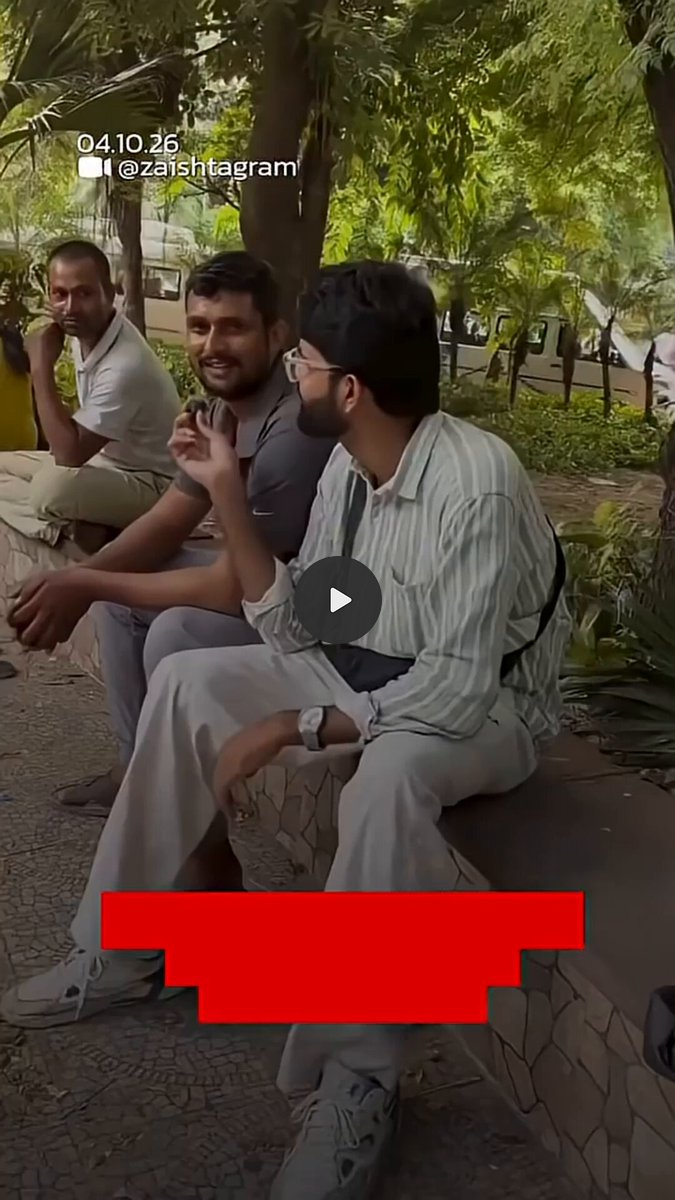
So indiscriminate were the police in picking up suspected protestors on October 10, 11 and 12 that they also scooped up the driver of a bus the police had themselves brought to central Delhi to detain people.

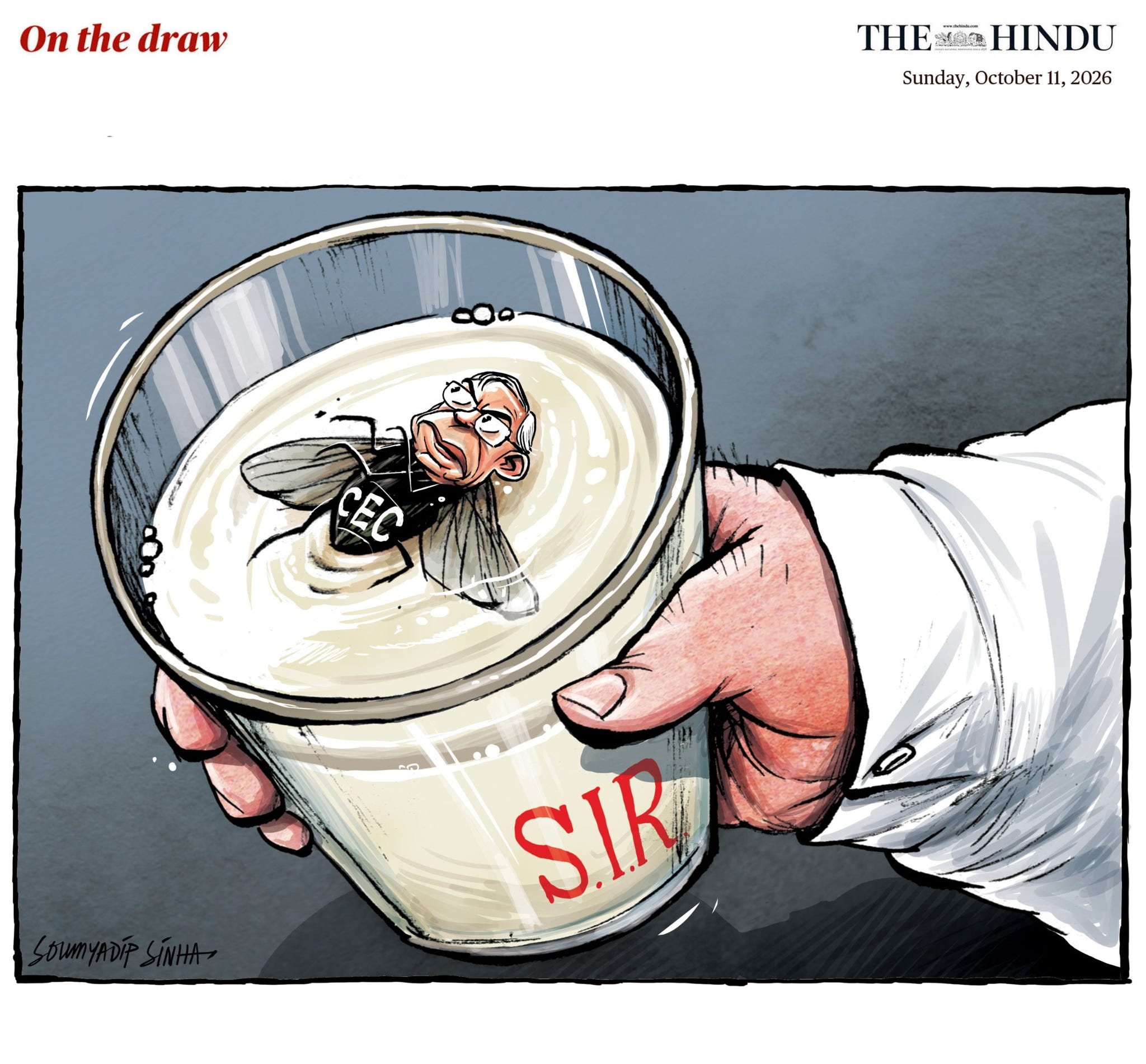
Drawn and quartered
Deep dive
In the Leap Blog, Amol Phadke, Nikit Abhyankar and Umed Paliwal examine how renewable energy combined with storage can provide reliability and operational flexibility comparable to coal power at a lower, fixed cost, drawing on evidence from India’s market test.
Prime number: $70,000
The US Department of Homeland Security (DHS) has proposed requiring international students to pay up to around Rs 67.7 lakh ($70,000) for certain work-training programmes if they want to work in the US, as part of the Trump administration’s broader crackdown on foreign visa holders. This could have a significant impact on Indian students, who make up one of the largest international student communities in the US.
Opeds you don’t want to miss
When a private company’s software effectively overrides statutory authority and results in the mass exclusion of citizens from the electoral roll, that company – in this case, TCS – owes the country answers, writes S. Raghotham. More dramatically, he also asks whether there is a link between TCS, SIR’s digital stack, and the Noel Tata-N. Chandrasekaran tussle where the government clearly appears to have chosen a side.
Neera Chandhoke analyses how the alleged actions of CEC Gyanesh Kumar and Modi’s government have sparked public protests and how the movement against SIR will persist despite coercion.
Strong editorials in several dailies against the Modi government’s crackdown on peaceful protestors. “An authoritarian reflex in the national capital”, says Deccan Herald. “Instead of calling for accountability from the Election Commission of India, which has disenfranchised millions of Indians in a clear act of illegality, the BJP and its central and State governments are deploying the strong arm of the state to defend him,” writes The Hindu, adding: “That itself suggests that Mr. Kumar’s relationship with the BJP is different from his relationship with all other parties. The Modi government should play by the rules, and not misuse power against citizens.” The Telegraph also looks forward, even as it condemns the crackdown:
“Gyanesh Kumar’s resignation — if his transgressions are proved true — is not going to resolve the matter. His departure, if it does take place, could be followed by the government appointing another pliable functionary. The malaise is deeper; it is systemic. What is required is the certainty that the selection process of the members of the Election Commission of India must take place on even, impartial ground.”
Craig Tindale writes about India’s “existential materials trap” – its dramatic, even crippling over-dependence on imported minerals and formulations that its public sector companies once excelled at making but which successive governments shuttered in favour of privatisation:
“The irony is bitter. A republic born of the fight to throw off colonial chains, whose first leaders built state plants to make its own rare earths, magnesium and penicillin, put on new chains by choice. It took up the West’s financial doctrine, which counts dollars and cannot see smelters. It closed the banks that funded its factories and let its plants rust. Today India is solvent in money and insolvent in matter, and the country that profits is the one it fears most.”
Namita Bhandare criticises Indian media obituaries on Nana Patekar for ignoring the allegations of sexual harassment and groping made against him by actor Tanushree Dutta:
“An obituary is not a verdict, nor does it settle allegations. Patekar’s considerable talent, his achievements as an actor and a philanthropist are a matter of record. But so are Dutta’s allegations and the price she paid. More than an individual accusation, they tell us about the power imbalance in the film industry, they tell us about the unacceptable price of speaking up. To leave that out while celebrating the rest is to tell only part of the story.”
Listen up
Apoorva Jadhav speaks to G. Sampath about India’s demographic dividend, and whether its cities are ready for the jobs and growth ahead.
Watch out
Journalist Aakar Patel speaks with Professor Radhika Desai on ‘Do World Leaders Even Respect Modi?’
Over and out
A Hindustani Bella Ciao echoes outside the metro station at lunchtime in the capital as the anti-establishment protest finds its voice in ‘Jana Gana Mana Adhinayak’.
Samar Jodha looks at Ahmed Ali’s photographs of workers and industry “within the wider history of industrial photography, from Soviet state imagery and Sunil Janah to Lewis Hine.”
That’s it for today. We’ll be back with you tomorrow, on a device near you. If The India Cable was forwarded to you by a friend (perhaps a common friend!) book your own copy by SUBSCRIBING HERE.