
A newsletter from The Wire | Founded by MK Venu, Pratik Kanjilal, Sidharth Bhatia, Siddharth Varadarajan, Sushant Singh, Seema Chishti, and Tanweer Alam | Contributing writers: Kalrav Joshi, Anirudh SK
If you like our work and want to support us, then do subscribe. Sign up with your email address by clicking on this link and choose the FREE subscription plan. Do not choose the paid options on that page because Stripe – the payment gateway for Substack, which hosts The India Cable – does not process payments for Indian nonprofits.
Our newsletter is paywalled but once a week we lift the paywall so newcomers can sample our content. Today is that day. To take out a fresh paid subscription or to renew your existing monthly or annual subscription, please click on the special payment page we have created – https://rzp.io/rzp/the-india-cable.
Snapshot of the day
April 24, 2026
Anirudh S.K.
Washington will dispatch special envoy Steve Witkoff and US President Donald Trump’s adviser and son-in-law Jared Kushner to Islamabad on Saturday for a second time to conduct direct talks with Iran, the White House has announced. Vice President JD Vance, who led the US delegation to the Pakistani capital for the previous round of peace talks, “is on standby and is willing to dispatch to Pakistan if we feel it’s a necessary use of his time”, press secretary Karoline Leavitt said. Iran’s foreign minister Abbas Aragchi is already in Islamabad, having arrived on Friday night. For his part he did not say who would meet, writing that his visit relates to “bilateral matters” and consultations on “regional developments”.
Pakistan had been trying to orchestrate a second iteration of talks after the first round ended without an agreement. Trump earlier this week indefinitely extended the ceasefire with Iran but the US continues to blockade Iranian ports on the Strait of Hormuz, something that Tehran had deemed a violation of the ceasefire and which prompted it to resume its own closure of the key chokepoint.
The deputy foreign ministers and special envoys of the BRICS countries met in Delhi on Friday but their meeting did not yield a joint statement; instead India, currently BRICS chair, issued a chair’s statement, highlighting divisions in the expanded grouping: Iran and the UAE, which Tehran has struck in response to the US-Israeli attacks on itself, are both members. The chair’s statement said that attendees “expressed deep concern on the recent conflict in the Middle East and offered views and assessments on the matter”. This is a break from the grouping’s more pointed language last year under Brazil’s leadership. The current impasse also occurs as Iran has urged BRICS to play a “strong” and “constructive” role in addressing the crisis.
High-frequency indicators of economic activity for March “displayed divergent trends” against the background of the West Asia war, wherein “demand conditions remained resilient, despite some pockets of slowdown in economic momentum”, the RBI has said in its ‘State of the Economy’ publication included in its bulletin. The central bank said that although overall demand conditions were resilient, “early signs of deceleration are … evident in select indicators like port cargo, air passenger traffic and the outlook of purchasing managers”.
Elevated oil prices caused by the war as well as a decline in IT stocks took the Nifty 50 and Sensex indices down by 1.9% and 2.3% respectively over the week, ending two weeks of gains. Alongside the heavy foreign portfolio outflows India has witnessed, the spike in oil prices has also eroded the valuation of the rupee relative to other major currencies: its 40-currency real effective exchange rate went down to 92.72 per the RBI’s bulletin. Jaspreet Kalra explains that
“A weaker real-effective exchange rate helps make exports out of India more competitive, while increasing the cost of imports. It also offers foreign investors a cheaper entry point to the currency, even while hitting the value of their existing investments in Indian equities and fixed income in foreign currency terms.”
As Pakistani officials prepared to host a second round of US-Iranian peace talks on short notice, swathes of Islamabad remained cordoned off, affecting business and travel plans. A produce vendor pointed out speaking to Ariba Shahid that trucks full of fruits and vegetables are idling outside the perimeter, and a bus station manager said that over a thousand passengers have been cut off every day. Journalists are among those affected too: “Camera crews remain poised. Equipment is ready. Phones are checked and rechecked. But after a week of waiting, there is little to report,” Shahid wrote in her report published before Witkoff and Kushner’s second trip was announced.
Seventy-three opposition MPs have submitted a second notice seeking the removal of Chief Election Commissioner Gyanesh Kumar, citing nine alleged faults including a “partisan asymmetry” in enforcing the model code of conduct, the Election Commission’s “straight talk” post aimed at the Trinamool Congress and the “mass disenfranchisement” caused by the West Bengal special intensive revision, Sravasti Dasgupta reports. The MPs submitted their notice to the Rajya Sabha secretary general days after their previous attempt was rejected by the chairmen of both Houses.
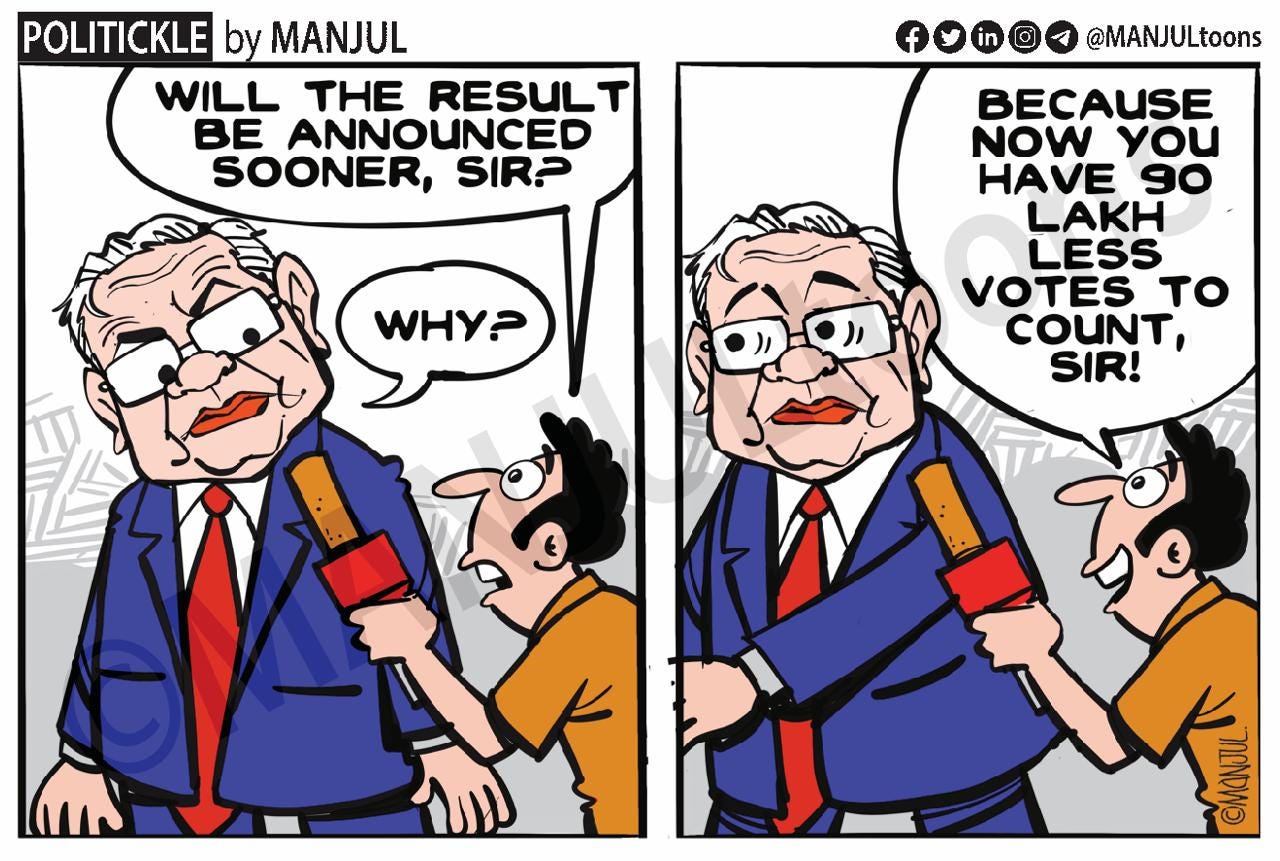
In a move that raises serious questions about access to electoral rights, the Supreme Court refused to hear petitions from electoral officers whose names were struck off the rolls during the Bengal SIR – even as the first phase of voting is over. LiveLaw reports that 65 officers on election duty, complete with EPIC numbers, approached the court after being left out of the rolls. A bench led by Chief Justice Surya Kant sent them back to appellate tribunals that the petitioners said have yet to act on their appeals already filed on April 5. The court’s refusal to entertain the petition will mean that there is a good chance their appeals will not be heard in time. Out of over 14 lakh people found ineligible to vote in the first phase, only 136 were reportedly cleared by the appellate tribunal – barely 0.01% of those affected.
Yesterday the Congress issued a “summary response” to the EC’s notice to party president Mallikarjun Kharge for calling Modi a “terrorist”, denying that it had violated the model code of conduct and objecting to the 24-hour response window given to it as insufficient given that Kharge was in the middle of campaigning. The response, written by party MP Jairam Ramesh to CEC Kumar, also said Modi violated the MCC with his April 19 national address and, allegedly, Shah with his pre-poll remarks but that the EC did nothing then. Ramesh also said that the Congress received two copies of the notice, each signed by a different official and only one of which mentioned the Trinamool Congress’s Derek O’Brien as a complainant [see Drawn and quartered].
Meanwhile, the Indian Express reports that the Enforcement Directorate conducted almost 20 operations in West Bengal over the past two months – involving searches of more than 50 premises across six cities, summons to nine individuals and arrests of four people. The ED has framed many of its interventions as efforts to ensure “free, fair and fearless elections”, a claim strongly contested by the Trinamool Congress.
Among the notable actions were searches at the residence of I-PAC director Pratik Jain and the arrest of fellow director Vinesh Chandel. I-PAC, a political consultancy firm, counts the TMC among its major clients.
As Pavan Korada observes, the pattern is hard to miss: Union agencies like the ED are frequently deployed by the BJP during elections, even as its conviction rate remains low and trials in most Prevention of Money Laundering Act have yet to begin. [See Item 1]
Hearing a case where the Saharanpur police lodged a kidnapping FIR based on a complaint by the father of an 18-year-old woman saying she had eloped with another man, the Allahabad high court was not amused. “No one has business to tell a major, where he or she will stay, or with whom he or she will live, marry or spend his or her life,” the bench comprising Justices J.J. Munir and Tarun Saxena said this week while quashing the FIR. It pointedly added: “The police are doing great disservice by registering FIRs such as these, and more than that, chasing the young couple, [sometimes] with [an] ulterior motive to forcibly separate them … These actions are absolutely illegal and some of them are offences.”
In light of the AI firm Anthropic claiming that its new model Claude Mythos has identified “thousands of high-severity vulnerabilities, including some in every major operating system and web browser” – something that has generated consternation in the financial and regulatory worlds – Union finance minister Nirmala Sitharaman met the chiefs of various banks along with senior officials from the RBI and the National Payments Corporation of India to take stock of the situation.
Appearing for the All India Muslim Personal Law Board, advocate M.R. Shamshad argued in the Supreme Court that while Islam does not prohibit women from going to mosques, they cannot enter through the front door or demand not to be separated from the men inside. The court was considering constitutional questions arising from the challenge against its 2018 Sabarimala judgment as well as a plea by a Muslim couple from Pune. Shamshad also said that “as far as men’s position is concerned, it is obligatory for him to be part of the congregation … For women, it is preferable that she stays at home”, although she is not prohibited from going to the mosque.
When the three-member selection committee comprising the prime minister, the home minister and the Lok Sabha leader of opposition deliberated on whom to appoint as chief information commissioner, Rahul Gandhi had asked that former IAS officer Sumita Dawra be made CIC or, if the panel was inclined to peruse names outside the shortlist prepared, consider former Odisha high court Justice S. Muralidharan or academic Faizan Mustafa too. The government-majority panel ended up selecting Shah’s choice, ex-law secretary Raj Kumar Goyal, as CIC, per documents the Union personnel and training has now made public.
A year after the deadly Pahalgam terrorist attack, Peerzada Ashiq reports that local residents are still struggling with its aftermath. Tourism remains subdued, many have lost their livelihoods and a heavy security presence continues to shape daily life, leaving the community facing an uncertain future.
Earlier this week the CBI arrested one official each from the Directorate General of Civil Aviation and Reliance Industries on allegations that they agreed on a bribe to process drone import applications from Reliance subsidiary Asteria Aerospace. Today a Delhi court remanded the duo to judicial custody till May 6. For those of us who have never heard of Asteria before, Reuters has this primer.
Zen Sadavarte, daughter of lawyer Gunratan Sadavarte, has filed a police complaint against the woman who bravely confronted Maharashtra BJP minister Girish Mahajan after his rally against the opposition’s blocking of the Modi government’s delimitation agenda choked up the city’s Worli neighbourhood. Sadavarte alleged that the unidentified woman attempted to trigger a stampede and sought action against her under multiple sections of the BNS. No FIR has been lodged (yet), but one has been registered against members of the BJP morcha for violating the conditions under which the march was greenlit.
Raghav Chadha, Ashok Mittal, five other AAP Rajya Sabha MPs set to join BJP
Weeks after his public falling out with the Aam Aadmi Party, which moved to replace him as its deputy leader in the Rajya Sabha with Ashok Mittal, Raghav Chadha is now set to join the BJP, which he had called “anpadh gundon ki party” (‘a party of uneducated thugs’) in 2022. In a press conference in Delhi with Mittal and Sandeep Pathak, Chadha announced that he, alongside two-thirds of the AAP’s members in the Rajya Sabha, have decided to “merge ourselves with the BJP”. “Besides us, there are Harbhajan Singh, Rajinder Gupta, Vikram Sahney and Swati Maliwal,” he announced, saying that the AAP is no longer working “in the national interest but for personal gain”. This also comes a week after the ED conducted searches at premises linked to Mittal. AAP Rajya Sabha MP Sanjay Singh said he will formally ask to have Chadha, Mittal and Pathak disqualified from the House.
The timing is telling. Modi’s home state, Gujarat, is heading for local body elections, which are about more than municipal control [See Prime number]. While the BJP remains comfortable in its home state, the AAP has emerged as a significant rival. Once these seven AAP leaders formally become BJP MPs, the NDA’s strength in the currently 244-member strong Rajya Sabha would further increase to 149 (and the BJP’s to 113).
Telangana police invoke UAPA to extract info on outlet critical of ruling Congress
Telangana’s police have invoked the draconian, anti-terror Unlawful Activities (Prevention) Act to seek information pertaining to the X account of TeluguScribe, a social media outlet whose content is critical of the state’s Congress government and favourable of the Bharat Rashtra Samithi. An official of the police’s intelligence wing wrote to X saying that TeluguScribe’s account “is purported to contain derogatory content aimed at defaming in the local Public of Telangana State [sic]”. This content not only “undermines the dignity of a public figure” but could “incite hatred and violence”. TeluguScribe called the move “nothing but a blatant abuse of power”. Activists too have slammed the police’s actions.
Sergio Gor may go to Kathmandu as both US and China court new Balendra Shah govt
Sergio Gor, who apart from being the US’s ambassador to India is also special envoy for South and Central Asia, is planning to visit Kathmandu for four days starting April 30 as both Washington and Beijing forge ties with the new Balendra Shah-led government, reports Anil Giri for the Kathmandu Post. He writes it is not clear if Shah – who became prime minister after a landslide election victory in the wake of the youth-led violent uprising of September – will meet Gor because of his reported policy of meeting only ministers or higher-level officials from abroad. Gor’s visit would occur days after assistant secretary of state S. Paul Kapur’s trip to Kathmandu, which took place concurrently with that of Chinese foreign ministry official Cao Jing.
Book excerpt
Rape, beatings, addiction: the incalculable burdens borne by Delhi’s homeless girls
Harsh Mander
A sullied hand tugs insistently at your clothes. You turn to see a little arm outstretched – peremptory and tentative at the same time – a small head of tousled, matted hair, patchy and pallid skin coated with many days of unwashed dirt, bare sprightly feet, and a loose faded frock almost slipping off the little girl’s slender shoulders. On those shoulders rests the burden of the survival of a large destitute family. And yet, almost miraculously, what shines through the grime is the most beautiful pair of sparkling black eyes.
Delhi has far fewer street girls than boys, but those girls who are forced to work on its mean streets negotiate daily the metropolis at its most predatory. Shahida is barely ten years old. Part of a family of migrants from a village near Kolkata, she is delicate and fragile behind her grubby exterior. Neither she nor her younger sister can hear or speak. Their father is addicted to smack and lolls about all day in a small rented hut in Shastri Nagar. His two daughters beg with wordless insistence at Hanuman Mandir near Yamuna Pushta.
To throngs of waiting beggars, some temple devotees give bananas and other fruits, others bring cooked kulchas and kachoris with halwa; many give away sweetmeats as prasad. On festival days or in memory of loved ones, some even distribute clothes. But the day’s work for the sisters is not complete without collections of alms of cash, coins wheedled out of those who line up for worship at the shrine. Their mother sits on a side lane, and the deaf-mute girls leave with her their collections, and run back for more.
A group of volunteers are sitting outside the temple gates, talking with a group of girls who live by begging. Suddenly Shahida tenses, visibly wilts and tries to hide behind one of the young women volunteers. An older street girl, Shabana, fiercely runs and grabs the shirt of a disabled old man who is walking past. He too cannot speak, but he angrily gesticulates and threatens the girls. Shabana protectively embraces the younger Shahida. Her unspeakably gloomy and sordid tale then unfolds.
Shahida’s mother has sold her daughter to this aged man, a veteran of the temple premises. He rapes her regularly and in return, he gives money to the family to enable it to survive from day to day. We find her mother and urge her to let us take the girl under our care. She declines sadly. “I love my daughter. But if I let her go, how will we live?” While we plan to requisition the police to rescue the girl, I struggle to not judge the utterly defeated older woman. But I find this very hard.
Shabana’s family migrated years ago from Bihar. They had built a tiny shanty in a slum near the iron bridge across the Yamuna River, not far from the cremation grounds, and lived there for 18 years. But more than three years ago, these were razed by government dozers and they were forcibly shifted to a resettlement site in distant Bawana. The house sites there required a down payment of Rs 7,000, which they could not afford to pay. So they now live under a blue plastic sheet on a pavement.
Each day, the family of six takes a two-hour crowded bus ride each way, costing Rs 10 each, to reach the Yamuna Pushta area. Their father used to ply a rickshaw in Chandni Chowk, but these were recently banned by the traffic police, so he mopes unemployed. His four children have been set to work. For the younger two, work is begging at the temple, and for the older ones, earnings are more through ragpicking.
Many street boys courageously negotiate lives alone on the streets, rebelling against abuse and neglect in their homes by severing links with their families. By contrast, most street girls we encounter in Delhi continue to live on pavements or in slums with families, which send them out to earn to support their siblings and parents. This they do stoically and bravely, but with much less of the reckless joyfulness that street boys craft out of their hard-won freedom.
In their early years, street girls mostly beg. As they grow older, the majority rag-pick at waste dumps and markets, earning more than Rs 100 daily. Bullied and molested, they learn to shout swear words, and grapple with their fists. Many chew tobacco or sniff adhesive solution bought from cycle shops for a high. And either through their parents or on their own, many learn early ways to furtively earn larger sums from older men who seek street-sex with children.
Sita is 14, and is often detained by the local police. They call her an incorrigible thief. For years, her family has sent her out to earn, beating her if she returns with less than Rs 150 each evening. Usually this is not difficult, as she is an expert rag-picker. But she is not just her family’s principal bread earner; she is also a child. And there are days when she and her street friends lose track of time in their games in the public park. She realises it is evening, and she will be thrashed if she returns home empty-handed. So she breaks into homes and steals what she can clutch and sell in the black market. Other days, she finds a man who wants sex: they are easy to spot. She takes money in advance, and they quickly conclude their liaison in a dark corner of a park. Sometimes she is able to nimbly run away with the man’s money before he is able to grab her, but mostly she is not so lucky.
Many street girls have single mothers. Zahida’s husband left her ten years ago, and her sons grew into drunken vagabonds. It is her two daughters who help her light the kitchen fires through rag-picking. Asha’s father also left home, leaving behind three brothers and three sisters. Her mother started living with another man, who drinks away the money that the children bring home from rag-picking. For Zahida, the story was the same but it ended in gruesome tragedy five months earlier, when the man she lived with killed her son in rage when she refused to part with her life’s savings of Rs 4,000. He is now in jail, and Zahida is surviving on the pavements of Bawana.
Chandni’s blind mother has begged all her life but heroically taken her five daughters through elementary school. Proud that she has studied up to class VII, Chandni insists on speaking in broken English. But most street girls are not so fortunate. Every single girl we have met on the streets longs to study, but this is possible only if the government opens hundreds of residential schools for them.
The Delhi government has at last agreed to help us open three such residential schools for street children. And many more mothers have agreed than the schools have space for, to sacrifice the earnings of their girls so that they live safe and happy childhoods illuminated by learning.
One girl tells us wistfully, “Even if my father does not let me go, I want to wear a school uniform even for one day. Can I at least do that? Just for one day?”
Excerpted from Under Grey Smoggy Skies: Living Homeless on the Streets of India’s Cities (Yoda Press, February 2026). Harsh Mander is a social worker and writer.
Reportedly
During a discussion at the Hudson Institute on the ‘blind spots’ of the Indo-US relationship, Ram Madhav, who is seen as the RSS’s most credible voice on foreign affairs, asked what India may be doing wrong even after acceding to Washington on Iranian and Russian oil as well as Trump’s 50% tariff. “So where is India lagging behind exactly?” he asked on Thursday. Clearly his comments have embarrassed the Modi government because he took to X on Friday to ‘correct’ himself. “What I said was wrong. India didn’t agree to stopping import of oil from Russia anytime. Also it vigorously protested 50 percent tariff imposition … But factually incorrect. My apologies,” he said.
Drawn and quartered
Deep dive
After 2019 but especially after the 2024 general elections in which the BJP lost its parliamentary majority, Amit Shah’s public profile has been on the rise. He addressed more rallies in Bihar than Modi during last year’s election, was sitting next to Nitish Kumar as the latter filed his Rajya Sabha nomination this year, and has moved the government’s contentious business in parliament, including its delimitation agenda. Sravasti Dasgupta fleshes out this growth in Shah’s profile against the background of his overall political arc – and considers what it could mean in the short term but also for any succession plans the BJP may have for Modi.
Prime number: 730
In some 730 seats across the local bodies in Gujarat that are set to go to polls on the 26th, there will be no election because only one candidate remained in them after others withdrew their nominations. Here there is a “deeper concern about whether a level playing field existed in the first place”, Mehul Devkala writes in The Telegraph, noting the glaring parallel with the story of the pig Napoleon in George Orwell’s Animal Farm.
However, it isn’t just candidates who are under pressure: the BJP MP for Anand, Mitesh Patel, recently told voters that if they elected a Congress leader then ‘not a single rupee from his development grant would reach them’.
Opeds you don’t want to miss
Without a Quad summit hosted by India last year, and no summit planned for this year, the grouping is on the brink of extinction, writes Derek J. Grossman.
Against the backdrop of the energy shortages India is facing due to the West Asia war, Andy Mukherjee moots the idea of three time zones for the country. “If morning alarms in the eastern region go off half an hour earlier than now, its factories and offices could start and finish while large solar farms in the west are still pumping cheap electricity into the grid … The load on the national grid would get less spiky if the entire nation doesn’t simultaneously ramp up electric stoves, EV chargers and high-intensity cooling in factories and data centres.”
Instead of “empowering civil society leaders willing to advance peace and punishing those promoting and engaging in violence”, “political variables focused more on retaining power than achieving peace appear to have kept those seeking to advance hardline views in positions of influence on both sides of the divide” in Manipur under the BJP at the state and Union levels, The Hindu writes in its editorial. The state is reeling from a fresh uptick in unrest.
The Modi government went ahead with its Constitution (131st Amendment) Bill last week even though it knew it could not cross the two-thirds threshold in the Lok Sabha. In doing so, V. Venkatesan writes, “what is abused is not the amendment but its engineered defeat, recast as opposition obstruction”. The way the Bill was tabled and voted upon “threatens … the [two-thirds] rule’s standing as a serious constitutional instrument. When a government tables an amendment it knows cannot pass, the test the rule was meant to impose never runs.”
Kiranjot Kaur points out that the Punjab government’s new amendment to the Jaagat Jyot Sri Guru Granth Sahib Satkar Act could end up “[criminalising] natural wear and tear and accidental damage” to copies of the Guru Granth Sahib owned even by individuals and provide legal backing to religious vigilantes. With that in mind, she writes, the fundamental question is this: “can the state protect religious sanctity without encroaching on religious autonomy?”
Listen up
After the Modi government’s Constitution (131st Amendment) Bill leading its delimitation package was defeated in the Lok Sabha, the BJP has turned its attention to the state elections. Modi “has fallen on his nose and now he has turned aggressive,” says Nilanjan Mukhopadhyay, journalist and author, in this podcast conversation with Sidharth Bhatia.
Watch out
Writer and researcher Dhirendra K. Jha discusses the relationship between the RSS and the US with The Caravan’s Vishnu Sharma – explaining that since India’s independence in 1947, the US has sought to strengthen ties with the RSS because it saw the organisation as a counterbalance to the Congress. [In Hindi]
Over and out
Chillies are a staple of Indian cuisine and a vital crop for many women farmers. Despite the labour-intensive nature of the work – which discourages their male counterparts from taking it up – women farmers in Tamil Nadu say it offers a sense of independence that keeps them going. “If we labour hard enough in the fields for those few months, that extra income is enough to keep our homes running for the rest of the year,” one farmer told Kamala Thiagarajan. NPR captures their stories in a striking photo feature.
The MEA’s acquiescent response to Trump’s racist “hellhole” remark is telling. While Iran’s missions across India – from Hyderabad to Mumbai – took sharp digs at Trump, offering a masterclass in public diplomacy, India’s response felt timid and forgettable. Iran appears to be defending India’s reputation and honour stronger than the Modi government is.


That’s it for today. We’ll be back with you on Monday, on a device near you. If The India Cable was forwarded to you by a friend (perhaps a common friend!) book your own copy by SUBSCRIBING HERE.