
A newsletter from The Wire | Founded by MK Venu, Pratik Kanjilal, Sidharth Bhatia, Siddharth Varadarajan, Sushant Singh, Seema Chishti, and Tanweer Alam | Contributing writers: Kalrav Joshi, Anirudh SK
If you like our work and want to support us, then do subscribe. Sign up with your email address by clicking on this link and choose the FREE subscription plan. Do not choose the paid options on that page because Stripe – the payment gateway for Substack, which hosts The India Cable – does not process payments for Indian nonprofits.
Our newsletter is paywalled but once a week we lift the paywall so newcomers can sample our content. Today is that day. To take out a fresh paid subscription or to renew your existing monthly or annual subscription, please click on the special payment page we have created – https://rzp.io/rzp/the-india-cable.
Editor’s note: This post may be cut off in your inbox due to length. Click on the title above to read it in full on Substack.
Snapshot of the day
October 30, 2026
Kalrav Joshi, Anirudh S.K., Siddharth Varadarajan
Door-to-door enumeration for the population census – officially Phase II of the census process – will be conducted across India from January 25 to February 28, 2027, the Census Commissioner announced on Friday. In Uttarakhand, Uttar Pradesh, Goa and Punjab, the enumeration exercise will take place in the first week of January, as announced earlier, as these states go to the polls in February. The dates for Manipur will be announced later. According to an official notification, the reference date for the census shall be 00:00 hours of March 1, 2027, and will be the first census India has held since 2011.
“Enumerators will ask a set of 40 questions, including 13 new questions such as caste, (other than Scheduled Tribe/Scheduled Caste), religion, place and date of birth of both parents, number of bank accounts, spouse’s name, nationality, digital literacy, permanent residential address, place of Covid-19 vaccination, passport number, driving licence availability and mobile, Aadhaar and voter ID numbers, if available, which will be asked for the first time,” reports Vijaita Singh.
While the collection of Aadhaar details is not mandatory, the authorities may be training ground-level personnel to coax residents into providing it anyway. Vijaita Singh, who attended a census training programme in Uttar Pradesh, quotes a trainer as telling his students that:
“If any respondent creates an issue, they need to be told that the particular question is only to find out how many people have an Aadhaar. They are to be told clearly that we are not seeking their bank account details and Aadhaar cannot be used without biometrics anyway…”
Followed by these curious remarks:
“… At present, there is no single document that proves citizenship. If we get the accurate information during [the] census, then in the future, this document may act as a proof of citizenship.” (At the same time the trainer notes that census data is confidential.)
Aadhaar is only one of 13 new topics that this much-delayed population census will cover, and the new questions being asked have raised eyebrows because of their resemblance to those asked during the rehearsal for the controversial National Population Register, which its opponents said could be a precursor to a nationwide National Register of Citizens. A senior census official told Singh that “there is no instruction to link Aadhaar with [a] citizenship test”. Last month, former deputy registrar general K.N. Unni had noted that though census data is indeed confidential, there is a precedent in the 1951 census data being used to prepare a nationwide National Register of Citizens.
The Opposition’s movement against Chief Election Commissioner Gyanesh Kumar will see a ‘public impeachment’ on October 31 and a rally at the Ramlila grounds in Delhi on November 1, Sunday.
Manipur’s Kangpokpi district is under a 48-hour shutdown, the latest in a series of shutdowns over the past few weeks as tensions, abductions and attacks continue to escalate across the state. The latest call, issued by the Kuki-Zomi outfit Committee on Tribal Unity (CoTU), follows the alleged abduction of two Kuki men and demands their safe and unconditional release.
Meanwhile, tensions between the Meitei and Kuki communities have now extended to clashes between Meitei Hindus and Meitei Pangals. The unrest remains unresolved since 2023, even as parties in the ruling alliance trade charges against one another.
The law holds that the constituency-level electoral registration officer (ERO) has the power to decide who ought to be on the voter rolls. But this does not seem to have mattered in West Bengal where, during its especially contentious special intensive revision, EROs’ and assistant EROs’ decisions to place or remove electors on or from the rolls were sidelined by ‘observers’ appointed by the Election Commission, Aparna Bhattacharya reveals.
Drawing from official data from Bengal’s Nadia and Murshidabad as well as testimony from an AERO source, Bhattacharya reports: though the Supreme Court in February had ordered that cases still pending with EROs and AEROs on the deadline for the claims-and-objections period must be decided by judges (itself an unprecedented move), in reality cases that EROs and AEROs had already adjudicated on went to these judges as well, and in no trivial quantities at that.
The figures from Murshidabad are startling – though the district’s 22 EROs had by the deadline parked 18.3 lakh names for inclusion on to the final rolls, marked 41,214 for deletion and were yet to get to 13,513 others, a week later 11.01 lakh voters were marked ‘under adjudication’, and of these 4.55 lakh were struck off the rolls (that’s ten times as many people EROs/AEROs had flagged for deletion). This was because EC-appointed observers flagged cases already decided by the EROs/AEROs. Significantly, the EC’s communications from that time indicate it was not forthcoming about how cases ended up in this ‘under adjudication’ heading. And we all know what happened to those deleted by these judges – there were 27 lakh of them across Bengal – they ended up not being able to vote in the April assembly elections, not because they were once-and-for-all determined ineligible, but because the system was not given an opportunity to completely adjudicate their cases.
There’s more. What happened in Bengal did not go do down well with chief election commissioner Gyanesh Kumar’s two colleagues in Nirvachan Sadan, commissioners Sukhbir Singh and Vivek Joshi, whose “unease with the CEC peaked over this decision of switching decided cases onto adjudication overnight”, reports Bhattacharya citing highly placed sources.
Though the EC has said that the SIR declaration it has attached to Form 6 – asking new elector applicants for their or their relatives’s details on a past SIR roll – is only needed during the revision exercise, in Telangana officials have rejected Forms 6 that were submitted during the pre-SIR phase too on the grounds that they didn’t have this declaration attached, reports Swathi Vadlamudi. Despite the rules requiring Form 6 details to be exhibited at the ERO’s office and disposed of within a week, forms submitted up to June 14 (just before the SIR began in Telangana) are being processed now along with those filed during the SIR, Vadlamudi notes.
Every week more mischief by the BJP’s booth-level agents during the SIR comes to light. Suruchi Kumari reports from northeast Delhi’s Mustafabad constituency that though BJP BLA Chandra Shekhar Nainwal sought the deletion of 28 electors in the Dayalpur neighbourhood on the grounds that they have moved away or are absent, she could find all of them living there only. Mustafabad stands out in Delhi for recording the highest number of Form 7 applications at 843.
A helicopter carrying six people, including the pilot, has crashed amid snowfall and severe weather in Uttarakhand’s Joshimath, with search and rescue operations underway. The Dehradun-bound aircraft, operated by private firm Trans Bharat Aviation Pvt Ltd, took off from Badrinath at around 1:14 pm before losing communication over the Joshimath valley, officials said. The crash comes amid a troubling record of helicopter accidents along the Char Dham pilgrimage route, despite aviation authorities having “tightened safety checks and restricted some operations” following multiple accidents during the 2025 pilgrimage season.
Evidently rattled by a shifting public mood across the country – with the comments on Narendra Modi’s post on X offering just a glimpse of the discontent – the BJP is reaching for another polarising election plank. Union Home Minister Amit Shah has announced that the party will implement the Uniform Civil Code in Uttar Pradesh if it wins the 2027 Assembly elections. “This time, when the government comes to power, UCC will be implemented in Uttar Pradesh,” Shah told party colleagues at a daylong executive committee meeting in Lucknow, according to the Indian Express. “UCC has already been implemented in many states. If you form the BJP government in Uttar Pradesh, we will implement UCC in Uttar Pradesh.”
Putting an end to months of speculation over Brij Bhushan Sharan Singh’s political comeback, the controversial former BJP MP and ex-Wrestling Federation of India chief has been named to the party’s Uttar Pradesh state executive committee, three months after his acquittal in a sexual harassment case brought by female wrestlers. Ahead of the 2024 Lok Sabha elections, the BJP had dropped him from its candidates’ list amid the allegations, fielding his son from Kaiserganj instead.
Nepal’s police carried out a crackdown on the media in Kathmandu today, picking up three journalists and attempting to find at least three others. Two among the latter are Khagendra Pant and Nabaraj Mainali, editor and senior correspondent respectively with the Naya Patrika daily, who broke an explosive story yesterday revealing power broker Inam Sapkota’s communications with sitting Supreme Court Justice Hari Prasad Phuyal, including on a case which Sapkota sought to have dismissed claiming Prime Minister Balendra Shah’s interest. Those detained are NepalPress.com’s Bishwamani Subedi, Shobharaj Baral of Motivate News and Dhiraj Basnet of DNA Khabar. This action may be related to reportage surrounding Kathmandu’s alleged plans to sack Nepal police chief Dan Bahadur Karki, though the authorities have yet to release a public statement.
The Press Council of Nepal has taken serious note of plainclothes police officers entering newsrooms and seeking to detain journalists without clearly articulating the grounds for picking them up and even as it is unclear whether a criminal case exists at all. Shah’s office has claimed no knowledge of the police action and the PM is said to have ordered the release of the detained journalists.
The National Commission for Scheduled Castes has drawn a clear line: government posts reserved for SCs cannot be dereserved. If no eligible candidate is found, departments must appoint an SC candidate on contract or bring in an official on deputation. The commission’s unanimous decision is a warning to the government against diluting reservation. Read Nidhi Sharma’s report here.
The Supreme Court, meanwhile, has expressed concern at the corporate affairs ministry “hijacking” the staff recruitment process for the National Company Law Tribunal, “impinging upon the autonomy” of the institution. The bench, which included Justice Joymalya Bagchi and Justice V. Mohana, issued notices to the Centre and the tribunal, seeking their responses on regularising the appointment process through the UPSC or the SSC.
Heat exposure caused an estimated loss of 193 billion potential labour hours annually in India between 2016 and 2025, 75% higher than the annual average in the 1990s, according to the latest Countdown report by Lancet. In 2025, potential earnings lost because of heat-related reductions in labour capacity were equivalent to 4.2% of India’s GDP, compared with 0.91% globally. The report prepared in collaboration with the World Health Organization and led by University College London, also noted that half of the heatwave days experienced by people in India between 2016 and 2025 were directly attributable to climate change. It found that heat exposure is affecting people’s health and livelihoods, while air pollution, climate-sensitive diseases and water stress pose additional risks.
Takedown orders targeting cartoons are bad enough but now the authorities are deploying them against things as basic as news explainers (clearly Ashwini Vaishnaw has a different sense of the term freedom in mind when he talks about freedom of the press). The toolbox that is the IT Act and its Rules – 69A, 79(3)(b), all that jazz – can be hard to wrap your head around, but this article by Sejal Sharma in the Hindustan Times is a helpful refresher and jumping-off point for further reading.
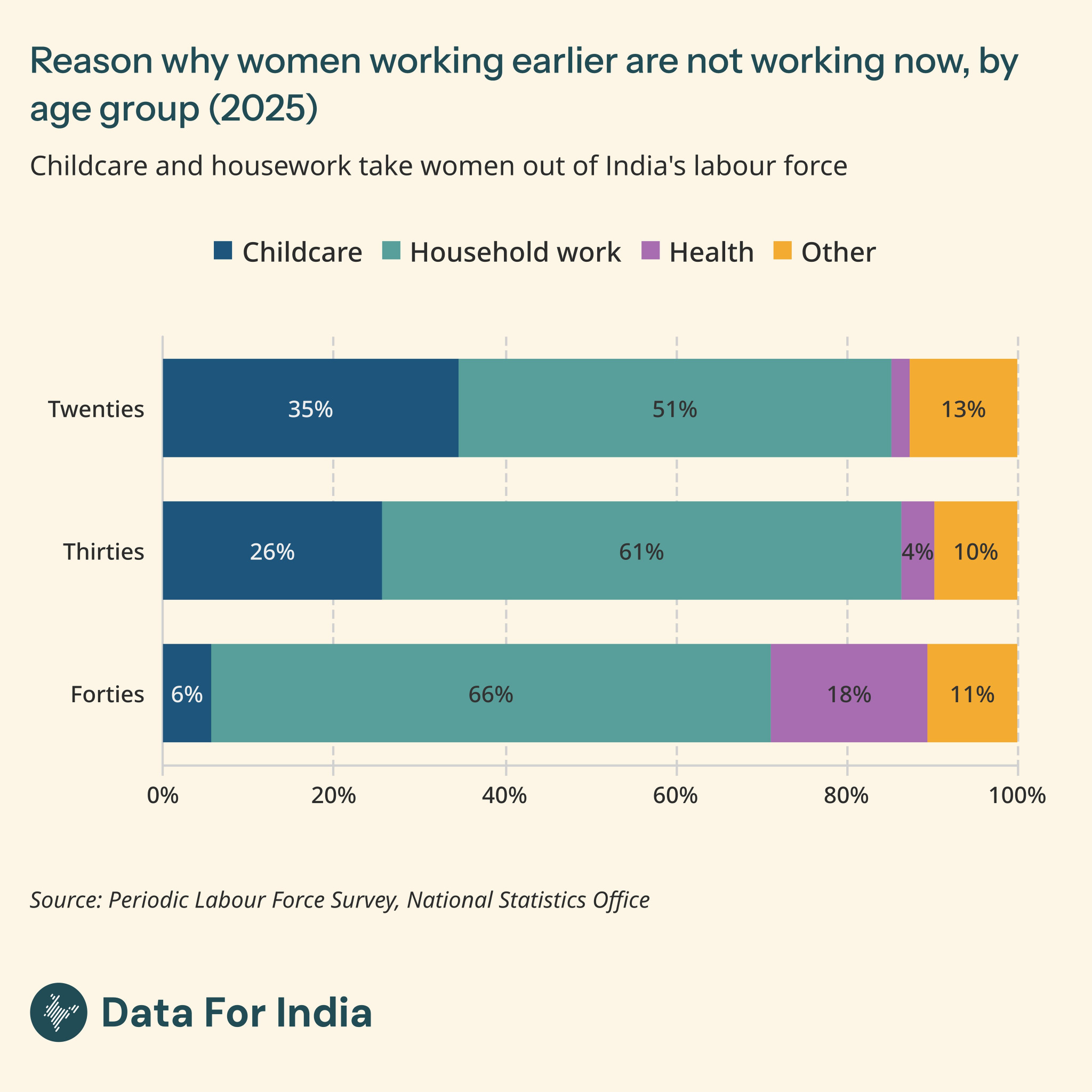
What the data says about why women drop out of the formal labour force
Childcare and unpaid housework continue to push women out of India’s labour force, notes A.K. Waghmare. “Both men and women may enter, leave, and re-enter the labour force for a range of reasons. However, the circumstances that take men and women out of the labour force are very different.
Health reasons take some women out of work as well, but the numbers are much smaller, and restricted to older women. Women in their twenties, thirties and forties who have dropped out of the labour force largely cite household work and childcare as the reasons they left the workforce. Childcare is a particularly important reason cited by young women, or those in their twenties. More than three in ten women between the ages of 20-29 years who were earlier working report childcare as the reason they do not work anymore.”
A tale of two citizens …
One R. Ganesh Kumar has approached the Madras high court seeking directions to the home ministry to probe Cockroach Janta Party leader Saurav Das’s nationality and to concomitantly cancel his passport and Aadhaar if he is determined to be a foreigner. Kumar – who also wants Das’s social media accounts blocked citing his ‘abuse of the judiciary’ – certainly thinks he is not Indian: he has “roots in Nepal” and fraudulently obtained Indian documents, he told the court. It is not clear what if any evidence he produced to that effect. And he didn’t stop there. Their lordships were also warned that Das is a “jobless person … [who] has used his social media handle to spread hatred amongst the youth”, alongside that he “is a communist” who “most definitely” must be receiving funds from abroad. Obviously, the court dismissed his petition at the outset. Just kidding – it has issued notice to the home ministry and to Das.
Das has not commented on this case but he did retweet a news item on a recent decision made by another high court: namely the Delhi HC’s move to quash the Central Information Commissioner’s order that the Air Force comply with an RTI request seeking details of PMs Manmohan Singh and Modi’s foreign trips on IAF aircraft. The applicant, information activist Commodore Lokesh Batra (retired), said the information must be released because it concerns public expenditure, but the IAF argued that releasing the information sought even with redactions would pose a national security threat. The high court took the IAF’s side, prompting Das to opine that in India there is “absolute privacy for some elected persons”.
Stubble burning ‘barely’ impacted Delhi’s AQI between 2024-2026
A recent study’s findings throw doubt on simplistic claims blaming stubble burning in Punjab and Haryana for Delhi’s air pollution. A new analysis by Delhi-based climate research organisation Climate Trends found that stubble burning fell 31.3% year-on-year across six northern states during the initial weeks of this season, and had ‘barely influenced’ the capital’s air quality in September and October between 2024 and 2026.
E20’s broken promise to farmers
In what has become a familiar pattern of governance, a policy is defended in the name of farmers, while the reality on the ground tells a different story. The government claims its E20 push benefits farmers, with Petroleum Minister Hardeep Singh Puri putting the figure at Rs 1.4 lakh crore. But Vaishnavi Rathore’s report from the ground in Uttar Pradesh and Madhya Pradesh finds little to show for it. Read why the ethanol push is failing farmers.
The Long Cable
Protest against ‘Modi’s Baap’ Remarks: Now Think of Modi’s ‘Pappu’, ‘Jersey Cow’, ‘Hybrid Calf’, ‘50 Crore Girl Friend’ Jibes
P. Raman
‘Modi ka baap bhi jayega’ (‘Modi’s father too will go’), Mallikarjun Kharge responded when someone from the audience said he will not be ousted without a rebellion against him. This was enough for the BJP bosses to launch nationwide protests against Kharge for ‘insulting’ the PM’s father, who had died in 1989.
Senior leaders like Amit Shah and Rajnath Singh will join the ‘Save Democracy, Remove Anarchy’ campaign soon after the opposition’s November 1 protests. This is all part of a drive. Shah may join its padayatras in Haryana and Telangana, while Singh could participate in Bhopal.
In reply to Kharge’s ‘Modi ka baap bhi jayega’, the BJP has now released a song ‘Modi kahi nahi jayega’ (‘Modi is not going anywhere’), which is being publicised in a big way.
But Shashi Tharoor, who was once moving closer to the BJP, does not agree with this proposition. ‘Modi ka baap bhi jayega’ is a common expression and does not amount to an insult to anybody’s father, he said.
Kharge’s ‘Modi ka baap’ remark pales in comparison with the sharp attacks Modi had hurled before and after becoming PM. During L.K. Advani’s Bharat Uday Yatra in 2004, Modi called Sonia Gandhi a ‘Jersey cow’ and Rahul a ‘hybrid calf’. In 2018, she was described as ‘Congress ki vidhva’ (‘Congress’s widow’). His jab on Tharoor was that he was the one with a ‘50 crore girlfriend’. Tharoor was then a Union minister.
As for Rahul Gandhi, let us confine ourselves to ‘Pappu’, the most abused term. He got the nickname soon after he began his political career. In fact, he had been the worst victim of nicknames and monikers. Just last month back the Madhya Pradesh chief minister had derided Rahul as ‘Pappu’. This, in turn, had provoked the Congress to say Rahul had already emerged as the “BJP’s papa”.
Shah, at his level, has been repeatedly deriding Rahul as Pappu. He had done so even six months before the 2014 elections. “Congress thinks the prime minister’s chair is Pappu’s birthright. But this is a democracy, you need people’s blessings, and the people’s blessings are with Narendra Modi,” said Shah at a rally.
The BJP even tried to put the Pappu jab in its election advertisements. However, the Election Commission – this was much before Shah put Gyanesh Kumar in the poll panel – strongly disapproved. The term is ‘derogatory’ towards a ‘specific person who is commonly known by that name’ and cannot be used, the Commission reportedly insisted.
It is not that Modi does not misspeak. Look at the bloomers galore by the PM which always go unreported by the pro-government media. The mainstream media carefully avoids any report adverse to Modi. On the other hand, they look for every minor slip up by Rahul Gandhi and highlight these.
Even this did not provoke the Congress leader. “The best thing that happened to me as a politician, as a human being, is the abuse I got … from the BJP and the RSS [Rashtriya Swayamsevak Sangh]. [It] has been the biggest gift they could give me.” “I look at Modi when he abuses me and I feel like giving him a hug,” Gandhi said while addressing a public meeting at Bhubaneswar in 2019.
And he had already practiced what he preached. Seconds after ending his address in Lok Sabha during the no-confidence motion, Gandhi walked across the floor to where Modi was seated and gave him a warm hug. The PM did not stand up, yet Rahul gave a tight hug to a visibly flustered Modi.
“You have hatred for me. You have anger against me. I am Pappu to you. But I do not have an ounce of hate for any of you,” Rahul said in the Lok Sabha, calling out his opponents who make fun of him using the slang term.
P. Raman is a veteran journalist.
Reportedly

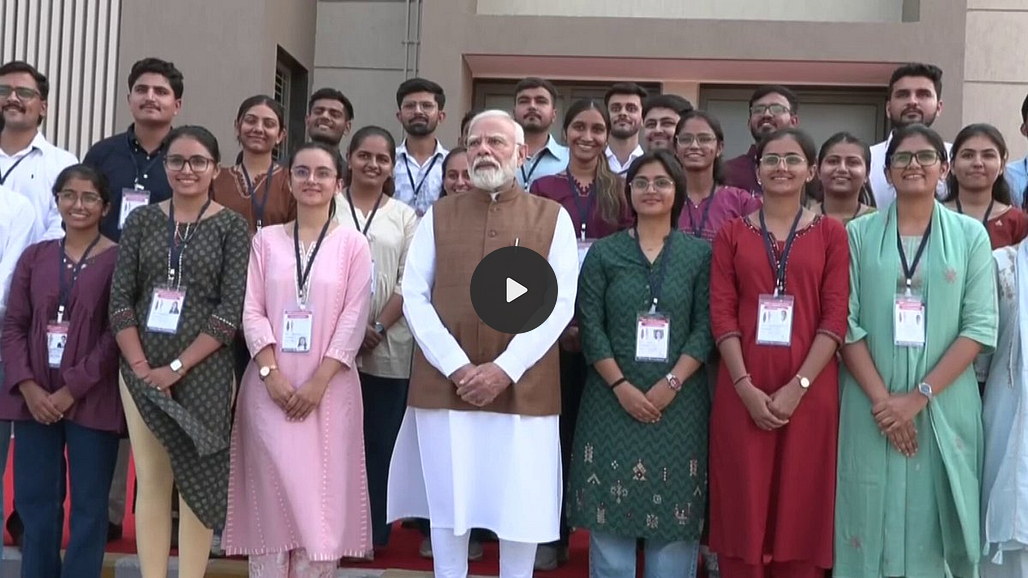
It takes a special kind of tone deafness for a regime to stage manage approbation of this kind for the Dear Leader – a public loyalty test – and then have the national broadcaster tweet it out as a great, rather than a cringe, moment.
Drawn and quartered
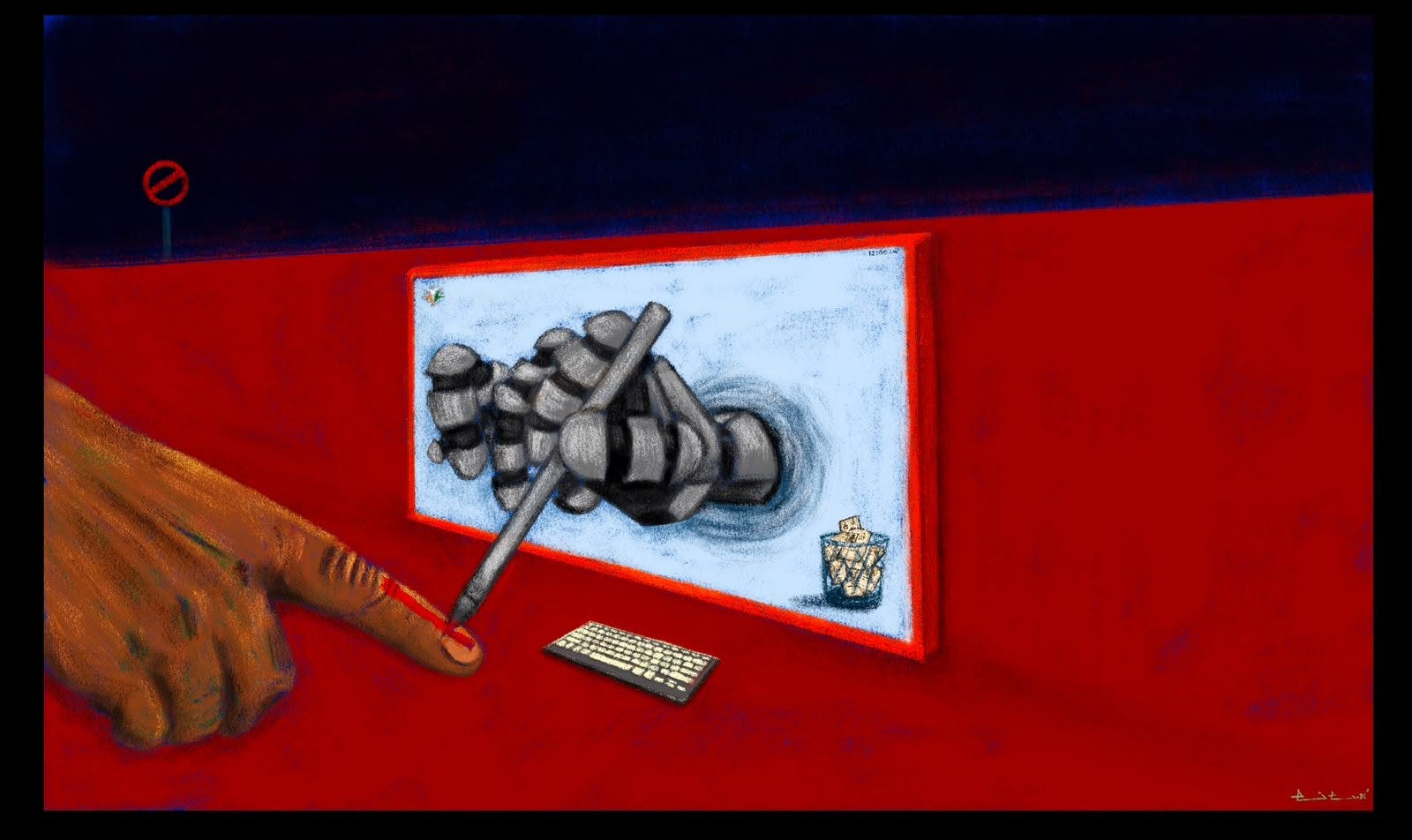
SIR and Software versus people and their right to vote.
Deep dive
Neeraj Hatekar and Hitesh Potdar argue why Dharavi’s redevelopment cannot be reduced to a mere housing problem as it “risks fragmenting its labour networks and leaving an empty shell”. It must be understood as a complex ecosystem of labour, production and value creation, they argue.
Prime number: 0
For a snapshot of the Modi years of governance, look no further than the Surat Diamond Bourse. Three years ago, PM Modi inaugurated the Rs 3,200-crore project, calling it “the best diamond in the world” and a testament to “Modi’s guarantee” for Surat. Today, what was billed as the “world’s biggest office space in a single project” stands largely empty.
Opeds you don’t want to miss
Harish Khare writes about the Ambanis’ great seduction game — the agenda behind the messaging we saw and heard from Mukesh Ambani’s three children at the Jio Platforms IPO launch. Reliance is India and India is Reliance, notwithstanding the recent evidence that Reliance is beyond India as well:
“It has been suggested that the whole advertising extravaganza was organised to soothe the anxieties and doubts voiced in many quarters over the Jamnagar tableau, featuring US secretary of state Marco Rubio and Mukesh Ambani. It was probably the first time that a serving American secretary of state (who also happens to wear the national security adviser hat) did not care to call on the prime minister during a visit to India. Bad optics. Avoidable optics.
“The Jamnagar show not only confirmed Mukesh Ambani’s stature as the tallest Indian global businessman, it also carried with it the suggestion that perhaps he has become bigger than the Indian state—a man with his own global connections and global protection network. This is a perception that the very suave corporate house would want to do without. What the “Jio aapne banaya” tag-line does is divert attention away from the Jamnagar pageant and its lingering shadow.”
The cabinet secretary is said to be planning a third round of administrative reforms. Ordinarily such a move would prompt excitement but this one is almost an indictment of the Modi government’s failures at previous reform attempts, says Pratap Bhanu Mehta. What keeps going wrong? For starters its political economy – as the chief economic adviser himself has suggested – is one of “influence and corruption”. But the deeper problem is the government’s
“ideology of governance. There can be no lasting reform unless the state machinery, on principle and by instinct, is committed to three propositions: Presumptive trust in citizens, decentralisation to appropriate levels of governance, and a hostility to unnecessary surveillance and control. This government is off the charts on all fronts.”
Haseeb Drabu writes about the decimation of J&K cadre in the bureaucracy:
“The return of cadre autonomy and political control over the civil service is not merely one among several requirements of statehood — it is the necessary starting point for any genuine process of restoration. Without the capacity to direct the permanent executive, an elected government cannot exercise effective authority over the institutions that implement policies and allocate resources.”
There are many things wrong with the Suvendu Adhikari-led West Bengal police’s moves to extrajudicially kill three rape and/or murder suspects over the last few months, which Jhuma Sen lists in her article. One of these things is the patriarchy implicit in such fake encounters: “the licence is claimed in women’s name, and kinship locates them: daughters, sisters and mothers, men’s kin whose avenging restores male honour – not persons with rights, including the right to the investigation and trial of violence against them.”
When it comes to insults hurled at it, there are those the BJP can exploit and the ones it can’t, writes Bharat Bhushan. “An insult from an institutional political heavyweight is like a bonus for a party on the back foot, while abuses from the grassroots or unpredictable youngsters are a security and law and order issue.”
Listen up
Can religious conversion erase generations of social disadvantage? On the Infocus podcast, Abhinay Lakshman unpacks the Supreme Court’s ruling on reservation benefits for OBCs who convert to Islam, DMK president M.K. Stalin’s response, and the larger questions it raises about caste-based discrimination and social justice.
Watch out
Our very own Punjabi star Diljit Dosanjh has joined hands with Puerto Rican reggaeton star Daddy Yankee for a new international single, ‘Pokito’.
Over and out
The world’s top four whiskies by sales volume are all Indian – Royal Stag, McDowell’s, Officer’s Choice and Imperial Blue – with more than 100 million cases sold between them. Scotland’s Johnnie Walker comes in at fifth position with a mere 20 million cases.
That’s it for today. We’ll be back with you on Monday, on a device near you. If The India Cable was forwarded to you by a friend (perhaps a common friend!) book your own copy by SUBSCRIBING HERE.